 How to resolve AdBlock issue?
News
Bismarck Dinius, 40, was scheduled to go on trial this month for felony vehicle manslaughter involving a boat and boating under the influence.
However, Deputy District Attorney John Langan – who took over prosecuting the case when Deputy District Attorney David McKillop left for a job in Kern County – is currently in the midst of retrying the David Deason murder case, so he requested the case be moved to May.
The move "was requested by Mr. Langan and I didn't oppose it," said Dinius' defense attorney, Victor Haltom of Sacramento.
Dinius was at the tiller of a sailboat owned by Willows resident Mark Weber on the night of April 29, 2006, when the boat was struck by a speedboat driven by Russell Perdock, then a chief deputy in the Lake County Sheriff's Office, as Lake County News has reported. Due to a reclassification of agency rankings, Perdock is now listed as a captain with the sheriff's office.
Weber's fiancée, 51-year-old Lynn Thornton, was fatally injured in the collision and died a few days later.
The District Attorney's Office charged Dinius with manslaughter for reasons including the alleged failure to be under way with the sailboat's running lights on. The case also alleges that Dinius had a blood alcohol level of 0.12, which is above the legal limit of 0.08.
Last summer, following a lengthy preliminary hearing, Judge Richard Martin ordered Dinius to stand trial on the charges.
As he waits for the spring – jury selection is now scheduled to begin on May 19 – Haltom said he has an investigation under way, and is having a blood sample that he said is Perdock's retested.
Haltom said McKillop had offered a deal of misdemeanor manslaughter, which he refused. "We're not willing to accept any resolution that has my client admitting being the cause of Lynn Thornton's death because it's our position that somebody else was the cause of her death.”
However, District Attorney Jon Hopkins was adamant that he never authorized a plea bargain deal.
“I can guarantee you that no offer was ever made,” he said.
Hopkins said he had conversations with McKillop throughout the initial stages of the case up until McKillop left. There are always discussions between attorneys regarding possible case settlement, Hopkins said; however, he said McKillop never asked him to discuss plea bargaining.
Last year, an involved civil lawsuit over the case was settled. Haltom said Perdock's insurance policy paid out the maximum amount – $300,000, according to KGO TV – which he said “would raise the eyebrows of an objective observer.”
Dinius' insurance also paid $300,000, and Weber's $100,000, according to KGO's coverage of the civil lawsuit.
Haltom said Dinius is having to spend “a ridiculous amount of money” to defend himself. He added that the best possible outcome for the case, in his decision, would be to dismiss the charges against Dinius and file charges against Perdock.
While trials are always risky, Haltom said he expects to have a positive outcome for his client, “assuming I have rational jurors.”
E-mail Elizabeth Larson at
{mos_sb_discuss:2}
The 2nd District, which Wiggins represents in the Legislature, includes the counties of Lake, Humboldt, Mendocino, Napa, Solano and Sonoma.
While in the Assembly, Wiggins was co-author of legislation (Assembly Bill 1475) establishing the SRTS program in 1999.
The California Department of Transportation (Caltrans), which administers SRTS, recently put out a call for communities to apply for funding grants, which are designed to provide students in grades K-12 with easier and healthier ways to safely travel to and from schools.
“Pedestrian accidents have been a leading cause of fatal injuries for school-aged children, including in school zones lacking crosswalks or sidewalks,” Wiggins said. “That is one of the many great things about this program: Funds can be used for crosswalks, pedestrian and bicycle pathways, bike lanes, sidewalks and a number of ‘traffic calming’ measures.
“By creating a more hospitable environment for children to walk or ride to school,” Wiggins added, “we are also helping to promote exercise, which is a necessary component of the effort to reduce the incidence of obesity in our young people.”
On its Web site, Caltrans describes Safe Routes to School as “an international movement that has taken hold in communities throughout the United States. The concept is to increase the number of children who walk or bicycle to school by funding projects that remove the barriers that currently prevent them from doing so. Those barriers include lack of infrastructure, unsafe infrastructure, lack of programs that promote walking and bicycling through education/encouragement programs aimed at children, parents, and the community.”
The highly competitive program (local school districts, boards, city councils and state agencies can request funding through yearly application cycles) has enabled communities to increase the safety of children walking or riding to school.
The grant funds have been awarded for projects in Lake County, as Lake County News has reported.
Wiggins' office reported that $48.50 million worth of projects will be funded in the next cycle. Caltrans districts are apportioned funds based on student enrollment. District review committees will score and rate applications using standardized evaluation forms furnished by Caltrans headquarters and develop two lists.
Once projects are selected and prioritized, Caltrans districts will then determine which projects will be placed on the Tier I list (those that are ready to go now), and on the Tier II list (those that are selected for future funds) based on a project’s delivery schedule. Projects in Tier I will be funded with FY 08/09 funds up to FY08/09 apportionment level, while Tier II projects will be funded when the next round of funding becomes available. Caltrans will validate district selections and compile a statewide list of selected projects for each cycle for director approval. Districts will notify all applicants of the results.
Any incorporated city or county is eligible to apply. Capital projects must fall under the broad categories of pedestrian facilities, traffic calming measures, installation of traffic control devices, construction of bicycle facilities, and public outreach, education and enforcement. There is a 10% local match required; $900,000 is the maximum amount that can be requested.
For more information, communities are encouraged to visit www.dot.ca.gov/hq/LocalPrograms/saferoutes/saferoutes.htm, or contact Joyce Parks, Safe Routes to School coordinator at Caltrans Headquarters, at 916-653-6920, or
Applicants must submit an original and one copy to their respective Caltrans district local assistance engineers by the April 15 deadline. Applications postmarked on the deadline are acceptable. Additional information is available at www.dot.ca.gov/hq/LocalPrograms/dlae.htm.
Thirty years ago, 60 percent of children living within a two-mile radius of a school walked or bicycled to school. Today, that number has dropped to less than 15 percent. Roughly 25 percent commute by school bus, and well over half are driven to/from school in vehicles. And back then, 5 percent of children between the ages of six and 11 were considered to be overweight or obese. Today, that number has climbed to 20 percent.
These statistics point to a rise in preventable childhood diseases, worsening air quality and congestion around schools, and missed opportunities for children to grow into self reliant, independent adults.
Wiggins represents California’s 2nd Senate District, comprised of parts of all of six counties: Humboldt, Lake, Mendocino, Napa, Solano and Sonoma. Readers interested in learning more about the Senator can visit her Web site at http://dist02.casen.govoffice.com/.
{mos_sb_discuss:3}
The proposed regulations, stemming from the 2000 passage of AB 885, would require inspections of septic systems every five years and institute more stringent requirements that could require many homeowners and businesses to have to entirely replace their systems.
The State Water Resources Control Board crafted the proposed regulations, which are meant to protect groundwater and surface water quality from wastewater discharge.
Kathie Smith, a spokesperson for the State Water Resources Control Board, said the new regulations are supposed to be in place by Jan. 1, 2010, but AB 885 included an automatic six-month delay, making the regulations official by July 2010.
According to an environmental impact report prepared on the proposals, there are an estimated 1.2 million households statewide that would have to comply, including about 15,000 Lake County homes. Those estimates are based on the number of septic systems known to be in operation in 1999.
“Everyone will be impacted to some degree by the proposed regulations,” said Jim Hemminger, a staff consultant with the Regional Council of Rural Counties.
The council is especially concerned about the prospect of high costs for rural areas, where septic servicing may not be readily available and may becoming prohibitively expensive due to drive and transport time.
Hemminger said the council has been working with the state to come up with regional regulations that can be cost-effectively applied. “We don't feel we're anywhere close to being there right now,” he said.
He said AB 885 grew out of one area's specific problem – a pollution situation in Santa Monica Bay that was believed to have come from septic tanks in sandy soil along the beach.
Hemminger said the regulations originally were started along the state's coast, but since have spread to the entire state.
One of his biggest concerns is that he interprets the regulations to have no flexibility or room for variances regarding site- or region-specific impacts. There are a lot of variations in groundwater, geology and other natural features throughout the state, he explained.
They also won't allow much budge room for regional water boards, and could result in higher-than-anticipated costs, Hemminger suggests.
What the regulations would require
Those households with septic tanks – called on-site wastewater treatment systems (OWTS) in the environmental impact report – would expect to pay between $150 and $500 for the inspections at least once every five years.
If upgrades were required, the report states, “The cost to households and businesses that must install new OWTS with supplemental treatment units and to convert conventional OWTS to OWTS with supplemental treatment units would be substantial.”
By substantial, the report estimates the costs for installing new septic tanks with a supplemental treatment unit to be in the range of $25,000 to $45,000, or $13,900 to $23,300 for a conventional septic system.
Businesses using septic systems that are “high-strength waste dischargers” could expect to have to pay $100,000 to $400,000 to replace a system or install a new one with a supplemental treatment unit.
A Regional Council on Rural Counties comment letter on the draft regulations' environmental impact reports says AB 885 has no express mandate for creating regulations. The letter also faults the state's proposals for establishing “inflexible siting, construction and performance requirements.”
Debate over local impacts
Locally, Lake County Farm Bureau Executive Director Chuck March is concerned that residents could be facing additional regulations.
He pointed out that the proposed regulations have additional requirements for septic systems that will be located within 600 feet of a water body that is listed as “impaired” – or doesn't meet water quality standards – because of high nutrient levels.
Among those impaired water bodies is Clear Lake and its entire watershed, March explained.
“We're still trying to evaluate what the effects in Lake County will be,” said March.
March said Clear Lake's impairment is largely a matter of phosphorous loading, and isn't from septic tanks. But there are still “a whole lot of questions” about how the new rules might ultimately apply, and much clarification is needed.
The Lake County Farm Bureau is part of a monitoring program that is looking at the Big Valley Watershed. In that area, the only material noted to be exceeding acceptable levels is E. Coli, and they've not been able to track where it's coming from. However, 50 percent is believed to be coming from human sources, which makes septic tanks a possible source.
Ray Ruminski, director of Lake County Environmental Health, said he doesn't think there will be widespread impacts locally if the regulations become law.
Ruminski said Clear Lake is on a federal impairment list for mercury, which is not a septic issue. It's also listed as impaired because of nutrients, but again those may not be a result of septic tanks. The element of interests – phosphorous – is more an issue of stormwater drainage and erosion.
The Regional Council of Rural Counties' comment letter interprets the regulations as requiring every septic system within 600 feet of a water body with a total maximum daily load that has been approved “to be equipped with expensive advanced treatment systems” or to become part of a centralized treatment or collection system. Other council documents estimate the number of impaired water bodies in the state as 296.
However, Smith said that, under the proposed regulations' definition of impaired water bodies, Clear Lake – which falls into the water board's Region 5 – doesn't apply.
She said there are no such impaired bodies listed for Region 5 at all, said Smith, and only a few in the whole state, with most of them being located in Southern California.
The draft environmental impact report for the proposed regulations lists the following impaired water bodies that would be subject to the proposed regulations: Malibu Creek and its entire watershed, and Northern Santa Monica Bay beaches, both in Los Angeles County; Santa Clara River, Ventura and Los Angeles counties; Canyon Lake and Lake Elsinore, Riverside County; and Rainbow Creek, San Diego County.
Exploring the ramifications
Despite the state's estimate of the number of Lake County's septic tanks – slightly over 15,000 – Ruminski said his office actually does not have a precise count.
The agency's records go back to the 1960s, and track septic systems they've permitted. But that doesn't give an accurate picture of what's actually in use, Ruminski said.
“There's a lot more actually in use, constructed, than we have permits on,” he said.
Stopab885.org, which is advocating against the regulations in their current form, reports that many local jurisdictions and counties have adopted strict regulations of their own to address the concerns raised in the original legislation.
Similarly, Lake County already is taking an approach that Ruminski said “is not all that different in some respects” from what the State Water Resources Control Board is proposing.
Ruminski's take on the requirements is that existing septic systems would need to be sampled every five years if a well was on the property. The inspection would then make a recommendation regarding whether or not the tank needed to pumped, repaired or replaced.
“We think that's good practice, but we're not sure it needs to be in state law,” said Ruminski.
He said septic tanks are necessary because not every place in California can have a sewer system. However, he said there are some blank spaces around Clear Lake where sewer systems would, in his opinion, be a benefit.
Hemminger, who suggested the proposed regulations are a “solution looking for a problem to solve,” said he doesn't foresee them having a positive groundwater impact.
Rather than trying to create an ill-fitting set of blanket regulations, Hemminger suggested the water board should focus on problem areas, since most septic systems in the state are functioning as required.
To be imposing costs of hundreds of millions a year on the state's homeowners, said Hemminger, “just doesn't seem prudent.”
Smith said the water board's staff currently is in the process of hosting a series of public workshops around the state.
Of the 11 workshops, nine have taken place so far, said Smith. One is scheduled for Tuesday evening in Santa Rosa, with another set to take place on Wednesday in Eureka (see accompanying story, “Septic tank regulations: How to get involved” for times and locations.). The water board also will host a Feb. 9 public hearing in Sacramento.
“There's been a lot of public interest. It's kind of been building,” said Smith, noting that the Jan. 22 Fresno workshop was standing-room-only.
Smith said there have been a “range of concerns” over the proposals, especially the possible price tag.
“The cost is probably the thing that comes up the most often,” she said, adding there also have been concerns raised about having more government regulations.
She said the water board staff will take information submitted by the public at the workshops, digest it and come up with appropriate revisions to the regulations.
“This is not written in stone at this point, any of these regulations,” Smith added.
E-mail Elizabeth Larson at
{mos_sb_discuss:2}
Judge Arthur Mann handed down the sentence to Sean Thomas Selig, 24, on Jan. 20, according to a statement from the Lake County District Attorney's Office.
Selig was represented by attorney Judy Conard and prosecuted by Deputy District Attorney John Langan.
The charges against Selig arose from an Oct. 6, 2004, crash in which his passenger, 21-year-old Samuel Adrian Solario, was killed.
The two young men, who investigators said had been spotted having drinks at a Nice restaurant and bar, were riding in a GMC Sierra pickup truck, driven by Selig, along Lakeshore Boulevard in Nice when the crash occurred.
Selig overturned the vehicle then, according to investigators, he fled, allegedly leaving Solario at the scene, where he died.
The District Attorney's Office said that Selig allegedly went to a friend's home where he spent the night, not mentioning that he had been involved in the crash.
According to the report, Selig allegedly told law enforcement that he had an “alcoholic blackout.”
Langan said Solario's parents confronted Selig the day after the fatal crash.
Selig allegedly told them that Solario had been driving, a story he would repeat to law enforcement throughout the investigation. Langan said Selig first gave that statement to officials not long after the crash occurred.
Selig also allegedly had stated that he had been ejected through the driver side window from the passenger seat without suffering any apparent injury, a story which the District Attorney's Office called “implausible.”
Early in 2005, Selig left Lake County to move to Redding. He was staying there with his grandparents when he was arrested by the California Highway Patrol in August of that year and brought back to the county for face the charges.
The case took a long time to resolve. Since it got under way, the original prosecutor, David McKillop, left to accept a position in Kern County, so Langan took the case over.
More recently, Conard – who could not be reached for comment late Monday – had accident reconstructions prepared in order to evaluate the incident, according to Langan.
Fleeing the scene and the accounts of the story he gave to officials ended up being “aggravating factors” that counted against Selig in court, according to the District Attorney's Office.
Mann found those factors outweighed Selig's youth and lack of any prior criminal convictions. He also denied Selig's probation request, nothing that his actions belied his account of the blackout.
Selig, now being held in the Lake County Jail, originally also had faced hit-and-run charges.
Although Mann denied Selig's probation request, the prison time he gave, based on the penal code's description of gross vehicular manslaughter sentences, was the lower term. Selig could have faced a maximum of 10 years in prison.
E-mail Elizabeth Larson at
{mos_sb_discuss:2}
Sherrill and Howard Foster and Sheila Burton's lawsuit against Shannon Edmonds and his ex-girlfriend, Lori Tyler, concluded following a Dec. 12 settlement conference facilitated by a federal court judge, according to Russell Robinson, the attorney for the Fosters and Burton.
The families sued over the deaths of their sons, Rashad Williams and Christian Foster, both 22, who were shot to death as they fled from Edmonds' and Tyler's Clearlake Park home in the early morning hours of Dec. 7, 2005.
Robinson said the settlement is governed by a confidentiality agreement, so the monetary amount cannot be disclosed.
The San Francisco law firm Cesari, Werner and Moriarty represented Tyler. Dennis Moriarty, one of the lawyers representing Tyler, did not return calls seeking comment on the case.
In a Sept. 25, 2008, letter to federal Magistrate Bernard Zimmerman of the U.S. District Court for the Northern District of California, Tyler's attorneys noted that she was unemployed and on disability. “Like defendant Edmonds, Ms. Tyler has no funds to contribute towards a settlement ...”
Allied Insurance, which court records noted was the liability insurance carrier at the time for Edmonds and Tyler, paid the settlement.
“We have settled with our policy holder and as far as we are concerned the matter is closed,” said Liz Christopher, a media spokesperson for Allied and its parent company, Nationwide Insurance.
Christopher added that the company does not discuss the details of private policies.
In 2007 the Foster and Burton families filed the lawsuit against Edmonds and Tyler in federal court, alleging that the shootings were racially motivated and followed a fight, as Lake County News has reported.
Edmonds allegedly shot Christian Foster and Rashad Williams as they ran from his home. Their families have denied they were there to take part in a break-in, which is what the District Attorney's Office alleged had led to the shootings.
The District Attorney's Office did not file charges against Edmonds, who is white, for shooting the two young black men, saying they did not believe they could successfully prosecute him based on the available evidence.
Officials did prosecute the young mens' friend, Renato Hughes, for their shootings under the provocative act law, which allows a person to be prosecuted for any deaths that occur during a violent crime in which they are alleged to have taken part.
The case led to accusations of racism and allegations that Hughes could not get a fair trial in Lake County. His trial was moved to Martinez and he was acquitted this past summer of the two mens' deaths, but found guilty of burglary and assault with a firearm, and sentenced to eight years in prison. He is appealing the conviction.
The families' suit alleged that Rashad Williams' and Christian Foster's civil rights were violated.
The lawsuit was amended after its original filing to add the city of Clearlake, the county of Lake and 100 unnamed individuals – believed to have been Clearlake Police or Lake County Sheriff's employees at the time – as defendants.
The Foster and Burton families alleged that Edmonds was a known drug dealer. They added the local governments to the suit for allowing Edmonds and Tyler “unlawfully to sell recreational drugs, to possess firearms, to use minors in unlawful sale of recreational drugs, and for failing to protect persons such as Christian and Rashad.”
In May, federal Judge William Alsup dismissed the case against the county and city, as Lake County News has reported.
The case was set to move to trial in September of 2009. However, with the federal claims against the jurisdictions dismissed, Robinson said the federal court was losing its jurisdiction over the case.
Zimmerman, a magistrate judge, kept the case in federal court, however, and asked the two sides – including Allied Insurance – to sit down to the Dec. 12 settlement conference, Robinson said.
Robinson said the parties reached an agreement by day's end.
“It was not an easy case to settle,” he said, crediting Zimmerman for bringing the two sides together.
The families willingly settled the case, but it isn't a truly satisfying conclusion, he said.
“You can't bring their kids back,” said Robinson.
E-mail Elizabeth Larson at
{mos_sb_discuss:2}
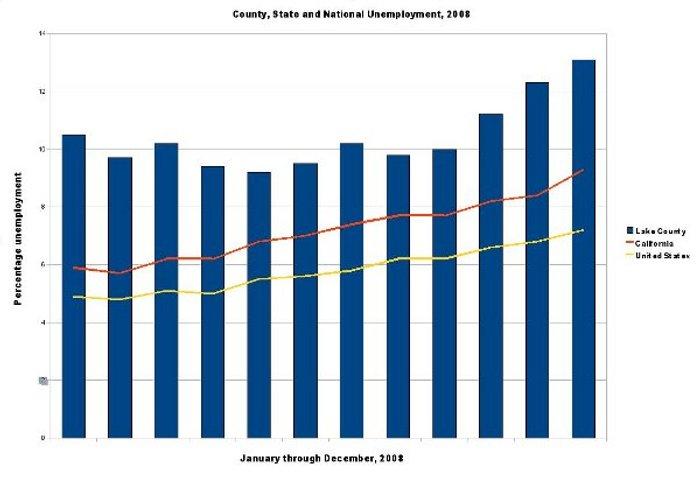
LAKE COUNTY – Unemployment rates in Lake County, California and the nation are continuing their steep upward climb, according to new government reports. {sidebar id=116}
California's unemployment hit 9.3 percent in December, up from 8.4 percent in November, according to the state Employment Development Department (EDD). In December of 2007, unemployment in California was at 5.9 percent.
The US unemployment rate was 7.2 percent for December, up from 4.9 the previous year, according to the US Bureau of Labor Statistics.
In Lake County, December's unemployment rate was at 13.1 percent, the highest local rate since March of 1997, according to EDD records. That was up from the 12.4 percent rate last November.
Lake County's December 2007 unemployment rate was 9.6 percent, with 2,420 people out of work. This past month, approximately 3,430 people were out of work locally, a growth of 1,010 people added to the unemployment rolls over a year's time.
California lost 78,200 nonfarm jobs in December, and had 257,400 fewer jobs in December 2008 than it did the previous year, according to the EDD.
In all, California has 1,732,000 unemployed workers – a number that was up by 166,000 from November and up by 653,000 compared with December of 2007. Those who were unemployed included 785,200 who were laid off and 125,300 who left their jobs voluntarily.
The rest were either new entrants or reentrants into the labor market, or persons who completed temporary jobs, according to a federal household survey.
Not all of those on unemployment are receiving any help. The EDD reported that 655,445 people across the state received regular unemployment insurance benefits during the December survey week, compared with 593,670 in November and 451,098 in December 2007.
EDD reported that new claims for unemployment insurance were 87,979 in December 2008, compared with 80,920 in November and 56,984 in December of last year.
The US Bureau of Labor Statistics reported that, nationwide, payroll employment fell by 524,000 jobs in December and by 1.9 million over the last four months of 2008, with job losses being “large and widespread across major industry sectors.”
The actual number of unemployed nationwide increased by 632,000 in December to reach 11.1 million, the bureau reported.
Since December 2007, when the recession is recorded as starting, 3.6 million people have become unemployed across the nation, which caused the national unemployment rate to climb by 2.3 percentage points.
Government looks at solutions
In a statement on the recent unemployment report, Gov. Arnold Schwarzenegger said he is fighting for “aggressive economic stimulus” in the state's drawn out budget negotiations.
“Our increasing unemployment rate makes it clear that the crisis in our nation’s economy that has led to job losses is completely tied to our state budget shortfall,” Schwarzenegger said.
He said the state's fiscal problems can't be solved without working to stimulate the economy, and he's pushing for four elements he believes are immediately necessary: spending reductions, increasing revenues, making government run more efficiently and stimulating the economy by putting people back to work and helping families stay in their homes.
Economic stimulus for the entire nation is a stated goal of legislation at the federal level.
Last week, North Coast Congressman Mike Thompson reported that the House Ways and Means Committee, of which he is a member, voted 24-13 to support a comprehensive economic recovery package – HR 598 – that is making its way through Congress. The legislation is due to be combined with other legislative components into HR 1, the American Recovery and Reinvestment Act.
Thompson is advocating for rural areas to receive a fair share of bond funding in the legislation that is targeted at infrastructure projects and job training programs.
During his first weekly address on Saturday, President Barack Obama discussed the $825 billion American Recovery and Reinvestment Plan, which he said will jumpstart the economy and tackle unemployment.
“Just this week, we saw more people file for unemployment than at any time in the last 26 years,” he said, noting that experts agree that if nothing is done the nation's unemployment rate could reach double digits.
Some of the plan's key points involve creating four millions jobs over the next few years while building new infrastructure – such as 3,000 miles of new electric grid transmission lines – weatherizing millions of homes, securing ports, renovating schools and protection health insurance for millions of Americans who face losing it.
Republicans in Congress, including Sen. John McCain and House Minority Leader John Boehner, are skeptical of the proposal.
In a Sunday appearance on NBC's “Meet the Press,” Boehner warned against raising taxes during a recession, and was critical of the plan favored by Obama and a reported majority of Democrats.
“We need an economic rescue package, but we all want one that works, one that helps small businesses, helps American families, helps create jobs and preserves jobs in America, and what we see with their plan is a lot of spending that I just don’t think will work,” Boehner said.
E-mail Elizabeth Larson at
{mos_sb_discuss:2}