 How to resolve AdBlock issue?
News

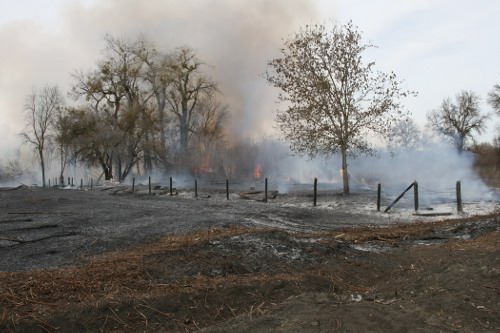
LAKEPORT – Lakeport firefighters and air quality officials responded to a fire Wednesday morning that may have been a control burn that got away.
The fire, which burned about two acres, was first reported at about 11:30 a.m. east of the 2700 block of Clipper Lane and on the lake side of Soda Bay Road.
Lakeport Fire Protection District sent four engines and a water tender, seven firefighters and Chief Ken Wells. Two Cal Fire personnel from Kelseyville also were on scene.
Lake County Air Quality Management District staff also were on scene to investigate the burn, which officials said appeared to have started out as a control burn.
Two men on scene appeared to have been tending the fire went it got out of control, burning thistle and berry bushes and large tree branches that were being cleared from the land, and spewing thick smoke into the midday sky. A slight breeze from the south southeast may have contributed to the fire getting away.
Wells said they believed the fire had been permitted. If an investigation by air quality and fire officials reveals it wasn't, Wells said the property owners could be held liable for covering firefighting costs. That report could come out next week.
Clipper Lane residents were concerned about the nearby burning field, but Wells said the threat to the homes was reduced by the high humidity.
Lakeport Fire engines returned to the station just past 4 p.m. after getting the fire under control and mopping up.
E-mail Harold LaBonte at
{mos_sb_discuss:2}
The State Children’s Health Insurance Program (SCHIP) was created in 1997 to provide health care coverage for children in families that earn too little to afford health insurance for their children but too much to qualify for Medicaid.
The bill signed by the president Wednesday reauthorizes SCHIP through 2013 and preserves the coverage for all 7.1 million children currently covered by SCHIP, including 1,538,416 children in California and an estimated 1,600 Lake County children.
The bill also extends health care coverage to 4.1 million additional low-income children, who are currently uninsured. The bill is fully paid for.
“This is only the first step,” the president said. “As I see it, providing coverage for 11 million children is a down payment on my commitment to cover every single American.”
Congressman Mike Thompson (D-St. Helena) was invited and attended the ceremony at the White House.
“Today change came to America as our country took the first major step towards reducing the number of children who don’t have health insurance,” Thompson said in a written statement. “The State Children’s Health Insurance Program has been an extraordinary success – over 1.5 million children in California get their health care through this program. However, over a million and a quarter kids are still uninsured in our state alone- which is just plain wrong.”
By signing the bipartisan bill into law, almost 700,000 uninsured children in California and 4 million uninsured children across the country will now have access to health care, said Thompson. “Our children deserve a healthy start and this legislation gives kids that chance.”
“Passage of SCHIP will result in hundreds of children in Lake County getting the health care they need and deserve,” said Gloria Flaherty, executive director of the Lake Family Resource Center. “This will mean healthier children, families and communities – and peace of mind for parents. We are proud of our congressman for his continued support and dedication to this cause, our president, for making children’s health a priority, and our country for recognizing that children’s health is important to all.”
This bipartisan bill has been endorsed by dozens of organizations, representing millions of Americans – ranging from business groups such as the National Federation of Independent Businesses and Business Roundtable to the American Hospital Association, AARP and Families USA.
{mos_sb_discuss:3}
The collision occurred just before 8 p.m. at Highway 20 and Howard in Nice, according to the California Highway Patrol.
Initial reports indicated a vehicle struck a child on a bicycle.
REACH air ambulance lifted off at about 8:44 p.m. en route to Children's Hospital of Oakland, according to the CHP.
No other information was available late Wednesday.
Harold La Bonte contributed to this report.
{mos_sb_discuss:2}
The Mendocino County Sheriff's Office reported Tuesday that the body of Brian Richard Siberry, 41, was discovered in a rental cabin at the Manchester KOA Campground on Jan. 25.
Deputies were dispatched to the campground, located on Kinney Lane, shortly before 6 p.m. that day on the report of an injured person, according to Lt. Rusty Noe.
When they arrived at the scene they found Siberry deceased inside one of the rental cabins located on the campground premises. Noe reported that deputies noticed what appeared to be fresh injuries to Siberry's face and head, suggesting he had been the victim of a physical assault.
The Mendocino County Sheriff's Office Detective Unit was summoned and detectives responded to the campground, according to Noe. Upon arrival detectives processed the cabin, wherein Siberry was located, for items of evidence and numerous interviews were conducted of possible witnesses.
Noe said a forensic autopsy was conducted on Siberry's body by the Mendocino County pathologist on Jan. 27. The preliminary results of the autopsy showed blunt force trauma to Siberry's face but his cause of death is pending blood alcohol and toxicology analysis.
Detectives have learned Siberry had been staying in the rental cabin with a friend for two weeks preceding his death, said Noe.
During the two-week period Siberry was contacted several times by persons working or staying at the campground. Noe said witnesses described Siberry has having been extremely intoxicated by alcoholic beverages, having poor balance and sustained accidental falls to the ground.
Witnesses described seeing the physical injury to Siberry's face the day prior to his death and hours before his death, Noe reported.
Noe said information collected to date suggests the injury to Siberry's face was caused by an accidental fall but detectives are continuing to investigation the incident.
Anyone with information that can assist with this investigation is asked to call the Mendocino County Sheriff's Office Tip-Line at 467-9159.
{mos_sb_discuss:2}
The prescribed burning will be conducted starting at 10 a.m. and end at 1 p.m. and will be located in and around Berryessa Estates. Smoke from the pile burning may be visible from parts of Napa and Lake counties.
The return of winter moisture will enable Cal Fire personnel to implement the vegetation management tool of prescribed burning for the purpose of burning piles of vegetation that were removed to create a shaded fuel break around the community of Berryessa Estates.
Prescribed vegetation management burns are carefully planned and controlled burns and must meet strict criteria of ecological benefit, weather parameters, smoke management, and fire safety guidelines. When all conditions (prescriptions) are met, trained firefighter’s burn, while monitoring the set criteria, fire behavior, and designated fire control lines.
Shaded fuel breaks are designed to reduce the threat to a community in the event of an unexpected wildland fire by removing shrubs, small trees, and down woody materials, but leaving large overstory trees.
By leaving the larger trees, the fuel break will maintain a higher degree of shade cover, lessening the rapid re-growth associated with direct sunlight and retaining higher fuel moisture in the fuels within the fuel break.
These projects are designed to remove the understory ladder fuels and the dead/down fuels that could become hazardous in case of extreme fire behavior. Shaded fuel breaks are often constructed in strategic areas along roadsides and ridgetops to provide firefighters with improved access to suppress unwanted wildfires and to manage prescribed burns more safely.
For more information about fire safety or prescribed fire and its benefits you may go to the Cal Fire Web site at www.fire.ca.gov or your local Cal Fire facility.
{mos_sb_discuss:2}
The gathering, titled "Tribal corruption is not traditional," will take place from 11 a.m. to 3 p.m. on Thursday, Feb. 5, on the north side of the State Capitol Building, 10th and Street and the Capitol Mall in downtown Sacramento.
United Native Americans Inc. and the American Indian Rights and Resources Organization (AIRRO) are sponsoring the event, whose guest speakers will include Lehman Brightman, founder of United Native Americans Inc.; Wanda Quitiquit, who the Robinson Rancheria Citizens Business Council has targeted for disenrollment, along with her family; John Gomez, president of AIRRO who was himself disenrolled from the Pechanga Band of Luiseno Indians in 2004; Cesar Caballero of the Shingle Springs Band of Miwok; Clayton Duncan of the Lucy Moore Foundation and a Robinson Rancheria member; Norman "Wounded Knee" DeOcampo, a disenrolled Miwok from Vallejo; and Ukiah resident Loise Lockhart, another victim of disenrollment.
"Nobody quite understands what's going on in Indian Country," said Quanah Brightman, vice president of United Native Americans Inc., based on the Bay Area.
Brightman, who is Lakota Sioux and Creek, said it's important to get beyond some current myths about Indians to get to the core of the very complex issues facing Indian nations around the country.
For one, he said, it's believed that because of casinos and an exemption from income tax that Indians are rich. “It's the furthest thing from the truth,” he said.
To emphasize that point, Brightman said the gathering is scheduled for Feb. 5, the one-year anniversary of California voters approving gaming compacts between the state and the Pechanga, Morongo Band of Mission Indians, Sycuan Band of the Kumeyaay Nation and the Agua Caliente Band of Cahuilla Indians.
Brightman said one of the event's goals is to give Indian leaders the chance to meet with state legislators and to educate them and the general public about the issue of disenrollment – the increasing practice of tribes kicking out members.
He called disenrollment "the new form of termination" for Indians. "We're becoming extinct," he said.
Disenrollment is having far-reaching, divisive consequences for Robinson Rancheria.
In December, Robinson Rancheria's tribal council disenrolled about 50 of its members. Those who were disenrolled included the Quitiquit family, who supported EJ Crandell for the tribal chair seat in a general election last summer. The sitting tribal chair, Tracey Avila, disputed the election, which was decertified.
Avila said the disenrollments were necessary to clean up the tribal rolls and address the membership of those whose place in the tribe had been questioned.
Last month Avila was reelected without any opposition after Crandell was disqualified from running by the tribe's election committee, largely composed of Avila's family members.
Also in January, the disenrollees formed a rival tribal council, with Crandell at its head. That group is applying to the Bureau of Indian Affairs for recognition.
Because of the Robinson Rancheria tribal constitution, the issue of tribal membership ultimately is up to the BIA, which must now also decide whether or not to grant the disenrollees' appeals and reinstate them in the tribe, which Avila has contended in a previous interview is not up to the agency.
The bureau has weighed in on disenrollments in the tribe previously, such as it did 20 year ago, when Wanda Quitiquit had faced a disenrollment, which the agency found was not warranted based on a study of her genealogy.
Troy Burdick, superintendent of the BIA's Central California Agency, received the appeals from the disenrolled Robinson members and said he forwarded his suggestion to the next level in the agency around mid-January; BIA now has 45 days to make a final decision. He would not disclose what his proposed decision to the higher levels of BIA was.
Dale Risling, BIA's deputy regional director, confirmed his office is at work on the matter.
"We're going to begin our review process of their appeals, which is called for under their tribal law," he said.
He added, "We'll be responding to the tribe with our findings on that and our position."
Another tribe that has a constitution giving the BIA the power to review appeals, the San Pasqual Band of Mission Indians of San Diego County, was told by the BIA late last year that the tribe could not move forward with disenrolling about 60 members, as Lake County News has reported.
Brightman said Indian leaders plans to introduce a new state bill on Thursday that will call for an end to the disenrollment practice.
E-mail Elizabeth Larson at
{mos_sb_discuss:2}