 How to resolve AdBlock issue?
News
The meeting will begin at 9 a.m. in the board chambers at the Lake County Courthouse, 255 N. Forbes St., Lakeport. TV 8 will broadcast the meeting live.
Beginning at 10 a.m., the board will discuss the possibility of transferring Community Development Block Grant program income money from the Business Expansion and Retention Revolving
Loan Fund to finance other projects, including curb, gutter and sidewalk projects in the Northshore Redevelopment Project Area and a feasibility study for the Lucerne Hotel property.
The hotel, which has housed the Lucerne Christian Conference Center for many years, has been put up for sale by its owners after bookings for Christian retreats and camps in the coming year began to drop significantly, as Lake County News has reported.
On Jan. 13 the board discussed possibly becoming involved with buying the property to hold it for a new buyer or assisting with active marketing it to assist in a speedy sale. At that time, supervisors approved looking at using grant funds for a study to look at the building's structural integrity and also conducting an appraisal.
Other items on the board's agenda include the following.
Timed:
9:15 a.m.: Public hearing on the Planning Commission’s recommendations for approval of proposed amendments to the Lake County Zoning Ordinance pertaining to bed and breakfast inns, detached
granny units and creating a new category of off-site signage for certain shopping centers and business districts.
9:45 a.m.: Public hearing on Planning Commission's recommendation for approval of a one-year time extension of the Vintage Faire General Plan of Development for applicant De Nova Homes; project is located at 20740 and 20830 State Highway 29, Middletown.
10:30 a.m.: Appointment of District 1 Lake County Planning Commissioner and administer Oath of Office; and consideration of applications from members of the public for appointment to miscellaneous Lake County committees, commissions and advisory boards.
11 a.m.: Public hearing on Ronald Jacobs' appeal of the Planning Commission’s decision to grant the appeal of Erik Thorsen, trustee, Edgar F. Thorsen Trust, regarding the issuance of a lakebed encroachment permit and supporting California Environmental Quality Act (CEQA) Notice of
Exemption to Ronald Jacobs for the construction of pier/covered deck/gangway/suspended platform/covered electric boat lift; project is located at 1925 Westlake Drive.
Untimed items:
– Consideration of recommendation for award of bid for Fourth through Fifth Avenue Lucerne Sidewalk Improvement Project; and consideration of proposed agreement for construction
inspection services for Lucerne Sidewalk Improvement Project.
– An ordinance establishing annual payments for lakebed encroachment permits and annual lease fees – (second reading).
The board also will hold a closed session to discuss labor negotiations.
E-mail Elizabeth Larson at
{mos_sb_discuss:3}
Highlights of the Water Plan and Volume 1 – Strategic Plan are now posted at www.waterplan.water.ca.gov/cwpu2009/index.cfm.
Update 2009 outlines a new approach in how California manages its water resources. Titled “Integrated Water Management,” it is the state’s blueprint for statewide and regional integrated water management, integrated flood management, and sustainable use of this valuable resource.
Guided by a 21 state-agency steering committee, Update 2009 is a result of collaboration between government and private agencies, Native Americans, cities, farms, industry and environmental organizations.
The document addresses concerns from every arena of water use, supply, flood protection, and for the environment.
The plan includes 27 resource management strategies (Volume 2) to meet various water management goals: reduce water demand, improve operational efficiency and transfers, increase water supply, improve water quality, practice environmental stewardship, and improve flood management.
The strategic plan includes 13 objectives with more than 100 near-term and long-term actions. New analytical methods and tools will help plan for future effects of climate change, population growth, and other factors outside the water community’s control.
Volume 3 Regional Reports looks at water conditions and concerns in California’s 10 hydrologic regions and two special areas of concern: the Sacramento-San Joaquin River Delta and Mountain Counties Area in the Sierra Nevada foothills.
All drafts will be posted at www.waterplan.water.ca.gov/cwpu2009/index.cfm.
The Water Plan Highlights and Volume 1 – The Strategic Plan were posted Jan. 7; Volume 2 – Resource Management Strategies will be posted Jan. 21 and Volume 3 – Regional Reports will be available Jan. 28. Printed highlights containing a CD of the other volumes will be available in February.
Public comment workshops will be held in all regions mid-April through May. Refer to the www.waterplan.water.ca.gov/cwpu2009/index.cfm Web site for meeting dates and locations. Comments will also be posted at this location.
Comments may be sent through June 5 via:
Email:
Fax: 916-651-9289
Postal Mail: Attn: Paul Dabbs
Strategic Water Planning
Statewide Integrated Water Management
California Department of Water Resources
P.O. Box 942836
Sacramento, CA 94236-0001
{mos_sb_discuss:2}
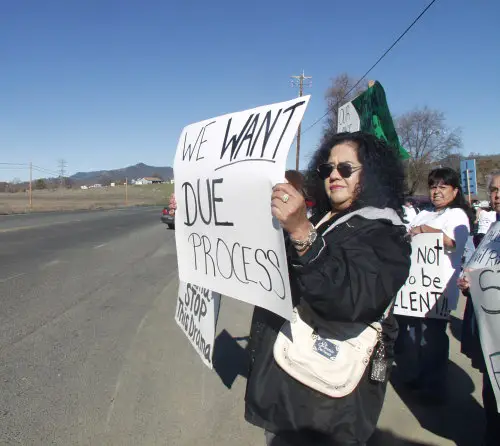
NICE – Dozens of Robinson Rancheria tribal members – those under threat of disenrollment and those who aren't – as well as nontribal members lined a short stretch of Highway 20 near the tribe's casino on Saturday, protesting the tribal council's action to remove at least 60 people from its rolls and to fire numerous people from jobs with the tribe.
The disenrollment, which took place last month as Lake County News has reported, has deepened divisions in the tribe, according to those who marched and chanted Saturday.
The Bureau of Indian Affairs must approve the action, according to the tribe's constitution. That agency has yet to do that, according to tribal members who appealed their disenrollment and await a decision.
That disenrollment action was followed earlier this month by sudden firings for disenrollees and nontribal members working at California Tribal TANF, which offers social services to Indians, and the tribe's well-respected environmental program.
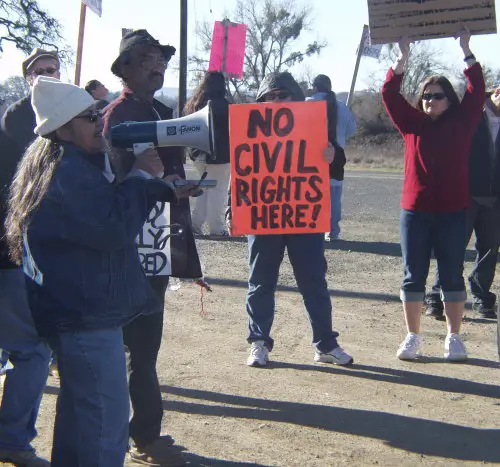
Indian and non-Indians alike carried signs that read, “Corruption spoken here,” “Can you smell the greed,” “Justice for who? All,” “Did our ancestors die for injustice,” “All tribes united to fight tribal corruption,” “Honk for justice” and “Fairness and quality for all RR (Robinson Rancheria) Pomos.”
About 50 people were engaged in the protest at any one time, with many people coming and going over five and a half hours. Drivers of dozens of cars honked and waved to the group.
Clayton Duncan helped start the morning out with a brief smudging ceremony, burning sage and offering a blessing of the protest and its participants, who ranged from young children to elders.
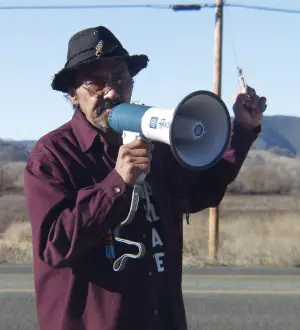
Duncan expressed concern over what the disenrollment could mean for the tribe's future and its young people, some of whom also are proposed to be stricken from membership rolls.
“What about our children?” Duncan said. “They don't even think about our children.”
Wanda Quitiquit, one of those targeted for disenrollment and a member of the American Indian Rights and Resources Organization (AIRRO), credited AIRRO – which cosponsored the protest – with being the only group to actively fight for Indian civil rights.
“I'm not disenrolled as far as I'm concerned,” said Quitiquit, who called California “the home of disenrollment.”
She said AIRRO estimates that 3,000 California Indians have been disenrolled from their tribes. “There is something very bad going on in Indian land today.”
Wanda Quitiquit and her brother, Marion Quitiquit, have been part of AIRRO since it was founded several years ago with the help of the Foreman family of Redding Rancheria, who were themselves disenrolled.
Quitiquit said Indian gaming “is our downfall,” and said the present disenrollment crisis requires Indians to step up their political activism like they did in the 1960s, 1970s and 1980s.
The Children’s Health Insurance Program Reauthorization Act (H.R. 2) was approved by a vote of 289-139.
The bill is very similar to the legislation that President Bush vetoed twice in the 110th Congress.
“Investing in children’s health care is one of the wisest choices our federal government can make,” Thompson said during a speech on the House of Representatives floor. “Children have to be healthy to get an education and achieve their full potential as adults. When kids see the doctor more regularly, they receive the preventive services that keep them healthier longer – and they are less likely to end up in the emergency room, which saves everyone money.”
Thompson said almost a million and a quarter children in California are uninsured, which he called “simply unacceptable.”
He said that, in contrast to President Bush’s multiple vetoes of similar bills, President-elect Obama gave his enthusiastic support to providing coverage for 4 million additional children. “That is truly change we can believe in,” Thompson said.
SCHIP was created in 1997 to provide health care coverage for children in families that earn too little to afford health insurance for their children but too much to qualify for Medicaid.
The bill passed last week by the House of Representatives reauthorizes SCHIP through 2013 and preserves the coverage for all 7.1 million children currently covered by SCHIP, including 1,538,416 children in California.
Thompson's office has previously estimated that 1,600 Lake County children will receive coverage under the legislation.
The bill also extends health care coverage to 4.1 million additional low-income children, who are currently uninsured. The bill is fully paid for.
This bipartisan bill has been endorsed by dozens of organizations, representing millions of Americans – ranging from business groups such as the National Federation of Independent Businesses and Business Roundtable to the American Hospital Association, AARP and Families USA.
{mos_sb_discuss:2}
View Larger Map
I’m going to spend a few columns over the next few months describing Lake County’s American Viticultural Areas (AVAs) so people can learn a little bit about the different wine-growing regions and wines in our area.
We live in one of the world’s greatest wine-growing regions and most people don’t know just how great an area it is. There’s a lot of ground to cover (pardon the pun), so bear with me as I give a little background on what makes an AVA.
Local conditions create terroir (loosely translated as “the taste of a place”) and make a specified growing area, and factors include the composition of the soil, climate conditions and topography (including altitude), with the emphasis that the conditions are unique and not to be found anywhere else.
Called an appellation in some parts of the world, an American Viticultural Area (or AVA) is to grapes as clover or orange blossoms are to honey. The honey made with these blossoms tastes like honey but is kissed with the essence of the flowers the bees made it with.
In much the same way, wine tastes like the place where it is grown. The United States has its own designations set by the Alcohol, Tobacco, and Firearms Bureau which authorizes official American Viticultural Areas. These viticultural areas are designated for grape growing but can and are called appellations almost interchangeably.
In the United States, AVA regions can be huge, like the Ohio River Valley (26,000 square miles), or extremely small, like Mendocino’s Cole Ranch AVA (about one-quarter square mile). One AVA can contain even smaller AVA regions within them.
The six counties north of San Francisco make up the “North Coast” AVA (Lake, Marin, Mendocino, Napa, Sonoma and Solano), which within it also has smaller AVAs.
Because of the strong French influence in winemaking and marketing, using the word “appellation” instead of AVA sometimes helps to clarify for the consumer the specific area their wine comes from. Whichever term you prefer, it’s like comparing apples to pommes. However the French are far more fastidious about what qualifies as an appellation than America is about establishing an AVA.
Interestingly, only vineyards that are located within one AVA use grapes grown within that same AVA, and make the wine inside the boundaries of that AVA can legitimately claim they are “Estate Bottled.”
This was an important factor to the Brassfield Estate which is the only estate bottled wine currently produced in the High Valley AVA. In most of the wine industry the word “estate” is thrown around loosely, kind of like “fine dining” on truck stop signs. However, the term “estate bottled” is carefully guarded by its practitioners.
In 1875 the Ogulin family settled in the High Valley and planted Muscat and Zinfandel vines on 400 acres. The Ogulin family still lives in the county and still owns about 100 acres of High Valley, including 15 of those original vines which are still alive and are said to be the second oldest grapevines in California. The oldest grapevines in California are currently living in Napa.
Established in 2005 in eastern Lake County, the High Valley AVA is three miles wide by nine miles long, with volcanic and alluvial (sandy soil once moved by water) soils. Ranging from 1600 feet to 3000 feet in altitude, High Valley is cooler than most of Lake County due to high-altitude sea air which is constantly blowing in.
The shape of the valley also helps create its unique climate. Imagine a bowl with one side just slightly lower than the other; cool sea air blows in on the lower side of the bowl, flows over the valley then hits the higher far side of the bowl (Round Mountain, on the eastern side of the valley) and then settles back down in the bottom of the bowl. The climate on the floor of the valley is best for white wines while the slopes are ideal for reds.
The High Valley AVA has the cooling qualities which come from both Clear Lake and from the Pacific Ocean. Not only does High Valley have its unique design, which scoops up the cool breezes coming in from the sea, but it has the geological oddity of being a valley that runs east-west while most of the world’s – yes I said most of the world’s – valleys run north-south.
High Valley was a lake itself many years ago, but nature decided through gravity, erosion and sedimentation that it would make better real estate if it were dry land.
There is graphic proof that the valley floor was once much lower than it currently is. When a well was being drilled for one of the vineyards, the drill bit reached 400 feet below the surface and the drill hit redwood, bringing chips of wood to the surface.
How did the redwood get down that far? Apparently at one time that was the level where redwoods were growing. Sometimes nature likes to rearrange the furniture.
Lake County has the cleanest air in all of California, an accolade it has claimed every year for as long as records of air quality have been kept in the state. This is due to the fact that cool, high altitude breezes from the Pacific Ocean pass over the lower altitude areas between the coast and the lake without being touched, but then are stopped by the plateau that both the lake and High Valley sit on, giving residents and vines alike the freshest air around.
The unique shape, altitude and isolation of the valley shelters it from being heavily affected by the warmth of the lake.
During the winter when it snows, I get very little snow in my yard and it sticks for little more than a few hours, while snow in High Valley can lasts for a couple of days although it is less than a mile away from where I live.
One of the reasons for this is that I am closer to the lake and the lake acts like a heat sump and melts the snow, while the mountains around High Valley protect the snow from the stabilizing effects and temperatures of the lake.
The unique topography also gives High Valley the benefit of being almost inaccessible. While there are several entries into the valley, only High Valley Road is public and easily found.
Following High Valley Road along its entire length, it eventually becomes a poorly maintained dirt road that only vehicles with big tires, good suspensions and alert drivers should attempt; but if you have the time, talent and desire to find a remote but gorgeous drive give it a try. The road empties out in Lucerne, and just remember to bring a camera, binoculars and a cell phone with a full battery. Hope you have service up there ...
Wineries within the AVA include Brassfield, High Valley Winery, Shannon Ridge and Monte Lago.
Jerry Brassfield purchased the old High Serenity Ranch and started his winery, although the original farmhouse and smokehouse from the ranch are still on the property. There also is a lake full of bass on the property that has been protected from my eternally hungry fishing equipment.
Brassfield owns 2,500 acres of High Valley, with only 367 acres planted with 19 grape varietals. Brassfield’s tasting room is on the estate three and a half miles up from the intersection of Highway 20 on High Valley road.
High Valley Winery has a new tasting room on Highway 20 and, although it is owned by Dustin Brassfield, the two wineries are completely separate and unrelated (no pun intended) companies.
High Valley Winery owns 80 acres with 28 of those planted with five varietals. Dustin and Bobbie Brassfield live on the property, and the wall and trees depicted on their wine label shows a part of an old wall that stretches over a mile through their property and the valley.
Shannon Ridge Vineyards and Winery owns more than 1,000 acres of the High Valley AVA with 450 planted with 15 varietals. Shannon Ridge has a pond with fish on its property that has also escaped my fishing equipment’s advances.
Clay Shannon was the first of the modern era of winemakers to see High Valley for the vineyard potential that it has. The vineyard also claims one of the steepest vineyards in California with a slope of 40 degrees. The Shannon Ridge tasting room is located in an old school house that the winery restored on Highway 20 in the Oaks.
The 600-acre Dharmapalan Estate is host to the Monte Lago vineyards, which grows 130 acres of grapes of six varietals. The remaining 370 acres is maintained as a wildlife preserve and they have no plans to expand the vineyard.
While they don’t have a public tasting room they do produce their own label of wines called Dharma wines. Dharma wine labels are a testimony to their Indian heritage by being collectable, numbered, silk labels depicting beautiful Indian women on them. Monte Lago has the honor of being the first wine produced out of High Valley.
Besides all sharing an AVA, another common factor I found in speaking to the owners of these wineries is they all have a commitment to the land, wildlife and ecology of the High Valley.
Much of High Valley has been set aside by the owners of the various properties as wildlife preserves. Reports of wildlife in High Valley include the typical deer, turkeys, hawks, owls, coyotes and small game, but also include bears, elk and cougars.
All the wineries have committed to laying aside land to stay natural and/or practice sustainable growing practices.
Also within the AVA are several private homes and ranches. High Valley Ranch and Conference Center owns about 1,700 acres of High Valley but doesn’t grow anything on them. They also have a working landing strip for small aircraft that sees occasional use.
Halden Ranch owns about 1,600 acres in the area and was once a working cattle ranch. It now acts as a nature reserve. Driving down High Valley Road at dusk, it is almost guaranteed that you will see plenty of deer.
High Valley AVA is already becoming nationally well known and noticed by wine enthusiasts throughout the United States through the various efforts of all the wineries in the valley. I will admit that I have personally purchased many cases of wine from almost all of the wineries in the valley and feel they are the very best quality.
Ross A. Christensen is an award-winning gardener and gourmet cook. He is the author of "Sushi A to Z, The Ultimate Guide" and is currently working on a new book. He has been a public speaker for many years and enjoys being involved in the community.
{mos_sb_discuss:2}
It’s been a long, a long time coming
But I know a change is gonna come, oh yes it will
– A Change Is Gonna Come by Sam Cooke, circa December 1964
The great Sam Cooke sang those poignant words to us, seemingly from the portals of heaven (or hell, depending on your perspective at the time). You see, the song was released by RCA Victor Records just mere weeks after “The Man Who Invented Soul” was tragically shot to death in a seedy motel in the Watts neighborhood of Los Angeles. (The legacy of the life and death of Cooke is a great American mystery about which volumes have been written, none of which completely explain it. Perhaps we will discuss it in a later column.)
At the time of its release “Change” only became a moderate, posthumous hit for Cooke. As the Civil Rights Movement was propelled forward though, the song became an anthem for the movement. Indeed, President Elect Obama stated to his supporters in Chicago after winning the election, “It's been a long time coming, but tonight, change has come to America.”
As we begin this new era in the political evolution of humanity, I am reminded of some of the things I have seen in my lifetime.
I remember attending Washington Elementary School in Oakland when John F. Kennedy was slated to give the commencement address at the University Of California at Berkeley in the year 1962.
Our teachers at Washington found out that President Kennedy’s motorcade would be traveling on Shattuck Avenue past our school. We gleefully and dutifully prepared placards and signs in anxious anticipation of our beloved president seeing us seeing him.
When the big moment was upon us, the whole school stood at erect, rapt attention as we spied the flashing red lights of the motorcade approach, about a mile away. As the motorcade got closer, it became obvious that they were moving pretty fast. So fast in fact that all we got was a glimpse of a shadow in the limo that must’ve been our president. We were waving and cheering but he had his back to the window.
Those Oakland cops had that motorcade speeding at about 50 miles per hour in a school zone! It seemed to be out of the president’s hands. Some of us were disappointed yet, I imagine some of us were glad to be out of school.
Eight months later, I was in what was then called junior high school, when John F. Kennedy was assassinated. I remember walking home from school with my peers. We were really hoping that whoever did it wasn’t African-American. I guess our perception was that we were already in enough trouble by virtue of our race.
Then, in seeming rapid succession, Malcolm X, Martin Luther King and Robert Kennedy all became victims of the assassin’s bullet. Malcolm X spoke of self-determination for the American negro before his pilgrimage to Mecca, yet became convinced after visiting the Holy Land that, yes, all races could live together.
Martin Luther King was a spokesman for all oppressed and poor people through nonviolent social change. Robert Kennedy, who visited East Oakland shortly before his untimely death, uncannily predicted a black president by 2008.
In the meantime the machinery that is American – no cross that out – global politics, has paralyzed the American – cross that word out again – global economy primarily along class lines. It seems to be afflicting the world, poor people under the wealthy, weighty boot of the rich. And the media hands us the narcotic, sleight of hand, smoke and mirrors of television and the over-stimulus of Hollywood.
Are we making sense of it yet? Or is it making cents out of us? Yeah, God bless America all right. Humph! God is also big enough to bless the whole world. That’s what I’m counting on.
As Jimi Hendrix stated to the faithful at Bill Graham’s Fillmore East on New Year’s Day 1970, shortly before he was vaporized,
“Yes, it has been a long time, hasn’t it?
Keep prayin’, keep thinkin’ those kind thoughts!
* * * * *
Upcoming cool performances:
Mighty Mike Schermer at the Blue Wing Salon and Café’s Blue Monday on Monday Jan. 19, at 6:30 p.m.
Morris Day and The Time at Cache Creek Casino on Saturday, Feb. 14, at 8 p.m.
* * * * *
Correction from last week’s blog
Yes, the CyberSoulMan will interview Teeny Tucker on Blue Monday at KPFZ 88.1 FM on Monday Jan. 26, at 8 a.m. The rebroadcast of the interview will be streamed over the Internet on Tuesday Feb. 3, at 3 p.m. on www.theworldofblues.com, In The Blues Spot.
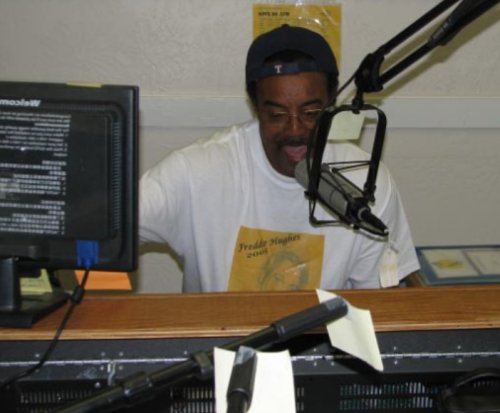
T. Watts is a writer, radio host and music critic. Visit his Web site at www.teewatts.biz.
{mos_sb_discuss:4}
Education
Health
Business
Obituaries
Veterans
Recreation
Religion
Arts & Life
Government & Politics