 How to resolve AdBlock issue?
News
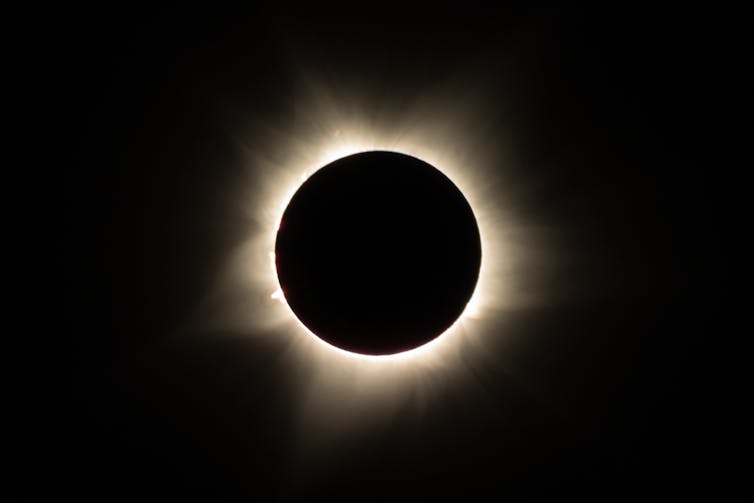
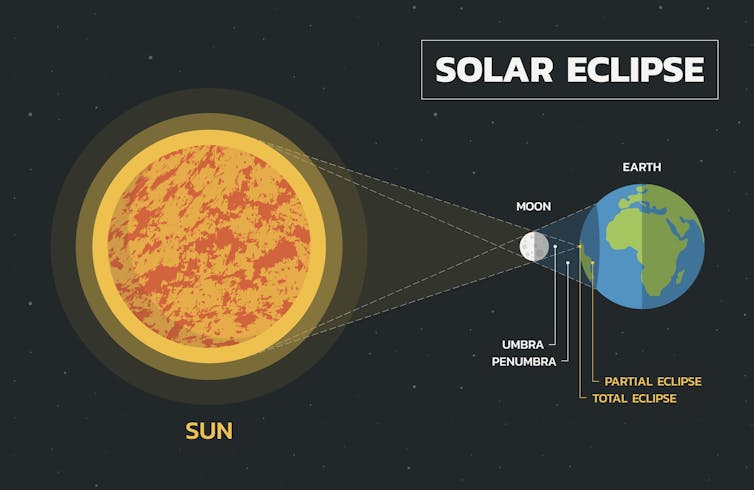
A total solar eclipse takes place on April 8 across North America. These events occur when the Moon passes between the Sun and Earth, completely blocking the Sun’s face. This plunges observers into a darkness similar to dawn or dusk.
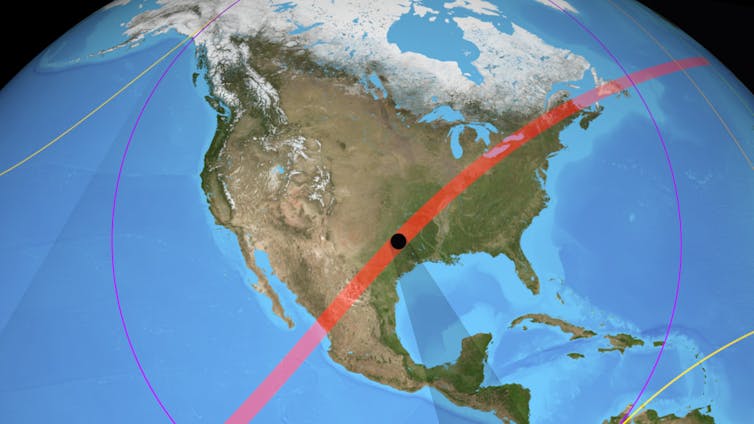
During the upcoming eclipse, the path of totality, where observers experience the darkest part of the Moon’s shadow (the umbra), crosses Mexico, arcing north-east through Texas, the Midwest and briefly entering Canada before ending in Maine.
Total solar eclipses occur roughly every 18 months at some location on Earth. The last total solar eclipse that crossed the US took place on August 21 2017.
An international team of scientists, led by Aberystwyth University, will be conducting experiments from near Dallas, at a location in the path of totality. The team consists of PhD students and researchers from Aberystwyth University, Nasa Goddard Space Flight Center in Maryland, and Caltech (California Institute of Technology) in Pasadena.
There is valuable science to be done during eclipses that is comparable to or better than what we can achieve via space-based missions. Our experiments may also shed light on a longstanding puzzle about the outermost part of the Sun’s atmosphere – its corona.
The Sun’s intense light is blocked by the Moon during a total solar eclipse. This means that we can observe the Sun’s faint corona with incredible clarity, from distances very close to the Sun, out to several solar radii. One radius is the distance equivalent to half the Sun’s diameter, about 696,000km (432,000 miles).
Measuring the corona is extremely difficult without an eclipse. It requires a special telescope called a coronagraph that is designed to block out direct light from the Sun. This allows fainter light from the corona to be resolved. The clarity of eclipse measurements surpasses even coronagraphs based in space.
We can also observe the corona on a relatively small budget, compared to, for example, spacecraft missions. A persistent puzzle about the corona is the observation that it is much hotter than the photosphere (the visible surface of the Sun). As we move away from a hot object, the surrounding temperature should decrease, not increase. How the corona is heated to such high temperatures is one question we will investigate.
We have two main scientific instruments. The first of these is Cip (coronal imaging polarimeter). Cip is also the Welsh word for “glance”, or “quick look”. The instrument takes images of the Sun’s corona with a polariser.
The light we want to measure from the corona is highly polarised, which means it is made up of waves that vibrate in a single geometric plane. A polariser is a filter that lets light with a particular polarisation pass through it, while blocking light with other polarisations.
The Cip images will allow us to measure fundamental properties of the corona, such as its density. It will also shed light on phenomena such as the solar wind. This is a stream of sub-atomic particles in the form of plasma – superheated matter – flowing continuously outward from the Sun. Cip could help us identify sources in the Sun’s atmosphere for certain solar wind streams.
Direct measurements of the magnetic field in the Sun’s atmosphere are difficult. But the eclipse data should allow us to study its fine-scale structure and trace the field’s direction. We’ll be able to see how far magnetic structures called large “closed” magnetic loops extend from the Sun. This in turn will give us information about large-scale magnetic conditions in the corona.
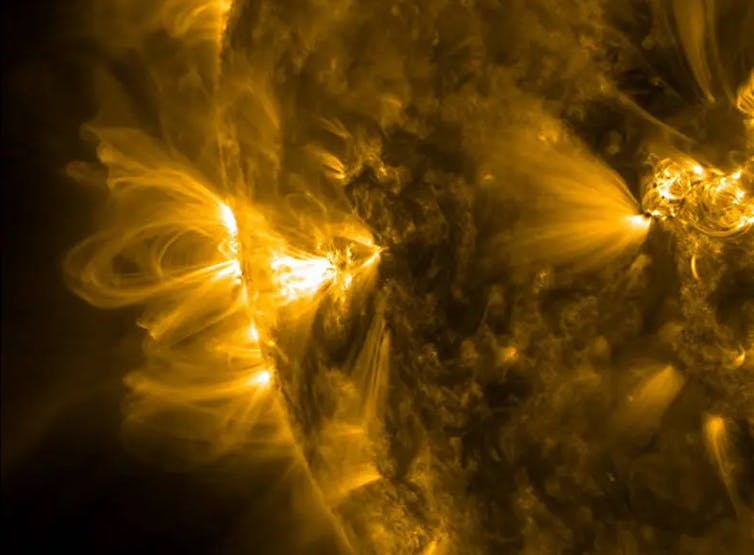
The second instrument is Chils (coronal high-resolution line spectrometer). It collects high-resolution spectra, where light is separated into its component colours. Here, we are looking for a particular spectral signature of iron emitted from the corona.
It comprises three spectral lines, where light is emitted or absorbed in a narrow frequency range. These are each generated at a different range of temperatures (in the millions of degrees), so their relative brightness tells us about the coronal temperature in different regions.
Mapping the corona’s temperature informs advanced, computer-based models of its behaviour. These models must include mechanisms for how the coronal plasma is heated to such high temperatures. Such mechanisms might include the conversion of magnetic waves to thermal plasma energy, for example. If we show that some regions are hotter than others, this can be replicated in models.
This year’s eclipse also occurs during a time of heightened solar activity, so we could observe a coronal mass ejection (CME). These are huge clouds of magnetised plasma that are ejected from the Sun’s atmosphere into space. They can affect infrastructure near Earth, causing problems for vital satellites.
Many aspects of CMEs are poorly understood, including their early evolution near the Sun. Spectral information on CMEs will allow us to gain information on their thermodynamics, and their velocity and expansion near the Sun.
Our eclipse instruments have recently been proposed for a space mission called Moon-enabled solar occultation mission (Mesom). The plan is to orbit the Moon to gain more frequent and extended eclipse observations. It is being planned as a UK Space Agency mission involving several countries, but led by University College London, the University of Surrey and Aberystwyth University.
We will also have an advanced commercial 360-degree camera to collect video of the April 8 eclipse and the observing site. The video is valuable for public outreach events, where we highlight the work we do, and helps to generate public interest in our local star, the Sun.
Huw Morgan, Reader in Physical Sciences, Aberystwyth University
This article is republished from The Conversation under a Creative Commons license. Read the original article.
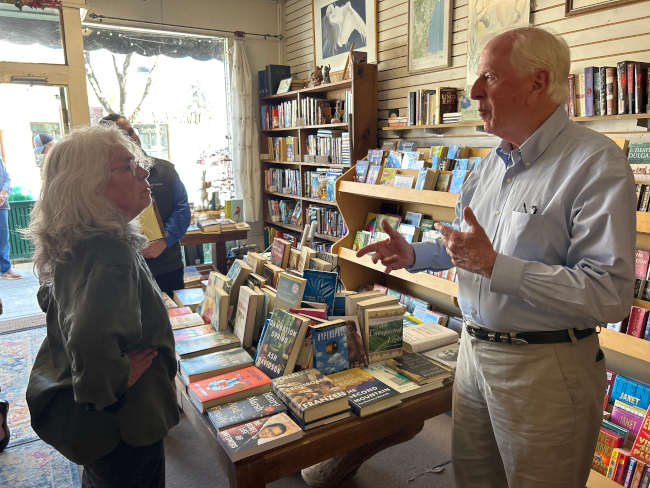
LAKE COUNTY, Calif. — Congressman Mike Thompson visited Lake County on Tuesday, spending time with local businesses and meeting with tribal leaders.
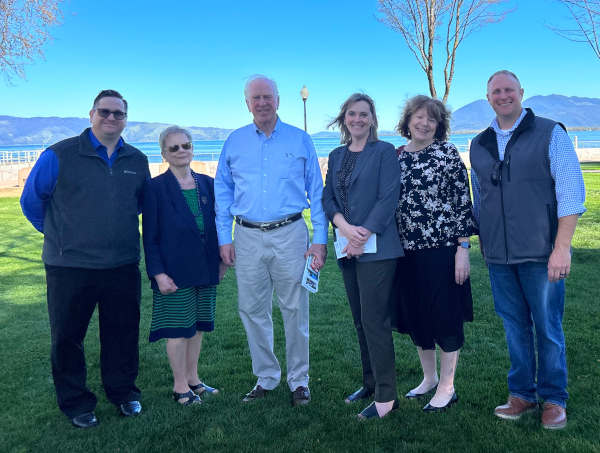
Thompson joined the Lakeport Economic Development Advisory Committee, or LEDAC, to tour Lakeport’s small businesses.
They discussed how they can work together to strengthen the local economy and help create jobs.
Among the businesses Thompson visited were On the Waterfront, Watershed Bookstore, Marcel’s French Bakery and Cafe, Veronica’s Jewelers and Wine in the Willows.
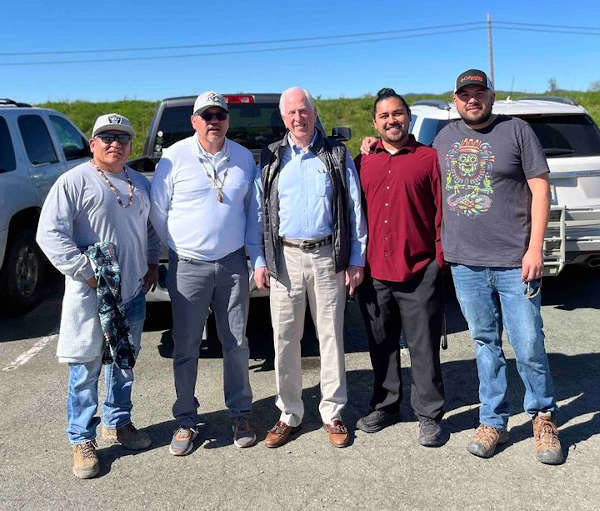
Also on Tuesday, Thompson met with Robinson Rancheria Band of Pomo Indians Tribal Chairman Beniakem Cromwell and tribal leadership to discuss how they can work together to preserve and protect Clear Lake hitch.
They also discussed how to support the tribe’s efforts to protect the community against fires and other natural disasters.
The text of the proclamation follows.
Our state’s public libraries provide hundreds of thousands of programs each year, adapting to the needs of Californians. They offer online tutoring, adult literacy programs, summer reading, test prep, resources for science, technology, engineering, the arts and math (STEAM), early learning for infants and toddlers, meals for children and services for jobseekers. They provide free Wi-Fi and house collaborative work spaces, career centers, quiet spaces for studying and community gardens. Libraries also support community resilience by serving as heating and cooling centers, technology and communication providers and as safe places during emergencies.
California’s library workers play an essential civic role, helping people of all ages and all backgrounds access the resources, programs and services they need and serving as a key source for trusted information. Librarians help us start new chapters at every stage of our lives, from showing us the magic of reading as children to teaching us new skills in our golden years, with expanded digital access offering more opportunities than ever before.
All too often, libraries – and librarians – face censorship and attacks amid rising school and library book challenges, many targeting LGBTQ+ authors and writers of color. It is more important than ever that we recognize the significance of books and materials that reflect the breadth of our rich diversity and defend the essential role of public libraries in protecting intellectual freedom.
In California, we know libraries hold more than books — they are the heart of our communities. During National Library Week, we honor our libraries and library workers and the endless possibilities they offer to enrich the lives of Californians across the state.
NOW THEREFORE I, GAVIN NEWSOM, Governor of the State of California, do hereby proclaim April 7-13, 2024, as “California Library Week.”
IN WITNESS WHEREOF I have hereunto set my hand and caused the Great Seal of the State of California to be affixed this 5th day of April 2024.
GAVIN NEWSOM
Governor of California
ATTEST:
SHIRLEY N. WEBER, Ph.D.
Secretary of State

Students in rural America still lack access to high-speed internet at home despite governmental efforts during the pandemic to fill the void. This lack of access negatively affects their academic achievement and overall well-being. The situation has been getting worse as the urgency of the pandemic has receded.
Those findings are based on a new study we did to determine the post-pandemic outlook on internet access for rural students.
During the pandemic, school districts quickly deployed emergency resources such as Wi-Fi hot spots to facilitate remote learning. In rural Michigan, student home internet connectivity soared to 96% by the end of 2021, a remarkable 16 percentage-point increase from 2019.
However, these gains are proving temporary. By 2022, student access in rural Michigan began to decline. Today, many more students are disconnected than during the height of the crisis. The downward trend is likely to continue as resources from pandemic emergency measures diminish
We surveyed students in grades 8-11 from 18 rural Michigan schools before and after the pandemic, tracking changes in their digital access, educational outcomes and well-being. We found that one-third of rural students still lack high-speed broadband internet at home.
Why it matters
Our recent report highlights how rural gaps in access to the internet, mainly the lack of broadband home internet access, were not resolved over the pandemic. And these persistent access gaps could affect students’ digital skills, academic performance and well-being.
Rural students lacking adequate home internet face significant educational disadvantages compared with their better-connected peers. These disadvantages include lower classroom grades, lower standardized test scores, lower educational aspirations and lower interest in STEM careers. Our findings link these adverse outcomes, which start with access gaps, to subsequent gaps in digital skills. These digital skills are less likely to develop without reliable broadband connectivity at home.
In early 2020, schools mobilized state and federal relief to provide students with home internet and laptops. Our study demonstrates the success of these initiatives in rural areas, where school-provided Wi-Fi hot spots accounted for nearly all of the 16 percentage-point increase in home internet access during the pandemic’s peak. Importantly, as hot spot funding has ended, many households maintained access by subscribing to local internet service providers.
The success in transitioning students from school-provided Wi-Fi hot spots to paid subscriptions is now at risk. Many low-income households rely on the Affordable Connectivity Program, the nation’s largest internet affordability initiative, created under the Bipartisan Infrastructure Law of 2021. This program provides a monthly discount of up to US$30 for eligible households and up to $75 for households on Native American tribal lands. The program is set to expire in April 2024.
We found that internet access among rural students had begun to decline in 2022. This trend is likely to accelerate with the end of the Affordable Connectivity Program.
Young people’s time spent online – such as surfing the internet, playing video games and interacting on social media – helps them develop valuable skills. These skills include problem-solving, information literacy and creative expression. These skills apply across both digital and offline environments. Our research shows that digital skills helped rural students maintain their interest in STEM fields and their goals of pursuing college, even as these interests declined during the pandemic.
Additionally, rural adolescents are at a heightened level of risk for social isolation. While adolescent mental health within our study – as measured by self-esteem – returned to pre-pandemic levels, rural students without adequate home internet remain at higher risk.
What still isn’t known
A major challenge in bridging the access divide is pinpointing underserved areas. Accurate maps are crucial to direct billions of dollars in funding from programs such as the Broadband Equity Access and Deployment Program, also known as BEAD, and the Rural Digital Opportunity Fund toward truly underserved communities. As part of the process to receive BEAD funding, each state must identify unserved and underserved homes. Local governments, nonprofit organizations and internet service providers can also develop scientifically rigorous and reliable approaches to challenge the accuracy of these maps.
Maps must be finalized and grants must be made to states before large-scale infrastructure improvements will commence. However, some other early initiatives are now coming online. For example, in 2022, the Quello Center at Michigan State University, in partnership with a regional education network nonprofit, started the Michigan MOON-Light project. Funded with a $10.5 million grant from the Broadband Infrastructure Program, this project increases the bandwidth on Michigan’s education network that is being made available to local service providers. These providers will deliver reliable high-speed internet to 17,000 previously unserved households by the end of 2024.
Still, other major infrastructure improvements across the country will not be realized for several years.
The Research Brief is a short take on interesting academic work.
Gabriel E. Hales, Ph.D. Candidate and Research Assistant, Michigan State University and Keith N. Hampton, Professor of Media and Information and Interim Director of the Quello Center, Michigan State University
This article is republished from The Conversation under a Creative Commons license. Read the original article.

CLEARLAKE, Calif. — Clearlake Animal Control has more new dogs waiting for families this week.
The Clearlake Animal Control website lists 33 adoptable dogs.
This week’s dogs include a 2-month-old male pit bull terrier puppy with a tan and white coat.

There also is “Blanch,” a female pit bull terrier with a tricolor coat.
Another available dog is “Petunia,” a 1-year-old female pit bull terrier mix with a black coat.

The shelter is located at 6820 Old Highway 53. It’s open from 9 a.m. to 6 p.m. Tuesday through Saturday.
For more information, call the shelter at 707-762-6227, email
This week’s adoptable dogs are featured below.
Email Elizabeth Larson at
What's up for April? Some easy-to-spot planets, there's still time to observe comet 12P, and how to enjoy this month's solar eclipse if you're not in the path of totality.
For several days in the first half of April, early risers can watch Mars and Saturn rising together in the morning. Taking a look about half an hour before sunrise, you can find them low in the east, about 10 degrees above the horizon. They're at their closest on April 10 and 11, but still really close in the sky the whole second week of April.
Now, on the evening of April 10th you can find the Moon with Jupiter in the west. Jupiter's easy to identify as a bright, unflickering light, low in the west following sunset, all month. Being just a couple of days after its "new moon" phase, the Moon shows only 7% of its illuminated surface on this evening, making for a beautiful crescent shining there with the giant planet Jupiter.
This is also a good night to have a look for comet 12P/Pons-Brooks, which has been getting brighter, and is easily observable with binoculars or a small telescope, especially if you can get away from bright city lights. The comet will be just beneath the Moon, and just right of Jupiter, but you'll have to be quick, as it drops below 10 degrees elevation an hour after sunset and then sets an hour later. So you'll want a clear view toward the horizon, and be looking for it as twilight ends.
If you want to catch this comet, do it soon, because it will be too close to the Sun in the sky to observable after mid-April, and later when it makes its closest approach to Earth, it will be on its way outward from the Sun and growing fainter.
2024 total solar eclipse
There's a total solar eclipse on the way, and it's kind of a big deal. We've been really fortunate to have two total eclipses visible across a wide swath of the U.S. recently, first in 2017, and now on April 8. The next time such an eclipse will cross the States is 21 years from now. If you live in or near the path of totality, or you're traveling there to experience the eclipse, you're in for an incredible experience.
But what if you're not going to be able to experience totality for this eclipse in person? What can you expect, and how can you still enjoy it? Well for starters, NASA has you covered with a live webcast, from multiple locations, as the Moon's shadow moves across the country. So join us for the total eclipse online, whatever your plans.
If you're anywhere in the continental U.S. outside of totality, you'll still experience a partial solar eclipse. The amount of the Sun to be covered by the Moon at maximum eclipse depends on how far you are from the path of totality.
In observing a partial eclipse, you'll still need to use specialized eye protection, such as eclipse glasses, a pinhole projector, or a telescope with a solar filter. One of the easiest methods is something most of us have in our kitchen – a regular colander. These make excellent pinhole cameras that project the eclipse onto the ground.
And barring that, the sun dapples that filter through the tree leaves do something very similar. It's also fun to note the eerie way the sunlight dims during the eclipse, especially in places where the Moon covers 80% or more of the Sun's disk.
NASA has a bunch of eclipse resources to help you get ready for this awe-inspiring celestial event. There's info on safe-viewing, citizen science opportunities, and you'll even find our "eclipse explorer," where you can find eclipse details for your specific zip code.
From wherever you're observing, solar eclipses are remarkable events. So observe safely, and join our live webcast, because it's an event you surely don't want to miss.
Preston Dyches works for NASA's Jet Propulsion Laboratory.