 How to resolve AdBlock issue?
News
LAKE COUNTY, Calif. — Lake County’s newest municipal advisory council’s members have been selected and the group is expected to hold its first meeting this month.
At its April 2 meeting, the Board of Supervisors selected the five members and one alternate to fill the seats on the council, which will represent the Kelseyville planning area.
The council was officially formed at the board’s March 12 meeting.
The supervisors voted unanimously to appoint Angel Acosta, Megan Lankford, Big Valley Tribal Chair Flaman McCloud, Brian Hanson and Joy Merrilees to the general membership seats, and Greg Panella as the alternate.
Acosta, Lankford, Hanson, Merrilees and Panella were all part of the group involved with drafting the new council’s bylaws.
At the March 12 Board of Supervisors meeting, it was reported that the advisory council would hold its first meeting on April 17.
However, so far, an agenda has not been released or posted on the county’s website, and the new council isn’t listed on the county webpage for board-appointed councils and commissions.
Email Elizabeth Larson atThis email address is being protected from spambots. You need JavaScript enabled to view it. . Follow her on Twitter, @ERLarson, or Lake County News, @LakeCoNews.
At its April 2 meeting, the Board of Supervisors selected the five members and one alternate to fill the seats on the council, which will represent the Kelseyville planning area.
The council was officially formed at the board’s March 12 meeting.
The supervisors voted unanimously to appoint Angel Acosta, Megan Lankford, Big Valley Tribal Chair Flaman McCloud, Brian Hanson and Joy Merrilees to the general membership seats, and Greg Panella as the alternate.
Acosta, Lankford, Hanson, Merrilees and Panella were all part of the group involved with drafting the new council’s bylaws.
At the March 12 Board of Supervisors meeting, it was reported that the advisory council would hold its first meeting on April 17.
However, so far, an agenda has not been released or posted on the county’s website, and the new council isn’t listed on the county webpage for board-appointed councils and commissions.
Email Elizabeth Larson at
Chair of the House Gun Violence Prevention Task Force, Rep. Mike Thompson (CA-04), is lauding the Bureau of Alcohol, Tobacco, Firearms, and Explosives’ final rule expanding required background checks before firearm sales.
“Today’s rule is a leap forward in closing dangerous, decades-old loopholes that have allowed many firearm buyers to bypass background checks,” said Thompson in a statement released early Thursday morning. “There’s no doubt this rule will help save lives by keeping guns out of dangerous hands.”
Chairman Thompson has long supported expanding background checks for firearm sales. Rep. Thompson has introduced background check legislation every Congress since the 2012 Sandy Hook Elementary shooting which killed 20 children and six adult staff members.
The Justice Department announced Wednesday that it has submitted to the Federal Register the “Engaged in the Business” Final Rule, which makes clear the circumstances in which a person is “engaged in the business” of dealing in firearms and thus required to obtain a federal firearms license, in order to increase compliance with the federal background check requirement for firearm sales by federal firearms licensees.
Previously, only sellers “engaged in the business” of firearm dealing were required to register as a Federal firearm licensee, or FFL, and therefore conduct background checks for firearm sales.
The new rule expands the definition of "engaged in the business" of dealing firearms to anyone who sells firearms to earn a profit, greatly expanding the number of firearms dealers legally required to register as FFLs.
Firearms sellers previously operating without running background checks will be obligated to perform them before selling a firearm to a buyer.
“Under this regulation, it will not matter if guns are sold on the internet, at a gun show, or at a brick-and-mortar store: if you sell guns predominantly to earn a profit, you must be licensed, and you must conduct background checks,” said Attorney General Merrick B. Garland. “This regulation is a historic step in the Justice Department’s fight against gun violence. It will save lives.”
This rule was made possible by the Bipartisan Safer Communities Act, the most consequential gun violence prevention legislation signed into law in decades which Rep. Thompson said he was proud to help pass.
“The Bipartisan Safer Communities Act enhanced background checks and closed loopholes, including by redefining when a person is ‘engaged in the business’ of dealing in firearms. Today’s rule clarifying application of that definition will save lives by requiring all those in the business of selling guns to get a federal license and run background checks — thus keeping guns out of the hands of violent criminals,” said Deputy Attorney General Lisa Monaco. “I applaud the hard work of ATF in drafting this rule and reviewing the hundreds of thousands of public comments, which overwhelmingly favored the rule announced today. Because of that work, our communities will be safer.”
“This is about protecting the lives of innocent, law-abiding Americans as well as the rule of law. There is a large and growing black market of guns that are being sold by people who are in the business of dealing and are doing it without a license; and therefore, they are not running background checks the way the law requires. And it is fueling violence,” said Director Steven Dettelbach of the Bureau of Alcohol, Tobacco, Firearms and Explosives (ATF). “Today’s Final Rule is about ensuring compliance with an important area of the existing law where we all know, the data show, and we can clearly see that a whole group of folks are openly flouting that law. That leads to not just unfair but, in this case, dangerous consequences.”
The Bipartisan Safer Communities Act (BSCA), enacted June 25, 2022, expanded the definition of engaging in the business of firearms dealing to cover all persons who devote time, attention, and labor to dealing in firearms as a regular course of trade or business to predominately earn a profit through the repetitive purchase and sale of firearms.
On March 14, 2023, President Biden issued Executive Order 14092, which, among other things, directs the Attorney General to develop and implement a plan to clarify the definition of who is engaged in the business of dealing in firearms and thus required to obtain a federal firearms license.
The Final Rule conforms the ATF regulations to the new BSCA definition and further clarifies the conduct that presumptively requires a license under that revised definition, among other things.
Federally licensed firearms dealers are critical to federal, state, local, tribal, and territorial law enforcement in our shared goal of promoting public safety. Licensees submit background checks on potential purchasers to the FBI’s National Instant Criminal Background Check System, which helps to keep firearms out of the hands of prohibited persons.
Further, licensees keep records of sales transactions to help ensure that when a gun is used in a crime and recovered by law enforcement it can be traced back to the first retail purchaser; they help identify and prevent straw purchasers from buying firearms on behalf of prohibited persons and criminals; and they facilitate safe storage of firearms by providing child-safety locks with every transferred handgun and offer customers other secure gun storage options.
Unlicensed dealing, however, undermines these public-safety features — which is why Congress has long prohibited engaging in the business of dealing in firearms without the required license.
To increase compliance with the statutes Congress has enacted, the Final Rule identifies conduct that is presumed to require a federal firearms license. And, in addition to implementing the revised statutory definition discussed above, the Final Rule clarifies the circumstances in which a license is — or is not — required by, among other things, adding a definition of “personal firearms collection” to ensure that genuine hobbyists and collectors may enhance or liquidate their collections without fear of violating the law. The Final Rule also provides clarity as to what licensees must do with their inventory when they go out of business.
The Final Rule goes into effect 30 days after the date of publication in the Federal Register.
On Sept. 8, 2023, the Justice Department published a notice of proposed rulemaking, and during the 90-day open comment period, ATF received nearly 388,000 comments.
“Today’s rule is a leap forward in closing dangerous, decades-old loopholes that have allowed many firearm buyers to bypass background checks,” said Thompson in a statement released early Thursday morning. “There’s no doubt this rule will help save lives by keeping guns out of dangerous hands.”
Chairman Thompson has long supported expanding background checks for firearm sales. Rep. Thompson has introduced background check legislation every Congress since the 2012 Sandy Hook Elementary shooting which killed 20 children and six adult staff members.
The Justice Department announced Wednesday that it has submitted to the Federal Register the “Engaged in the Business” Final Rule, which makes clear the circumstances in which a person is “engaged in the business” of dealing in firearms and thus required to obtain a federal firearms license, in order to increase compliance with the federal background check requirement for firearm sales by federal firearms licensees.
Previously, only sellers “engaged in the business” of firearm dealing were required to register as a Federal firearm licensee, or FFL, and therefore conduct background checks for firearm sales.
The new rule expands the definition of "engaged in the business" of dealing firearms to anyone who sells firearms to earn a profit, greatly expanding the number of firearms dealers legally required to register as FFLs.
Firearms sellers previously operating without running background checks will be obligated to perform them before selling a firearm to a buyer.
“Under this regulation, it will not matter if guns are sold on the internet, at a gun show, or at a brick-and-mortar store: if you sell guns predominantly to earn a profit, you must be licensed, and you must conduct background checks,” said Attorney General Merrick B. Garland. “This regulation is a historic step in the Justice Department’s fight against gun violence. It will save lives.”
This rule was made possible by the Bipartisan Safer Communities Act, the most consequential gun violence prevention legislation signed into law in decades which Rep. Thompson said he was proud to help pass.
“The Bipartisan Safer Communities Act enhanced background checks and closed loopholes, including by redefining when a person is ‘engaged in the business’ of dealing in firearms. Today’s rule clarifying application of that definition will save lives by requiring all those in the business of selling guns to get a federal license and run background checks — thus keeping guns out of the hands of violent criminals,” said Deputy Attorney General Lisa Monaco. “I applaud the hard work of ATF in drafting this rule and reviewing the hundreds of thousands of public comments, which overwhelmingly favored the rule announced today. Because of that work, our communities will be safer.”
“This is about protecting the lives of innocent, law-abiding Americans as well as the rule of law. There is a large and growing black market of guns that are being sold by people who are in the business of dealing and are doing it without a license; and therefore, they are not running background checks the way the law requires. And it is fueling violence,” said Director Steven Dettelbach of the Bureau of Alcohol, Tobacco, Firearms and Explosives (ATF). “Today’s Final Rule is about ensuring compliance with an important area of the existing law where we all know, the data show, and we can clearly see that a whole group of folks are openly flouting that law. That leads to not just unfair but, in this case, dangerous consequences.”
The Bipartisan Safer Communities Act (BSCA), enacted June 25, 2022, expanded the definition of engaging in the business of firearms dealing to cover all persons who devote time, attention, and labor to dealing in firearms as a regular course of trade or business to predominately earn a profit through the repetitive purchase and sale of firearms.
On March 14, 2023, President Biden issued Executive Order 14092, which, among other things, directs the Attorney General to develop and implement a plan to clarify the definition of who is engaged in the business of dealing in firearms and thus required to obtain a federal firearms license.
The Final Rule conforms the ATF regulations to the new BSCA definition and further clarifies the conduct that presumptively requires a license under that revised definition, among other things.
Federally licensed firearms dealers are critical to federal, state, local, tribal, and territorial law enforcement in our shared goal of promoting public safety. Licensees submit background checks on potential purchasers to the FBI’s National Instant Criminal Background Check System, which helps to keep firearms out of the hands of prohibited persons.
Further, licensees keep records of sales transactions to help ensure that when a gun is used in a crime and recovered by law enforcement it can be traced back to the first retail purchaser; they help identify and prevent straw purchasers from buying firearms on behalf of prohibited persons and criminals; and they facilitate safe storage of firearms by providing child-safety locks with every transferred handgun and offer customers other secure gun storage options.
Unlicensed dealing, however, undermines these public-safety features — which is why Congress has long prohibited engaging in the business of dealing in firearms without the required license.
To increase compliance with the statutes Congress has enacted, the Final Rule identifies conduct that is presumed to require a federal firearms license. And, in addition to implementing the revised statutory definition discussed above, the Final Rule clarifies the circumstances in which a license is — or is not — required by, among other things, adding a definition of “personal firearms collection” to ensure that genuine hobbyists and collectors may enhance or liquidate their collections without fear of violating the law. The Final Rule also provides clarity as to what licensees must do with their inventory when they go out of business.
The Final Rule goes into effect 30 days after the date of publication in the Federal Register.
On Sept. 8, 2023, the Justice Department published a notice of proposed rulemaking, and during the 90-day open comment period, ATF received nearly 388,000 comments.
State and local leaders discussed unique challenges facing rural California at an event hosted by the Public Policy Initiative of California last month. The event put a spotlight on a statewide initiative to support regional economic development efforts—the focus of a 2022 Little Hoover Commission study.
"California's vibrant sustainable future depends on its rural communities,” said Ashley Swearengin, former Mayor of Fresno and current President and CEO of the Central Valley Community Foundation. She added that investment in rural California "actually means a brighter future for other parts of the state.”
California has a unique opportunity to further its efforts to build a “regions up” approach to development that brings together goals surrounding economy, equity, and environment through the Regional Investment Initiative, Swearengin told the crowd.
The Regional Investment Initiative (formerly the Community Economic Resilience Fund, or CERF, is a $600 million state initiative launched in 2021 to support regional collaboratives as they work to develop and implement strategies for inclusive development.
In its November 2022 report Equitable Economic Development across California, the Commission applauded Governor Newsom and state leaders for this bold investment in California’s regional economic agenda.
The initiative, the commission found, offered a tremendous opportunity for the state to strengthen and expand existing grassroots coalitions and accelerate more inclusive and sustainable regional economic growth.
In turn, these efforts would help California lift up its inland and rural regions, which suffer from disparities in income, employment, and opportunity, as compared to the state’s coastal cities.
However, the commission also learned that the initiative suffered from challenges, including balancing among different outcome goals, ensuring that regions receive the scale of investment necessary to change their economic trajectories, and coordinating the range of state programs that can support inclusive regional economic development.
In recognition of these obstacles, the commission outlined several recommendations to help the state better support regions as they seek to execute economic development strategies:
• Prioritize historically disadvantaged regions and subregions for funding within the Regional Investment Initiative and related programs.
• Provide greater strategic clarity to the Regional Investment Initiative by focusing the program more specifically on the creation of quality jobs in sustainable industries with high growth potential and on connecting members of disadvantaged communities with the quality jobs created.
• Encourage and support regional investments in traded sectors (those that sell goods and services outside of the region).
• Create a single, senior point of leadership for regional economic development. Further, the state should coordinate state funding and programs in support of regional economic development strategies.
• Increase regional capacity for inclusive economic development by dedicating ongoing funding for regional partnerships responsible for guiding regional economic development. The state should also plan for how to structure and sustain regional collaboration after the end of Regional Investment Initiative.
• Allocate ongoing funding to better enable colleges and universities to act as leaders in regional economic development and improve alignment with regional economies.
• Institutionalize the regular reporting of metrics relating to the health of regional economies and the extent of regional economic disparities.
Regional collaboratives are in the midst of developing roadmaps, including a strategy and recommended series of investments, for their respective regions.
Last month, Gov. Newsom also announced the creation of the California Jobs First Council, which will help support regional collaboratives to expand industry and create jobs locally.
"California's vibrant sustainable future depends on its rural communities,” said Ashley Swearengin, former Mayor of Fresno and current President and CEO of the Central Valley Community Foundation. She added that investment in rural California "actually means a brighter future for other parts of the state.”
California has a unique opportunity to further its efforts to build a “regions up” approach to development that brings together goals surrounding economy, equity, and environment through the Regional Investment Initiative, Swearengin told the crowd.
The Regional Investment Initiative (formerly the Community Economic Resilience Fund, or CERF, is a $600 million state initiative launched in 2021 to support regional collaboratives as they work to develop and implement strategies for inclusive development.
In its November 2022 report Equitable Economic Development across California, the Commission applauded Governor Newsom and state leaders for this bold investment in California’s regional economic agenda.
The initiative, the commission found, offered a tremendous opportunity for the state to strengthen and expand existing grassroots coalitions and accelerate more inclusive and sustainable regional economic growth.
In turn, these efforts would help California lift up its inland and rural regions, which suffer from disparities in income, employment, and opportunity, as compared to the state’s coastal cities.
However, the commission also learned that the initiative suffered from challenges, including balancing among different outcome goals, ensuring that regions receive the scale of investment necessary to change their economic trajectories, and coordinating the range of state programs that can support inclusive regional economic development.
In recognition of these obstacles, the commission outlined several recommendations to help the state better support regions as they seek to execute economic development strategies:
• Prioritize historically disadvantaged regions and subregions for funding within the Regional Investment Initiative and related programs.
• Provide greater strategic clarity to the Regional Investment Initiative by focusing the program more specifically on the creation of quality jobs in sustainable industries with high growth potential and on connecting members of disadvantaged communities with the quality jobs created.
• Encourage and support regional investments in traded sectors (those that sell goods and services outside of the region).
• Create a single, senior point of leadership for regional economic development. Further, the state should coordinate state funding and programs in support of regional economic development strategies.
• Increase regional capacity for inclusive economic development by dedicating ongoing funding for regional partnerships responsible for guiding regional economic development. The state should also plan for how to structure and sustain regional collaboration after the end of Regional Investment Initiative.
• Allocate ongoing funding to better enable colleges and universities to act as leaders in regional economic development and improve alignment with regional economies.
• Institutionalize the regular reporting of metrics relating to the health of regional economies and the extent of regional economic disparities.
Regional collaboratives are in the midst of developing roadmaps, including a strategy and recommended series of investments, for their respective regions.
Last month, Gov. Newsom also announced the creation of the California Jobs First Council, which will help support regional collaboratives to expand industry and create jobs locally.

Reinforcing California’s commitment to supporting legal cannabis operators and dismantling the illegal market, the Governor’s Unified Cannabis Enforcement Taskforce, or UCETF, seized more than $53,620,600 million in illegal cannabis in the first quarter of this calendar year.
Other enforcement highlights from the period of Jan. 1, 2024, through March 31, 2024, includes:
• 31,866 pounds of unlicensed cannabis seized.
• 54,137 unlicensed cannabis plants eradicated.
• $34,858 in cash seized.
• 11 firearms seized.
• Four arrests.
“California is home to the largest legal cannabis market in the world,” said Gov. Gavin Newsom. “As we continue to cultivate a legal marketplace, we're taking aggressive action to crack down on those still operating in the shadows — shutting down illegal operations linked to organized crime, human trafficking, and the proliferation of illegal products that harm the environment and public health.”
“UCETF continues to strengthen its momentum by focusing on priority targets and strategically removing operations having a significant impact on the illegal cannabis supply chain,” said Nathaniel Arnold, acting chief of the CDFW Law Enforcement Division. “We are utilizing all the available resources from our partner agencies and are committed more than ever to providing public safety, protecting the environment, and helping the regulated market succeed and thrive.”
“A key to UCETF’s success is a collaborative approach relying on intelligence gathering, targeted investigations and leveraging the expertise of our members,” said Bill Jones, chief of the Law Enforcement Division for DCC. “The Taskforce continues to play a crucial role in protecting the legal cannabis market while eliminating the often-dangerous activities associated with unlicensed cannabis operations.”
The following state agencies and departments participated in UCETF operations during Q1 2024: Department of Alcoholic Beverage Control, Department of Cannabis Control, Employment Development Department, Department of Fish and Wildlife, California National Guard Counter Drug Task Force, California Division of Occupational Safety and Health, California State Parks, and the Department of Tax and Fee Administration. In addition, multiple federal and local partners assisted with enforcement operations during the first quarter of 2024.
A total of 18 search warrants were served during Q1 2024 in the following counties: Alameda (2); Fresno (1); Kern (5); Los Angeles (1); Riverside (2); San Joaquin (1); and Orange County (6).
Since inception, UCETF has seized $371,199,431 in unlicensed cannabis through 236 search warrants. The taskforce has also eradicated 401,458 plants and seized 139 firearms.
Created by Governor Newsom in 2022, the Unified Cannabis Enforcement Taskforce has been charged to further align state efforts and increase cannabis enforcement coordination between state, local and federal partners. UCETF’s enforcement actions protect consumer and public safety, safeguard the environment, and deprive illegal cannabis operators and transnational criminal organizations of illicit revenue that harms consumers and undercuts the regulated cannabis market in California.
The taskforce is co-chaired by the Department of Cannabis Control and the California Department of Fish and Wildlife and coordinated by the Homeland Security Division of the Governor’s Office of Emergency Services. The taskforce includes more than two dozen local, state, and federal partners working together to disrupt the illegal cannabis market.
The Department of Cannabis Control, or DCC, licenses and regulates commercial cannabis activity within California. DCC works closely with all stakeholders, including businesses and local jurisdictions, to create a sustainable legal cannabis industry and a safe and equitable marketplace. DCC develops and implements progressive cannabis policies with robust protections for public health, safety, and the environment.
To learn more about the California cannabis market, state licenses and laws, visit www.cannabis.ca.gov.
LAKE COUNTY, Calif. — An incoming cold front is expected to bring rain Friday and over the weekend.
Lake County has enjoyed several sunny days with warmer temperatures, a pattern forecast to hold on Thursday.
The National Weather Service said the warmer seasonal conditions will give way to “widespread
light rain and gusty south wind Friday afternoon into the weekend. Warmer weather will return mid next week.”
The Lake County forecast calls for rainfall amounts of up to an inch for Friday and Saturday, with slighter chances of rain on Sunday.
Gusting winds of about 10 miles per hour are in the forecast for Friday and Saturday.
Temperatures from Friday to Sunday will range from the high 50s during the day to the low 40s at night.
From Monday through Wednesday, temperatures will be on the rise again, reaching the high 60s during the day while at night lingering in the low 40s.
Email Elizabeth Larson atThis email address is being protected from spambots. You need JavaScript enabled to view it. . Follow her on Twitter, @ERLarson, or Lake County News, @LakeCoNews.
Lake County has enjoyed several sunny days with warmer temperatures, a pattern forecast to hold on Thursday.
The National Weather Service said the warmer seasonal conditions will give way to “widespread
light rain and gusty south wind Friday afternoon into the weekend. Warmer weather will return mid next week.”
The Lake County forecast calls for rainfall amounts of up to an inch for Friday and Saturday, with slighter chances of rain on Sunday.
Gusting winds of about 10 miles per hour are in the forecast for Friday and Saturday.
Temperatures from Friday to Sunday will range from the high 50s during the day to the low 40s at night.
From Monday through Wednesday, temperatures will be on the rise again, reaching the high 60s during the day while at night lingering in the low 40s.
Email Elizabeth Larson at
The number of foreign-born people in the United States rose by more than 5 million over 10 years to 45.3 million or 13.7% of the nation's population, according to the 2018-2022 5-year American Community Survey, or ACS, estimates.
We compare estimates for the 2018-2022 period to the 5-year ACS period a decade earlier (2008-2012) when there were 39.8 million foreign-born people, or 12.9% of the population.
A new Census Bureau visualization explores where immigrants lived in the United States and how it changed between the two five-year periods at the national, state and county level.
It also features select indicators of socio-cultural and economic integration at the national level. Data users can look at the foreign-born population overall or select a specific place of birth, including regions (e.g., Africa), sub regions (e.g., Eastern Africa) and countries (e.g., Ethiopia).
The foreign-born population consists of anyone living in the United States who was not a U.S. citizen at birth, including naturalized U.S. citizens, lawful permanent residents (immigrants), temporary migrants such as foreign students, humanitarian migrants such as refugees and asylees, and unauthorized migrants. Estimates in the data visualization exclude those born at sea.
Highlights of the foreign-born population in 2018-2022 compared to 2008-2012:
• Immigrants made up over a fifth of the population in four states: California (26.5%), New Jersey (23.2%), New York (22.6%) and Florida (21.1%). Their numbers grew in all four states over the 10-year span.
• California, Florida, New Jersey and Texas had the largest increases, with Florida and Texas each gaining more than 850,000 foreign-born people.
• New Mexico was the only state whose foreign-born population decreased during that period.
Harris County, Texas, had the largest increase, followed by Miami-Dade County, Florida, and King County, Washington.
• The top 10 states where immigrants lived did not change, led by California, Texas and Florida in 2018-2022.
• Nine of the top 10 counties did not change, with Broward County, Florida, joining the group and Maricopa County, Arizona, leaving.
• Almost half (49.1%) of all immigrants in the United States entered the country before 2000.
More than half (52.3%) were naturalized U.S. citizens.
• Nearly a quarter of the foreign-born population 25 years and older had a bachelor’s (18.7%) or graduate or professional degree (14.9%), compared to 21.4% and 13.1% for the native-born population.
• An estimated 63.5% were employed, with over a third of the civilian employed foreign-born population (16 years and older) in management, business, science and arts occupations.
Joyce Hahn is a demographic statistician in the Foreign-Born Population Branch in the Census Bureau’s Population Division. Lauren Medina is chief of the Foreign-Born Population Branch in the Census Bureau’s Population Division.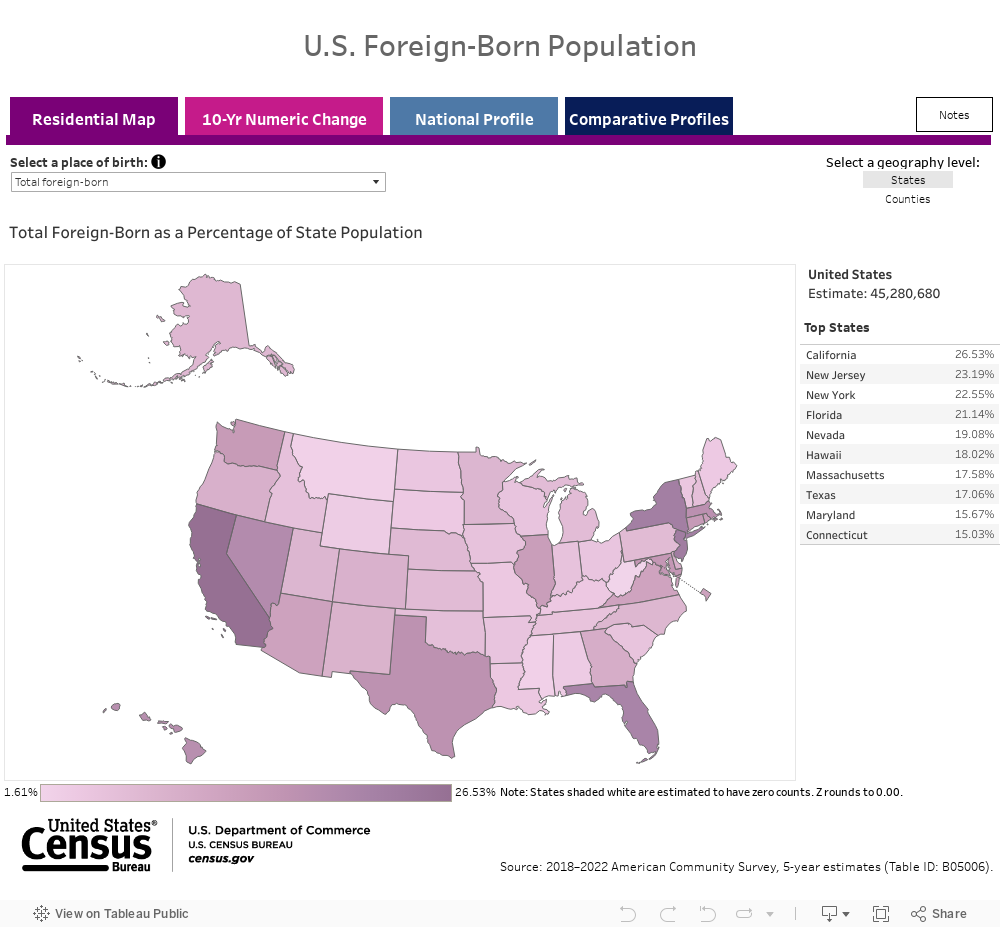
We compare estimates for the 2018-2022 period to the 5-year ACS period a decade earlier (2008-2012) when there were 39.8 million foreign-born people, or 12.9% of the population.
A new Census Bureau visualization explores where immigrants lived in the United States and how it changed between the two five-year periods at the national, state and county level.
It also features select indicators of socio-cultural and economic integration at the national level. Data users can look at the foreign-born population overall or select a specific place of birth, including regions (e.g., Africa), sub regions (e.g., Eastern Africa) and countries (e.g., Ethiopia).
The foreign-born population consists of anyone living in the United States who was not a U.S. citizen at birth, including naturalized U.S. citizens, lawful permanent residents (immigrants), temporary migrants such as foreign students, humanitarian migrants such as refugees and asylees, and unauthorized migrants. Estimates in the data visualization exclude those born at sea.
Highlights of the foreign-born population in 2018-2022 compared to 2008-2012:
• Immigrants made up over a fifth of the population in four states: California (26.5%), New Jersey (23.2%), New York (22.6%) and Florida (21.1%). Their numbers grew in all four states over the 10-year span.
• California, Florida, New Jersey and Texas had the largest increases, with Florida and Texas each gaining more than 850,000 foreign-born people.
• New Mexico was the only state whose foreign-born population decreased during that period.
Harris County, Texas, had the largest increase, followed by Miami-Dade County, Florida, and King County, Washington.
• The top 10 states where immigrants lived did not change, led by California, Texas and Florida in 2018-2022.
• Nine of the top 10 counties did not change, with Broward County, Florida, joining the group and Maricopa County, Arizona, leaving.
• Almost half (49.1%) of all immigrants in the United States entered the country before 2000.
More than half (52.3%) were naturalized U.S. citizens.
• Nearly a quarter of the foreign-born population 25 years and older had a bachelor’s (18.7%) or graduate or professional degree (14.9%), compared to 21.4% and 13.1% for the native-born population.
• An estimated 63.5% were employed, with over a third of the civilian employed foreign-born population (16 years and older) in management, business, science and arts occupations.
Joyce Hahn is a demographic statistician in the Foreign-Born Population Branch in the Census Bureau’s Population Division. Lauren Medina is chief of the Foreign-Born Population Branch in the Census Bureau’s Population Division.