 How to resolve AdBlock issue?
News
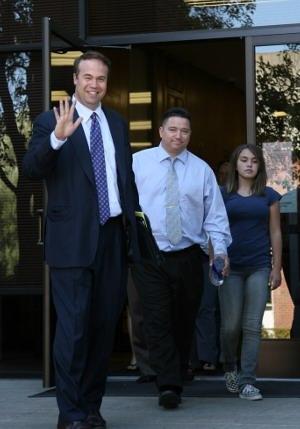
LAKEPORT – Following nearly an hour of legal instructions Wednesday morning, the judge in a fatal sailboat crash case handed it over to the jury, which will decide if a Carmichael man was responsible for the injuries suffered by a woman in a nighttime collision more than three years ago.
The prosecution and defense made their closing arguments in the trial of 41-year-old Bismarck Dinius on Tuesday. The trial has included 13 days of testimony and 51 witnesses, four of which were recalled to give additional or rebuttal testimony.
Now the case is in the hands of the jury, whose members are considering a felony count of boating under the influence causing great bodily injury to 51-year-old Lynn Thornton of Willows.
If they reject the felony, they would then consider two misdemeanor charges of boating with a blood alcohol level over 0.08 and boating while under the influence.
District Attorney Jon Hopkins alleges that Dinius – who was at the tiller of a sailboat owned by Thornton's boyfriend, Mark Weber, on the night of April 29, 2006 – was negligent in operating the boat without its navigation lights on Clear Lake. Dinius also is alleged to have had a blood alcohol level of 0.12.
The sailboat was hit from behind by a powerboat driven by Russell Perdock, an off-duty chief deputy with the Lake County Sheriff's Office. While an initial investigation report from a Sacramento County Sheriff's official found that Perdock broke safe speed rules – testimony has alleged he was going between 35 and 50 miles per hour – he was not charged.
But Perdock's speed and questions of proximate cause and responsibility have been key parts of the case, with defense attorney Victor Haltom arguing that Perdock's speed led to the crash.
Just after 9 a.m. Wednesday Judge J. Michael Byrne began reading the instructions to the jury. Byrne, Hopkins and Haltom had crafted the instructions, which laid out the laws which the jurors needed to consider in making their decision. A copy of the jury instructions were given to jurors to take with them into deliberations.
“You're going to get a lot of instructions at one time,” said Byrne, explaining that the law required him to read them the instructions in open court.
He began by telling the jury, “You must decide what the facts are. It is up to you, and you alone, to decide what happened.”
Jurors must follow the law even if they disagree with it, and must abide by the instructions over the statements made by the attorneys.
The attorneys' remarks and questions are not evidence, but testimony is, said Byrne. Testimony stricken during the trial must be disregarded. Stipulations – agreements to which both attorneys agree – may be accepted by true.
In weighing testimony, Byrne said jurors should consider how well witnesses could see or perceive things about which they testified and how well they could remember.
Witnesses' behavior also is important; were they influenced by bias or prejudice? Did they make previous statements that were, or were not, consistent with their testimony on the stand? If a witness deliberately lied on the stand, the jury should consider not believing anything that witness had to say, explained Byrne.
Jurors may compare witness qualifications and disregard all or any part of an opinion that they find unbelievable, unreasonable or unsupported by evidence, the judge said.
He went over the charges against Dinius, which stemmed from the allegation that he failed to show ordinary care and didn't fulfill his duty to exhibit side lights. Byrne said the jury can convict Dinius if the resulting injury – Thornton's – was a direct result of Dinius allegedly failing to show ordinary care and fulfill the duty.
If the jurors believes that the sailboat's lights were on at the time of the collision, they can't find Dinius guilty on the felony boating under the influence count, said Byrne.
“There may be more than one cause of injury,” said Byrne, and the failure to perform a legal duty causes an injury only if it's a substantial factor.
To find Dinius guilty, the jury must not only find him to have committed an act or failed to do the required act, but that he did do so with wrongful intent, said Bryne.
Byrne read through the navigational rules, which included a statement about the master of the vessel, who “holds his appointment at the pleasure of the owner.”
Any vessel overtaking another shall stay out of the way of the vessel it's overtaking, Byrne noted. “A power driven vessel shall keep out of the way of a sailing vessel.”
He said the law requires all vessels on inland waters to proceed at a safe speed at all times, and boats must take action to avoid collisions.
As he finished the instructions, Byrne told the jury to appoint a foreperson, keep open minds and freely exchange ideas as they tried to reach a verdict.
“Your role is to be an impartial judge of the facts, not to act as an advocate for one side or another,” he said, adding that the case must only be discussed in jury room when all jurors are present.
Exhibits would be sent into the jury room with the jury when they begin deliberations, said Byrne. “The verdict on each count must be unanimous.”
He added, “You must reach your verdict without any consideration of punishment.”
The nine-man, three-woman jury was then sent to begin deliberations, with one female alternate and one male alternate dismissed but placed on call if they were needed. Bailiff Dave Jones was then sworn in; he'll remain outside of deliberations but available to the jury to relay messages to the judge.
Deliberations continue through rest of day
Over the course of five hours, the jury deliberated on the case in a small jury room next to the Department One courtroom, which remained open and was inhabited by the bailiff, a court clerk and several members of the news media, who reported that they could heard loud talking, exclamations and partial sentences coming from the jury room.
Shortly before 3 p.m. the jury rang a buzzer attached to a white light over the jury room door. When Jones when to see what they needed, he was handed a piece of paper with questions on it. Judge Byrne came in, looked over the document and told Jones to call the attorneys.
When Hopkins arrived a few minutes later, he stated that he understood members of the media had reported about the sounds from the jury room and announced it was a misdemeanor for people to hear the jury deliberations. That's despite the fact that the people in the courtroom were in a public setting.
Haltom and Dinius returned to court shortly before 3:30 p.m. and court reconvened out of the presence of the jury, which had continued deliberating.
Byrne read the jury's questions: “Can we get written rules regarding navigation rules?”
They also wanted clarification on the definitions of “master” and “crew.”
Haltom wanted to give them the navigation rules under judicial notice.
He also suggested telling them that the master is the owner and the crew is composed of others on the boat. “That's clearly the opposite of what the law says,” replied Hopkins.
Hopkins said the Harbors and Navigation Code talks about operators, masters, mates and seamen, and a whole host of other concerns. “They even talk about what happens if pirates take over the ship,” said Hopkins.
Byrne pointed out that the rules don't go specifically into pleasure boats on lakes.
“My view of this is like the jury asking us, 'How deep is the lake at that point?'” said Hopkins.
“Let's honor their request and give them the rules,” said Haltom.
Hopkins said those rules were not in evidence but had been given as instructions. “We gave a substantial number of rules.”
As the judge was preparing to have the jury brought in, Hopkins complained that the noise strip on the jury room door wasn't working, and he suggested closing the courtroom to the public. “We've got people in here who can listen.”
Byrne said he would close the courtroom, which Haltom objected to, saying it was a violation of the Constitution. Hopkins replied it was a misdemeanor to hear the jury's deliberations.
The jury came in shortly after 3:30 p.m., at which time Byrne told them that the court wasn't exactly clear on their questions.
Regarding the jury's request about navigation rules, Byrne told them that what they have in their instructions are the rules.
The jury also wanted clarification on the master and crew. “That was the one that we were wondering about,” said the female foreperson.
“We gave you that rule and there's nothing else in there,” said Byrne.
He suggested the jury could write out more specific questions.
“I don't want to get into a dialogue. I've made mistakes trying to do that,” said Byrne, before sending the jury back in to deliberations.
Once the jury was back in its room, the judge suggested the attorneys wait a few minutes to see if more questions were forthcoming, but none emerged.
In the meantime, Haltom argued to the judge that closing the courtroom to the public would be a violation of the Sixth Amendment of the US Constitution – the right to a speedy and public trial – and would violate the California Constitution as well.
Byrne said he would open the courtroom again when the court went on the record. He said it's a balancing act between the public and the defendant's rights and the jury's right to privacy.
He also stated he could hear the noise of the jury from the next room.
The courtroom was then closed and the observers waited in the fourth floor hallway until the jurors asked to go home at 4 p.m. and were dismissed for the day.
Jurors will return at 9 a.m. Thursday to continue their deliberations.
E-mail Elizabeth Larson at
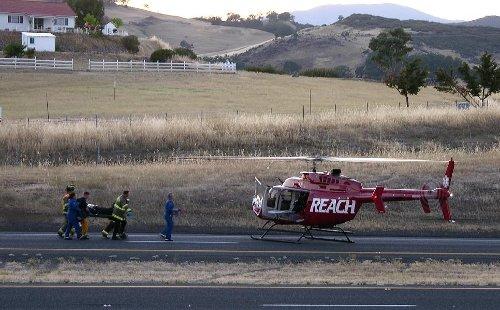
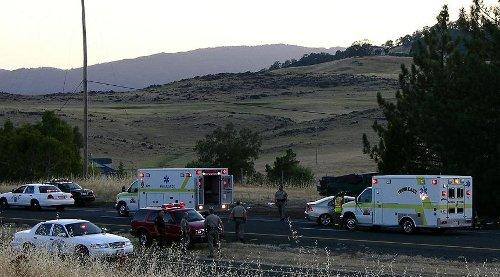
NORTH LAKEPORT – Three people were injured in an early evening crash that occurred in the North Lakeport area on Tuesday evening.
Larry Hammond, 38, of Clearlake Oaks, suffered major injuries in the crash, with 48-year-old Cynthia Olson of Reno, Nev., and Donald Ivan, 63, of San Andreas, both sustained moderate injuries, according to the California Highway Patrol.
At about 7 p.m. Tuesday Ivan was seated in his 1993 Chevrolet pickup on the right shoulder of the westbound of Highway 29, south of Whalen Way, awaiting a tow truck because he had a flat tire, the CHP reported.
The CHP said Olson was traveling southbound on Highway 29 when her 2008 Honda Civic struck the back of Ivan's pickup.
Lakeport Fire Protection District responded to the call, with Northshore Fire Protection District offering mutual aid.
Hammond, who was riding in the right front passenger seat of Olson's Civic, sustained major injuries and was transported by REACH air ambulance to Santa Rosa Memorial Hospital, as was Ivan, the CHP reported.
The CHP reported that Olson later was arrested for allegedly driving under the influence of alcohol and was released for medical treatment. She was transported to Sutter Lakeside Hospital by Lakeport Fire Protection District ambulance.
All of those involved in the crash were wearing their safety belts, the CHP reported.
E-mail Elizabeth Larson at
The EPA is putting out its engineering evaluation and cost analysis to clean up contaminated mine waste originally used in the 1970s to construct BIA 120, the primary access road to the Elem Indian Colony.
The mine waste, which originated from the Sulphur Bank Mercury Mine – now a federal Superfund site – is contaminated with unsafe levels of mercury, arsenic and antimony, officials reported.
This removal action is to ensure that Elem Indian Colony residents and their visitors are not exposed to the elevated levels of toxic metals that are present in the mine waste.
In 2006 the EPA carried out a cleanup on a portion of the colony, removing several older homes and replacing them with new ones, as Lake County News has reported.
In this latest proposed project, EPA’s preferred removal action alternative is “Alternative 2B,” which calls for reconstructing roadway and cover shoulders on BIA 120's entire length. It also calls for raising the roadway profile to prevent excavating mine waste.
Most of the work will not occur until June through August of 2010. Public comments are being accepted now and until Sept. 9.
Copies of the engineering evaluation and cost analysis and all supporting documents are located at the Lake County Library in Lakeport, Redbud Library in Clearlake, and the Live Oak Senior Center, located at 12502 Foothill Blvd. in Clearlake Oaks. The documents are available online at http://cleanlake.org/newsletters.html .
The public can send written comments postmarked no later than Sept. 9 to Rick Sugarek (SFD-7-2),
U.S. EPA, 75 Hawthorne Street, San Francisco, CA 94105.
For more information on this site, please contact Sugarek, remedial project manager, at 415-972-3151.
Dr. Dietrick McGinnis of McGinnis and Associates will review the documents on behalf of the Clear Lake Environmental Action Network (CLEAN) Superfund Technical Advisor Grant (TAG).
Family, friends and supporters looked on as Bismarck Dinius, 41, sat through the day-long arguments in Lake County Superior Court's Department One, with District Attorney Jon Hopkins and defense attorney Victor Haltom exchanging verbal barbs and challenging each other's conclusions.
On the evening of April 29, 2006, Dinius was steering the Beats Workin' II, a sailboat owned by Willows resident Mark Weber, when it was hit by a powerboat driven by Russell Perdock, an off-duty chief deputy sheriff.
Dinius is accused of felony boating under the influence with great bodily injury and two lesser included offenses of boating with a blood alcohol level over 0.08 and boating while under the influence.
Weber's girlfriend, 51-year-old Lynn Thornton, was injured and died three days later. Perdock was not charged, but Dinius is on trial because Hopkins alleges that Dinius was under the influence of alcohol and had a duty to see the boat's lights were on.
The defense has argued throughout the trial that Dinius was merely a crew member on Weber's boat, the lights for which were on until the collision knocked them out, Haltom argued.
In close to three hours of arguments on Tuesday, Hopkins hammered away on responsibility and proximate cause.
Haltom, whose closing arguments lasted just minutes short of an hour, offered a passionate summation to the jury, accusing the sheriff and district attorney's offices of bias, corruption and incompetence, and urging the jury to teach local officials a lesson by handing down a correct verdict, which would acquit his client.
Trial's last witnesses heard
Closing arguments got under way after Judge J. Michael Byrne denied a motion to release Perdock's personnel records as well as information from an internal affairs investigation, in which Perdock is facing a misconduct allegation.
That decision followed a brief hearing in which Perdock's attorney, Alison Berry Wilkinson, argued strenuously against the motion.
Before making the decision, Judge Byrne went into chambers with Deputy County Counsel Ryan Lambert, Capt. James Bauman of the Lake County Sheriff's Office, a court clerk and the court reporter. He emerged to say he found nothing discoverable for the purposes of Dinius' case.
Both Hopkins and Haltom called brief rebuttal witnesses, beginning with Hopkins presenting April Aalto, a registered nurse who worked on a REACH air ambulance the night of the crash.
Aalto said the helicopter was called to Konocti Harbor Resort & Spa on April 29, 2006, to pick up a patient for transport, but no ambulance arrived and they did not transport a patient.
That testimony contradicts a statement made by defense witness Dennis Olson, a former Konocti Harbor security employee who recalled an ambulance and a patient arriving at a landing zone he helped set up.
Aalto also noted that a flare used to light up the landing pad rolled down the hill and she was afraid it was going to start a fire. Olson said he and another employee had used sandbags to keep the flares weighed down.
The helicopter returned to its base at Lampson Field after leaving Konocti Harbor, said Aalto. Early on the morning of April 30, 2006, they were summoned to Sutter Lakeside Hospital where they picked up Thornton and transported her to David Medical Center.
Hopkins also called Tom Clements, a detective sergeant with the Clearlake Police Department who had previously retired from the agency and, for a time, was working as an investigator for the District Attorney's Office.
In April of 2007 Clements conducted two phone interviews with Brian Stole, a witness who said he saw the crash while standing on a grassy knoll at Bayview Estates.
Stole told Clements he heard Perdock's powerboat coming around Fraser Point, saw its red and green bow lights and estimated its speed at about 45 miles per hour.
In a subsequent interview Clements said Stole stated that he saw a white or yellow light and a green light on an object that he thought was a dock, which merged with the powerboat.
Initially Stole estimated the distance to the crash from shore was five to 10 miles; in the second interview he estimated 500 yards. Stole said he wasn't drinking alcohol when he saw the crash.
Haltom asked Clements if he told Stole the interview was being recorded, and Hopkins objected to the relevance. Byrne allowed Clements to answer. He said he didn't remember telling Stole that, but he usually informs interviewees of recordings.
Haltom asked Clements his relationship to Perdock. He said he's known him professionally during the 12 years he's worked for Clearlake Police. Clements said he's not a member of the local Masonic Lodge to which Perdock belongs.
Did Stole tell him that he estimated the powerboat's speed to be between 45 and 50? Haltom asked. “I remember him saying 45,” said Clements.
Haltom asked if Clements disputed that in the recording Stole also said 50. Clements said he doesn't know why he wouldn't have noted that had Stole said it.
Hopkins asked if Stole used the word “merge” to recall the lights coming together. “I don't recall,” said Clements.
Haltom asked if Stole said the lights “came together.” Clement said yes.
The final rebuttal witness was Jean Strak, who had testified earlier in the trial to seeing the sailboat leave Richmond Park Bar & Grill with its lights on. She also stated a sheriff's deputy came to her tanning salon on Soda Bay Road to interview her, but no report about her interview was ever filed, according to Hopkins.
Haltom asked if she was interviewed by deputies about two separate incidents? Yes, said Strak. In addition to the boat crash, she was interviewed about a bar fight during which she was assaulted by a male subject at Richmond Park in May of 2006.
Hopkins asked her when she was interviewed about the bar fight. She said it was around midnight at the bar. “I was in the wrong place at the wrong time and a guy hit me.”
How many deputies talked to her? Hopkins asked. She didn't know. He asked if three deputies spoke to her. She said she didn't know, she had been hit in the face, was bleeding and not paying attention. Had she been drinking that night? “I had a couple,” she said.
Strak said she later received four or five phone calls from deputies about the fight. For a time in May of 2006 she was in Mexico on vacation and when she got back was contacted by deputies again.
An insurance investigator also called her about the boat crash, said Strak, and she also spoke to a deputy about it. “I heard nothing else ever again until two months ago.”
She said her friend Julie Knight was at her salon at one point and talked to an investigator.
During a brief break between the final rebuttal witnesses and the beginning of closing arguments, Haltom attempted to enter a piece of evidence which Hopkins objected to due to foundation, and Byrne sustained it.
Haltom also renewed his motion to have Dinius acquitted from the charges based on the question of whether he had a duty to turn on the lights. Byrne denied the motion.
Hopkins questions experts as he presents final arguments
Hopkins presented his closing arguments over an hour and 15 minutes in the morning session.
He began by talking about jurors' obligations and the prosecution's burden to prove the case beyond a reasonable doubt.
“That is not a standard that is legal mumbo jumbo,” Hopkins said of the reasonable doubt concept. “It's really one that can translate into everyday life.”
He told the jurors that they must have an abiding conviction that the charges are true, but they don't have to eliminate all doubt, since everything in life is open to some degree of doubt.
In convicting Dinius Hopkins said he must prove that Dinius operated the vessel, that he operated it under the influence of an alcoholic beverage, that he neglected the performance of a legal duty – in this case, having the lights on – and that his failure to perform his duty led to bodily injury.
Those four elements “all kind of fit almost in a ladder – one leads to the next. All four must be proven,” Hopkins said.
He said they have heard testimony from several people that Dinius was operating the boat. He recalled Jim Ziebell's testimony, which included an account of being the helmsman on Weber's sailboat during the Konocti Cup earlier on the day of the crash.
“Steering the sailboat is not just a simple task,” said Hopkins, noting there are complexities, including considering the wind and sails.
Ed Dominguez and Zina Dotti, who were on the sailboat that night, stated Dinius was at the tiller, while Weber was sitting on a step facing them and away from the front of the boat. Dinius himself said he occasionally stood up to see over the cabin and was watching the wind indicator, said Hopkins.
Witnesses also had described Dinius as drinking, and Dinius also said he was, said Hopkins. Three hours after the collision he still had a blood alcohol level of 0.12, one and a half times the legal limit, which meant that additional alcohol had been in his system at the time of the crash, he said.
On the issue of what Dinius had to drink, Hopkins said, “The exact number is not important. What's important is he was above a .08, and that makes him under the influence.”
A sober person would be aware of all conditions on lake around them, said Hopkins. Dinius had a responsibility to exhibit the sailboat's lights, just as a person who got into another person's car would have a responsibility to turn on the lights when driving.
Dinius should not have taken the tiller while impaired, and he should have checked the lights, said Hopkins, suggesting that Dinius could have turned around and leaned over from his position at the tiller to see if the stern light was on.
“He's using this vehicle, he's required to make sure he does not neglect the duties put upon him by law,” Hopkins said. “The issue then goes next to whether lights on sailboat were off or on.”
Different people saw the boat's lights when it went out. “It is clear that some kind of light was on,” said Hopkins.
However, they didn't see the crash and no witnesses saw the sailboat past Little Tule Point, about halfway up the shore of Konocti Bay, with lights on, he said.
Dominguez, Dotti and Dinius didn't recall the stern light, but they did remember the cabin lights, said Hopkins. Only Weber, who testified to saying, “We've got lights, let's go,” claimed to have seen them, but no one testified to hearing Weber make that statement. Hopkins also pointed to discrepancies in whether or not they sailed out or motored out, an issue which may be a matter of intoxication or focus of witnesses.
Two hours after the crash, Weber had a blood alcohol level of 0.18, added Hopkins, suggesting Weber may have knocked the running lights switch off when he went down into the cabin in his inebriated state.
Weber later would call Dinius and ask if the lights were on, Hopkins noted.
“People do go out on the lake at night and turn off their lights,” especially if it's a pleasure cruise and they think that no one else is out there. Perhaps the famous Lake County gnats were getting into the wine glasses, Hopkins suggested.
Perdock and James and Jordin Walker don't see the sailboat lights, neither did witnesses on shore who heard and saw the powerboat, Hopkins said. Two fishermen, Colin Johnson and Anthony Esposti, saw a sailboat without lights, and heard laughing and talking, as did teenager Jennifer Patterson, who was watching from shore.
“It's crucial that a vessel be lighted appropriately so everyone knows what everyone else is doing,” he said.
Hans Peter Elmer, a retired policeman who saw the crash from the Young Scandinavians Club, thought the boat was going fast because he saw it on a 45-degree angle, but Hopkins said others saw the boat leveled out and on plane. “He thought it was going really fast because of its noise.”
Elmer and the fishermen all saw Perdock's boat because of the running lights. "It was a very dark night but it was clear,” said Hopkins.
They also saw the powerboat collide with something that wasn't lit, he said.
Stole, who saw the boats lights merge before the collision, was “a little confused,” said Hopkins, who suggested that Stole really saw the lights of the fishing boat carrying Esposti and Johnson, not the sailboat's lights.
Hopkins pointed out that Stole did not say he saw that crash. “There is not a reliable witness that saw the sailboat lights on at the time of the collision.”
Doug Jones was the last person to see the sailboat with lights as it went past Little Tule Point. Hopkins said most of the witnesses testified to seeing the cabin lights on, but those don't justify the legal requirement for lighting.
Hopkins faulted defense expert Dr. William Chilcott, who had criticized Department of Justice criminalist Toby Baxter's work on the sailboat light filaments. Hopkins said Chilcott, in his written report on the case, never suggested that a stretch in the filaments was due to a manufacturing process. Rather, Chilcott said it was due to the lights being on.
Chilcott also didn't trace pulled out wires on the sailboat to the stern light, which is where he stated they went, said Hopkins.
“Dr. Chilcott was clearly not objective in this case,” said Hopkins. “He clearly had a bias.”
There also isn't support for Chilcott's theory about the wires being pulled out, causing the lights to go out, argued Hopkins. “It doesn't really matter how famous he is” if he doesn't have the facts, Hopkins said of Chilcott.
Hopkins said that Dinius had a duty to exhibit the boat's lights. “But for the lights being off, this collision does not occur, so it's a direct result,” he said.
Is it likely someone will run into you if the lights aren't on? “The answer is of course, there's no question about it,” said Hopkins, explaining that it's totally forseeable that a power boat will run into another unlighted boat.
“If there is more than one cause, then Mr. Dinius' failure to have lights on has to be a substantial factor,” said Hopkins, noting there can be several causes.
Are there other negligent people involved? Hopkins asked. “It doesn't matter,” he said, answering his own question.
Perdock and Weber both can be negligent but Dinius' alleged negligence is the substantial factor, he said.
Defense: Wrong man on trial
Hopkins rested at the end of the morning session, with Haltom beginning his closing arguments after lunch.
“This case is, more than anything else, a tragedy,” Haltom began.
He asserted that Hopkins “has turned this into a travesty” by prosecuting the wrong man – Dinius – while Perdock was not charged.
Haltom said he would present evidence of rampant corruption, bias and incompetence in the upper echelons of the county's sheriff's and district attorney's offices.
Using a PowerPoint presentation, one of his screens had the words “Russell Perdock is a liar” in large, bold white letters.
Haltom said the jury could help people in the sheriff's and district attorney's offices learn the difference between right and wrong by acquitting Dinius.
He said the issue of bias was obvious. Perdock, the No. 2 man in the Lake County Sheriff's Office, could affect the promotions and pay of his subordinates.
“He was treated with kid gloves from the get go,” said Haltom, noting that Sheriff Rod Mitchell hugged Perdock at the crash scene. He also alleged that mention of the sheriff's presence at the scene later was removed from reports.
He referred to former sheriff's Sgt. James Beland's testimony that he was ordered at the scene not to give a breath test, and cited the Masonic Lodge membership shared by John Flynn, one of Hopkins' investigators, and Perdock.
Haltom said Dinius is a good man who should not be on trial, but that it's Perdock who should be prosecuted.
In giving examples of corruption, Haltom said the sheriff's office failed to report contacts with witnesses who saw the sailboat's lights on, specifically Jones and Strak.
He also raised the issue of Perdock having access to evidence facilities where his blood sample and the boats were kept. Haltom said the prosecution provided no evidence about where Perdock was the day after the crash – a Sunday – during which there was a 16-hour interval that he had access to the blood sample. He said Perdock has stated that he was home at the time.
“He has absolutely no credibility in this case,” Haltom said, explaining to jurors that the judge will give them instructions on discounting testimony of witnesses who don't give credible statements.
“He lied to you all, from that stand, about going to Konocti (Harbor),” Haltom said.
Perdock wasn't walled off from the investigation, said Haltom. He received an October 2006 e-mail from a sheriff's office employee that included copies of the 911 records. Richard Higinbotham, a former Lake County District Attorney's Office investigator, testified that in September 2008 he interviewed Perdock, who Haltom said “wanted to have a say in what was going on in this investigation.”
On the stand Perdock denied talking about speed and lights with Higinbotham, who Haltom said impeached that testimony point by point.
“We're not playing nice here, this is hard ball,” said Haltom.
He charged local officials with incompetence in carrying out their investigation.
Boat Patrol Supervisor Sgt. Dennis Ostini admitted his mistakes in leaving the sailboat unattended for several hours at the Boat Patrol facility, said Haltom. “That's a critical item of evidence in this case,” he said. “It was tainted from the get go.”
Then-Sgt. Charles Slabaugh from the Sacramento County Sheriff's Office was brought into the investigation. “Did you hear anything about the result of Lt. Slabaugh's accident reconstruction investigation? You heard zip,” said Haltom. “You ought to ask yourselves why.”
Slabaugh didn't conduct interviews, only speaking with Perdock and Elmer, Haltom said.
With the exception of retired engineer Richard Snyder, Haltom said all of the prosecution's experts were either incompetent or unfamiliar with sailing. One of them, state Department of Justice criminalist Gregory Priebe, admitted to having sunk a sailboat. Still others who testified about electricity couldn't explain the difference between direct current and alternating current.
“That is the essence of incompetence,” Haltom said.
But the maddening part of the case, said Haltom, is that investigations into the allegations against Dinius were still going on during the trial – three years after the crash – with the evidence's integrity damaged by the length of time.
Going point by point, Haltom accused Perdock of lying about everything from fixing his son breakfast on the day of the crash to not telling the truth about going to Konocti Harbor, where Haltom alleged he was drinking.
Haltom said he presented several witnesses that placed Perdock at the resort in the hours before the crash, including John Jansen, who testified to seeing Perdock at the resort and racing boats with him later. Haltom said Jansen's statements linked other witness testimony, and also revealed, in Haltom's opinion, another motivation for Perdock to drive fast that night, after being “blown away” by Jansen's boat.
While Perdock denied reviewing official sheriff's reports, Haltom said Sgt. Dave Garzoli testified to finding Perdock's initials in the main report's audit trail. Haltom also accused Perdock of lying about seeing the green glow of his bow light off the sailboat before the collision. At the angle he was approaching, the bow light reflection would have been red.
“He's got so many lies going he can't keep them all straight,” Haltom said.
Quoting a US Supreme Court Case, Duncan v. Louisiana, Haltom explained the importance of juries. That 1968 decision guaranteed the right to trial by jury in order to avoid government oppression and address fears of unchecked power. “That's why you all are here.”
It was Perdock who broke numerous navigational rules, said Haltom, from failing to have a lookout to traveling a safe speed.
Addressing the charges against Dinius, Haltom told the jury there's a very simple way to decide the case: “If you find the lights were on, you acquit – that's it.” They must ask themselves if Hopkins proved beyond a reasonable doubt that the lights weren't on, which Haltom suggested he hadn't done.
Haltom challenged Hopkins' assertion that Stole saw the lights of the fishing boat and not the sailboat when he saw the crash, and called Hopkins' suggestion that Weber could have hit the lights in the cabin and turned them off as an “Alice in Wonderland, chasing the white rabbit theory.”
While Haltom said Dinius was drinking that night, he said Dinius' sobriety had nothing to do with the crash, which he attributed to Perdock driving at “an absurd speed.”
Haltom said Dinius also was innocent of the lesser charges of boating under the influence and boating under the influence with a blood alcohol level above 0.08.
Haltom told the jurors that they get to decide between what's right and what's wrong in the case.
“Russell Perdock needs to learn that he doesn't own Clear Lake and he cannot escape responsibility for taking Lynn Thornton's life,” said Haltom, adding that Perdock isn't above the law because he has a badge, and that Dinius is the patsy in the case.
“Lynn Thornton deserves a just result in this case,” he said.
District attorney attacks “sales pitch” defense
As he began his rebuttal arguments, Hopkins told the jury, “I feel like I've been through an advertising pitch.”
Throughout his rebuttal statements, which included a point by point response to Haltom, Hopkins would liken Haltom's arguments to taglines and advertising jargon.
He questioned how he could prosecute Perdock on the accusations Haltom made.
“There's this huge allegation that there's bias, corruption, incompetence, liars, the wrong man on trial and therefore throw this whole thing out,” said Hopkins.
He denied the sheriff's hugging Perdock was a sign of bias. Hopkins reminded the jury of the tragic circumstances that night. He said they knew someone was dying as a result of the crash.
Addressing the allegations about Beland and the breath testing, Hopkins said, “As a prosecutor I wish all three of them ” – Dinius, Weber and Perdock – “had been immediately tested.”
Perdock wasn't given a pass, said Hopkins. When Hopkins' investigator, John Flynn, interviewed Perdock in May, “it was downright confrontational,” with Flynn challenging Perdock's time line for April 29, 2006.
The community is a small one, said Hopkins, with many people belonging to the same clubs – such as the Masons, to which both Perdock and Flynn belong – and churches, but that doesn't amount to bias.
Perdock may have had keys to the evidence facility, but based on the testimony of state Department of Justice criminalists, who testified about how they opened the blood evidence, there is no signs of tampering, said Hopkins. “The whole thing is absurd.”
Hopkins challenged Haltom's witnesses, including Joe Glebe, Konocti Harbor's security director, who at first didn't remember seeing Perdock at Konocti Harbor before testifying that he did, and Peter Erickson, who said he heard Perdock at the scene talking about having a soda at Konocti Harbor before heading to Richmond Park. “He's soda hopping? That doesn't make a whole lot of sense,” Hopkins said.
Erickson was angry in his testimony, and “angry at a number of things,” said Hopkins. “He's a biased witness.”
As to the value of Jansen's testimony, Hopkins said his statements contradict those given by Donna Perdock, Russell Perdock's ex-wife, and Olson. He suggested Jansen was listening to his buddies popping off about racing Perdock and decided to make up his own story to get on television.
Hopkins suggested that if two boats are in a collision, they both have an obligation, which raised an objection from Halton. Byrne said he would allow the comment but not for theory.
Hopkins spent time questioning Stole's testimony, reiterating his belief that Stole saw the fishing boat's lights, not those of the sailboat. Hopkins questioned if he could rest a prosecution on Stole's testimony.
Dinius had an obligation under law to exhibit side and stern lights, said Hopkins. “He never checks at all,” despite sitting next to it. Hopkins objected, saying Hopkins was misstating the evidence. Byrne overruled.
Despite his statement that he was down in the cabin, Weber was found knocked out on the sailboat's deck, which led Hopkins to argue that Weber's recollection of that night went away due to his injuries.
Esposti and Johnson came across an unlighted sailboat, saw a mast but not a sail. “There's no other sailboat out there,” Hopkins said. “There's certainly no other sailboat without its lights on.”
Hopkins noted that he was getting to the end of his notes, when one man said “Good!” loudly from the audience.
Based on an estimate from Snyder, Hopkins said Perdock's powerboat was going between 37 and 48 miles per hour, which launched it up and over the sailboat.
Snyder's studies on crashes found that at 20 miles per hour a powerboat would ramp up and slam down onto another boat and stay there. Even at 20 miles per hour there might have been more injuries and deaths, Hopkins suggested.
Whose fault is it if the lights go out? The operator's, said Hopkins.
“This safe speed thing” has been talked about as a rule, and Hopkins said it's similar to getting into a car. If you run into someone you're not going a safe speed, unless you come upon a drunk driver driving slowly on a blind curve with their lights off.
Hopkins told jurors they can't use sympathy for Lynn Thornton to decide the case. “You're supposed to look at the evidence.”
Jury to begin deliberations Wednesday
At the conclusion of closing arguments, Byrne told the jurors he would give them the instructions Wednesday morning, when they return at 9 a.m. He credited them with paying attention during the case.
After the jurors were gone Byrne praised both the defense and prosecution for their work, saying they'd both acted professionally.
“I think it was a well-tried case,” said Byrne.
“I take it you haven't made up your mind yet,” said Hopkins, which hearkened to Byrne's admonishment to the jury to keep open mind.
“Nobody asked me about my opinions,” Byrne said with a smile.
E-mail Elizabeth Larson at
Dr. Karen Tait said Lake County had a second reported case of H1N1, the pandemic strain of Novel Influenza A – previously known as “swine influenza” – in the last few weeks, and she's expecting the local number of cases to increase over the coming week.
The first local case, reported late in June, was an outpatient, but since then the state and the federal Centers for Disease Control have changed reporting guidelines for the virus, limiting the formal count to hospitalized cases and deaths, Tait said.
Outside of those officially reported cases, Tait said there have been several other local outpatient cases that Public Health found out about, but which health care providers no longer are required to report to the agency.
She said the CDC changed the reporting requirements for a few reasons, one of them being that they're attempting to focus on the more serious cases, which provides more meaningful data and helps them prioritize the groups they'll vaccinate.
The California Department of Health on Monday reported that there have been 1,057 hospitalizations and 104 fatalities for H1N1 in the state. Nationwide, there have been 7,511 hospitalizations and 477 deaths, according to the CDC.
In its severity, the H1N1 virus has resembled the seasonal flu, said Tait. However, its severe cases have tended to target children and young adults, whereas she said seasonal influenza tends to be more problematic for older adults and very young children.
H1N1 also has been problematic for pregnant women. Tait said a disproportionate numbers of cases have been found among pregnant women; approximately one-third of California women of child-bearing age hospitalized for H1N1 have been pregnant.
One of the local cases Tait heard of involved a pregnant woman diagnosed with H1N1. “Fortunately she never required admission to the hospital, so we lucked out there,” Tait said.
Both forms of influenza can cause severe illness in people of any age with chronic medical conditions, she said.
Another possible risk factor Tait mentioned is obesity. “That hasn't really been definitely listed as a risk factor but there's some significant obesity in patients who have been hospitalized or died throughout the states, and so they're looking at that as a possible risk factor.”
Tait said she's expecting more cases of H1N1 to show up this fall, at about the same time as the normal seasonal flu begins to make its rounds.
Tait said it will be important than ever this year to avoid getting the flu and to get immunized for both flu strains as soon as vaccines become available.
She said there will be two separate influenza vaccines – one for the usual seasonal influenza strains and one for H1N1.
The seasonal flu vaccine is expected to arrive earlier this year, with inoculations or a nasal spray application to become available later this month or in September, Tait said.
She said the seasonal flu vaccine is especially important for adults 50 and older; children aged 6 months up to their 19th birthday; pregnant women; nursing home residents; health care workers; individuals with a chronic health condition; people who live with or care for an adult over 50, a children under 5 or anyone with a chronic health condition.
The H1N1 vaccine currently is in development and is anticipated to be ready by October, said Tait. Supplies of the vaccine are expected to be limited.
Tait said Public Health will follow federal guidelines from the Centers for Disease Control in recommending who should be vaccinated earliest, with the focus likely to be on children, pregnant women, health care workers (including emergency medical responders), children and adults under
age 65 with certain chronic medical problems, and parents/caretakers of people at high risk of complications or children under 6 months of age.
When supplies of the vaccine are more readily available, it will be recommended for everyone over 6 months of age, said Tait. Vaccination against H1N1 likely will require two doses approximately one month apart for all age groups.
While Public Health gears up to do some vaccinating, Tait said the agency will be working with several local pharmacies, which also will be offering vaccinations. She said they've had the legal ability to do so for some time. That will help get the vaccines out to more people.
“We are so small ourselves that we are really going to depend on the medical community to help us with this,” Tait said.
Health officials continue to urge simply precautions, including regular hand washing and covering coughs and sneezes, to help prevent spread of either type of influenza. As well, people who are sick with influenza symptoms should stay home from work or school, generally for one week after
the onset of illness or until fever-free for 24 hours, whichever is longer. Healthy people experiencing mild illness can be treated at home.
Tait said those who have chronic medical conditions, are under age five, are pregnant or are experiencing shortness of breath or other severe symptoms should consult a health provider early when
ill with influenza-like illness. Symptoms include fever of 100 degrees or higher, sore throat and/or cough.
For more information contact Lake County Public Health, 707-263-1090, or visit the California Department of Public Health online at www.cdph.ca.gov/HealthInfo/discond/Pages/Influenza(Flu).aspx or www.cdph.ca.gov/HealthInfo/discond/Pages/SwineInfluenza.aspx .
E-mail Elizabeth Larson at
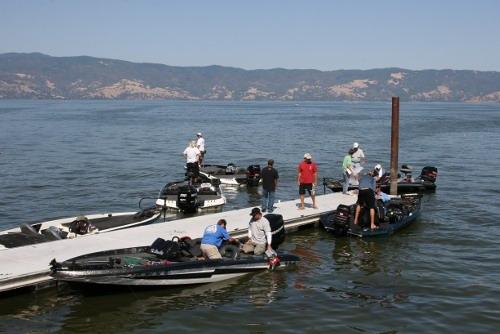
LAKEPORT – The WON summer series of bass fishing competition returned to Clear Lake Saturday for a one-day tournament.
The winning team for the weekend event brought in more than 24 pounds of bass.
Twenty-six boats, each floating two amateur or semi professional bass fishermen, pushed off from the Skylark Motel in Lakeport Saturday morning.
For the competition all anglers were limited to the frog lure, a rubber lure that really does look like a 2- to 3-inch-long frog.
Tournament rules are very specific and tournament officials inspected each boat. All containers and built-in cavities in the competitors' bass boats were inspected before they were allowed to push away from the docks.
Tournament director Bret Smith indicated that none of the tournament rules had been violated and all the boats left the docks with a clean slate.
Six hours later the boats began their well-timed and well coordinated return to the Skylark docks.
Boat after boat approached the floating docks. One at a time, contestants leaped from their boats with two or three heavy water filled sacks of thrashing fish.
Other boats approached and waited 200 or more feet off shore waiting for their opportunity to drop their cargo.
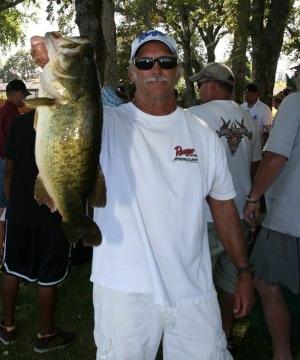
The day's winning team was Dave Erwin and Jim Stich, whose fish weighed 24.04 pounds. Second place went to Rob Bass and Mike Turner, with 22 pounds.
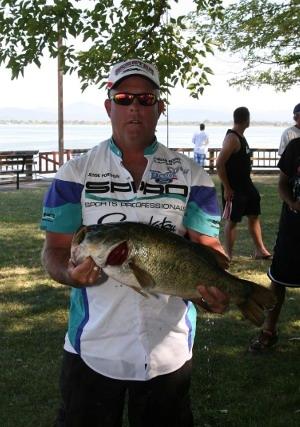
Jesse Forthun of San Diego had the day's big fish, weighing in at 9.02 pounds. He placed fifth overall.
The series is run by the Western Outdoor News Bass organization. Unlike purely professional or pro-am tournament competition each boat had to pay there own way to participate. No corporate sponsorship for entry fees or travel expenses is allowed.
E-mail Harold LaBonte at
Education
Health
Business
Obituaries
Veterans
Recreation
Religion
Arts & Life
Government & Politics