How to resolve AdBlock issue?
News
The exercise will take place from 6 p.m. to 9 p.m. Thursday, Aug. 27. Smoke will be visible throughout the entire Ukiah and Redwood Valley areas.
The training burn's purpose is to assist the US Army Corps of Engineers in removing the vegetation from the face of the Lake Mendocino Dam, allowing access and visibility for the required earthquake inspection.
In addition, the exercise will be used to train and enhance the skills of local firefighters during live fire exercises.
Personnel from the Ukiah Valley Fire District, Ukiah City Fire Department, Hopland Fire Department, Redwood Valley/Calpella Fire Department and the Potter Valley Fire Department will take part.
Spectators are welcome to come and watch the fire agencies at work but are requested to park in the fish hatchery parking lot near the base of the dam. Spectators also are reminded to drive very carefully while in the area as there may be many other cars and pedestrians.
The training burn will be conducted under very tight restrictions for the personal safety of firefighters and area residents.
If there are any indications that the training burn cannot be conducted in a safe manner, such as if there are high winds or local fire activity, the training exercise will be canceled. Cal Fire said the safety of all residents is the agency's utmost concern.
But the federal defenders assigned to Upper Lake resident Tom Carter's case said in court documents filed this week that the complaint against him is “sadly deficient” and offers little in the way of information about his alleged involvement in a May marijuana deal arranged by an informant.
Dozens of Drug Enforcement Administration (DEA) agents armed with assault rifles and driving more than two dozen black Cadillac Escalades descended on the Hunter Point Road home Carter shares with wife, Jamie Ceridono, on Tuesday just before 7:30 a.m., Ceridono said Friday.
Ceridono said she counted four helicopters flying overhead at one point during the operation.
Later that day, Brett Bassignani, Carter's co-defendant in the case, was arrested at his Clover Valley Road home, Ceridono said. Also arrested was a neighbor, Scott Feil.
“I don't know the charges,” said Ceridono. “I don't know what's going on. No one has told me.”
Ceridono said her husband is being held at a jail facility in the Oakland area. Initially, after the arrest, she said he was taken to Sonoma County and was checked by medical personnel after his blood pressure shot up, causing her to believe he was having a heart attack.
“I don't know what he could have done to cause this,” she said, noting that her husband has worked hard all of his life, donated time to community causes and done fundraisers, as well as introducing the recent Rainbow Bridge Festival.
She said she saw a sheriff's official and another man who she believed was a local policeman on scene. Capt. James Bauman of the Lake County Sheriff's Office said the agency wasn't involved in the DEA operation earlier this week.
DEA spokesperson Casey McEnry would offer little information about the raid.
“I can confirm the enforcement operation; however, the search warrants remain under court seal and I am prohibited from providing further details relating to the operation. I don't anticipate the warrants being unsealed anytime soon,” McEnry said in an e-mail response to Lake County News' inquiry about Carter's arrest.
When pressed on the circumstances of Carter's arrest, McEnry referred Lake County News to the US Attorney's Office in San Francisco. Repeated attempts to contact a spokesperson at that agency Friday afternoon were unsuccessful.
Carter, who was arraigned Wednesday, is facing two felony counts of conspiracy and possession with the intent to distribute under the federal Controlled Substance Act.
At his hearing, the US Attorney's Office requested that he be detained “on the basis of flight risk and danger to the community,” according to federal court documents obtained by Lake County News.
A detention hearing is set for Wednesday, Aug. 26, in San Francisco before US Magistrate Judge Bernard Zimmerman.
Ceridono said she was held in a chair in her front yard from about 7:30 a.m. to 3 p.m. on Tuesday. Also held were members of her husband's construction crew. Her teenage daughter was allowed to leave with her older daughter during the operation.
Officials took 154 marijuana plants that Ceridono said were covered by medical marijuana prescriptions held by her husband and several others. Also taken was her computer.
Agents went through Carter's and Ceridono's home, but she said they didn't trash it. She said a head agent seemed surprised not to find more plants or evidence.
Ceridono said at one point agents “didn't have anything to do.”
“They were playing with my dogs, they were so bored,” she said.
She said her husband, whose hard physical labor has resulted in a lot of aches and pains, also suffered a fracture in his back in May when he rolled his truck, and uses medical marijuana to deal with pain. Ceridono said she doesn't use the drug.
Federal court documents show that the US Attorney's Office requested on Aug. 14 – four days before Carter's arrest – that documents filed against him in the United States District Court for the Northern District of California be sealed, which US Magistrate Judge Maria-Elena James agreed to do the same day.
On Wednesday, US Magistrate Judge Bernard Zimmerman signed an order to unseal the documents at the request of Assistant US Attorney Tarek Helou.
On Thursday, federal defenders Barry J. Portman and Geoffrey A. Hansen filed a 26-page pre-trial memorandum regarding Carter's detention to dismiss the case, citing “sadly deficient” evidence.
The document explains that a confidential informant claimed to have arranged to purchase marijuana from Carter, leaving a message on an unspecified number alleged to be Carter's voice mail to set up the deal. That same informant allegedly made a purchase deal with Bassignani.
Carter's federal defenders said the case against Carter contains no claim that he got the phone message the number that the informant allegedly called and its relationship to Carter also isn't set out in the complaint against him, they noted. Feil''s arrest wasn't listed in the documents.
“All the complaint says is that another individual, Mr. Bassignani, called the informant, claimed he worked for 'Carter Construction,' and arranged a marijuana deal,” Carter's defense attorneys state.
The document continues, “The deal later took place, and the only other reference to Mr. Carter is the conclusory claim that the informant 'had agreed on the price with Carter.' No context, no specifics, and no other information is provided in the complaint which indicates that Mr. Carter in fact talked to the informant, arranged a marijuana deal, and indicated that he (Carter) was knowingly involved in a marijuana transaction.”
The attorneys added, “This complaint is sadly deficient with regard to whether Mr. Carter has done anything to indicate that he conspired to break the law. It should be dismissed accordingly.”
Carter's counsel also is seeking to receive copies of any evidence that may have been collected by wiretap.
Ceridono said she and a group of friends and supporters are planning to travel to San Francisco next Wednesday for her husband's hearing in federal court.
In the wake of the raid, Ceridono said she feels like she's living in another country. “I don't feel like I'm in California at all.”
E-mail Elizabeth Larson at
The state Employment Development Department (EDD) released its July unemployment report on Friday.
The report shows that Lake County's unemployment was 15.4 percent for July, down from 15.7 percent in June, but up from 10.4 percent in July of 2008, according to EDD statistics. In all, there were 3,950 people not employed in the county in July.
The EDD listed unemployment rates for communities around Lake County. By percentage, Clearlake Oaks has the most unemployed, with 22.7 percent, followed by Nice, with 21.6 percent.
The area with the largest number of unemployed – 970 – is the city of Clearlake, with 21.3 percent unemployment.
The lowest unemployment was in Upper Lake, at 6.2 percent.
Other areas ranked included Middletown, 18.8 percent; Lucerne, 16.1 percent; Kelseyville, 15.1 percent; Lakeport, 13.9 percent; North Lakeport, 13.5 percent; Cobb, 12.7 percent; Hidden Valley Lake, 12.4 percent; and Lower Lake, 12.2. percent.
California’s unemployment rate was 11.9 percent in July, up from 11.6 percent in June and over the July 2008 unemployment rate of 7.3 percent. Those numbers are derived from a federal survey of 5,500 California households.
Nationwide, unemployment decreased in July to 9.4 percent, down slightly from 9.5 percent in June, according to the US Bureau of Labor Statistics.
Lake's unemployment rate ranked it No. 47 in the state. Marin had the lowest rate at 8.2 percent.
Neighboring counties ranked as follows: Colusa, 16.4 percent, No. 52; Glenn, 15.9 percent, No. 49; Mendocino, 10.6 percent, No. 13; Napa, 8.8 percent, No. 3; Sonoma, 10.3 percent, No. 11; Yolo, 11.2 percent, No. 19.
The EDD reported that in July in California nonfarm payroll jobs declined by 35,800. Nonfarm jobs in California totaled 14,249,600 in July, a decrease of 35,800 over the month, according to a survey of businesses that is larger and less variable statistically.
The survey of 42,000 California businesses measures jobs in the economy, the EDD reported. The year-over-year change (July 2008 to July 2009) shows a decrease of 760,200 jobs (down 5.1 percent).
The federal survey of households, done with a smaller sample than the survey of employers, shows a decrease in the number of employed people. It estimates the number of Californians holding jobs in July was 16,260,000, a decrease of 87,000 from June, and down 798,000 from the employment total in July of last year, the agency reported.
The number of people unemployed in California was 2,187,000 – up by 33,000 over the month, and up by 840,000 compared with July of last year.
EDD’s report on payroll employment – wage and salary jobs – in the nonfarm industries of California totaled 14,249,600 in July, a net loss of 35,800 jobs since the June survey. EDD officials reported that this followed a loss of 66,100 jobs (as revised) in June.
Categories adding jobs over the month were professional and business services and leisure and hospitality, with 2,900 jobs added.
Eight categories – construction; manufacturing; trade, transportation and utilities; information; financial activities; educational and health services; other services; and government – reported job declines in July month, down 38,700 jobs.
Trade, transportation and utilities posted the largest decline over the month, down by 15,900 jobs, while one category, natural resources and mining, reported no change.
In a year-over-year comparison (July 2008 to July 2009), nonfarm payroll employment in California decreased by 760,200 jobs (down 5.1 percent). One industry division, educational and health services, posted job gains over the year, adding 17,900 jobs (a 1.0 percent increase).
The EDD reported that 10 categories – natural resources and mining; construction; manufacturing; trade, transportation and utilities; information; financial activities; professional and business services; leisure and hospitality; other services; and government – posted job declines over the year, down 778,100 jobs.
The largest decline on a numerical basis was in trade, transportation and utilities, which was down by 196,600 jobs, a decline of 6.9 percent. On a percentage basis, construction posted the largest decline, down by 18.6 percent – a decrease of 144,500 jobs.
During the EDD's July survey week, 812,165 people received regular unemployment insurance benefits, down from 820,387 in June and up from 480,226 in July of last year.
In July new claims for unemployment insurance were 80,048, compared with 86,016 in June
and 58,131 in July of 2008.
E-mail Elizabeth Larson at
Local health officials said Thursday that the bird and mosquito findings serve as reminders that local residents and visitors should remember to take appropriate precautions to avoid mosquito bites, which is the way that West Nile virus (WNV) spreads to humans.
The first WNV-positive dead bird was an American crow collected in Lucerne on July 1. The next WNV-positive dead bird was an immature Western scrub jay collected in the city of Clearlake on Aug. 5.
Two samples of Western Encephalitis mosquitoes (Culex tarsalis), both collected near Upper Lake on Aug. 18, were reported positive for WNV Thursday morning.
West Nile virus first arrived in California in 2003 and in Lake County for the first time in 2004, officials reported. The virus infects humans, birds, tree squirrels, horses and humans and is transmitted through the bite of infected mosquitoes. Once established in an area, it has the potential to cause illness in humans.
In 2008, there were no confirmed human cases of West Nile virus in Lake County, but there was one case of illness in a horse and the virus was detected in dead birds, mosquitoes and in a sentinel chicken flock that is tested routinely.
The low incidence of West Nile virus disease in Lake County residents can be attributed to vigorous efforts to control mosquitoes, according to the Thursday report. While mosquitoes are an important part of the environment and cannot be completely eliminated, the reduction of heavy mosquito populations near places where people live and recreate is an important disease prevention measure.
In addition, people must take personal responsibility to avoid mosquito bites by wearing protective clothing, using appropriate mosquito repellants, and staying indoors during morning and evening hours when mosquito activity is high.
Most (approximately 80 per cent) of people who catch West Nile virus do not show any symptoms. About one in five infected people experience fever, headache, body aches, nausea, vomiting, and occasionally swollen lymph glands or a skin rash. These symptoms can last for a few days, but sometimes continue for weeks.
About 1 in 150 cases of West Nile virus will develop severe illness, which can lead to disorientation, coma, tremors, convulsions, muscle weakness and other neurological symptoms, sometimes resulting in death.
There is no specific treatment for West Nile virus, nor is there a vaccine for humans, officials reported.
According to the Lake County Public Health Officer, Dr. Karen Tait, “The best way to stay healthy during West Nile virus season is to prevent exposure to mosquito bites. Avoiding West Nile virus infection involves both personal protection against bites and reduction of environmental breeding grounds for mosquitoes. These are precautions that need to be taken every year.”
A lot of people assume that since this has been a dry year and the lake level is low that there are no mosquitoes, but that has not been the case. The Lake County Vector Control District reports that mosquito activity – particularly for the Culex mosquitoes that transmit WNV—has been very high in some localized areas of the county.
The Vector Control District has been regularly trapping and testing mosquitoes throughout the county to identify the areas that are at highest risk, and target those areas for source reduction and treatment.
Lake County Vector Control District Manager and Research Director, Jamesina J. Scott, Ph.D., asks residents to maintain their pools to prevent mosquitoes, and to let the District know of unmaintained swimming pools and spas.
“An unmaintained swimming pool can produce hundreds of thousands mosquitoes per week, and those mosquitoes can fly up to five miles away. So a single neglected swimming pool can increase an entire community’s risk of mosquito bites and mosquito-borne illness,” Scott said.
The Lake County Vector Control District can put mosquito-eating fish into pools that will be out-of-service for a month or more, or use biorational control products like Bti, a bacterial spore that controls mosquitoes without affecting other plants or animals that use the water.
Residents can call the district at 707-263-4770 to report neglected swimming pool or to request mosquito fish, mosquito inspections or mosquito control services.
For more information, visit http://www.cdc.gov/Features/WestNileVirus/ or www.westnile.ca.gov/ .
The 58-year-old man, whose name was not released pending family notification, died at the scene of the crash, south of Spruce Grove Road South on Highway 29, according to California Highway Patrol Officer Steve Tanguay.
Arrested for driving under the influence of alcohol and drugs was Paul Cuschieri, 27, of Guerneville, said Tanguay.
Tanguay said the crash happened at approximately 11 a.m.
The unidentified driver was driving a 1988 Plymouth Voyager southbound on Highway 29 at approximately 55 miles per hour, with Cuschieri driving his 2005 Jeep Wrangler northbound at the same speed.
The two vehicles collided head on toward the center of the roadway, said Tanguay.
The driver of the Plymouth Voyager was pronounced deceased at the collision scene, while Cuschieri was transported to U.C. Davis Medical Center by REACH helicopter for major injuries, Tanguay said.
Both men were wearing their seat belts and the air bags were deployed in the Jeep, according to Tanguay.
Tanguay said the collision is still under investigation by Officer Steve Curtis.
E-mail Elizabeth Larson at
THIS STORY HAS BEEN UPDATED
LAKEPORT – Following three weeks of testimony and seven hours of jury deliberation, a Carmichael man was found not guilty on Thursday of felony boating under the influence for a fatal 2006 sailboat crash on Clear Lake.
Bismarck Dinius, 41, received the jury's verdict at about 11:30 a.m. Thursday, not long after the jury had asked to take a morning break.
The trial's nine-man, three-woman jury found that Dinius was not guilty of felony boating under the influence causing great bodily injury. They similarly acquitted him of a misdemeanor count of boating under the influence.
The jury deadlocked on a third count, boating with a blood alcohol level of more than 0.08. The foreperson said the vote was 11 to 1, with the majority believing Dinius was not guilty.
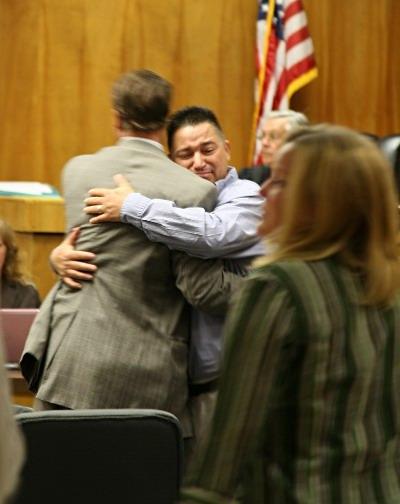
A relieved Dinius hugged his wife, Roshell, after the verdict.
Dinius' case has unfolded over the last two years. He was charged in the case a year after the fatal April 29, 2006, crash, when he was at the tiller of the Beats Workin' II, owned by Willows resident Mark Weber.
The sailboat was under way at night when it was hit by a powerboat driven by Russell Perdock, an off-duty sheriff's deputy. Weber's longtime girlfriend, Lynn Thornton, 51, died a few days later due to blunt force trauma injuries to the head.
Perdock was not charged but District Attorney Jon Hopkins prosecuted Dinius, alleging that he had a blood alcohol level of 0.12 at the time of the crash and that he had failed in his duty to have the sailboat's navigation lights on. Experts presented by defense attorney Victor Haltom maintained the lights were on.
The prosecution had moved forward despite Thornton's family and friends sending letters to the court seeking the charges be dropped.
Jurors reveal their verdict
The jury notified bailiff Dave Jones at about 10:50 a.m. that it had reached a verdict. Judge Byrne had set a half-hour waiting period to let everyone get back to the court before reading the verdict.
The courtroom filled up with community members, district attorney's staffers and several local attorneys who wanted to hear the verdict.
The Diniuses, who had been in Kelseyville, arrived in the courtroom shortly after 11:20 a.m.
Jones warned the gallery that no emotional outbursts were going to be allowed in the courtroom during the reading of the verdicts.
Once Dinius had arrived, Judge J. Michael Byrne came in and asked the counsel to approach briefly before turning to Jones and saying, “All right, let's see what we've got.”
Jones brought in the jurors, some of whom were smiling as they took their seats.
The jury had indicated in its message about reaching a verdict that it had decided on two of the counts but deadlocked on a third.
Noting that they had only deliberated for about a day and a half following the lengthy presentation of testimony, Byrne asked if they had had enough time to come to a decision.
“I don't think time is going to affect it one way or the other. It think we're pretty set in division,” said the female foreperson.
“We made a lot of progress from last night to this morning,” the foreperson explained. “We're just where we're at.”
She added, “We went over it and over it and over it. I don't think we're going to change on that one count,” noting they were “polarized.”
Byrne asked if they needed testimony read back. “Not on this count, no,” the foreperson said.
What about more information on the law? asked Byrne. The foreperson said she didn't think so.
“Is there anything in your mind that we can do to help you?” Byrne asked. The foreperson said no.
Byrne asked the other jurors if they disagreed with the foreperson, or if they needed to hear additional information from any witnesses. There was no response, and Byrne said, “I'm getting that some of you are good poker players.”
He told the jury, “We tried to give you anything we possibly could.”
Haltom wanted to know on which count the jury was deadlocked. Hopkins said he didn't think they're supposed to ask them directly.
Byrne then asked Jones to collect the verdict sheets from the foreperson. Jones took them from her and handed them to the judge.
Looking them over, Byrne then asked Dinius to stand for the verdict as the court clerk read the jury verdict forms.
On count one, felony boating under the influence causing great bodily injury, the jury found Dinius not guilty.
The silent courtroom waited as the clerk read out the verdict on count two, misdemeanor boating under the influence – not guilty.
It was the third count – misdemeanor boating with a blood alcohol level of .08 or above – that deadlocked the jury.
Byrne asked the foreperson what the split was on count three. “I'm curious, anyway, to be honest,” he said.
The foreperson said it was 11 to 1, with the majority voting for acquittal.
The judge said he was satisfied that the jury had reached a point where they weren't going to reach a decision, and he declared a mistrial on the third count.
Byrne then released the jury, telling them they now had the right to speak to anyone about the case.
“You were a very good group to work with,” he said.
He also read them a statute explaining that they must wait 90 days before negotiating or agreeing to take payment for information on the case.
Dinius hugged Haltom and Paige Kaneb, an attorney with the Innocence Project, which supported the case.
As the jurors filed out most appeared to avoid reporters seeking comments. Jurors Lake County News approached would not comment on the case.
However, one of the male jurors stopped and hugged Roshell Dinius.
Once the jury was gone, Byrne asked Hopkins what he wanted to do about count three, which deadlocked the jury.
“I would move to dismiss count three, Your Honor,” Hopkins said.
Byrne told both Hopkins and Haltom that they did a good job on the case.
Shortly afterward Hopkins strode quickly from the courtroom.
After court, Haltom and Kaneb were happy and relieved with the verdict.
Haltom said in terms of twists, turns and the cast of characters, this case “takes the cake.”
Although he said he wasn't surprised by the verdict, he was nervous as court reconvened for the verdict Thursday.
He said that the testimony of Jim Ziebell and Doug Jones, two of Hopkins' first witnesses who said they saw the sailboat's lights on earlier in the evening before the crash, was important. But perhaps the most significant moment in the case for Haltom was when Hopkins didn't call Perdock.
“I think that revealed the merits of the case,” Haltom said.
Kaneb said The Innocence Project has worked with Haltom before, and decided to sign on to the case.
She questioned defense witnesses Zina Dotti and Joe Gliebe in court, helped with research and crafting the closing arguments.
Hopkins: Case needed to be prosecuted
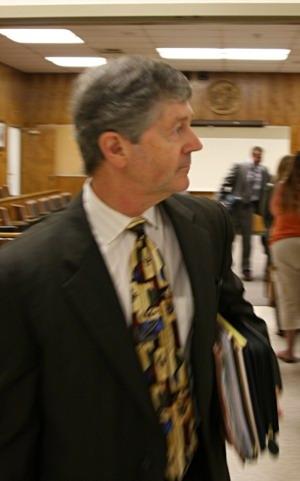
Later that day, sitting in his office behind the courthouse and already working on other cases, Hopkins said it was clear the jury grappled with the case, which he realized from the beginning was a difficult one.
The jury also didn't appear to buy the defense's suggestion that they needed to punish Lake County officials, he said.
The issue of the difference between the master and crew, which defense expert Dr. William Chilcott introduced in the case, had no application, Hopkins contended, noting he should have addressed it more carefully.
“My view is that the lights were out,” and that Dinius was responsible, with Weber drunk and not paying attention, he said.
Hopkins said one of his former deputy district attorneys, David McKillop, who handled driving under the influence prosecutions, charged the case. Later, after McKillop left for another job out of county, Deputy District Attorney John Langan was given the case.
In June, Hopkins himself took over the prosecution. He wouldn't outline a specific reason, saying only that it became clear to him that he needed to do it.
He said he believed a lot of fault was with Weber, but Weber couldn't be charged in the case because, according to Hopkins' interpretation of the law, Weber wasn't the sailboat's operator.
Hopkins said there was no evidence that Perdock was drinking, and on the issue of the powerboat's speed, there's no speed limit on Clear Lake, so he can't say Perdock was violating a speed law.
“How do I convict somebody of running into a sailboat with its lights off?” said Hopkins.
In his reading of cases in the Admiralty Courts, which are civil in nature, Hopkins said a vessel with its lights off is the “prime offender.”
If Dinius hadn't been drinking, Hopkins said he would have let the civil court resolve it. He said Dinius had a misdemeanor DUI conviction in 1999 in which he was tested at about 0.14, “so he knows better.”
“I felt like it was a case that had to be prosecuted,” Hopkins said. “Drinking and boating on Clear Lake is a serious issue.”
There haven't been many boating under the influence prosecutions, and Hopkins said an Aug. 8 BUI checkpoint resulted in no arrests. He suggested the case may be having the right impact.
Responding to the criticism about the case, Hopkins said, “I've made a career of not backing away from difficult cases, and I certainly am not going to be intimidated by a publicity campaign.”
He said if he were to back down due to fears of criticism he wouldn't be acting in the public's best interest. Hopkins said he'll continue to prosecute cases in the interest of public safety.
The bottom line, said Hopkins, is this: “If you're intoxicated, you should think twice about getting on a boat.”
The way forward
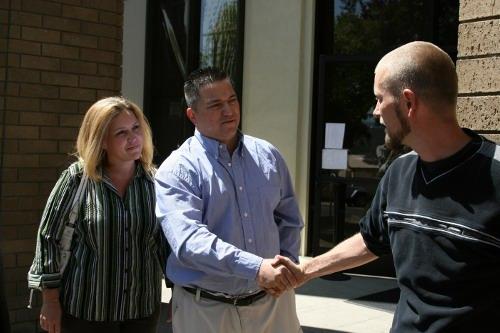
As the courtroom emptied out, Bismarck and Roshell Dinius wept, hugged and kissed.
Ziebell, called by the prosecution as the case's first witness on July 28, came in and hugged Bismarck Dinius; other supporters hugged and congratulated him as well.
With the trial over, the Diniuses and their 12-year-old daughter, Brittany, are looking forward to moving on with their lives.
The couple's relationship has been overshadowed by the case.
They've known each other for five years, but it was just days after the crash that they went on their first date – May 5, 2006, to be exact.
“I told her to run,” said Dinius, explaining that he told Roshell that he was involved in something “heavy.”
“I believed in him, though,” she said.
“She never listens to me,” he quipped.
It was in late April of 2007, around 4:30 p.m. on a Friday afternoon, when Dinius got the call from a local law enforcement investigator notifying him that he was being charged in the case. Originally, he also faced a felony manslaughter charge, which was dropped shortly before the trial.
“I was stunned,” he said.
He didn't know at the time that he was the only one who was charged, and thought if he faced prosecution, others would, too.
Bismarck and Roshell Dinius were married June 21, 2008, right after the conclusion of the hard-fought preliminary hearing, that had begun in late May and then was held over to finish in June. They said they had a “budget wedding.”
Then, this past May 18 – a day before the original trial date – Bismarck Dinius lost his job with Verizon Wireless because of the case.
Dinius hired Haltom after being referred to him by an attorney who handled his civil case in connection the trial. “What a godsend that has been,” said Dinius, who called Haltom “an incredible lawyer.”
After the crash he initially was spooked about sailing. But Dinius soon got back on the water.
“I love sailing. It's my passion,” he said. “And I'm really, really frickin' good at it.”
He said he has no comment on the possibility of a civil case against the county because of the prosecution, but he added, “We'll discuss that, I'm sure.”
He said the support from the worldwide sailing community has been “overwhelming.”
Not only have he and his wife received numerous letters and messages of support, but they're also getting financial contributions to go toward his legal bills, which he estimates to be between $250,000 and $300,000.
He said he's grateful for the financial help. “It's so moving. And it's made a huge difference.”
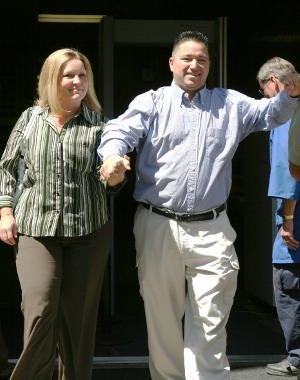
About an hour after the verdict was handed down, the couple walked out of the court holding hands, as friends and supporters clapped loudly for them, with Haltom following behind.
E-mail Elizabeth Larson at