How to resolve AdBlock issue?
News
An Office of Emergency Services engine housed at South Lake County Fire's Middletown station was sent to the Station Fire in Los Angeles on Monday, according to Northshore Fire Chief Jim Robbins.
Robbins received the call from the state OES for the engine at 1 a.m. Monday, and within a short time the engine and several firefighters were under way.
The Station Fire is located in Los Angeles County in the Angeles National Forest's jurisdiction. It began Aug. 26 and has so far burned more than 105,000 acres and was only 5 percent contained late Monday.
Over the weekend the fire claimed the life of two firefighters, according to the Governor's Office.
Over the weekend, Gov. Arnold Schwarzenegger declared states of emergency in Los Angeles, Monterey and Placer counties because of the wildfires burning in those areas.
Late Sunday night Robbins also was called on to assemble a five-engine strike team to send to the 49 fire, which has destroyed 60 structures and burned 340 acres at Highway 49 and Rock Creek near Auburn, according to Cal Fire.
Evacuations are in effect for several areas as a result of that fire, which was 70-percent contained late Monday, Cal Fire reported.
However, after Robbins got the strike team – 15 firefighters and a battalion chief – ready to get on the road, the state called to cancel.
About a week ago a strike team of local firefighters – both paid and volunteer, from the county's several fire districts – and engines returned from a 16-day deployment in Shasta County, according to Northshore Battalion Chief Pat Brown.
Locally, firefighters have continued working on some small summer fires, including an early morning grass fire that burned a fence behind Sentry Market in Nice on Friday and a Saturday afternoon fire that burned on acre on Collier and Hammond, Robbins said.
The fire at Collier and Hammond was sparked by a young man on a riding lawn mower, which hit a rock while mowing during the heat of the day, Robbins said.
Robbins said they were unable to find a cause for the fire behind Sentry Market.
E-mail Elizabeth Larson at
Robert Lavern Davison, 41, pleaded guilty to one count of coercion and enticement for illegal sexual activity in the US District Court of Utah's Central Division on Aug. 24, according to court records.
The Federal Bureau of Investigation, assisted by the Lake County Sheriff's Office, arrested Davison and served search warrants on his Cobb home on Feb. 12, as Lake County News has reported.
Davison had allegedly met a 13-year-old Utah girl online in 2008 while playing an Internet game, “World of Warcraft.” That is alleged to have led to instant messaging in which Davison urged the girl to meet him in California.
The case came to the attention of the Centerville, Utah, police last November when the girl was reported missing. She later was found at a Salt Lake City bus station, where she was scheduled to get on a bus using a ticket Davison had purchased for her through a third party, according to case records.
Initially, Davison pleaded not guilty to the charge, and a jury trial was set for Sept. 28.
However, on Aug. 24 a change of plea hearing was held in which Davison entered the new guilty plea.
The charge carries a minimum 10-year sentence and a maximum life sentence, plus a $250,000 fine, according to federal documents.
Davison's plea document states that between June 1, 2008, and Nov. 13, 2008, he used the Internet and, in particular, instant messaging, “to coerce a minor to travel to California to engage in sexual activity with me.” He further admits that the girl was 13 years old at the time.
In exchange for the plea, the federal government agree to reduce his offense level under sentencing guidelines and suggest that he be sentenced to 10 years in prison.
Davison's sentencing is set for Dec. 17 before Judge Dale A. Kimball.
Also on Aug. 24, Kimball granted the federal government's request that a psychosexual evaluation be prepared on Davison.
If that evaluation report is completed in less than 120 days, Davison's sentencing will be moved up at the request of his attorney.
E-mail Elizabeth Larson at
The awards were made to tribal governments in California, Kansas, Mississippi, Montana and Oklahoma.
The tribal governments that received the grants included the Big Valley Band of Pomo Indians, based at Big Valley Rancheria in Lakeport, which received $446,700.
The grant will provide community resource and referral information services for victims of domestic violence and sexual assault and provide emergency food and clothing to victims of domestic violence and sexual assault, or offer referrals to service providers.
The funds awarded to Big Valley also will be used to provide domestic violence counseling services or offer referrals to service providers, coordinate tribal, jurdisdictional and non-tribal victim service programs for Indian women by establishing formal memorandums of understanding and develop a comprehensive public education and outreach campaign to raise awareness.
These tribal awards are in addition to the more than $8.9 million in Recovery Act funds that were awarded earlier this week to 10 tribal governments and 10 tribal coalitions in Alaska, Arizona, California, Michigan, Minnesota, North Dakota, Oklahoma, South Dakota, Washington and Wisconsin.
“American Indian and Alaska Native women are more likely to experience sexual assault and domestic violence than women from other racial or ethnic groups, which is why these funds are so vital,” said Attorney General Holder. “As the Department of Justice convenes the Tribal Nations Listening Conference and pre-sessions, these funds are just the beginning of a renewed partnership between the Department and our tribal communities to ensure the safety of every Indian woman and address Tribes’ criminal justice challenges.”
The landmark American Recovery and Reinvestment Act of 2009, signed into law by President Obama, provides the Justice Department’s Office on Violence Against Women (OVW) with $20.8 million for the Indian Tribal Governments Program to decrease the number of violent crimes committed against Indian women, help Indian tribes use their independent authority to respond to crimes of violence against Indian women and make sure that people who commit violent crimes against Indian women are held responsible for their actions. The award period is 36 months.
The Recovery Act provides OVW with $2.8 million for the Tribal Domestic Violence and Sexual Assault Coalitions Program to provide much needed resources for organizing and supporting efforts to end violence against Indian women and provide technical assistance to member programs. The award period is 24 months.
OVW, a component of the U.S. Department of Justice, provides leadership in developing the nation’s capacity to reduce violence against women through the implementation of the Violence Against Women Act (VAWA) and subsequent legislation. Created in 1995, OVW administers financial and technical assistance to communities across the country that are developing programs, policies and practices aimed at ending domestic violence, dating violence, sexual assault and stalking.
John Wesley Dunn Jr., 25, was arrested on Aug. 7 on allegations of rape while using drugs to prevent resisting, kidnap with the intent to rape and assault with the intent to commit a crime.
The alleged victim, a 25-year-old Hidden Valley Lake woman, told authorities that Dunn had driven her home after she was out with friends and family having dinner and drinks on July 31.
After Dunn's arrest, Lake County Sheriff's investigators put out an additional call for information on the case, as they try to find more people who may have seen Dunn and the alleged victim together on the night of the reported assault.
Dunn's attorney, Stephen Carter, said Dunn – who has no criminal history whatsoever – is facing life in prison for just the kidnap charge alone.
Since his arrest Dunn – an assistant golf pro at Hidden Valley Lake's golf course – has been held on $350,000 bail.
But after many of Dunn's friends and acquaintances testified to his character in an unusual three-hour Friday hearing, Judge Arthur Mann released Dunn on his own recognizance.
Carter had set up a bail hearing for Aug. 21 but it was delayed after the prosecution said that the 25-year-old victim had not been notified of the hearing.
His friends returned on Friday to Judge Richard Martin's Department Two courtroom. Martin, who had a full calendar of cases on Friday, had Dunn transferred to Mann in Department Three.
Before Martin handed off the case, prosecutor Ed Borg objected to Carter being able to submit dozens of letters on Dunn's behalf to the judge, questioning their relevance to the case.
When the hearing convened in Mann's courtroom, he noted that he had read the report on Dunn's case, including a six-page report from Lake County Probation, but not the letters, acknowledging the prosecution's objections to the court acceptance the evidence.
Elaborating on his objection, Borg said the letters contain hearsay, which doesn't meet standards of evidence.
Carter replied that there was no evidentiary objection he's aware of that would keep out hearsay. He said the court routinely considers letters, and Probation Department reports also consider hearsay evidence, which he maintained is admissable at a bail hearing.
Borg replied that his concerns were centered on relevance.
Mann took a brief recess to research the question. When he returned, Carter cited a case that allowed for relaxed evidentiary hearings at a bail hearing, just like sentencing. Borg said he wasn't aware of any such evidentiary rule changes.
Carter replied that the previous week the prosecution had argued that it was the defense's duty to notify the victim of the bail hearing. “That wasn't accurate and there was no basis for it,” he said.
Mann noted that while Marsy's Law – which provides for notifying crime victims of hearings – doesn't specify who is responsible for notification, it's likely to fall to the prosecution. “That's not an issue before the court now,” Mann said.
“Out of an abundance of caution” Mann sustained Borg's objection to allowing the letters into evidence.
Borg said he would offer a stipulation testifying to statements on Dunn's moral character to save time, but Carter declined, saying that, by not allowing the letters, the court didn't have the benefit of knowing the information being presented on Dunn's behalf.
Borg then asked to exclude the witnesses, which Mann declined to do.
Over the next two and a half hours court was in session, Carter called more than 15 witnesses who supported Dunn's character. They stated he was honest, sincere and sensitive, and gentlemanly in his demeanor toward everyone, especially women.
Theresa Hart said she's known Dunn for four years, and he's been “a very positive influence” for her young son.
When Carter asked if she had seen Dunn interacting with the alleged victim, Borg objected.
“I don't believe I have to put on an evidentiary hearing that I have a good case,” Borg said.
Mann overruled, and allowed Hart to explain that a few weeks before the alleged rape she had seen Dunn and the young woman at a local bar. When Dunn came up to Hart to talk to her, she said she saw the young woman giving her dirty looks from across the room, which she believed was a result of her talking to Dunn.
Hart said at one point an upset Dunn came up and asked her for a ride home after a confrontation with the alleged victim's mother, who had accused him of being a “player” and not dancing with the young woman or buying her a drink. At Borg's objection, Mann struck that portion of testimony from the record.
Several witnesses testified that Dunn often gave people who had too much to drink a ride home, a courtesy he extended to both men and women. Borg's main question for each of the witnesses was whether or not they had ever been mistaken in their assessment of someone's character, which drew mixed responses – some said yes, some no.
Barry Silva, Dunn's best friend, called the charge against his friend “crazy,” which Mann agreed to strike at Borg's objection.
Silva said he also had seen Dunn interact with the alleged victim at a local bar. He said the young woman came up and kept grabbing Dunn and pulling him away from his friends so he would buy her drinks, which Silva said happened at least three times one evening.
Dunn didn't behave in an inappropriate manner, said Silva. “John would be the last person to do something like that.”
As the witnesses continued making their way to the stand, Borg objected to an undue use of time, which Mann overruled.
Gregory Young Sr. said Dunn had a high moral character who he once saw offer to drive home a man who had had too much to drink at Mulligan's bar in Hidden Valley Lake. He called Dunn a “stand up” citizen. “I think that's important to be said.”
Craig Sharp, Hidden Valley Lake's golf professional and Dunn's boss, also came out to support Dunn, who he's known for two and a half years. Sharp said he trusted Dunn's character.
After Carter's witnesses were finished, Borg called the alleged victim, who has a right to attend the hearing and speak.
The woman asked the court not to release Dunn and said she was afraid of him being set free.
Mann ended by ruling that Dunn be released on his own recognizance.
Dunn is next due in court in October for a pre-preliminary hearing.
Carter said he felt the ruling was a proper one, noting that his client wasn't a flight risk.
“It's not, by far, the end of the case and there's a lot more serious work to be done,” said Carter.
E-mail Elizabeth Larson at
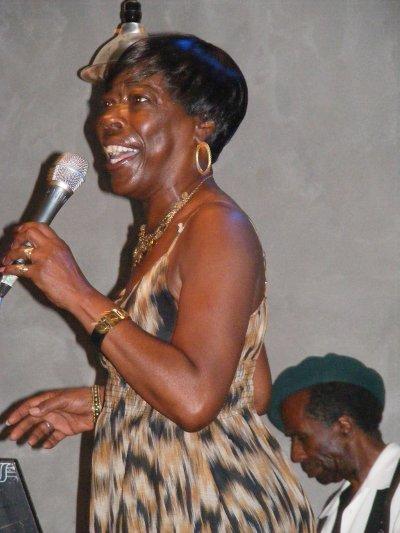
In my previous column, I cryptically referred to a “rightly energized space” in Lake County where Soul Diva Betty Mae Fikes would record a live album last week. I am happy to report that Diva Fikes did indeed cut the album at Ancient Lake Gardens. More on the Gardens momentarily. First, let’s explore a little of the history of Ms. Bettie Mae.
Some of you recall the Konocti Blues Café, not to be confused with the larger venue on Soda Bay Road. Many of us packed the KBC every weekend to hear the uncut funk laid down by a rotating cast of superior players, all recruited by KBC Music director and former Lake County resident Robert Watson. The hardest working man in show business, Mr. James Brown, referred to Watson as the Blaster. Rob Watson was the last guitarist James Brown ever hired.
Watson was responsible for bringing folks like Grammy-winning keyboardist Rodney Franklin, Miles Davis sideman Barry Finnerty, Sly & The Family Stone Bassist Rusty Allen and Volker Strifler to the KBC.
The recording band at Ancient Lake Gardens were all regular players at the KBC. They were Watson on bass, Tony DeWayne on guitar, Frankie J. and Robert Reason on keyboards and Billy Johnson on drums.
All the musicians I’ve mentioned so far came to the Konocti Blues Café to augment the Bettie Mae Fikes experience. It was her showcase, owned by her childhood friend and veteran Civil Rights attorney, Charles Bonner.
Bettie Mae Fikes has a successful career as a singer of blues and gospel. She is from a community called Selma, Alabama, which was a hotbed of activity during the period of 1963 to 1965, a crucial time in the Civil Rights Movement.
In a 2005 interview, Ms. Fikes speaks of her initial involvement with SNCC, the Student Non-Violent Coordinating Committee:
“… In the early sixties, I just needed an avenue to get out of the house from going to church so much. This fellow here, Mr. Bonner and my other dear friend Cle, was telling us about SNCC. They got all of their friends involved including me. When The Movement hit, it was like, you went to bed one night and you woke up the next day with a new world order.”
“All of a sudden these people are coming to town and they're talking about voters' rights. I didn't even know that was happening, — that our parents didn't have the right to vote. There were a few black people that were registered, mostly in Selma. Lowndes County and all these [surrounding] counties were unregistered. So these are the things that brought me into the Movement.”
Through her involvement with SNCC, Bettie became a SNCC Freedom Singer which has paralleled her career as a Blues and Gospel singer. To access the above referenced interview with Bettie Mae Fikes and Charles Bonner go to www.crmvet.org/nars/chuckbet.htm .
Freedom’s road brought Bettie Mae Fikes to Ancient Lakes Garden this past Wednesday to record her latest CD in front of a live, enthusiastic gathering of souls.
The event was organized by Monte Black, caretaker of the site. He describes it thusly:
“We are trying to bring some solid cultural diversity to Lake County. It seems that if we don’t create it, we don’t get it. We are trying to put a small, spontaneous venue together here. We’d like to have four to six performances here a year. That’s just a piece of the vision. We want to create a cultural center here with artists and musicians set amid the agricultural environment of the land. We already have a forge here where metal artist Brian Kennedy is creating art that is finding its way out of Lake County into higher end locales. We also have a woodworker here who is an Anthroposophist in the tradition of Rudolph Steiner. It seems as though many people who pay attention to Rudolph Steiner are landing here. We have a beekeeper and a dowser. Simply put we are trying to string together some cottage industries: artisans, crafts persons and musicians in an organic farming setting. As far as developing the music venue, we will need to get a limited use permit to make it commercially viable and we are looking into that. Until then we will keep our events private.”
Bettie Mae’s association with local poet and publisher Carolyn Wing Greenlee led to the recording session coming together quickly. The sound engineer for the project is Dan Worley.
Most of the musicians Robert “The Blaster” Watson recruited for the project hail originally from Vallejo. Watson, Tony DeWayne and Robert Reason have played together since they were teenagers and consequently groove accordingly. Tony Dewayne has tenured as former Tower Of Power lead singer, Lenny Williams’ Music Director. Drummer Billy Johnson was the drummer for Frankie Beverly and Maze. The fertile, funky sound they lay down has its roots in trailblazing funkateers like Sly & The Family Stone and Con Funk Shun who also hail from Vallejo.
Before Bettie graced the stage on Wednesday for the first of two sets, the BMF Band, as they have been known in the past, funkafized Bobby Womack’s Breezin’ and Leon Russell’s This Masquerade, tunes made popular by George Benson.
I’m not going to reveal the set list performed by Bettie. That is a surprise until you acquire the CD. No word on when it will be released, but there are some positively stratospheric monologues that accompany the tunes that are alone worth the price of Bettie’s melodic intuition.
Those in attendance were thoroughly enraptured by Bettie. Folks were moving their bodies and responding to her call. It was a very interesting mix of energy and song and when it’s released, you don’t want to miss it.
Keep prayin’, keep thinkin’ those kind thoughts.
*****
Upcoming cool events:
Lake Blues All-Stars with Neon, Blues Monday, 6:30 p.m. to 9 p.m. Aug. 31, Blue Wing Saloon & Café, 9520 Main St., Upper Lake. Information: 707-275-2233 or www.bluewingsaloon.com .
Open mike night, 6 p.m. to 8:30 p.m. Thursday, Sept. 3, Blue Wing Saloon & Café, 9520 Main St., Upper Lake. Information: 707-275-2233 or www.bluewingsaloon.com .
Will Siegal & Friends, Blue Wing Saloon & Cafe Sunday Brunch, Sept. 6. Brunch from 10 a.m. to 3 p.m.; music from 11:30 a.m. to 2 p.m. Blue Wing Saloon & Café, 9520 Main St., Upper Lake. Telephone 707-275-2233, www.bluewingsaloon.com .
Labor Day Special In The Garden: Roy Rogers & The Delta Rhythm Kings plus Gerald Mathis and Starlight. 5 p.m. Monday, Sept. 7. Blue Wing Saloon & Café, 9520 Main St., Upper Lake. Telephone 707-275-2233, www.bluewingsaloon.com .
Con Funk Shun, 8 p.m. Saturday, Sept. 5. Cache Creek Casino Resort, 14455 Highway 16 in Brooks. Information: 888-77-CACHE or www.cachecreek.com .
Petaluma Summer Music Festival, through Sept. 13. For lineup go to www.cinnabartheater.org/cinnabar.2009-petaluma.summer.music.festival.html or call 707-763-8920.
T. Watts is a writer, radio host and music critic. Visit his Web site at www.teewatts.biz.
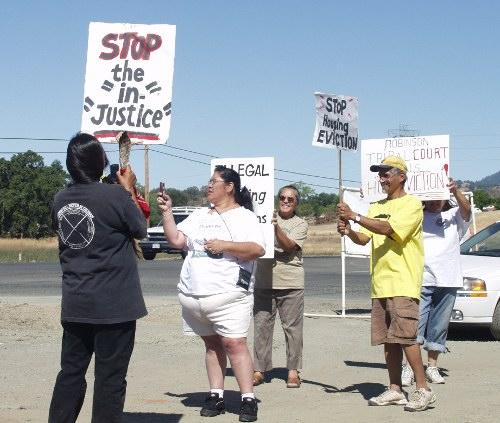
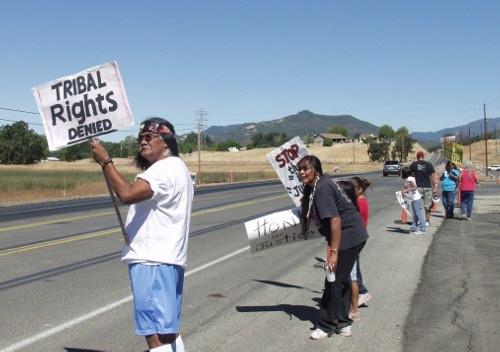
NICE – Tensions between the Robinson Rancheria Citizens Business Council and a group of tribal members the council is trying to remove from tribal membership is continuing to mount, and culminated in another protest at the casino's entrance on Saturday.
The Saturday rally is in response to a round of evictions under way by the tribe's housing committee.
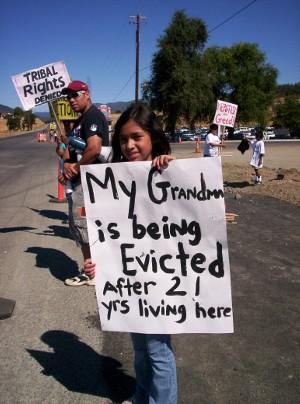
About 30 people carried signs and walked along the edge of Highway 20 at Robinson's entrance. Sign slogans ranged from “Robinson Rancheria court equals housing eviction,” “Illegal housing evictions and fraud,” “Stop tribal council fraud,” “Lies, cheat, steal, “Honk for justice,” “Tribal rights denied,” “Nepotism and greed” and “My grandma is being evicted after 21 years living here.”
Over the three hours the group protested Saturday, they received numerous honks and gestures of support from passersby. One couple from out of the area stopped by to ask about the protest and what was happening.
Last December, following months of controversy over a disputed election, the Robinson Rancheria Citizens Business Council – headed by Tribal Chair Tracey Avila – passed disenrollment resolutions on 63 tribal members, according to recently released documents.
The council also disenrolled an additional three tribal members for lack of blood quantum – the amount of blood a person is supposed to have to quality for tribal membership.
Before taking the disenrollment votes on those 66 tribal members, the council also unanimously voted to disenroll Marie Boggs Quitiquit, who had by that time been dead for several years. The votes to disenroll her children and grandchildren, part of the large Quitiquit family totaling more than 30 members, then followed.
Marie Quitiquit's daughter, Wanda Quitiquit, is currently leading the disenrollment appeal effort to the Bureau of Indian Affairs, which has granted numerous delays in the process since the start of the year. Next month, the final appeals are due, and a BIA decision on whether the disenrollments were valid is expected to take place.
A previous protest by those who were disenrolled by the council and those who supported the disenrollees' case was held in front of the casino on Jan. 17, as Lake County News has reported.
That same month, the tribe's housing committee began efforts to evict several of those whose names were on the disenrollment list from homes built on the rancheria with federal Housing and Urban Development funds.
HUD officials have confirmed to Lake County News that they issued findings in February that found the tribe was not in compliance with the guidelines of its federal housing grants. The tribe could be forced to repay its grants – the amount was not disclosed – it it refuses to take corrective actions.
Those facing eviction include Inez Sands, who is raising her grandchildren in a five bedroom home that protesters on Saturday said already is being measured for new tile and carpet for new occupants. She received a three-day quit letter in January but has refused to give up her home.
Another person targeted for eviction is Karen Ramos, who was told she needed to come up with $4,000 in back mortgage payments for face eviction, according to her daughter, Tonia Ramos.
While many of those slated for eviction owe back mortgages, tribal member EJ Crandell – whose disputed win over Avila for tribal chair last year appeared to set the disenrollments in motion – said owing back mortgage payments was common among all tribal members, even the council, after the tribe took over its own housing agreements after severing ties with Northern Circle Indian Housing Authority in Ukiah.
Lake County court records show that Avila also had been sued by Northern Circle at one point over housing issues several years ago, which were resolved.
The current housing committee includes members of the Anderson family, to which Avila belongs also. Committee members include Judy Anderson, Michelle Monlo, Diane Boggs, Deborah Anderson and Audrey Gutierrez.
Crandell, whose grandfather is a part of the leadership for the Hopland Band of Pomo Indians, said Robinson's tribal council attempted to have Hopland's tribal court handle 11 eviction cases, but Hopland turned down that request.
At one point Saturday morning Gutierrez showed up and confronted the protesters, using a cell phone to photograph and record the encounter. The protesters yelled questions at her, asking her which house she was going to get after the evictions were carried out.
Another election was held Saturday, Aug. 22, with the top vote getters being Curtis Anderson and Clayton Duncan. A runoff election is due to be held, although Crandell said there were concerns that the election was being invalidated, just as the election in which he beat Avila last year was overturned.
The election is having other ramifications for some tribal members. Tonia Ramos said her husband, a longtime Robinson Rancheria casino employee, abstained from voting in the tribal election, as is his normal practice. The result this time: The tribe suspended him pending an administrative hearing in which he faces losing his job.
Crandell's mother also has been threatened with eviction action.
E-mail Elizabeth Larson at