How to resolve AdBlock issue?
Refresh this page
How to resolve AdBlock issue?
Refresh this page
Lake County News,California
  • Home
    • Registration Form
  • News
    • Education
    • Veterans
    • Community
      • Obituaries
      • Letters
      • Commentary
    • Police Logs
    • Business
    • Recreation
    • Health
    • Religion
    • Legals
    • Arts & Life
    • Regional
  • Calendar
  • Contact us
    • FAQs
    • Phones, E-Mail
    • Subscribe
  • Advertise Here
  • Login

News

America faces a power disconnection crisis amid dangerous heat: In 27 states, utilities can shut off electricity for nonpayment even in a heat wave


When homes lose power, they lose cooling, too. Edmund Lowe Photography/Moment via Getty Images

An alarming number of Americans risk losing access to utility services because they can’t pay their bills. Energy utility providers in 2022 shut off electricity to at least 3 million customers who had missed a bill payment. Over 30% of these disconnections happened in the three summer months, during a year that was among the hottest on record.

In some cases, the loss of service lasted for just a few hours. But in others, people went without electricity for days or weeks while scrambling to find enough money to restore service, often only to face disconnection again.

As researchers who study energy justice and energy insecurity, we believe the United States is in the midst of a disconnection crisis. We started tracking these disconnections utility by utility around the country, and we believe that the crisis will only get worse as the impacts of climate change become more widespread and more severe.

In our view, it is time government agencies and utilities start treating household energy security as a national priority.

1 in 4 households face energy insecurity

Americans tend to think about the loss of electricity as something infrequent and temporary. For most, it is a rare inconvenience stemming from a heat wave or storm.

But for millions of U.S. households, the risk of losing power is a constant concern. According to the most recent data from the U.S. Energy Information Administration, 1 in 4 American households experience some form of energy insecurity each year, with no appreciable improvement over the past decade.

For many low-income households, the risk of a power shut-off reoccurs month after month. In a recent study, we found that over the course of a single year, half of all households whose power was disconnected dealt with disconnections multiple times as they struggled to pay their bills.

A woman sits on wooden steps outside a door. Two backpacks, one belonging to a small child, sit on the steps beside her.
A woman sits outside the NeedLink Nashville offices after filling out an application to avoid losing electricity in 2022. William DeShazer for The Washington Post via Getty Images

Energy insecurity like this is especially common among low-income Americans, people of color, families with young children, individuals who rely on electronic medical devices or those living in poor housing conditions. During the first year of the COVID-19 pandemic, we found that Black and Hispanic households were three and four times, respectively, more likely to lose service than white households.

Along with existing financial constraints, people are facing rising electricity rates in many areas, rising inflation and higher temperatures that require cooling. Some also face a history of redlining and poor city planning that has concentrated certain populations in less efficient homes. Taken together, the crisis is apparent.

Coping strategies can put health at risk

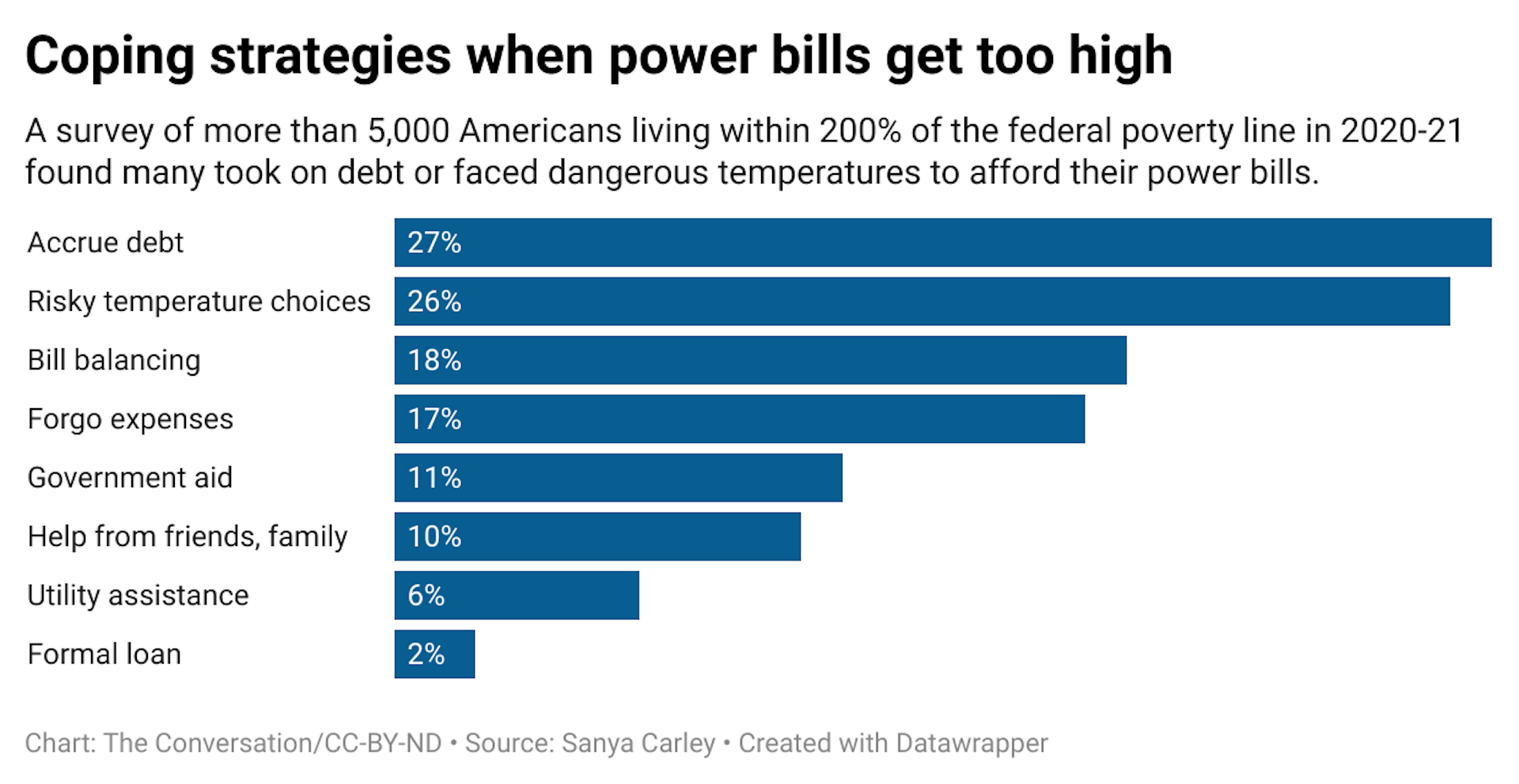
We have found that over half of all low-income households engage in some coping strategies, and most of them find they need multiple strategies at once.

They might leave the air conditioner off in summer, allowing the heat to reach uncomfortable and potentially unsafe temperatures to reduce costs. Or they might forgo food or medicine to pay their energy bills, or strategically pay down one bill rather than another, known as “bill balancing.” Others turn to payday loans that might help temporarily but ultimately put them in deeper debt. In our research, we have found that the most common coping strategies are also the most risky.

Once people fall behind on their bills, they are at risk of being disconnected by their utility providers.

The loss of critical energy services may mean that affected people cannot keep their homes cool – or warm during the winter months – or food refrigerated during any season. Shut-offs may mean that people with illnesses or disabilities cannot keep medicines refrigerated or medical devices charged. And during times of extreme cold or heat, the loss of energy utility services can have deadly consequences.

Where disconnection rates are highest

Our research team created the Utility Disconnections Dashboard, in which we track utility disconnections in all places where data is available.

In recent years, more states have required regulated utilities across the country to disclose the number of customers they disconnect. However, state regulations only apply to the utilities that they regulate. Public utilities and cooperatives, which serve over 20% of U.S. electricity customers, often aren’t covered. That leaves massive gaps in understanding of the full magnitude of the problem.
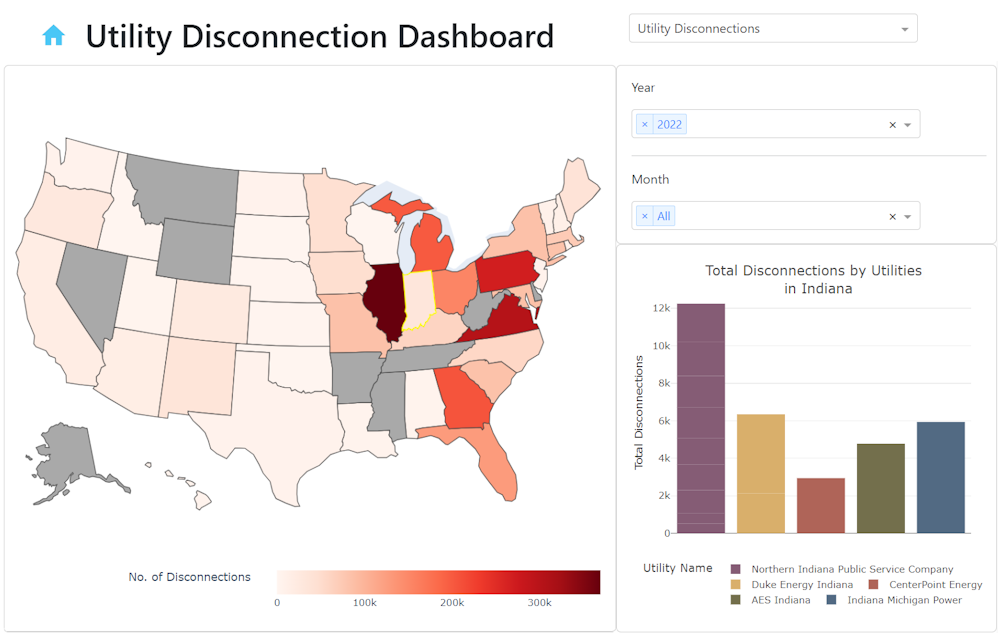
A screengrab of the Utility Disconnections Dashboard shows data from the state of Indiana, where five utilities had more than 2,000 disconnections each due to customers not paying bills on time. Indiana's total  was over 32,000 in 2022.
The Utility Disconnections Dashboard shows the number and rate of disconnections by utility in each state. Energy Justice Lab, CC BY-ND

The data we do have reveals that disconnection rates soar during the summer months and are typically highest in the Southeast. Large investor-owned utilities in Florida, Georgia, South Carolina and Indiana have averaged disconnection rates near 1% of customers, and some city utilities have been even higher.

Only 23 states restrict summer shut-offs

State public utility commissions place certain restrictions on the circumstances when utilities can disconnect customers, but summer heat is often overlooked.

All but a handful of states limit utilities from shutting off customers during winter months or on extremely cold days. Most have at least some medical exemptions.

Yet, more than half of the states do not place any limits on utility disconnections during summer months or on very hot days.

Only 23 states and the District of Columbia have such summer protections. They typically take the form of designating time periods or temperatures when customers cannot be disconnected from their service. Virginia became the most recent state with a such a policy, with protections going into effect on July 1, 2024.

We believe it is untenable for states to go without temperature protections in an era of climate change, as more parts of the country will increasingly experience excessive-heat days.

These state-level policies provide a baseline of protection. As we learned during the COVID-19 pandemic, moratoriums that prohibit utility disconnections can help alleviate energy insecurity.

But these policies are highly variable across the country. Moreover, details about customer protections can be difficult for people to find and understand.

Better rules and a new mindset on right to energy

As we see it, the U.S. needs more robust customer protections, with states, if not the federal government, mandating better disclosure of when and where disconnections occur to identify any systemic biases.

Most of all, we believe Americans need a collective change in mindset about energy access. That should start with a principle that all people should have access to critical energy services and that utilities should only shut off service to customers as a last resort, especially during health-compromising weather events.

The country cannot wait for deadly heat waves to prove how important it is to protect American households.

This is an update to an article originally published July 5, 2023.The Conversation

Sanya Carley, Presidential Distinguished Professor of Energy Policy and City Planning, University of Pennsylvania and David Konisky, Lynton K. Caldwell Professor, Indiana University

This article is republished from The Conversation under a Creative Commons license. Read the original article.

Coast to coast, millions of Americans are experiencing sweltering temperatures this summer, with seemingly little relief in sight. For people who struggle to access or afford air conditioning, the rising need for cooling is a growing crisis.

Ridge fire growth held in check

LAKE COUNTY, Calif. — Firefighters on Sunday managed to check the growth of the Ridge fire, which burned more than 2,300 acres within several hours of starting on Saturday.

The fire, which began on Saturday afternoon on the border of Lake and Colusa counties, grew to 2,629 acres on Sunday, an increase of just over 300 acres. Containment remained at 15%.

Cal Fire said 50 structures in the two impacted counties remain under threat.

Firefighters on Sunday worked to construct and tie in control lines around the fire, with a focus on the north perimeter, Cal Fire said.

Officials said they also had bolstered both air and ground resources on the fire Sunday to help keep the fire within its current perimeter.

Still in effect in Lake County are evacuation orders for zones CLO-E070, CLO-E089, CLO-E022 and CLO-E083, with an evacuation warning in place for CLO-E104. Zones can be seen here.

As of noon on Sunday, Highway 20 had been fully reopened east of Clearlake Oaks at Highway 53 in Lake County. The highway had been closed on Saturday.

Email Elizabeth Larson at This email address is being protected from spambots. You need JavaScript enabled to view it.. Follow her on Twitter, @ERLarson, or Lake County News, @LakeCoNews.

Supervisors to consider appointments, mental health services contract

LAKE COUNTY, Calif. — The Board of Supervisors will consider appointments and an updated mental health services contract when it meets this week.

The‌ ‌board will meet beginning ‌at‌ ‌9‌ ‌a.m. Tuesday, July 23, in the board chambers on the first floor of the Lake County Courthouse, 255 N. Forbes St., Lakeport.

The‌ ‌meeting‌ ‌can‌ ‌be‌ ‌watched‌ ‌live‌ ‌on‌ ‌Channel‌ ‌8, ‌online‌ ‌at‌ ‌https://countyoflake.legistar.com/Calendar.aspx‌‌ and‌ ‌on‌ ‌the‌ ‌county’s‌ ‌Facebook‌ ‌page. Accompanying‌ ‌board‌ ‌documents, ‌the‌ ‌agenda‌ ‌and‌ ‌archived‌ ‌board‌ ‌meeting‌ ‌videos‌ ‌also‌ ‌are‌ ‌available‌ ‌at‌ ‌that‌ ‌link. ‌ ‌

To‌ ‌participate‌ ‌in‌ ‌real-time, ‌join‌ ‌the‌ ‌Zoom‌ ‌meeting‌ ‌by‌ ‌clicking‌ ‌this‌ ‌link‌. ‌ ‌

The‌ ‌meeting‌ ‌ID‌ ‌is‌ 865 3354 4962, ‌pass code 726865.‌ ‌The meeting also can be accessed via one tap mobile at +16694449171,,86533544962#,,,,*726865#. The meeting can also be accessed via phone at 669 900 6833.

In an untimed item, the board will consider appointing Sharron Zoller as the new District 5 planning commissioner.

The board also will discuss appointments to the Maternal, Child and Adolescent Health Board, the Western Region Town Hall, and the local area plan advisory committees for Kelseyville, Lakeport and Upper Lake/Nice.

In another untimed item, the board will consider the third amendment to the agreement between the county of Lake and Community Behavioral Health for specialty mental health services in the amount of $13,000,000 for fiscal years 2023 to 2026.

The amendment explains that the contract is being amended to raise it from a total maximum compensation of $3.2 million to $13 million.

Under the agreement, doctors make $1,394.46 per hour or a flat rate of $6,275.07 for 4.5 hours a day.

The full agenda follows.

CONSENT AGENDA

5.1: Approve amendment to the bylaws of the Big Valley Advisory Council changing the monthly meeting day to the second Wednesday of every month to allow PEG TV to attend.

5.2: Approve first amendment to the agreement by and between California Forensic Medical Group Inc. and the county of Lake for medical services in Lake County Detention Facility for an increase of 4.7% and a new base sum of $4,132,876.50 for the period of Jan. 1, 2024, through Dec. 31, 2024, and authorize the county administrative officer and chair to sign.

5.3: Approve annual agreement between the county of Lake and Visit Lake County California for provision of administrative services to Lake County Tourism Improvement District in the amount of $112,500 from July 1, 2024, to June 30, 2025, and authorize chair to sign.

5.4: Adopt resolution amending Resolution No. 2024-68 amending position allocations for fiscal year 2024-2025, Budget Unit No. 2603 Code Enforcement and Budget Unit No. 2702 Planning.

5.5: Adopt resolution approving an agreement with the state of California, Department of Food and Agriculture for State Organic Program Cooperative Agreement # 24-0092-000-SA for $4,565 for the period July 1, 2024, through June 30, 2025.

5.6: Approve long distance travel for Animal Control Officers Serena Copas and Kaitlyn Murry to attend the Level 1 Equine Investigations Academy in Durango, Colorado, from Aug. 18 to Aug. 24, 2024.

5.7: Approve memorandum of understanding between the county of Lake and the Lake County Continuum of Care to alleviate and prevent homelessness in Lake County and authorize the chair to sign.

5.8: Approve resolution of the Board of Trustees of the Konocti Unified School District ordering a school bond election, and authorizing necessary actions in connection therewith.

5.9: Approve resolution of the South Lake County Fire Protection District Board of Directors calling for a special election for the purpose of establishing a new appropriations limit.

5.10: Approve Board of Supervisors meeting minutes for July 9, 2024.

5.11: Approve first amendment of agreement between the county of Lake and 4LEAF Inc., to extend term to Oct. 1, 2025, and increase compensation by $90,000, for a total compensation not to exceed $140,000, for building permit processing and inspection services, including but not limited to the Maha Guenoc Valley mixed-use development, and authorize the chair to sign.

5.12: Approve fiscal year 2024/2025 renewal of Veterans Subvention Certificate of Compliance and Medi-Cal Cost Avoidance Program Certificate of Compliance and authorize the board chair to sign.

5.13: Adopt proclamation designating the week of July 21 to 27, 2024, as Probation Services Week in Lake County.

5.14: Approve contract between county of Lake and California Department of Social Services for agency adoption services and resource family approval family evaluations, in the amount of $1,218,968, and authorize the chair to sign.

5.15: (a) Approve purchase of two 2025 Ford Explorer police pursuit vehicles from Napa Ford Lincoln in the amount not to exceed $104,000 from the Sheriff/Pursuit Replacement Budget Unit 2217, Object Code 62.72; and (b) authorize the sheriff/coroner or his designee to sign the purchase order.

5.16: Approve agreement between the county of Lake on behalf of CSA-02, Spring Valley and Brelje & Race Consulting Engineers for engineering and design services for the County Service Area #2 (CSA-2) Spring Valley Water Distribution System Improvements Project for an amount not to exceed $259,900, and authorize the chair to sign.

5.17: Sitting as the Board of Directors Lake County Watershed Protection District, approve the agreement for caretaker services at the Highland Springs Recreation Area Park in Lake County, California; approve the lease agreement, and authorize the Water Resources director to sign both agreements.

TIMED ITEMS

6.2, 9:03 a.m.: Pet of the Week.

6.3, 9:05 a.m.: Presentation of proclamation designating the week of July 21 to 27, 2024, as Probation Services Week in Lake County.

6.4, 9:15 a.m.: Public hearing, consideration of Ordinance 1658 Article V. – Commercial Weighing and Measuring Device Registration Program to reflect the recent legislative changes that amend Section 12240 of the California Business and Professions Code.

6.5, 10 a.m.: Consideration of a contract with The Resiliency Initiative for the Multi-Jurisdictional Hazard Mitigation Plan Annexes, not to exceed $165,000, in cooperation with the city of Clearlake and city of Lakeport.

6.6, 11:30 a.m.: Hearing, consideration of post-abatement hearing on account and proposed assessment of abatement; located at 3112 Atholl Road, Lucerne (APN 034-373-01): property owner: Yvonne Cox.

UNTIMED ITEMS

7.2: Consideration of appointment of District 5 planning commissioner.

7.3: Consideration of Amendment No. 3 to the agreement between county of Lake and Community Behavioral Health for specialty mental health services in the amount of $13,000,000 for fiscal years 2023-2026.

7.4: Consideration of the following advisory board appointment: Maternal, Child and Adolescent Health, Western Region Town Hall.

7.5: Consideration of appointments to local area plan advisory committees (Kelseyville, Lakeport and Upper Lake/Nice), continued from July 16, 2024.

CLOSED SESSION

8.1: Conference with legal counsel: Existing litigation pursuant to Gov. Code sec. 54956.9(d)(1) – Cordova v. County of Lake, et al.

8.2: Public employee evaluation: Health Services director.

8.3: Public employee discipline/dismissal/release.

Email Elizabeth Larson at This email address is being protected from spambots. You need JavaScript enabled to view it.. Follow her on Twitter, @ERLarson, or Lake County News, @LakeCoNews.

Early week heat advisory issued for Lake County

LAKE COUNTY, Calif. — With temperatures forecast to top the century mark early this week, the National Weather Service has issued a heat advisory for Lake County.

The advisory will be in effect from 11 a.m. Monday to 10 p.m. Tuesday.

The National Weather Service said daytime temperatures are expected to range from 104 to 109 degrees, with nighttime temperatures in the high 60s.

Through Wednesday, winds of up to 20 miles per hour also are in the forecast.

Temperatures are supposed to start dropping into the 90s beginning on Wednesday.

By the end of the week, the forecast calls for daytime temperatures in the high 80s and nighttime temperatures in the mid 50s.

Email Elizabeth Larson at This email address is being protected from spambots. You need JavaScript enabled to view it.. Follow her on Twitter, @ERLarson, or Lake County News, @LakeCoNews.

High cyanotoxin levels prompts guidance for residents using private intakes from Clear Lake

LAKE COUNTY, Calif. — The Lake County Water Resources and Environmental Health departments, in partnership with Big Valley Rancheria, have issued guidance to community members who draw their drinking water from Clear Lake in light of high cyanotoxin levels in the lake.

This year, due to persistent heat, the partners monitoring water quality conditions are witnessing elevated levels of cyanotoxins in some areas of Clear Lake.

For Lake County residents with individual water systems that draw water directly from the lake using a private intake, drinking water may become unsafe when high levels of toxins are present.

There is no current data on toxin levels in the drinking water from these private intakes; however because of the high levels of cyanotoxins in Clear Lake, officials want to inform the public about precautions needed if you are a resident with an individual water system drawing from Clear Lake.

Residents with individual water systems around Sulphur Bank Mine and the shores of Clear Lake's Lower and Oaks Arms should be particularly cautious, as recent lake monitoring data demonstrated harmful concentrations of cyanotoxins.

Private water systems frequently do not effectively treat for these toxins, based on monitoring conducted through the Cal-WATCH program. 

Lake County’s Public Water Systems, even those whose raw water source is Clear Lake, effectively remove toxins through a multifaceted treatment process.

Tap water from public water systems is continually monitored to maintain compliance with state water quality requirements. Residents are urged to contact their public water system if they would like more information.

If you live outside of those areas, and you have an individual water system with a private intake that draws water directly from Clear Lake, it is important to maintain awareness of current water quality conditions.

Recent monitoring data is available here.

Big Valley EPA’s robust Clear Lake Cyanotoxin Monitoring Program collects samples from testing sites around Clear Lake at biweekly intervals during the summer months.

The most recent sampling on the shoreline of Clear Lake was conducted on July 10, and the tribe also received samples from the lake’s interior testing sites, which were collected by Lake County Water Resources on July 10.

Microscopy conducted on the lake samples determined 11 Locations met the danger threshold for microcystin toxins.

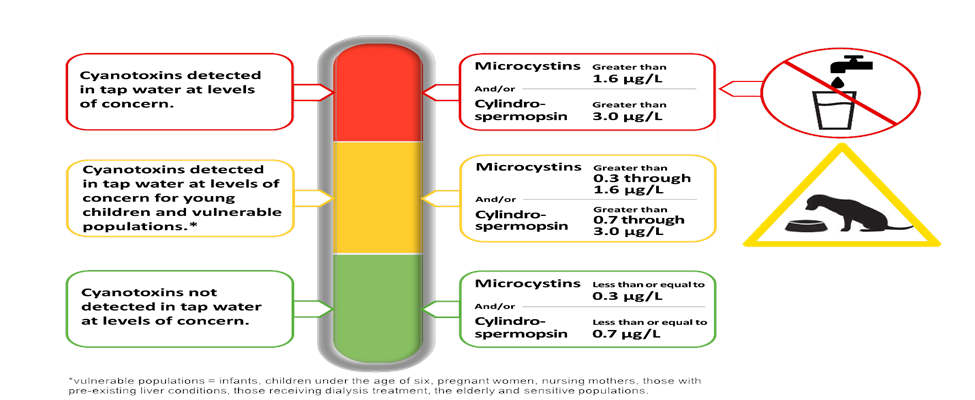
The chart below lists cyanotoxins and potential health effects from exposure to the toxins, along with the most common cyanobacteria producing the toxins. At some levels of cyanotoxin concentration in your drinking water, it is safe to use water to wash hands and shower; at higher levels (>0.3 µg/L), these activities may be harmful to the health of vulnerable individuals.

Please be cautious when bathing infants and young children, as they may swallow water. Do not drink or use water from any appliance connected to your water supply lines. This includes the water and ice dispensers in your refrigerator, freezer and dishwasher.

For households getting their tap water from individual water systems with private intakes from Clear Lake (and who have not previously participated), testing for contaminants such as cyanotoxins, nitrates, coliform bacteria, and herbicides is available through Big Valley EPA’s Cal-WATCH program detailed here: www.cal-watch.org

For additional information about cyanotoxins and harmful algal blooms, please visit the following websites:

• California Harmful Algal Bloom Portal: https://mywaterquality.ca.gov/habs/index.html;
• Centers for Disease Control and Prevention: www.cdc.gov/habs/index.html;
• Environmental Protection Agency: www.epa.gov/cyanohabs;
• Lake County Water Resources Cyanobacteria website.


Massive IT outage spotlights major vulnerabilities in the global information ecosystem


Displays at LaGuardia Airport in New York show the infamous “blue screen of death.” AP Photo/Yuki Iwamura

The global information technology outage on July 19, 2024, that paralyzed organizations ranging from airlines to hospitals and even the delivery of uniforms for the Olympic Games represents a growing concern for cybersecurity professionals, businesses and governments.

The outage is emblematic of the way organizational networks, cloud computing services and the internet are interdependent, and the vulnerabilities this creates. In this case, a faulty automatic update to the widely used Falcon cybersecurity software from CrowdStrike caused PCs running Microsoft’s Windows operating system to crash. Unfortunately, many servers and PCs need to be fixed manually, and many of the affected organizations have thousands of them spread around the world.

For Microsoft, the problem was made worse because the company released an update to its Azure cloud computing platform at roughly the same time as the CrowdStrike update. Microsoft, CrowdStrike and other companies like Amazon have issued technical work-arounds for customers willing to take matters into their own hands. But for the vast majority of global users, especially companies, this isn’t going to be a quick fix.

Modern technology incidents, whether cyberattacks or technical problems, continue to paralyze the world in new and interesting ways. Massive incidents like the CrowdStrike update fault not only create chaos in the business world but disrupt global society itself. The economic losses resulting from such incidents – lost productivity, recovery, disruption to business and individual activities – are likely to be extremely high.

As a former cybersecurity professional and current security researcher, I believe that the world may finally be realizing that modern information-based society is based on a very fragile foundation.

A display screen shows numerous rows of text
The outage led to thousands of flight delays on July 19, 2024. AP Photo/Yuki Iwamura

The bigger picture

Interestingly, on June 11, 2024, a post on CrowdStrike’s own blog seemed to predict this very situation – the global computing ecosystem compromised by one vendor’s faulty technology – though they probably didn’t expect that their product would be the cause.

Software supply chains have long been a serious cybersecurity concern and potential single point of failure. Companies like CrowdStrike, Microsoft, Apple and others have direct, trusted access into organizations’ and individuals’ computers. As a result, people have to trust that the companies are not only secure themselves, but that the products and updates they push out are well-tested and robust before they’re applied to customers’ systems. The SolarWinds incident of 2019, which involved hacking the software supply chain, may well be considered a preview of today’s CrowdStrike incident.

CrowdStrike CEO George Kurtz said “this is not a security incident or cyberattack” and that “the issue has been identified, isolated and a fix has been deployed.” While perhaps true from CrowdStrike’s perspective – they were not hacked – it doesn’t mean the effects of this incident won’t create security problems for customers. It’s quite possible that in the short term, organizations may disable some of their internet security devices to try and get ahead of the problem, but in doing so they may have opened themselves up to criminals penetrating their networks.

It’s also likely that people will be targeted by various scams preying on user panic or ignorance regarding the issue. Overwhelmed users might either take offers of faux assistance that lead to identity theft, or throw away money on bogus solutions to this problem.

Transportation Secretary Pete Buttigieg explains the effects of the outage on airlines and other transportation systems.

What to do

Organizations and users will need to wait until a fix is available or try to recover on their own if they have the technical ability. After that, I believe there are several things to do and consider as the world recovers from this incident.

Companies will need to ensure that the products and services they use are trustworthy. This means doing due diligence on the vendors of such products for security and resilience. Large organizations typically test any product upgrades and updates before allowing them to be released to their internal users, but for some routine products like security tools, that may not happen.

Governments and companies alike will need to emphasize resilience in designing networks and systems. This means taking steps to avoid creating single points of failure in infrastructure, software and workflows that an adversary could target or a disaster could make worse. It also means knowing whether any of the products organizations depend on are themselves dependent on certain other products or infrastructures to function.

Organizations will need to renew their commitment to best practices in cybersecurity and general IT management. For example, having a robust backup system in place can make recovery from such incidents easier and minimize data loss. Ensuring appropriate policies, procedures, staffing and technical resources is essential.

Problems in the software supply chain like this make it difficult to follow the standard IT recommendation to always keep your systems patched and current. Unfortunately, the costs of not keeping systems regularly updated now have to be weighed against the risks of a situation like this happening again.The Conversation

Richard Forno, Principal Lecturer in Computer Science and Electrical Engineering, University of Maryland, Baltimore County

This article is republished from The Conversation under a Creative Commons license. Read the original article.

  • 403
  • 404
  • 405
  • 406
  • 407
  • 408
  • 409
  • 410
  • 411
  • 412

Community

  • Lake County Wine Alliance offers sponsor update; beneficiary applications open 

  • Mendocino National Forest announces seasonal hiring for upcoming field season

Public Safety

  • Lakeport Police logs: Thursday, Jan. 15

  • Lakeport Police logs: Wednesday, Jan. 14

Education

  • Woodland Community College receives maximum eight-year reaffirmation of accreditation from ACCJC

  • SNHU announces Fall 2025 President's List

Health

  • California ranks 24th in America’s Health Rankings Annual Report from United Health Foundation

  • Healthy blood donors especially vital during active flu season

Business

  • Two Lake County Mediacom employees earn company’s top service awards

  • Redwood Credit Union launches holiday gift and porch-to-pantry food drives

Obituaries

  • Rufino ‘Ray’ Pato

  • Patty Lee Smith

Opinion & Letters

  • The benefits of music for students

  • How to ease the burden of high electric bills

Veterans

  • CalVet and CSU Long Beach team up to improve data collection related to veteran suicides

  • A ‘Big Step Forward’ for Gulf War Veterans

Recreation

  • Wet weather trail closure in effect on Upper Lake Ranger District

  • Mendocino National Forest seeking public input on OHV grant applications

  • State Parks announces 2026 Anderson Marsh nature walk schedule 

  • BLM lifts seasonal fire restrictions in central California

Religion

  • Kelseyville Presbyterian to host Ash Wednesday service and Lenten dinner Feb. 18

  • Kelseyville Presbyterian Church to hold ‘Longest Night’ service Dec. 21

Arts & Life

  • Auditions announced for original musical ‘Even In Shadow’ set for March 21 and 28

  • ‘The Rip’ action heist; ‘Steal’ grounded in a crime thriller

Government & Politics

  • Lake County Democrats issue endorsements in local races for the June California Primary

  • County negotiates money-saving power purchase agreement

Legals

  • March 3 hearing on ordinance amending code for commercial cannabis uses

  • Feb. 12 public hearing on resolution to establish standards for agricultural roads

How to resolve AdBlock issue?
Refresh this page