How to resolve AdBlock issue?
Refresh this page
How to resolve AdBlock issue?
Refresh this page
Lake County News,California
  • Home
    • Registration Form
  • News
    • Education
    • Veterans
    • Community
      • Obituaries
      • Letters
      • Commentary
    • Police Logs
    • Business
    • Recreation
    • Health
    • Religion
    • Legals
    • Arts & Life
    • Regional
  • Calendar
  • Contact us
    • FAQs
    • Phones, E-Mail
    • Subscribe
  • Advertise Here
  • Login

News

Ridge fire grows to 2,300 acres

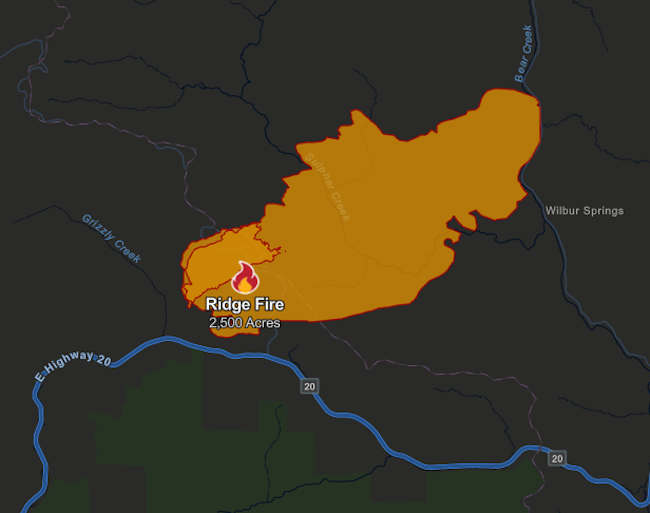
A map of the Ridge fire in Lake and Colusa counties in Northern California. Image courtesy of Cal Fire.

LAKE COUNTY, Calif. — A fire that began Saturday afternoon in the Walker Ridge area has quickly grown in size, prompting evacuations along the Lake and Colusa County lines and closing a portion of Highway 20.

The Ridge fire began at 4:26 p.m. Saturday in the area of Walker Ridge Road and Highway 20, east of Clearlake Oaks at the border shared by Lake and Colusa counties.

Cal Fire has not so far offered a possible cause for the fire, noting that it’s under investigation.

The fire is in an area that has been the site of numerous fires over the years.

Within a few hours the Ridge fire had reached 300 acres. Shortly before 9:30 p.m., air attack reported the fire was approximately 2,304 acres.

About a half hour earlier, Cal Fire had reported on its website that the fire was 2,500 acres, with no containment. That online report later was adjusted to match the report from the scene, putting containment at 10%.

As of Saturday night, Cal Fire said 50 structures were threatened — 30 in Lake County and 20 in Colusa County.

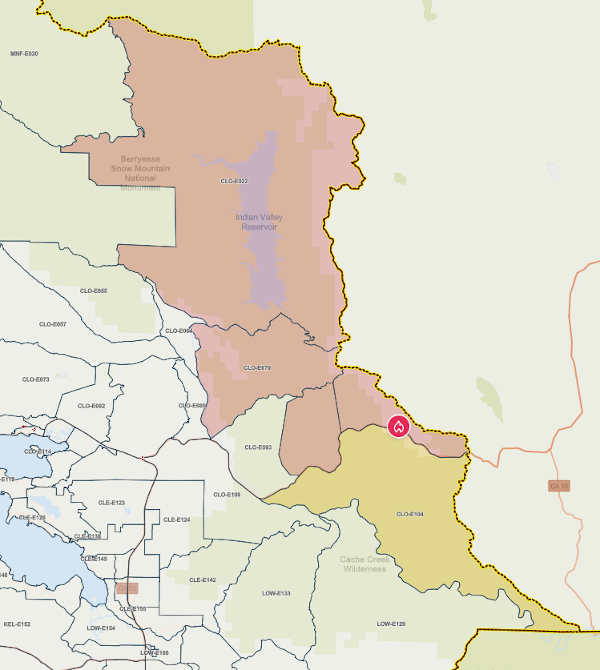
The Lake County Sheriff’s Office issued evacuation orders for several zones along Highway 20 and around Indian Valley Reservoir. The impacted zones are CLO-E070, CLO-E089, CLO-E022 and CLO-E083.

An evacuation warning was issued for CLO-E104.

Zones can be seen here.

In Colusa County, evacuation orders are in effect for Leesville Road to Leesville, Bear Valley Road to Highway 20, Wilbur Springs Road and Walker Ridge Road.

Caltrans said Highway 20 is fully closed east of Clearlake Oaks at Highway 53 in Lake County due to the fire, with no estimated time of reopening.

Officials said that Highway 20 closure extends all the way to E Street in Williams.

Other closures include Highway 16 from Brooks, Leesville Road at King Road and Leesville-Lodoga Road at Bear Valley Road.

Road conditions for state highways can be checked here.

Cal Fire said its priorities Saturday night are to hold the fire west of Bear Valley Road, south of Brim Road and at Highway 20 on the south side.

The agency said the fire is traveling northeast, but firefighters were expecting a potential wind shift at sundown that would send wind from the north.

By Saturday night, Cal Fire had quickly assigned a large contingent of resources to the incident, including 300 personnel, five helicopters, 29 engines, seven dozers, three water tenders and six crews.

Cal Fire said numerous firefighting air tankers from throughout the state were flying fire suppression missions as conditions allowed.

Radio and air traffic reported that Chinook fire helicopters were continuing to work on the incident throughout the night, with work focusing around the head of the fire and the Bear Valley Road area.

Throughout the night more private and agency dozers and water tenders were coming in. At one point, it was reported that 10 dozers were expected to arrive overnight.

Still more equipment is expected to arrive on Sunday, according to the incident command.

Email Elizabeth Larson at This email address is being protected from spambots. You need JavaScript enabled to view it.. Follow her on Twitter, @ERLarson, or Lake County News, @LakeCoNews.


Evacuation zone in Lake County, California. Image courtesy of genasys.com.


West Nile virus detected In Lake County mosquitoes

LAKEPORT, Calif. – Three mosquito samples collected in Lake County tested positive for West Nile virus earlier this month.

The mosquitoes were trapped on July 12 in Kelseyville and July 16 in Lower Lake.

“West Nile virus is a mosquito-borne illness that appears every year throughout California, including Lake County,” said Jamesina Scott, Ph.D., district manager and research director for the Lake County Vector Control District. “Protect yourself from mosquito bites by using an EPA-registered mosquito repellent, especially if you are out at dusk or dawn when mosquitoes are most active.”

The Lake County Vector Control District encourages residents to protect themselves with these steps:

• Eliminate mosquito habitat: Empty and clean any containers that hold water, such as tires, buckets, and planters.
• Maintain swimming pools. Just one neglected swimming pool can produce more than 1 million mosquitoes and affect people up to five miles away.
• Consider mosquito fish: For water sources that cannot be drained, such as ornamental ponds or unmaintained swimming pools, Vector Control offers free mosquito fish to help control mosquito larvae.
• Use insect repellent: Apply an EPA-registered insect repellent containing according to label instructions whenever outdoors.
• Wear protective clothing: When outside during peak mosquito biting times (dawn and dusk), wear long-sleeved shirts and pants.
• Report dead birds to the toll-free state hotline: 1-877-968-2473 or online at https://westnile.ca.gov/report.

“West Nile virus is a serious threat, but by taking these simple precautions, residents can significantly reduce their risk of infection,” Dr. Scott said.

No other West Nile virus has been detected in Lake County in 2024.

In 2023, six Lake County residents fell ill and one died from West Nile virus.

Statewide, 23 California counties have detected the virus this year in mosquitoes and dead birds.

The Lake County Vector Control District provides mosquito control services to our community.

If you need help with a mosquito problem, including reporting a neglected pool or spa, or have an in-ground yellowjacket nest on your property that you want treated, please contact the Lake County Vector Control District at 707-263-4770, Monday through Friday, 7:30 a.m. to 4 p.m., or submit a service request on the agency’s website at www.lcvcd.org.

For more information about West Nile virus, visit https://westnile.ca.gov/.

Information about mosquito repellents can be found on the US Centers for Disease Control and Prevention website at https://www.cdc.gov/mosquitoes/prevention/.

Sports in extreme heat: How high school athletes can safely prepare for the start of practice, and the warning signs of heat illness


The first two weeks of practice are hardest as the body acclimatizes. Derek Davis/Portland Portland Press Herald via Getty Images

High school sports teams start practices soon in what has been an extremely hot summer in much of the country. Now, before they hit the field, is the time for athletes to start slowly and safely building up strength and stamina.

Studies have found that the greatest risk of heat illness occurs in the first two weeks of team practices, while players’ bodies are still getting used to the physical exertion and the heat. Being physically ready to start increasingly intense team practices can help reduce the risk.

I am an athletic trainer who specializes in catastrophic injuries and heat illnesses. Here’s what everyone needs to know to help keep athletes safe in the heat.

Why should athletes restart workouts slowly?

One of the biggest risk factors for developing dangerous exertional heat illnesses is your physical fitness level. That’s because how fit you are affects your heart rate and breathing, and also your ability to regulate your body temperature.

If an athlete waits until the first day of practice to start exercising, their heart won’t be able to pump blood and oxygen through the body as effectively, and the body won’t be as adept at dissipating heat. As a person works out more, their body undergoes changes that improve their thermoregulation.

That’s why it’s important for athletes to gradually and safely ramp up their activity, ideally starting at least three weeks before team practices begin.

Two female soccer players sit on a field and drink from water bottles.
Taking breaks – ideally in the shade – and staying hydrated can help athletes avoid heat illnesses. Ian Spanier/ImageSource via Getty Images

There is no hard and fast rule for how much activity is right for preparing – it varies by the person and the sport.

It’s important to remember not to push yourself too hard. Acclimatizing to working out in the heat takes time, so start slow and pay close attention to how your body responds.

How hot is too hot for working out outside?

Anything that is hotter than normal conditions can be risky, but it varies around the country. A hot day in Maine might be a cool day in Alabama.

If it’s significantly hotter outside than you’re used to, you’re more likely to get a heat illness.

To stay safe, avoid exercising outside in the hottest periods. Work out in the shade, or in the early mornings or evenings when the sun’s rays aren’t as hot. Wear loose clothing and light colors to dissipate and reflect as much heat as you can.

Hydration is also important, both drinking water and replenishing electrolytes lost through sweating. If your urine is light-colored, you are likely hydrated. Darker urine is a sign of dehydration.

Football teammates, without pads or helmets, take a break around coolers of water on a hot August day.
Players need to stay hydrated and start practices slowly, without heavy equipment, to allow their bodies time to acclimate to the exertion and heat. Shawn Patrick Ouellette/Portland Portland Press Herald via Getty Images

What does acclimatization look like for teams?

Once team practices start, many states require heat acclimatization processes that gradually phase in activity, though their rules vary. Some states require 14 days of heat acclimatization. Some require six days or none. Some only require it for football.

Athletes who get a head start on acclimatization can help their bodies adapt faster and more efficiently to the heat. Regardless of what your state requires, all athletes participating in all sports should acclimatize carefully.

Heat acclimatization involves adding more strain during the workout every few days, but taking care not to add too much.

For example, instead of starting the first day of practice with full pads and full contact in football, players might start with just the helmets for the first few days.

A line of linemen practice tackling while wearing helmets and pads.
Contact practices generate body heat, and full pads and helmets hold that heat in. More than 50 high school football players died from heat illnesses between 1996 and 2022. AP Photo/Rogelio V. Solis

Acclimatization is also about limits: Holding practice only once a day in the beginning and capping how many hours players practice each day can help avoid putting too much strain on their bodies too fast. Coaches and athletic trainers must also keep an eye on the wet bulb global temperature – the combination of heat, humidity, radiation and wind speed – to gauge the heat risk to players and know when to limit or cancel practice.

This isn’t just for football. Whether it’s soccer, track and field, softball or baseball, heat illnesses do not discriminate. A Georgia basketball player died after collapsing during an outdoor workout in 2019 – she was accustomed to practicing indoors, not in the heat.

What are warning signs an athlete is overheating?

If a player starts to slow down or gets lethargic, that may be a sign that they’re overheating. You might see evidence of central nervous system problems, such as confusion, irritability and being disoriented. You might see someone stumbling or trying to hold themselves up.

Most of the time, someone with exertional heatstroke will be sweating. They might have red skin and be sweating profusely. Sometimes a person with heat stress can lose consciousness, but most of the time they don’t.
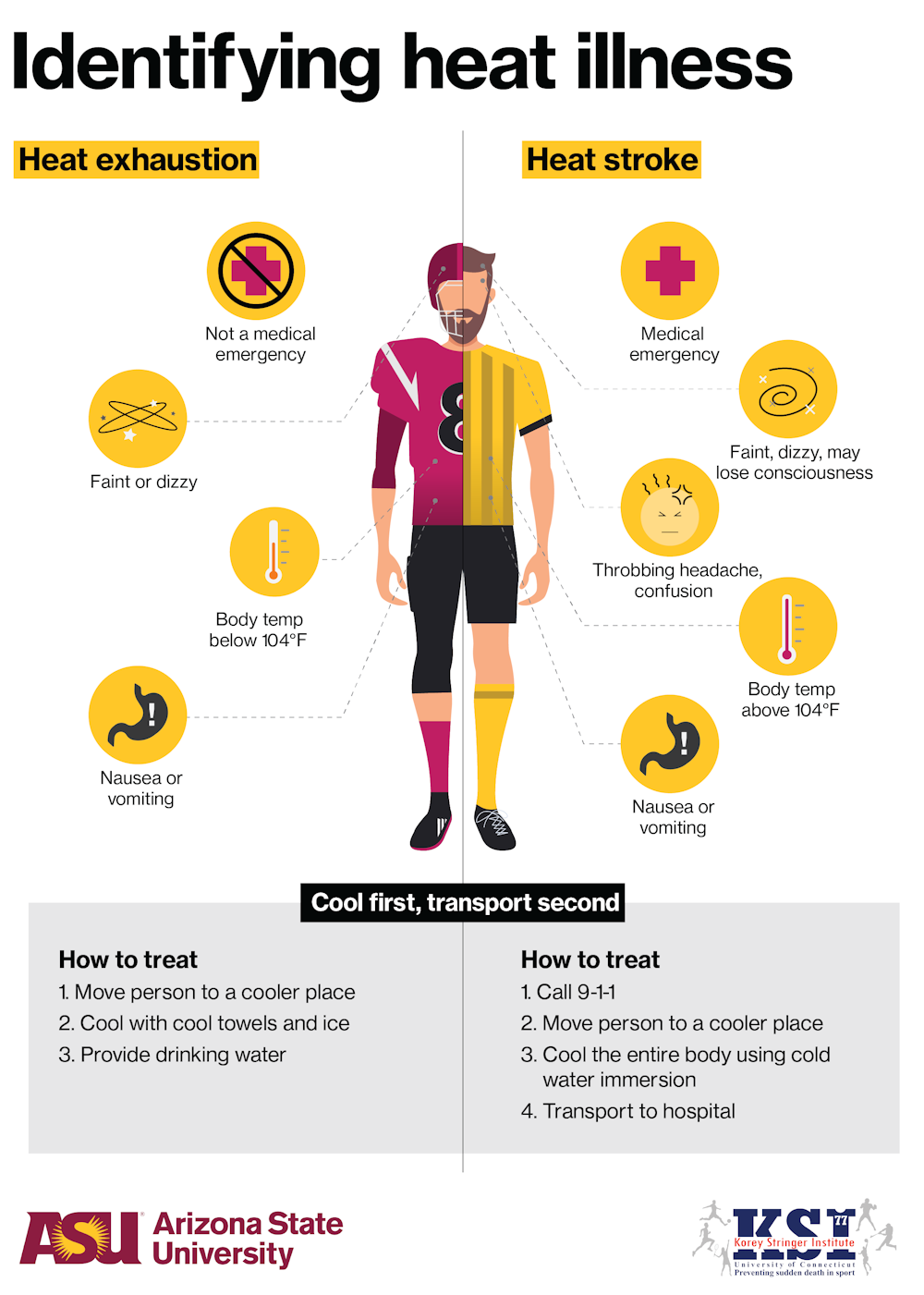
Illustration of an athlete shows symptoms of heat exhaustion and heat stroke
Signs of heat illness in athletes and what to do about it. Alexander Davis for Arizona State University, Korey Stringer Institute

What should you do if someone appears to have a heat illness?

If someone appears to be suffering from heat illness, cool them down as fast as possible. Find a tub you can put the person in with water and ice. Keep their head out of the water, but cool them as fast as possible.

Immersion in a cool tub is best. If you can’t find a tub, put them in a shower and put ice around them. Even a tarp can work – athletic trainers call it the taco method: Put the patient in the middle of the tarp, put some water in with ice, and hold up the sides to oscillate them slowly so you’re moving the water from side to side.

Every sports team should have access to a cooling vessel. About half the states require it. As that expands, these safety practices will likely trickle down to youth sports, too.

If a player appears to be suffering from heatstroke, cool them down and call 911. Having a comprehensive emergency action plan ensures that all personnel know how to respond.

What else can teams do to prepare?

Exertional heatstroke is a top cause of sports-related death across all levels of sports, but proper recognition and care can save lives.

Athletic trainers are vital for sports programs because they are specifically trained to recognize and manage patients suffering from exertional heatstroke and other injuries. As hot days become more common, I believe all sports programs, including high school sports programs, should have an athletic trainer on staff to keep players safe.The Conversation

Samantha Scarneo-Miller, Assistance Professor of Athletic Training, West Virginia University

This article is republished from The Conversation under a Creative Commons license. Read the original article.


Helping Paws: New arrivals

LAKE COUNTY, Calif. — Lake County Animal Care and Control has had several new arrivals to its kennels and is looking to get all of them new homes.

Dogs available for adoption this week include mixes of Australian cattle dog, Chihuahua, German shepherd, Labrador Retriever, pit bull terrier, poodle, pug, Rottweiler and terrier.

Dogs that are adopted from Lake County Animal Care and Control are either neutered or spayed, microchipped and, if old enough, given a rabies shot and county license before being released to their new owner. License fees do not apply to residents of the cities of Lakeport or Clearlake.

Those dogs and the others shown on this page at the Lake County Animal Care and Control shelter have been cleared for adoption.

Call Lake County Animal Care and Control at 707-263-0278 or visit the shelter online for information on visiting or adopting.

The shelter is located at 4949 Helbush in Lakeport.

Email Elizabeth Larson at This email address is being protected from spambots. You need JavaScript enabled to view it.. Follow her on Twitter, @ERLarson, or Lake County News, @LakeCoNews.


Kennel#33(Kora)'s preview photo
Kennel#33(Kora)

Kennel#34's preview photo
Kennel#34

Kennel#7's preview photo
Kennel#7

Kennel#18's preview photo
Kennel#18

Kennel#23(Rocky)'s preview photo
Kennel#23(Rocky)

Kennel#26(Sparkles)'s preview photo
Kennel#26(Sparkles)


Kennel#22's preview photo
Kennel#22

Kennel#14's preview photo
Kennel#14

Kennel#24's preview photo
Kennel#24

Kennel#25's preview photo
Kennel#25

Kennel#8's preview photo
Kennel#8

Kennel#15's preview photo
Kennel#15

Kennel#31(BigBoy)'s preview photo
Kennel#31(BigBoy)

Kennel#27's preview photo
Kennel#27

Kennel#17's preview photo
Kennel#17

Kennel#9's preview photo
Kennel#9


Kennel#6's preview photo
Kennel#6

Kennel#20a(No Collar)'s preview photo
Kennel#20a(No Collar)

Kennel#20b(YellowCollar)'s preview photo
Kennel#20b(YellowCollar)

Kennel#21(RedCollar)'s preview photo
Kennel#21(RedCollar)

Kennel#29a's preview photo
Kennel#29a

Kennel#29b's preview photo
Kennel#29b

Kennel#29c's preview photo
Kennel#29c


Kennel#28a's preview photo
Kennel#28a

Kennel#28b's preview photo
Kennel#28b

Kennel#4's preview photo
Kennel#4

Kennel#10's preview photo
Kennel#10


Kennel#19a's preview photo
Kennel#19a


Kennel#19b's preview photo
Kennel#19b


Space News: Could people turn Mars into another Earth? Here’s what it would take to transform its barren landscape into a life-friendly world


An artist’s illustration of what a terraformed Martian landscape might look like. Mark Stevenson/Stocktrek Images via Getty Images
Sven Bilén, Penn State

Curious Kids is a series for children of all ages. If you have a question you’d like an expert to answer, send it to This email address is being protected from spambots. You need JavaScript enabled to view it..


Is it possible that one day we could make Mars like Earth? – Tyla, age 16, Mississippi


When I was in middle school, my biology teacher showed our class the sci-fi movie “Star Trek III: The Search for Spock.”

The plot drew me in, with its depiction of the “Genesis Project” – a new technology that transformed a dead alien world into one brimming with life.

After watching the movie, my teacher asked us to write an essay about such technology. Was it realistic? Was it ethical? And to channel our inner Spock: Was it logical? This assignment had a huge impact on me.

Fast-forward to today, and I’m an engineer and professor developing technologies to extend the human presence beyond Earth.

For example: I’m working on advanced propulsion systems to take spacecraft beyond Earth’s orbit. I’m helping to develop lunar construction technologies to support NASA’s goal of long-term human presence on the Moon. And I’ve been on a team that showed how to 3D-print habitats on Mars.

To sustain people beyond Earth will take a lot of time, energy and imagination. But engineers and scientists have started to chip away at the many challenges.

A rocky brown landscape and a yellowish sky.
A photo taken of the bleak Martian surface by NASA’s Perseverance rover in June 2024. NASA/JPL-Caltech

A partial checklist: Food, water, shelter, air

After the Moon, the next logical place for humans to live beyond Earth is Mars.

But is it possible to terraform Mars – that is, transform it to resemble the Earth and support life? Or is that just the musings of science fiction?

To live on Mars, humans will need liquid water, food, shelter and an atmosphere with enough oxygen to breathe and thick enough to retain heat and protect against radiation from the Sun.

But the Martian atmosphere is almost all carbon dioxide, with virtually no oxygen. And it’s very thin – only about 1% as dense as the Earth’s.

The less dense an atmosphere, the less heat it can hold on to. Earth’s atmosphere is thick enough to retain enough heat to sustain life by what’s known as the greenhouse effect.

But on Mars, the atmosphere is so slight that the nighttime temperature drops routinely to 150 degrees below zero Fahrenheit (-101 degrees Celsius).

So what’s the best way to give Mars an atmosphere?

Although Mars has no active volcanoes now – at least as far as we know – scientists could trigger volcanic eruptions via nuclear explosions. The gases trapped deep in a volcano would be released and then drift into the atmosphere. But that scheme is a bit harebrained, because the explosions would also introduce deadly radioactive material into the air.

A better idea: Redirecting water-rich comets and asteroids to crash into Mars. That too would release gases from below the planet’s surface into the atmosphere while also releasing the water found in the comets. NASA has already demonstrated that it is possible to redirect asteroids – but relatively large ones, and lots of them, are needed to make a difference.

Terraforming Mars would likely take centuries.

Making Mars cozy

There are numerous ways to heat up the planet. For instance, gigantic mirrors, built in space and placed in orbit around Mars, could reflect sunlight to the surface and warm it up.

One recent study proposed that Mars colonists could spread aerogel, an ultralight solid material, on the ground. The aerogel would act as insulation and trap heat. This could be done all over Mars, including the polar ice caps, where the aerogel could melt the existing ice to make liquid water.

To grow food, you need soil. On Earth, soil is composed of five ingredients: minerals, organic matter, living organisms, gases and water.

But Mars is covered in a blanket of loose, dustlike material called regolith. Think of it as Martian sand. The regolith contains few nutrients, not enough for healthy plant growth, and it hosts some nasty chemicals called perchlorates, used on Earth in fireworks and explosives.

Cleaning up the regolith and turning it into something viable wouldn’t be easy. What the alien soil needs is some Martian fertilizer, maybe made by adding extremophiles to it – hardy microbes imported from Earth that can survive even the harshest conditions. Genetically engineered organisms are also a possibility.

Through photosynthesis, these organisms would begin converting carbon dioxide to oxygen. Eventually, as Mars became more life-friendly to Earthlike organisms, colonists could introduce more complex plants and even animals.

Providing oxygen, water and food in the right proportions is extraordinarily complex. On Earth, scientists have tried to simulate this in Biosphere 2, a closed-off ecosystem featuring ocean, tropical and desert habitats. Although all of Biosphere 2’s environments are controlled, even there scientists struggle to get the balance right. Mother Nature really knows what she is doing.

An illustration shows an astronaut on Mars, standing in front of a red, white and silver modular habitat.
Right now, Mars is a forbidding world, with a minuscule atmosphere, extremely cold temperatures and no liquid water. angel_nt/iStock via Getty Images Plus

A house on Mars

Buildings could be 3D-printed; initially, they would need to be pressurized and protected until Mars acquired Earthlike temperatures and air. NASA’s Moon-to-Mars Planetary Autonomous Construction Technologies program is researching how to do exactly this.

There are many more challenges. For example, unlike Earth, Mars has no magnetosphere, which protects a planet from solar wind and cosmic radiation. Without a magnetic field, too much radiation gets through for living things to stay healthy. There are ways to create a magnetic field, but so far the science is highly speculative.

In fact, all of the technologies I’ve described are far beyond current capabilities at the scale needed to terraform Mars. Developing them would take enormous amounts of research and money, probably much more than possible in the near term. Although the Genesis device from “Star Trek III” could terraform a planet in a matter of minutes, terraforming Mars would take centuries or even millennia.

And there are a lot of ethical questions to resolve before people get started on turning Mars into another Earth. Is it right to make such drastic permanent changes to another planet?

If this all leaves you disappointed, don’t be. As scientists create innovations to terraform Mars, we’ll also use them to make life better on Earth. Remember the technology we’re developing to print 3D habitats on Mars? Right now, I’m part of a group of scientists and engineers employing that very same technology to print homes here on Earth – which will help address the world’s housing shortage.


Hello, curious kids! Do you have a question you’d like an expert to answer? Ask an adult to send your question to This email address is being protected from spambots. You need JavaScript enabled to view it.. Please tell us your name, age and the city where you live.

And since curiosity has no age limit – adults, let us know what you’re wondering, too. We won’t be able to answer every question, but we will do our best.The Conversation

Sven Bilén, Professor of Engineering Design, Electrical Engineering and Aerospace Engineering, Penn State

This article is republished from The Conversation under a Creative Commons license. Read the original article.

Marshalls announces August grand opening for new Lakeport store

The new Marshalls store, shown here during construction this spring, will be located in the former Kmart building in Lakeport, California. Photo by Elizabeth Larson/Lake County News.

LAKEPORT, Calif. — Marshalls said Friday that it’s preparing to open its new store in Lakeport next month, while CareerPoint Lake is set to host a hiring event starting next week.

The new store, to be located at 2017 South Main St. in a portion of the former Kmart store, will have its grand opening from 8 a.m. to 10 p.m. Thursday, Aug. 22.

This week, CareerPoint Lake also announced that it has partnered with Marshalls to host a hiring event for 60 open positions.

Available positions are for cleaning, merchandizing, warehouse and customer service associates. The hiring rate is $16 per hour with a part-time schedule. The company said growth opportunities are available.

In-person interviews will take place from 9 a.m. to noon and 1 to 5 p.m. Monday, July 22, through Thursday, July 25, at CareerPoint Lake, 55 First St., Lakeport. Walk-ins are welcome. For information call 707-262-3116 or email This email address is being protected from spambots. You need JavaScript enabled to view it..

Marshalls is owned by the TJX Companies Inc., reported to be the leading off-price retailer of apparel and home fashions in the U.S. and worldwide.

TJX reported that it has more than 4,900 stores in nine countries. Of those, based on openings since the start of 2024, that number includes more than 1,200 Marshalls stores in the United States.

In addition to Lakeport’s store, in August Marshalls is opening new stores in Florida, New Mexico, New York, Pennsylvania and Texas.

Marshalls is the second retailer to open a new store in the former Kmart site.

Tractor Supply Co. opened its new store on the other end of the building May 19. That’s the second Tractor Supply store in Lake County; the other is in Clearlake.

There’s so far been no confirmation from the city of Lakeport about a business to fill the third spot, located between Tractor Supply and Marshalls.

The addition of another retailer is promising news for the city of Lakeport, which lost a major source of sales tax revenue when Kmart closed the store — reported to be one of the top 25 performers in the United States — at the end of 2019 after about 30 years in operation.

Before the Kmart closure, the city hired The Retail Coach to recruit new businesses to the city.

The company has played a key role in the work to bring Tractor Supply and Marshalls into the city’s retail mix.

Email Elizabeth Larson at This email address is being protected from spambots. You need JavaScript enabled to view it.. Follow her on Twitter, @ERLarson, or Lake County News, @LakeCoNews.
  • 404
  • 405
  • 406
  • 407
  • 408
  • 409
  • 410
  • 411
  • 412
  • 413

Community

  • Lake County Wine Alliance offers sponsor update; beneficiary applications open 

  • Mendocino National Forest announces seasonal hiring for upcoming field season

Public Safety

  • Lakeport Police logs: Thursday, Jan. 15

  • Lakeport Police logs: Wednesday, Jan. 14

Education

  • Woodland Community College receives maximum eight-year reaffirmation of accreditation from ACCJC

  • SNHU announces Fall 2025 President's List

Health

  • California ranks 24th in America’s Health Rankings Annual Report from United Health Foundation

  • Healthy blood donors especially vital during active flu season

Business

  • Two Lake County Mediacom employees earn company’s top service awards

  • Redwood Credit Union launches holiday gift and porch-to-pantry food drives

Obituaries

  • Rufino ‘Ray’ Pato

  • Patty Lee Smith

Opinion & Letters

  • The benefits of music for students

  • How to ease the burden of high electric bills

Veterans

  • CalVet and CSU Long Beach team up to improve data collection related to veteran suicides

  • A ‘Big Step Forward’ for Gulf War Veterans

Recreation

  • Wet weather trail closure in effect on Upper Lake Ranger District

  • Mendocino National Forest seeking public input on OHV grant applications

  • State Parks announces 2026 Anderson Marsh nature walk schedule 

  • BLM lifts seasonal fire restrictions in central California

Religion

  • Kelseyville Presbyterian to host Ash Wednesday service and Lenten dinner Feb. 18

  • Kelseyville Presbyterian Church to hold ‘Longest Night’ service Dec. 21

Arts & Life

  • Auditions announced for original musical ‘Even In Shadow’ set for March 21 and 28

  • ‘The Rip’ action heist; ‘Steal’ grounded in a crime thriller

Government & Politics

  • Lake County Democrats issue endorsements in local races for the June California Primary

  • County negotiates money-saving power purchase agreement

Legals

  • March 3 hearing on ordinance amending code for commercial cannabis uses

  • Feb. 12 public hearing on resolution to establish standards for agricultural roads

How to resolve AdBlock issue?
Refresh this page