 How to resolve AdBlock issue?
News
CLEARLAKE, Calif. – A week of workshops focused on reinventing and revitalizing Clearlake’s Lakeshore Drive drew significant attendance this past week.
Officials said that the participation in the events dedicated to the Lakeshore Drive Downtown Corridor was very high and extremely positive.
On Friday evening, a final workshop and community reception were held, which included the unveiling of the preliminary designs that a design team came up with based on community involvement. Lake County News will have a followup article on the specifics of those preliminary designs.
The “Envisioning the Future of Clearlake’s Downtown Lakeshore Corridor” events earlier in the week began with a walking assessment followed by a workshop in Clearlake City Hall on Tuesday evening.
Mayor Joey Luiz welcomed participants at the workshop at city hall and Paul Zykofsky, associate director of the Local Government Commission, moderated the evening’s event.
Special guest, Irwin Kaplan – former interim city of Clearlake Community Development director and head of the City’s Vision Task Force – discussed how the task force’s document and design guidelines that were used as blueprints for the current Lakeshore Drive planning project.
The Vision Task Force Report can be found at http://theclearlakevisiontaskforce.wikispaces.com/Report .
Kaplan reiterated a quote that still holds true, five years after he said it during the presentation of the task force’s report: “If you don’t know where you’re going, any road will take you there.”
With the new Caltrans grant that is helping to fund the Lakeshore Drive Downtown Corridor project, rather than reinventing the wheel, the Vision Task Force Report is an informative blueprint containing, “precious things to the community,” Kaplan said.
He reminded the audience and community that they were stakeholders, “with a chance to make things better.”
Alluding to the majestic trees that fill the city of Clearlake, Irwin compared improving the city to, “precious oaks – they don’t grow overnight.”
Zykofsky asked the audience for their vision of the Lakeshore corridor in 10 to 20 years down the road.
Community members were asked to write their answers on index cards that were provided. Then, they were asked to put down five different words about what they valued and why they connected with the city. These words were written on sticky notes and pasted together on the wall behind the audience.
The goal for improving Lakeshore Drive was to help design a livable and healthy community, and to “encourage your hopes, not your fears,” Zykofsky said.
Advisory and focus group meetings, along with the Lake County/City Area Planning Council, had weeks earlier helped set the tone for the evening’s events and the rest of the week’s.
Community members would become community designers, using aerial photographs to sketch suggestions and communicate their ideas for changes to the project area.
A slideshow was presented by Zykofsky, with projected improvements, including complete streets that support safe, comfortable and convenient routes, where transit, pedestrians and those using wheelchairs could proceed on the roads. The vision was for streets designed not only for cars but for people.
Several different towns were highlighted, showing their progress. In Shasta County, Cottonwood’s Main Street was featured, with new curb extensions and planters, bringing plazas and parking to life. Its roads, speed zones and gateway designs all changed positively with improvements.
Other examples presented included having 5-foot buffers, for side by side walking, crosswalk visibility and crossing islands. Street improvements included having skewed intersections and right angle-cross walk intersections.
Popular features on Lakeshore Drive are its bike lanes. Ten feet of space is needed for lanes, but it was explained that 12 feet would be even safer.
Back-in angled parking is a feature that is developing in numerous towns. Off Highway 16 in Esparto, the feature, with directions posted, allowed cars to back in, leaving their trunks facing the sidewalks, away from the main road, and car doors opening to a point of safety as well.
Roundabouts, a modern feature, can be found in two places in Lake County. Instead of a three- or four-way stop, roundabouts move traffic at a better capacity, according to traffic studies. Clearlake’s Olympic and Lakeshore Drive was deemed a good example for such a feature. The design team suggested that beautiful intersections could be created with roundabouts.
The city of Clearlake has three lakefront parks, and suggestions for improving them offered at the workshop included farmers’ markets and the kinds of improvements made at Lucerne’s waterside parks, where new grass, benches, lighting and other features were installed.
Having places to sit, lighting, murals and fountains also were highlighted in the presentation.
Kaplan reminded the audience that few cities have a main road that caters to tourist traffic as does Lakeshore Drive.
Community members then became “community designers.” They divided into several smaller groups for the design workshop portion of the evening. At each design table, groups were to design their solutions, writing and sketching their ideas, issues and concerns and present to the rest of the group.
Email Nathalie V. Antus at
LAKEPORT, Calif. – The Lake County Registrar of Voters Office reported that work is set to begin next week on the processing of vote by mail – or absentee – ballots, with testing of computer equipment and software used for ballots also to take place this month.
At 8 a.m. Tuesday, Oct. 16, Registrar of Voter Diane Fridley and her staff will begin processing vote by mail ballots for the statewide Consolidated General Election on Tuesday, Nov. 6.
Fridley said the processing of the vote by mail voter ballots will continue through Election Day as well as, during the official canvass.
Counting of the official ballots will commence on Nov. 6 in the Registrar of Voters Office, Room 209 of the Lake County Courthouse, 255 N. Forbes St. in Lakeport; however, results will not be announced until after the close of the polls at 8 p.m., Fridley reported.
The official canvass will commence at 9 a.m. Wednesday, Nov. 7, and will continue daily – excluding weekends and holidays – until completed, according to Fridley.
Observers are invited to view the processing and counting of the ballots, but shall not interfere with the election process, Fridley said.
Fridley also reported that, pursuant to regulations of the California State Commission on Voting Machines and Vote Tabulating Devices, a logic and accuracy test will be conducted for the ballot tabulation computer and software to be used for the Nov. 6 election.
The test will run on Thursday, Oct. 25, at 2:30 p.m. in the Registrar of Voters Office. All interested persons are invited to observe this test.
Usually, waking up before sunrise is a good way to get a head start on the day.
On Oct. 21, waking up early could stop you in your tracks.
Blame Halley’s Comet. Every year in mid- to late October, Earth passes through a stream of dusty debris from Comet Halley, and the predawn sky lights up with a pretty display of shooting stars.
“We expect to see about 25 meteors per hour when the shower peaks on Sunday morning, Oct. 21,” said Bill Cooke, the head of NASA’s Meteoroid Environment Office. “With no Moon to spoil the show, observing conditions should be ideal.”
Because these meteors streak out of the constellation Orion, astronomers call them “Orionids.”
“The Orionid meteor shower isn’t the strongest, but it is one of the most beautiful showers of the year,” noted Cooke.
The reason is its setting: The shower is framed by some of the brightest stars and planets in the heavens. Constellations such as Taurus, Gemini and Orion provide a glittering backdrop for the display. But that’s not all.
This year, Venus and Jupiter have moved into position with Sirius, the Dog Star, to form a bright triangle in the eastern predawn sky.
On the morning of Oct. 21, blazing pieces of Halley’s Comet will cut straight through the heart of this celestial triad.
To see the show, Cooke suggests going outside one to two hours before sunrise when the sky is dark and the constellation Orion is high overhead.
Lie down on a blanket with a broad view of the heavens. Although Orionids emerge from a small area near the shoulder of Orion, they will spray across the entire sky.
“Be prepared for speed,” he added. “Meteoroids from Halley’s Comet strike Earth’s atmosphere traveling 148,000 miles per hour. Only the November Leonids are faster.”
Speed is important because fast meteors have a tendency to explode. Occasionally, Orionid fireballs will leave incandescent streams of debris in their wake that linger for minutes.
Such filaments of meteor smoke twisted by upper atmospheric winds into convoluted shapes can be even prettier than the meteors themselves.
“It really is a wonderful morning to be awake,” said Cooke. “Just don’t plan on going anywhere in a hurry.”
Dr. Tony Phillips works for the National Aeronautics and Space Administration.
A trust beneficiary with a future right to part or all of the remaining balance of a trust estate provided they survive the current beneficiary is called a contingent remainder beneficiary.
Before the remainder beneficiary’s future rights in the trust can vest, however, he or she must first survive the current beneficiary.
This situation can create tensions between the current and remainder beneficiaries over the use and investment of trust assets while the current beneficiary is alive.
What present rights then do contingent remainder beneficiaries have to protect their future interests in the interim while they are still waiting to inherit?
Consider, for example, a deceased husband whose trust provides lifetime benefits for his surviving second wife and also provides that at her death the remainder goes to those of his children (from his first wife) who survive her.
Here the surviving second wife is the current beneficiary and the deceased husband’s children who survive him are contingent remainder beneficiaries. That is, the children’s right to inherit depends upon their still being alive when the surviving wife later dies; at that time each child’s rights vest provided he or she is still alive.
Under California statutory law contingent beneficiaries do not have an automatic right to receive an annual trust accounting from the trustee, unless the trust provides otherwise. Nonetheless they still have important rights.
All beneficiaries, including contingent beneficiaries, have the right to request the trustee to provide them with information about the trust’s assets, liabilities, receipts (income) and disbursements (expenses) of the trust, the acts of the trustee and the administration of the trust relevant to the beneficiary’s interest, including a complete copy of the trust.
Requesting such information is a preliminary step to showing that there is a problem with the trustee’s administration. The trustee’s response or lack thereof provides the grounds for petitioning the court for relief.
A contingent beneficiary can petition the court to order an accounting, to change the trustee, and/or to instruct the trustee (or successor trustee) as to the proper administration of the trust.
Furthermore, a contingent beneficiary has standing to petition the court to recover trust property that belongs to the trust.
For example, if the trustee improperly distributes assets to himself in violation of the trust, the contingent beneficiary can petition the court to recover the assets for the trust.
The contingent beneficiary does not have to stand by idly while the current beneficiary as a self-serving trustee plunders or misuses the assets of the trust to the detriment of the contingent remainder beneficiaries.
Nonetheless, contingent beneficiaries often fail to act for a variety of reasons, such as, they lack the money to pursue legal action; they do not know their legal rights; or they believe that any court petition would trigger the trust’s “no contest” clause and forfeit their inheritance rights.
A good faith meritorious petition to remove a trustee who is improperly administering the trust, however, will not trigger a no-contest clause that includes an attempt by a beneficiary to remove the trustee.
Conflicts between current and contingent beneficiaries can sometimes be prevented, or at least lessened, by good estate planning before the benefactor dies.
Alternative estate planning approaches vary with each situation. In the above example the deceased husband might have provided some assets or rights of occupancy and/or life insurance to his second wife but left the balance of his estate to his children immediately at his death.
Alternatively, the deceased husband might have at least appointed an impartial trustee (i.e., not his wife or children) to administer his trust estate.
Lastly, a final consideration, where parties are open to compromise, is to seek qualified mediation services. This can avoid costly litigation, emotional turmoil and protracted delays in reaching an outcome.
Dennis A. Fordham, attorney (LL.M. tax studies), is a State Bar Certified Specialist in Estate Planning, Probate and Trust Law. His office is at 55 First St., Lakeport, California. Dennis can be reached by e-mail at
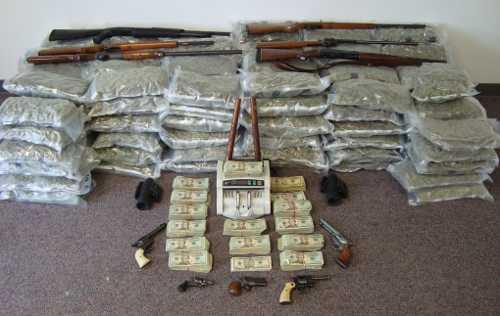
LAKE COUNTY, Calif. – The service of a search warrant on Thursday by the Lake County Sheriff’s Narcotics Task Force has resulted in three arrests, the seizure of 10 firearms, 181 pounds of processed marijuana and $73,220 in US currency.
During the operation, Mark Christopher Ramsey, 49, of Nice; Ricky Huie, 50, of Whitney, Calif.; and Jaime Rodriguez, 39, of Manor Pelham, New York, were arrested, according to Sgt. Steve Brooks.
Brooks said that narcotics detectives secured a search warrant on Wednesday for a residence located in the 1900 block of the Nice-Lucerne Cutoff in Nice. The following day, at approximately 8:30 a.m., they served the search warrant.
As they approached the residence a male subject fled the area on foot, Brooks said. Detectives entered the residence where they located Ramsey and Huie, detaining both without incident.
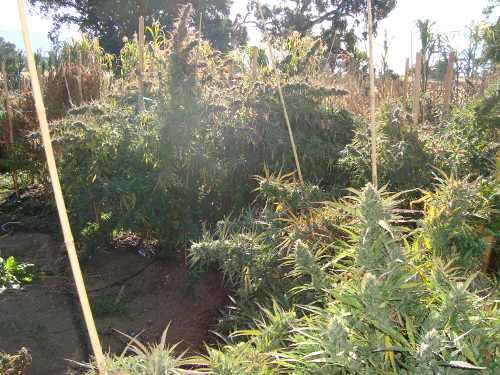
During a search of the property detectives located and seized 215 mature marijuana plants, 660 pounds of drying marijuana and 181 pounds of processed marijuana, Brooks said.
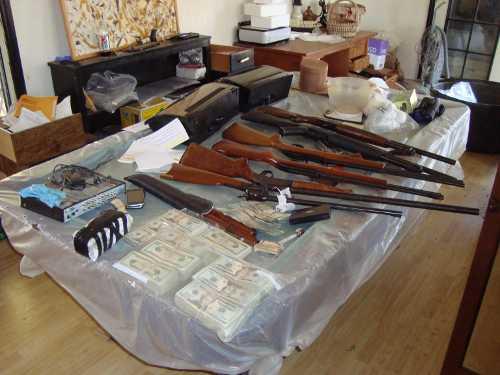
Narcotics detectives also located and seized six rifles, four handguns, one gram of methamphetamine, three sets of night vision monoculars, one money counter and $73,200 in US currency. Brook said most of the money was vacuum sealed in large bags.
Both Ramsey and Huie were arrested for cultivation of marijuana, possession of marijuana for sale, armed in the commission of a felony and possession of a firearm by a convicted felon. Brooks said Ramsey also was arrested for possession of methamphetamine.
While narcotics detectives were at the residence, Rodriguez arrived at Ramsey’s residence, Brooks said.
When contacted by detectives, Rodriguez attempted to drive away. Brooks said detectives were able to stop and detain Rodriguez.
A search of Rodriguez’s vehicle revealed that he was in possession of both methamphetamine and cocaine, and he was arrested for possession of a controlled substance.
Brooks said Ramsey, Huie and Rodriguez were transported to the Lake County Hill Road Correctional Facility and booked.
The Sheriff’s Narcotics Task Force can be contacted through its anonymous tip line at 707-263-3663.

LAKE COUNTY, Calif. – The Lake County Registrar of Voters Office reported this week that the deadline to register to vote in the Nov. 6 election is fast approaching.
To be eligible to take part in the fall general election, new voters and new county residents must register by Monday, Oct. 22, the Registrar of Voters Office reported.
That also is the deadline for reregistration for voters who have moved to a new address, changed their mailing address within the county or changed their name, officials said.
The completed voter registration form must be either personally delivered to the Registrar of Voters office on or before Oct. 22, or be postmarked on or before Oct. 22 and received by mail by the Registrar of Voters office.
Please be aware that pursuant to Section 2101 of the California Elections Code: “A person entitled to register to vote shall be a United States citizen, a resident of California, not in prison or on parole for the conviction of a felony, and at least 18 years of age at the time of the next election.”
Residents may register to vote at the Lake County Registrar of Voters office, Room 209, Courthouse, Lakeport, or may phone the Registrar of Voter’s office at 707-263-2372 for information.
Registration forms also are available at most local post offices, libraries, senior centers, city offices and chamber of commerce offices.