 How to resolve AdBlock issue?
News

It’s a big claim, but Washington University in St. Louis planetary scientist Frédéric Moynier says his group has discovered evidence that the Moon was born in a flaming blaze of glory when a body the size of Mars collided with the early Earth.
The evidence might not seem all that impressive to a nonscientist: a tiny excess of a heavier variant of the element zinc in Moon rocks.
But the enrichment probably arose because heavier zinc atoms condensed out of the roiling cloud of vaporized rock created by a catastrophic collision faster than lighter zinc atoms, and the remaining vapor escaped before it could condense.
Scientists have been looking for this kind of sorting by mass, called isotopic fractionation, since the Apollo missions first brought Moon rocks to Earth in the 1970s, and Moynier, PhD, assistant professor of Earth and Planetary Sciences in Arts & Sciences – together with PhD student, Randal Paniello, and colleague James Day of the Scripps Institution of Oceanography – are the first to find it.
The Moon rocks, geochemists discovered, while otherwise chemically similar to Earth rocks, were woefully short on volatiles (easily evaporated elements). A giant impact explained this depletion, whereas alternative theories for the Moon’s origin did not.
But a creation event that allowed volatiles to slip away should also have produced isotopic fractionation. Scientists looked for fractionation but were unable to find it, leaving the impact theory of origin in limbo – neither proved nor disproved – for more than 30 years.
“The magnitude of the fractionation we measured in lunar rocks is 10 times larger than what we see in terrestrial and martian rocks,” Moynier said, “so it’s an important difference.”
The data, published in the Oct. 18, 2012, issue of Nature, provide the first physical evidence for wholesale vaporization event since the discovery of volatile depletion in Moon rocks, Moynier said.
The Giant Impact Theory
According to the Giant Impact Theory, proposed in its modern form at a conference in 1975, Earth’s moon was created in a apocalyptic collision between a planetary body called Theia (in Greek mythology the mother of the moon Selene) and the early Earth.
This collision was so powerful it is hard for mere mortals to imagine, but the asteroid that killed the dinosaurs is thought to have been the size of Manhattan, whereas Theia is thought to have been the size of the planet Mars.
The smashup released so much energy it melted and vaporized Theia and much of the proto-Earth’s mantle. The Moon then condensed out of the cloud of rock vapor, some of which also re-accreted to the Earth.
This seemingly outlandish idea gained traction because computer simulations showed a giant collision could have created a Earth-Moon system with the right orbital dynamics and because it explained a key characteristic of the Moon rocks.
Once geochemists got Moon rocks into the lab, they quickly realized that the rocks are depleted in what geochemists call “moderately volatile” elements. They are very poor in sodium, potassium, zinc, and lead, said Moynier.
“But if the rocks were depleted in volatiles because they had been vaporized during a giant impact, we should also have seen isotopic fractionation,” he said. (Isotopes are variants of an element that have slightly different masses.)
“When a rock is melted and then evaporated, the light isotopes enter the vapor phase faster than the heavy isotopes, so you end up with a vapor enriched in the light isotopes and a solid residue enriched in the heavier isotopes. If you lose the vapor, the residue will be enriched in the heavy isotopes compared to the starting material,” explained Moynier.
The trouble was that scientists who looked for isotopic fractionation couldn’t find it.

Extraordinary claims require extraordinary data
Asked how he felt when he saw the first results, Moynier said, “When you find something that is new and that has important ramifications, you want to be sure you haven’t gotten anything wrong.”
“I half expected results like those previously obtained for moderately volatile elements, so when we got something so different, we reproduced everything from scratch to make sure there were no mistakes because some of the procedures in the lab could conceivably fractionate the isotopes,” Moynier said.
He also worried that fractionation could have occurred through localized processes on the moon, such as fire fountaining.
To make sure the effect was global, the team analyzed 20 samples of lunar rocks, including ones from the Apollo 11, Apollo 12, Apollo 15, and Apollo 17 missions – all of which went to different locations on the Moon – and one lunar meteorite.
To obtain the samples, which are stored in Houston at the Johnson Space Center, Moynier had to convince committee that controls access to them of the scientific merit of his project.
“What we wanted were the basalts,” Moynier said, “because they’re the ones that came from inside the Moon and would be more representative of the Moon’s composition.”
But lunar basalts have different chemical compositions, Moynier said, including a wide range of titanium concentrations. Isotopes can also be fractionating during during the solidification of minerals from a melt.
“The effect should be very, very tiny,” he said, “but to make sure this wasn’t what we were seeing, we analyzed both titanium-rich and titanium-poor basalts, which are at the two extremes of the range of chemical composition on the Moon.”
The low and high titanium basalts had the same zinc isotopic ratios.
For comparison, they also analyzed 10 Martian meteorits. A few had been found in Antarctica but the others were from the collections at the Field Museum, the Smithsonian Institution and the Vatican.
Mars, like the Earth, is very rich in volatile elements, Moynier said. “Because there is a decent amount of zinc inside the rocks, we only needed a tiny bit to test for fractionation, and so these samples were easier to get.”
What it means
Compared to terrestrial or martian rocks, the lunar rocks Moynier and his team analyzed have much lower concentrations of zinc but are enriched in the heavy isotopes of zinc.
Earth and Mars have isotopic compositions like those of chondritic meteorites, which are thought to represent the original composition of the cloud of gas and dust from which the solar system formed.
The simplest explanation for these differences is that conditions during or after the formation of the Moon led to more extensive volatile loss and isotopic fractionation than was experienced by Earth or Mars.
The isotopic homogeneity of the lunar materials, in turn, suggests that isotopic fractionation resulted from a large-scale process rather than one that operated only locally.
Given these lines of evidence, the most likely large-scale event is wholesale melting during the formation of the Moon. The zinc isotopic data therefore supports the theory that a giant impact gave rise to the Earth-Moon system.
“The work also has implications for the origin of the Earth,” Moynier pointed out, “because the origin of the Moon was a big part of the origin of the Earth.”
Without the stabilizing influence of the Moon, the Earth would probably be a very different sort of place.
Planetary sciences think the Earth would spin more rapidly, days would be shorter, weather more violent, and climate more chaotic and extreme. In fact it might have been such a harsh world, it would have been unfit for the evolution of our favorite species: us.

LOWER LAKE, Calif. – Firefighters on Friday continued to make progress on a fire that began the day before along Highway 29, with their efforts doubling containment and leading to the lifting of an evacuation order.
The 29 Fire was at 300 acres and 60 percent containment Friday evening, with Cal Fire anticipating full containment by 10 a.m. Saturday.
The fire, the cause of which is still under investigation, was sparked Thursday afternoon near Murphy Springs Road.
Cal Fire said that because its personnel levels are being held to peak staffing through the end of October, personnel and resources were readily available to aggressively battle the 29 Fire when it broke out.
Assigned to the incident Friday evening were 363 personnel, 34 engines, 16 fire crews, three bulldozers and one helicopter, Cal Fire said.
Lake County Deputy Administrative Officer Debra Sommerfield told Lake County News that one residence was destroyed and seven outbuildings were destroyed or damaged.
The aggressive efforts by firefighters had saved 10 homes in the fire’s path near Murphy Springs, and prevented the fire getting to another 50 homes in the Twin Lakes Subdivision, Sommerfield said.
Ten acres of vineyard were destroyed, but Cal Fire said firefighters saved another 90 acres of winegrapes.
In addition, Cal Fire said 11 vehicles and 12 pieces of equipment – the latter ranging from a riding lawn mower to a bulldozer – were destroyed by the fire.
Sommerfield said that as of 3 p.m. the mandatory evacuations for the Murphy Springs area had been lifted. She said Murphy Springs Road was being reopened to residents only.
State and local officials said no injuries have occurred.
Cal Fire said Pacific Gas & Electric is continuing to work on restoring power to residences in the area. Earlier in the day it was estimated that about 30 customers were still without power.
Cooperating agencies include Cal Fire, Lake County Fire Protection, Kelseyville Fire, Lakeport Fire, Northshore Fire, South Lake County Fire, Williams Fire Department, US Forest Service, Lake County Sheriff’s Office, American Red Cross, Lake Evacuation and Animal Protection, Lake County Animal Care and Control, the California Highway Patrol, California Department of Corrections and Rehabilitation, Caltrans, Lake County Public Health Department, Lake County Road Department and PG&E.
Email Elizabeth Larson at
LOWER LAKE, Calif. – Fire officials said containment has increased on a wildland fire south of Lower Lake, with some evacuations remaining in place.
The 29 Fire, burning since Thursday afternoon along Highway 29 and Perini Road, remains at 300 acres, having burned a barn and 10 vehicles, according to Cal Fire and county officials.
While Cal Fire said the fire's forward spread has been stopped, the number of personnel assigned to the incident since Thursday night has nearly doubled, rising to 363.
Cal Fire said firefighters are working hard to build and improve fire line, and are aided by 34 engines, 16 crews, one helicopter, three bulldozers and five water tenders.
Following a morning briefing on the fire, Lake County Deputy Administrative Officer Debra Sommerfield told Lake County News that officials were keeping in place mandatory evacuations for the Murphy Springs area.
A Red Cross evacuation shelter at Lower Lake High School remains on standby, Sommerfield said. No community members went to the shelter Thursday night.
She said about 30 Pacific Gas & Electric customers remained without power Friday morning, with the company expecting full power restoration by 8 p.m. Friday.
Highway 29, which had been closed during the initial fire response and then under one-way traffic control overnight, has been fully reopened, Sommerfield said.
Cal Fire said Murphy Springs Road remains closed.
Sommerfield said the fire's cause remains under investigation.
Email Elizabeth Larson at
LAKE COUNTY, Calif. – Lake County’s chapter of Habitat for Humanity has received a sizable grant from the U.S. Department of Agriculture to aid in improving the homes of low-income families.
Agriculture Under Secretary for Rural Development Dallas Tonsager announced that Habitat for Humanity Lake County had received a $55,541 grant to assist 12 homeowners in Lake County with home repairs and rehabilitation.
“For many rural residents, maintaining a home with basic features such as indoor plumbing and safe electrical wiring is often unaffordable,” Tonsager said. “This program supports basic repairs to improve living conditions for rural residents with extremely limited incomes.”
Habitat for Humanity Lake County was among seven California organizations to receive the funds from the USDA Rural Development’s Housing Preservation Grant program.
In California, each of the grants is being leveraged with funding from additional sources totaling over $629,000, the USDA reported.
Other California recipients include:
- County of Nevada: $85,000 grant will assist with repairs for seven homeowners in Nevada County.
- Great Northern Corp.:$45,184 grant will assist six families repair their homes in Siskiyou County.
- Los Coyotes Band of Cahuilla and Cupeno Indians: $47,500 grant will assist in repairing six tribal members’ homes.
- Self-Help Enterprises: $85,000 grant will help preserve seven homes throughout Fresno, Kings, Madera, Merced and Tulare counties.
- Self-Help Home Improvement Project: $95,000 grant will assist in repairing 25 homes in Shasta and Tehama counties.
- Yurok Indian Housing Authority: $47,500 grant will help repair 11 homes of tribal members.
In all, more than $4.4 million in funding was given to recipients from 49 states and the Commonwealth of Puerto Rico to make repairs and improve housing conditions for low- and very-low-income rural residents, the USDA reported.
Funds are provided to intermediaries such as town or county governments, public agencies, federally recognized Indian tribes, and nonprofit and faith-based and community organizations.
These organizations then distribute the funds to homeowners and owners of multi-family rental properties or cooperative dwellings who repair dwellings occupied by low- and very-low-income residents. Funds are not provided directly to the ultimate recipients by USDA.
The USDA said grants may be used to make general repairs, such as installing or improving plumbing or providing or enhancing access to people with disabilities.
Funds also may be used to weatherize and make homes more energy efficient, the USDA reported.
KELSEYVILLE, Calif. – As part of its continuing commemoration of Domestic Violence Awareness Month throughout October, Lake Family Resource Center will host an open house at its domestic violence shelter on Sunday, Oct. 21.
The open house will take place from 12:30 p.m. to 3:30 p.m. at Freedom House, located at 5350 Main St. in Kelseyville.
The event will provide the community with an opportunity to become familiar with the services available at the shelter, see “behind the fence” and hear about the programming available to domestic violence victims.
Freedom House shelters female and male victims with their children up to 18 years of age. Victims stay as long as necessary to prepare for a new safe and secure life after being sheltered. Plan to take advantage of this rare opportunity to tour this secure facility.
The public is encouraged to come and see Freedom House and learn some about domestic violence. Tours and refreshments will be provided.
Lake Family Resource Center is determined to call awareness to the tragedy of domestic violence in the hope of ending it in Lake County.
The center provides a multitude of services to build family stability and strength. The agency supports all Lake County residents in achieving stable, self-sufficient, and healthy families and communities.
Call them at at 707-279-0563 to find out more about what they offer.
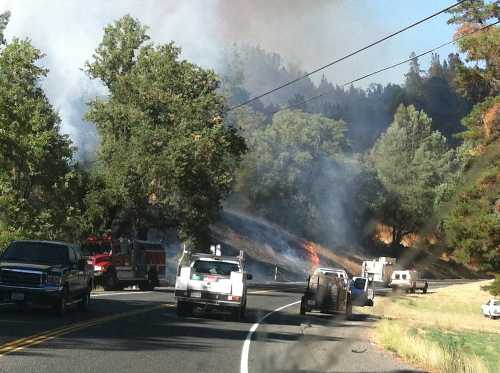
LOWER LAKE, Calif. – A fire that burned hundreds of acres along Highway 29 on Thursday forced mandatory evacuations that were remaining in effect overnight, however state fire officials said the forward progress on the blaze had been halted.
Cal Fire said more than 200 personnel were assigned to the 29 Fire, which was first reported at approximately 2:44 p.m. Thursday along Highway 29 south of Perini Road, between Lower Lake and Hidden Valley Lake.
It quickly grew in size, running up a hillside and endangering numerous nearby structures. By nightfall the fire had scorched 300 acres.
On Thursday afternoon, officials had reported that 10 vehicles and a structure had been burned. Lake County Deputy Administrative Officer Debra Sommerfield said later that it was believed that a barn and some outbuildings had in fact burned.
She said the fire’s cause remains under investigation.
Cal Fire’s Thursday night report said firefighters had achieved 20 percent containment on the fire, and forward spread had been stopped.
Sommerfield said mandatory evacuations in the area of Murphy Springs Road to Perini Road were remaining in effect until 8 a.m. Friday.
However, voluntary evacuations that had been taking place on Candy Lane to Joseph Trail in the Twin Lakes Subdivision were being lifted, Sommerfield said.
The Red Cross set up an evacuation shelter at the old gym at Lower Lake High School, located at 9430 Lake St., according to spokesperson Susanne La Faver.
As of shortly before 9 p.m., no one has come in to the shelter, and staff were putting up signage. “We are prepared,” said La Faver.
She said Lake County Animal Care and Control had left food and crates for any animals that arrived at the shelter with their owners.
Cole Creek Equestrian Center at 4965 Steelhead Drive in Kelseyville, 707-775-5880 or 707-349-1868, and Highland Springs Equestrian Center, 707-279-1903, reported that they were accepting horses that needed to be evacuated from the fire area.
Earlier in the day officials had shut down Highway 29 between the north and south ends of Spruce Grove Road as firefighters worked at the scene.
Sommerfield said Thursday night that one-lane traffic was in effect along Highway 29, with traffic control to stay in place until 8 a.m. Friday.
La Faver said she had traveled through the fire area from Hidden Valley Lake on the way to the Red Cross shelter at Lower Lake High School, and that traffic was moving smoothly.
Cal Fire said more than 30 engines, along with four fire crews, five airtankers, three helicopters and five dozers were assigned to the incident, with work to continue on Friday.
Lake County News will continue to post additional details on the fire as they become available.
Email Elizabeth Larson at