 How to resolve AdBlock issue?
News

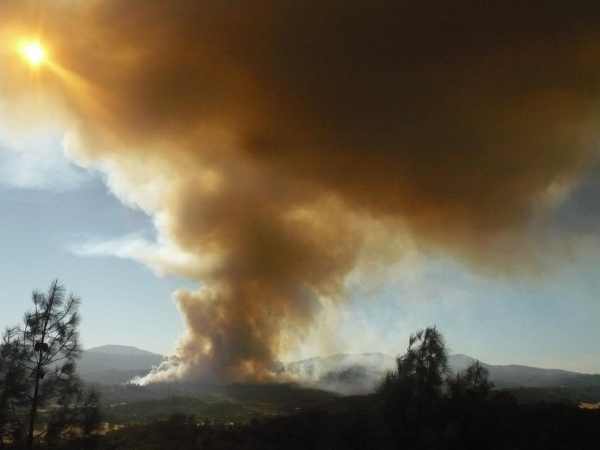
LOWER LAKE, Calif. – A fire burning between Lower Lake and Hidden Valley Lake has reached 300 acres and is requiring evacuations, according to state and local officials.
The 29 Fire, burning on the west side of Highway 29 and Perini Road, was first reported at about 2:45 p.m., as Lake County News has reported.
At 6:20 p.m. Lake County Deputy Administrative Officer Debra Sommerfield said the fire had burned 300 acres.
Sommerfield said the fire also had destroyed one residence and 10 vehicles.
Mandatory evacuations were in place for the area of Murphy Springs Road to Perini Road, Sommerfield said.
She said voluntary evacuations were in place for Candy Lane to Joseph Trail in the Twin Lakes Subdivision, south of Lower Lake.
Sommerfield said the fire was backing up into some nearby vineyards. Radio traffic indicated firefighters were continuing to hit the fire from the ground and the air in order to stop it.
Cal Fire did not give an estimate of containment early Thursday evening.
Highway 29 remains closed between Spruce Grove Road’s northern and southern entries onto Highway 29, Sommerfield said. Traffic was being diverted off of the highway onto Spruce Grove to keep the area clear.
She said a temporary evacuation center was being set up at Lower Lake High School, 9430 Lake St. Red Cross was set to open the center at 7 p.m.
Efforts also were under way to set up a temporary animal evacuation shelter, but Sommerfield did not have final confirmation on those plans.
Cole Creek Equestrian Center at 4965 Steelhead Drive in Kelseyville said it would take in horses that needed to be evacuated. The center can be reached day or night at 707-775-5880 or 707-349-1868.
Paul Marchand said emergency horse boarders also are welcome at Highland Springs Equestrian Center, 707-279-1903.
Cooperating agencies include Cal Fire, which has incident command in cooperation with the Lake County Office of Emergency Services, the California Highway Patrol, California Department of Fish and Game and the Lake County Sheriff’s Office, Sommerfield said.
Lake County News will continue to post updates on the fire throughout the evening.
Email Elizabeth Larson at
THIS STORY HAS BEEN UPDATED.
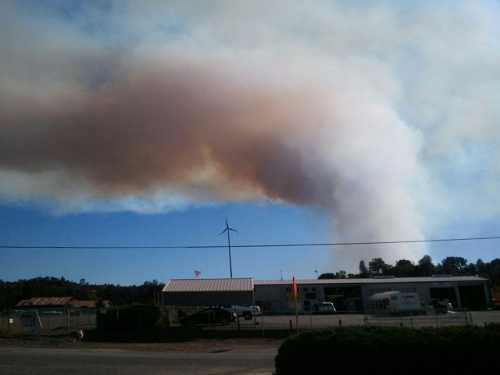
LOWER LAKE, Calif. – Firefighters are responding to a rapidly moving fire along Highway 29 between Lower Lake and Hidden Valley Lake that is threatening multiple structures.
The fire, on the west side of the highway near A Street and Agua Dulce Drive south of the Twin Lakes Subdivision, was first dispatched at 2:45 p.m.
Firefighters arriving at scene initially reported the blaze to be about one to two acres, with a rapid rate of spread and moving uphill, with at least one structure threatened.
Shortly after 3 p.m. the fire was reported to be about 15 acres, burning in oak woodland with a south wind hitting it, resulting in spotting, according to radio reports.
Lake County Fire Chief Willie Sapeta, after arriving at the scene, called for the California Highway Patrol to respond to close the highway’s southbound lane.
Minutes later, Sapeta asked for additional CHP to respond and fully close the highway between Murphy Springs and the origin of the fire, determined to be in the 13000 block of Highway 29 near A Street. He said traffic congestion was becoming a concern.
Central Dispatch reported that Fish and Game also was responding to assist with traffic control.
Cal Fire sent a full wildland dispatch, including air resources, which were hitting the fire. Resources also were responding from different fire agencies around the lake.
Radio reports indicated the fire was moving into a nearby vineyard and was threatening multiple structures.
Shortly before 3:30 p.m. a strike team request was sent out to fire agencies around the county following reports that the fire had grown to an estimated 40 acres.
Radio reports indicated at 3:30 p.m. that power lines were down in the fire area.
Before 4 p.m. there were reports of possible evacuations in the area. The CHP confirmed that evacuations were planned for the Twin Lakes Subdivision.
Just before 4:30 p.m., a strike team of five engines and two dozers were dispatched to the corner of Candy Lane and Lawrence Road off of Highway 29 north of the fire for structure protection.
The CHP said road closures were in effect for Highway 29 at Highway 53 and at Highway 29 and Spruce Grove Road.
At 4:50 p.m Cal Fire reported that the fire had reached 50 acres.
Additional details will be posted as they become available.
Email Elizabeth Larson at
LAKE COUNTY, Calif. – The unseasonably warm fall weather peaks Thursday, as cooler temperatures and the first rains of the season approach Lake County.
Forecasters predict that high daytime temperatures Thursday and Friday – in the mid- to upper-80s throughout the county – will give way to cooler temperatures and chances of rain and showers throughout next week beginning on Saturday evening.
A significant low-pressure system is making its way from the Gulf of Alaska towards Northern California and is expected to arrive Friday evening, bringing with it temperatures closer to average.
Expected daytime highs on Saturday will be in the upper-60s to low-70s with sunny skies, but clouds begin rolling in Saturday night, bringing a slight chance of rain.
Overnight lows will remain moderate, in the upper-40s, according to forecasters.
Chances for rain and showers continue through next Wednesday at this point, with some forecast models indicating a more significant storm event to impact the county on next Thursday.
Email Terre Logsdon at
In the first month since launching, more than 544,000 Californians have submitted a voter registration application using the Secretary of State’s online system.
This is peak registration season; Californians must register to vote by October 22 if they want to participate in the Nov. 6 election.
“Given all of the important issues on the November ballot, I am delighted so many Californians want to make their voices heard,” said Secretary of State Debra Bowen, California’s chief elections officer. “Since registering to vote is easier than ever with the quick online option, there is no excuse for not being ready to vote on Election Day.”
While more than 544,000 people used the online application, and many more are submitting paper applications, county elections officials still must verify eligibility and check for duplicate records before adding someone to the official voter roll, Bowen’s office reported.
Further, many of the applications are registration updates and not first-time registrants, so 544,000 online applications does not equate to 544,000 new voters. Finally, Bowen’s office said official statistics for all registrations will be available Nov. 2.
In California, voter registration application volume peaks each October before a November statewide general election (which comes in even-numbered years).
Hundreds of thousands of registration applications are submitted in the final weeks before a voter registration deadline, especially in presidential election years.
Voter registration applications must be submitted by midnight 15 days before the election. Postmarks count for paper applications, and online applications must be submitted – not started – by midnight on the Oct. 22 deadline (online registration records are time-stamped upon completion).
Voter records are maintained by county elections officials, who will use the next few days after the wave of last-minute applications on Oct. 22 to process and verify every one.
After all 58 county elections officials send their registration data to the Secretary of State, the secretary will compile the final statewide numbers with breakdowns by political district, political party, and more in the final Report of Registration on Nov. 2.
The official California voter registration application is at www.RegisterToVote.ca.gov . Paper applications are available at post offices, public libraries, many government offices and more.
Lake County residents may register to vote at the Lake County Registrar of Voters office, Room 209, Courthouse, Lakeport, or may phone the Registrar of Voter’s office at 707-263-2372 for information.
Keep up with the latest California election news and trivia by following @CASOSvote on Twitter.
LAKE COUNTY, Calif. – A new bill signed by the governor will establish new fees on boats in an effort to increase quagga and zebra mussel prevention efforts around California.
Gov. Jerry Brown’s office reported that on Sept. 23 he signed AB 2443 by Assemblyman Das Williams (D-Santa Barbara). The bill goes into effect on Jan. 1, 2013.
Williams’ bill would impose additional fees of up to $20 – over the current registration fees owners of water vessels pay to the state – which would be used for the implementation of dreissenid mussel monitoring, inspection and infestation prevention programs, according to the Legislative Counsel’s digest.
Dreissenid mussels – including quaggas and zebras – began appearing several years ago in Southern California water bodies.
They’re considered particularly devastating to ecosystems, and fears about their impacts have led to the establishment of inspection and sticker programs in Lake County in order to protect Clear Lake, Blue Lakes and other waterways.
State officials said the funds AB 2443 generates will be directed primarily to two agencies – the Department of Boating and Waterways and Department of Fish and Game – each of which will be administering a separate grant program.
Gloria Sandoval, spokesperson for the Department of Boating and Waterways, said AB 2443’s main purpose was to create a new and dedicated funding source for mussel monitoring and prevention programs around the state.
Sandoval said Boating and Waterways will take the lead in the formation of an advisory group that will set the amount of the new water vessel fees.
The fees that will go to Boating and Waterways will go into the Harbor and Watercraft Revolving Fund, she said.
The agency will administer grants to agencies that manage eligible lakes and reservoirs, according to Sandoval.
Andrew Hughan, a spokesman for the Department of Fish and Game, said that agency also will receive a percentage, which it intends to distribute through a separate grant program.
“We’re going to create a new grant program that does not exist now,” said Hughan, noting that current grant administration staff will take on the duties associated with the new program, with no new staff to be added.
He said each public agency that maintains a body of water will be able to apply for a grant that’s specific to mussel prevention efforts.
Hughan estimated that grants won’t be available until sometime in 2015 in order to give the state time to accumulate the new funds.
“It will take us a year at least to get up and going,” said Hughan.
He said the funds from AB 2443 won’t be going into Fish and Game’s prevention program. “We have our quagga program established and we have that built into our program.”
Hughan said Fish and Game wants to be more aggressive in preventing the spread of the mussels. “We want to do everything we can to help other jurisdictions,” which includes assisting with prevention and public education.
Department of Fish and Game wardens do some enforcement – as is the case in Lake County on Clear Lake – in the midst of their other duties, said Hughan.
“We rely on the local jurisdictions to really step up, which they have been,” Hughan said.
Because the bill is so new, Carolyn Ruttan, invasive species program coordinator with Lake County Department of Water Resources, said the local agency is not yet sure of how the new bill may benefit Lake County’s prevention program.
She said there is the concern that the money will be largely directed to affected lakes and waterways in Southern California rather than to prevention efforts in Northern California.
At the same time, she said Lake is hoping to form partnerships with the neighboring counties of Mendocino and Sonoma – all big players in terms of water resources – in order to consider mussel prevention from a regional standpoint.
“We need to think about this problem together,” Ruttan said.
Email Elizabeth Larson at
LAKE COUNTY, Calif. – Although there has been a 25 percent decline in large truck-involved fatal collisions from (2007-2010) nationally, the California Highway Patrol (CHP) is working daily to save even more lives through enforcement and education.
To further enhance that progress, the CHP will join forces with other law enforcement agencies throughout the US, Canada, and Mexico for the Commercial Vehicle Safety Alliance's Operation Safe Driver, October 14-20.
This operation targets unsafe and aggressive driving by both passenger and commercial vehicle drivers by conducting high visibility enforcement operations and public outreach.
The CHP, in a partnership with the California Trucking Association, will conduct high-visibility enforcement operations and public outreach during the Commercial Vehicle Safety Alliance (CVSA) Operation Safe Driver week. CHP will conduct enforcement activities statewide on highways and local roads.
In California, there has been a 40 percent decrease in the number of collisions involving a commercial vehicle that resulted in the death of a motorist between 2006 and 2010.
“By participating in education and enforcement efforts such as Operation Safe Driver, the CHP is striving to continue to reduce the number of people killed and injured on California’s roadways,” said CHP Commissioner Joe Farrow.
The CHP joins with the CVSA by encouraging motorists to keep in mind the following safety tips when driving near a big truck:
- Stay out of the No-Zone. A No-Zone is an actual blind spot where the car “disappears” from the view of the truck driver.
- Stay visible! Large trucks need a much longer braking distance than a car. Do not cut into a truck’s space; if this happens, it reduces a truck’s much-needed braking distance and restricts evasive action.
- Do not tailgate a truck. The further you are away from a truck the less likely you will be involved in a collision.
- Do not speed. Obey all speed limits.
- Allow plenty of room. Large trucks are almost as wide as your lane of travel. Following too close behind one prevents you from reacting to changing traffic conditions and patterns.
- Buckle up. Wearing your safety belt is the single most important thing you can do to save your life in a crash.
“Protect yourself and your passengers by learning how to share the road safely with large vehicles,” added Commissioner Farrow.
The CVSA, in partnership with the Federal Motor Carrier Safety Administration and state and local law enforcement launched the Operation Safe Driver campaign in 2007 to combat the number of deaths resulting from crashes involving large trucks, buses, and passenger vehicles.