 How to resolve AdBlock issue?
News
WILLOWS, Calif. – The Mendocino National Forest is asking for the community’s input on an application seeking state grant funds to help manage the forest’s off-highway vehicle program.
“The Mendocino National Forest offers over 200 miles of designated OHV trails providing exciting riding opportunities for a wide range of ability levels and vehicle types. In addition, over 1,300 miles of roughly graded roads are available for use by Off-Highway Vehicle enthusiasts,” said Mendocino National Forest Recreation Officer Tricia Christofferson.
The state of California Department of Parks and Recreation and the Mendocino National Forest have maintained a successful partnership for nearly 30 years.
This partnership has provided funding assistance for the management of OHV recreation on National Forest system lands through the California State OHV Grants and Cooperative Agreements Program.
Current regulations mandated by the state of California require annual public participation in this fund allocation process.
Officials are soliciting public input specific to the Mendocino National Forest’s upcoming grant application for the state’s 2012-13 grant cycle.
The grants will support on-going OHV management activities, with categories including ground operations – trail maintenance and facility operation and maintenance – and law enforcement.
In order to view and comment on the Mendocino National Forest’s Preliminary grant application, visit the state of California Web site at www.ohv.parks.ca.gov , then click the grants tab. The site offers instructions for providing comments.
Additionally, a link to the state’s Web site may be found on the Mendocino National Forest Web site at www.fs.usda.gov/mendocino .
Comments may be provided between March 5 and April 1, 2013.
“We appreciate your support and comments on our grant request,” said Christofferson. “Your comments will help the state determine the level of funding to provide the Mendocino National Forest for on-going trail maintenance, facility maintenance and law enforcement.”
Great white sharks off California’s coast will receive additional protection beginning March 1, the date it becomes a candidate species under the California Endangered Species Act.
In February, the California Fish and Game Commission determined that listing white shark as threatened or endangered may be warranted and designated the species as a candidate pursuant to the California Endangered Species Act, or CESA, as Lake County News has reported.
The commission received a petition to list the Northeast Pacific population of white shark as either threatened or endangered in August 2012.
As a candidate species, white sharks will be entitled to the full legal protection afforded to a listed species once notice of the commission’s action is published in the California Regulatory Notice Register, which is scheduled to occur on March 1.
Now that the species is a candidate, the Department of Fish and Wildlife will conduct an in-depth status review to provide the commission with information to aid in its decision on whether or not to list the species.
The status review is slated for completion by early next year.
CESA prohibits the take of listed or candidate species, even if that take is incidental to otherwise lawful activity, unless authorized by permit.
As defined in state law, take means “hunt, pursue, catch, capture, or kill or attempt to hunt, pursue, catch, capture, or kill.”
Anyone who takes a white shark without a permit may be cited for violations of CESA and subject to criminal prosecution.
“While targeted sport and commercial fishing for white shark has been banned in waters off California since the mid-1990s, there were some exceptions that allowed for incidental take and take associated with research activities,” said Marci Yaremko, program manager for state and federal marine fisheries at the California Department of Fish and Wildlife.
“The department now will consider exceptions only on a case-by-case basis, and will authorize take only under permits issued pursuant to CESA,” Yaremko added.
Under CESA, research permits may be issued for bona fide scientific research relating to white sharks.
An incidental take permit may also be obtained by commercial fishing operations or others whose non-research activities may result in take.
Information regarding CESA permitting is available on the department’s Web site, http://www.dfg.ca.gov/habcon/cesa/ .
More information on white shark and CESA candidacy is available on the department’s white shark information page, www.dfg.ca.gov/marine/whiteshark.asp .
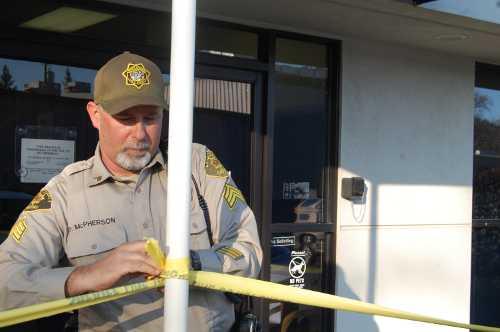
MIDDLETOWN, Calif. – Authorities on Wednesday evening continued to search for a male suspect who allegedly robbed a Middletown bank earlier in the day.
The robbery at Westamerica Bank, located at 21058 Calistoga Road, occurred at about 3:30 p.m. Wednesday, according to reports from the scene.
A male suspect – who claimed that he had a gun – allegedly robbed the bank and then fled on foot, with deputies searching the surrounding area, including the vicinity of nearby businesses and Twin Pine Casino, radio reports indicated.
The suspect was described as a white male adult with a scruffy beard, in his late 20s, with his height estimated at between 5 feet 8 inches tall and 5 feet 10 inches tall.
He was said to be wearing all black clothing, including a hoodie, a bulky jacket and a black hat.
There were reports that the suspect may have been at the Tri-Counties Bank – a short distance away, at 21097 Calistoga Road – about an hour previous to the Westamerica robbery, although Tri-Counties was not hit.
The suspect also was spotted going into Hardester’s Market, located next door to Westamerica Bank, shortly before the alleged robbery.
A group of third grade Girl Scouts from HVL Troop No. 10649 was selling cookies at a table in front of Hardester's Market not more than 60 feet from the entrance to the Westamerica Bank when the robbery occurred, according to Scout Leader Melissa Clark.
Clark said that 15 minutes before the suspect allegedly robbed the bank, one of the girls in the troop tried to sell him cookies when he came out of Hardester’s.
“We saw him hanging around Hardester's and at some point he left Hardester's and went in the bank. We didn't see him go in the bank because we had our backs to him at that point,” she said.
She added, “When we found out he had robbed the bank we grabbed our girls and had them near us.”
Lake County Sheriff’s officials had Westamerica Bank cordoned off with crime scene tape and were continuing the robbery investigation early Wednesday evening.
Lake County News will continue to post updates as they become available.
John Lindblom contributed to this report.
Email Elizabeth Larson at
THIS STORY HAS BEEN UPDATED.
MIDDLETOWN, Calif. – A Middletown bank was reported to be the target of a Wednesday afternoon armed robbery.
Westamerica Bank, located at 21058 Calistoga Road, was reported to have been robbed by a lone male assailant at around 3:30 p.m., according to radio reports.
The suspect was armed, according to reports from the scene.
A be on the lookout described the suspect as a white male adult with pale skin and scruffy facial hair, between 5 feet 8 inches tall and 5 feet 10 inches tall, wearing an all black hoodie, a bulky black jacket and a black hat.
The male suspect was reported to have left the scene on foot, with no vehicle descriptions given, based on reports from the scene.
Radio reports indicated the suspect was seen running down Wardlaw Street toward St. Helena Creek, behind Store 24, with four deputies searching the area.
Parents reported that nearby Middletown High School was placed on lockdown. Lake County News was unable to reach school and district officials to get an update on the situation at the school.
Additional information will be posted as it becomes available.
Email Elizabeth Larson at
CLEARLAKE, Calif. – An early Wednesday morning fire burned a garage in close proximity to several other buildings in a Clearlake neighborhood.
The fire, located at 32nd and Boyles avenues, was first reported shortly after 12:15 a.m. Wednesday, according to reports from the scene.
A caller from 32nd Avenue called in the fire, which also was spotted by a REACH air ambulance pilot who was coming into the city for a landing for a separate call, radio traffic indicated.
The pilot could see the structure was fully involved, and that's what firefighters reported finding when they arrived at the scene minutes later.
Firefighters reported over the radio that there were structures on three sides of the burning garage, and a vehicle also was involved.
No power lines were said to have been affected, but firefighters stated on the radio that they had received reports of a gas leak.
Additional details were not immediately available.
Email Elizabeth Larson at
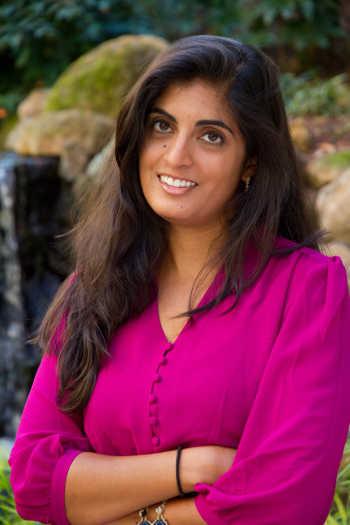
CLEARLAKE, Calif. – With February set aside as a time to commemorate American Heart Month, a new county cardiologist will host a Wednesday evening discussion on how women can have healthier hearts.
Dr. Monica Divakaruni will give the free lecture on basic lifestyle changes that can prevent disease and improve quality of life and health for women from 5:30 p.m. to 6:30 p.m. at St. Helena Hospital Clear Lake's Live Well Clinic, 15230 Lakeshore Drive, Clearlake.
Divakaruni, a leading interventional cardiologist trained at Stanford University, recently joined St. Helena Hospital Clear Lake's staff, as Lake County News has reported.
She's a member of the Adventist Heart Institute, which is composed of experienced cardiologists and cardiovascular surgeons who serve patients in Lake, Napa and Mendocino counties.
Cardiovascular health is a particular health concern in Lake County, according to available health data.
Statistics from California's Office of Statewide Health Planning and Development show that Lake County has a 12.4 percent unadjusted rate for diagnosed heart disease, the highest in the state. Similarly the county has the highest rate of hypertension in the state at 37.3 percent, with Clearlake alone reported to have a rate of hospitalizations due to heart attack that is five times the state average.
The state's most recent county health status rankings place Lake near the bottom – at No. 51 – out of California's 58 counties for its death rate for coronary heart disease, a problem that county health officials have attributed, in part, to the high local smoking rates.
There is increasing impetus on raising awareness not just of heart disease but of its impact on women, many of whom don't think of it as a serious potential health risk.
The American Heart Association said only one in five American women believe that heart disease is her greatest health threat, yet it's the No. 1 killer of women, causing one in three deaths annually – making it deadlier for women than all causes of cancer combined.
Dr. Divakaruni, who has a particular passion for women’s cardiovascular health, said that from 1988 to 2004 the rates of heart attacks in women increased.
The study that reported that increase suggested that the rise in female heart attack cases was related to better risk factor control in men than women. As a result, she said heart disease in women should be getting more notice.
There also has been a steady rise in heart disease rates in younger women – in the 35 to 45 age group – over the last decade, she said.
Women in certain ethnic groups are hit especially hard by heart disease.
Health data from the American Heart Association shows that cardiovascular disease is the leading cause of death for African American women, with 46.9 percent of African American women age 20 and older suffering from it.
Hispanic women similarly are at higher risk, with the disease also being their No. 1 cause of death, and a condition they're likely to develop a decade earlier than Caucasian women, the American Heart Association reported.
However, studies have shown that Hispanic women are more likely to take preventive actions for their family when it comes to heart health.
An American Heart Association report released last week showed that women’s heart disease awareness is increasing.
The number of women who know that heart disease is their leading cause of death has nearly doubled in the last 15 years, the report showed. However, there is still more to be done.
Understanding causes; taking simple steps
Finding a root cause for heart disease is a complicated issue.
Divakaruni said that among the “usual suspects” – smoking, diabetes, high blood pressure and high cholesterol – there is no one particular risk factor that makes women more unhealthy. Rather, it's the conglomerate of them all.
“In my experience, the biggest obstacle is that women, as mothers, heads of their households, workers, and in many other roles, have more difficulty taking time for themselves than others. In a broad general sweep, women are busy caring for others, and more and more, their own health suffers,” she said.
There also probably is still an unconscious bias amongst health care providers, some of whom still look at women as having a lower risk for heart disease, she suggested.
Social class also is believed to have an impact, with factors related to low socioeconomic status – which doctors don't completely understand – probably adding to overall heart disease risk, she said.
At her Wednesday talk, Divakaruni plans to offer guidance on simple lifestyle changes that can prevent heart disease and improve overall cardiovascular health for women.
Some of the basic steps include taking proactive control by knowing your numbers – including blood pressure and cholesterol – and asking your doctor if the numbers are within range.
Then there is the matter of nutrition. She said your mother was right – it's important to eat fruits and vegetables.
“The heart is the most important muscle in the body. But the most important part of your heart is probably what you put on your plate,” she said.
Next, get moving. Divakaruni suggested that 30 minutes a day of physical activity is best, but it doesn't need to be continuous.
“Park farther from the store. Take the stairs. Walk the dog one extra lap around the neighborhood. Little bits add up,” she said.
And just how resilient is the human heart?
“More than you might think,” said Divakaruni.
She said doctors don't yet know how to completely reverse all forms of heart disease, “but even if you've lived the most unhealthy lifestyle, your heart is resilient enough to keep you healthy if you change your habits.”
To RSVP for Divakaruni's lecture or to request a consultation call 707-995-3764.
Email Elizabeth Larson at