 How to resolve AdBlock issue?
News
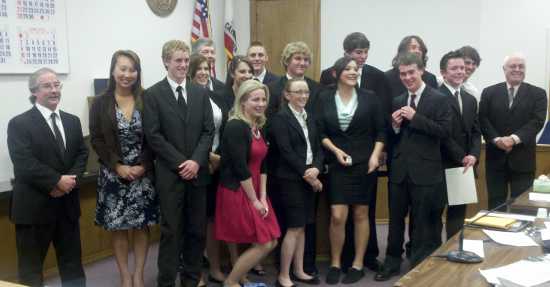
LAKEPORT, Calif. – Two teams of local high school students argued criminal law like professionals during the inaugural Lake County Mock Trial Competition, with one team now advancing to the team state championship.
Middletown High and Upper Lake High students showed off their lawyering abilities during the Friday competition, arguing, objecting, questioning and cross-examining with a poise that earned them commendations from a county judge.
Middletown High took the win, and the team now heads to the state competition in Riverside March 22-24.
The competition was brought to Lake County through a partnership between the Lake County Office of Education and the Lake County Superior Court.
“This is a first, this is a big day for us,” said Lake County Superintendent of Schools Wally Holbrook, who worked to bring the event to Lake County.
He thanked the many volunteers – including his fellow event coordinators, court staffer Suzanne Blavet and Stephanie Wayment of the Lake County Office of Education – for their efforts in developing, organizing and recruiting the new educational event.
Holbrook also appreciated the students for their courage in taking on the competition. “Your ability to stand up and try something new and different will pay off tremendously for you as adults.”
The competition was held in two, two-hour sessions in Lake County Superior Court on Friday, which was a court furlough day.
Judge Richard Martin presided in the morning session, with Judge Michael Lunas hearing the afternoon arguments. Judge Andrew Blum and Judge Stephen Hedstrom had presided over a scrimmage on Feb. 12.
The two teams took turns in the role of prosecution and defense, with the students role playing as witnesses, attorneys and court staff.
They were coached by local criminal defense attorneys Bill Conwell and Anna Gregorian; Jon Hopkins, Lake County's former district attorney; and Lake County deputy district attorneys Trang Vo and Ed Borg. Danielle Bruns and Mike Smith were teacher coaches.
As the event got under way, Wayment thanked Blavet and all of the county's judges for their help bringing the program to Lake County. “Without their support we would not have this program.”
She also congratulated the two teams, who came to the competition through “lots of hard work, lots of learning, lots of determination.”
Wayment added, “You guys have worked hard, you've done great.”
The students also got to meet Mike Curran, a retired sheriff's deputy, and Eddie, his facility use dog.
The charming golden labrador-golden retriever mix, which Curran acquired through Canine Companies for Independence, is used in multiple settings – education, medical and legal. In the case of the latter, Curran said Eddie will act as support for children in interviews and court appearances.
“We're looking forward to using him in as many ways as we possible can,” said Curran.
As Eddie lounged nearby, Curran added, “Even though he doesn't show it, he's thrilled to be here.”
A case centered on constitutional rights
The focus of the Friday competition was the fictional court case of People v. Vega, which had core issues relating to the Fifth Amendment of the U.S. Constitution and the U.S. Supreme Court decision, Miranda v. Arizona.
The defendant, Adrian Vega, a prominent resident of Hidden Valley and child of the city’s mayor, was charged with felony hit-and-run for allegedly leaving the scene after hitting bicyclist and triathlete Cameron Douglas.
According to the prosecution's case, Vega – who had just led his team to victory in a state qualifying swim meet – was driving his father's vintage care home while texting and failed to stop at a stop sign, hitting Douglas, then leaving the scene.
While the victim identified Vega as the driver, and a separate witness offered a description that matched Vega, the defense argued that Toni De Luca – an Italian exchange student who lived with the Vega family – actually was the driver, and that Vega had taken over driving after the crash.
De Luca was wearing similar clothing and also had been seen by an eyewitness standing by the driver's side of the vehicle when he and Vega were leaving the school that night.
The defense also argued that Douglas was a political opponent of Mayor Vega who had stated he would do “absolutely anything” to get Vega from office, which they asserted provided a motivation to identify Adrian Vega as the driver.
They also argued that Douglas' judgment was unreliable as his serious injuries had included a concussion.
Vega, according to the defense, had given a statement to police during custodial interrogation, without being given his Miranda rights. The substance of the statement – given while Vega was sitting in the back of the police car, with the door locked – was taken to be a confession, and resulted in Vega's arrest. His attorneys argued he was never told he was free to leave during the discussion with Officer Kelly Wright, in which Vega had gotten into the police car because it was cold.
While the defense had argued for having Vega's statement thrown out, both judges allowed it to remain, determining that the discussion with police was consensual and noncustodial.
Both Martin and Lunas encouraged, questioned and guided the students through the process.
As the arguments wrapped up in the afternoon session, Lunas lauded the students for their efforts.
“I want to congratulate you all. All of your performances are outstanding. You know the material, you handle yourselves well,” he said.
While in the morning Martin had found for the Upper Lake prosecution, Lunas found the two teams had essentially tied in the afternoon session, which meant that Middletown's prosecution had not proven its case beyond a reasonable doubt.
But the teams were not scored on the judges' decisions solely, but overall performance.
Individual prizes were awarded to Jacob Gill, Becca Pachie, Raphael Roy-Labelle, Trever Warren, Elliot Serena and Leo Saldana before Middletown was announced as the day's winner.
Wayment said the community's financial help is needed to send the team to Riverside.
For more information, contact Wayment at 707-262-4163, email
Participating students (listed alphabetically)
Brittney Benner, Landon Bracisco, Katrina Carrillo, Ellisia Castro-Ibey, Tristan Cockrall, Paloma Colacion, Michael Davis, Mercedes De Los Santos, Jacob Gill, Ashton Hicks, Shahid Hussein, Mason Justice, Morgan Lucas, Chris Monroe, Jessica Mooney, Kaylee O'Bryant, Becca Pachie, Tyler Peters, Gabe Ramos, Jacob Riccio, Raphael Roy-Labelle, Clayton Rudiger, Leo Saldana, Nick Santos, Ian Seevers, Elliot Serena, Trever Warren and Emma Zalusky.
Event coordinators
Suzanne Blavet, Lake County Superior Court; Wally Holbrook and Stephanie Wayment, Lake County Office of Education.
Scoring attorneys
Judge Richard Freeborn, retired, Lake County Superior Court; Lake County District Attorney Don Anderson; Lake County deputy district attorneys Susan Krones, Alan Upton, Sharon Lerman-Hubert and Megan Lankford; Cathy Ward; Joe McGlinchy; David Markham; John Hinely; Mendocino County deputy district attorneys Alexandra Khoury and Josh Rosenfield; and Colton Grove, Laytonville Mock Trial Team member.
Email Elizabeth Larson at
Congressman Mike Thompson (CA-5) and Congresswoman Ileana Ros-Lehtinen (FL-27) have introduced new legislation to help protect veterans and their family members.
H.R. 932, The Support and Defend Our Military Personnel and their Families Act, is bipartisan legislation cosponsored by four other members of Congress.
It allows active duty soldiers and veterans who serve honorably to expedite their own citizenship process as well as that of their family members, and helps to protect those veterans from deportation.
“This legislation will help fix our broken immigration system that unnecessarily burdens active-duty service members, veterans who honorably served our nation, and military families,” said Thompson. “The brave men and women of our armed forces are willing to fight and die for our nation – the last thing they should have to worry about on the battlefield is their family’s immigration status.”
“I thank Mike for his leadership in introducing this important legislation,” said Ros-Lehtinen. “This bill will expedite the U.S. citizenship of the men and women who have sacrificed so much to protect the freedoms and principles upon which our nation was founded. It will also promote family unity by allowing their immediate family members to apply for lawful immigration status.”
Ros-Lehtinen added, “Our patriots have risked their lives to secure our nation’s ideals of opportunity and democracy for future generations to come. These brave servicemen and servicewomen deserve our support; we will keep fighting for their rights.”
“This bill is an important step forward in resolving the serious immigration problems of America’s military families and of military veterans,” said Margaret D. Stock, counsel to the firm Lane Powell PC, and lieutenant colonel (retired), US Army Reserve, Military Police Corps.
Stock is representing Carlos Solorzano, a Lower Lake High School graduate now living in Alaska, who last month had faced a deportation hearing, as Lake County News has reported.
Solorzano, who was raised in the United States, was allowed to remain in the United States and pursue citizenship.
The legislation will help address some of the serious problems with the country's immigration process, according to Stock.
“For too long, our complex and dysfunctional immigration system has imposed grave hardships on military families and military veterans. In the face of Executive Branch inaction on the issue, Congress needs to take action,” Stock said.
The Congressional Research Service reports that more than 45,000 non-citizens are serving in the United States Armed Forces – Army, Air Force, Navy, Marine Corps, and Coast Guard.
In addition, many U.S. citizens serving in the military have family members who are not U.S. citizens. Non-citizen servicemembers and service members with non-citizen family members represent a significant portion of U.S. Armed Forces, and they often face daunting and complex immigration law and procedure.
The Support and Defend Our Military Personnel and their Families Act addresses these immigration concerns of America’s military personnel, our veterans, and their family members back home by:
- Helping veterans who have served honorably become U.S. citizens: The legislation allows soldiers who serve honorably during certain contingency operations to become U.S. citizens expeditiously.
- Reuniting lawful permanent residents serving in active-duty with family members: The bill exempts immigrant petitions filed for the spouses and children of military personnel from numerical caps that limit the number of immigration petitions that can be granted each year.
- Preserving family unity of military personnel: The bill permits immediate family members of military personnel to apply for lawful immigration status, subject to all necessary criminal and security background checks; and codifies existing guidelines for placing active-duty soldiers or veterans into removal proceedings.
H.R. 932 has since been referred to the House Committee on the Judiciary and the House Committee on Armed Services where it awaits further action.
Thompson represents California’s Fifth Congressional District, which includes all or part of Contra Costa, Lake, Napa, Solano and Sonoma counties.
Snow surveyors this week confirmed that water content in the mountain snowpack is well below normal for the date.
The snowpack hasn’t actually lost much water content since the season’s first survey on Jan. 2, when it was 134 percent of normal for that date, but it hasn’t continued to build as winter has deepened because of the continuing warm weather that set in after the storms of late November and early December, the California Department of Water Resources reported.
In other words, the snowpack has not kept pace with the calendar, the agency said.
As a result, Thursday's snow survey showed a snowpack with water content at only 66 percent of average for this time of year, and only 57 percent of the average April 1 reading, when the snowpack normally is at its peak before beginning to melt into the state’s streams, reservoirs and aquifers.
The snowpack – often called California’s “frozen reservoir “– normally provides about a third of the water for California’s farms and communities.
With no precipitation in the forecast, the Northern California region whose storms fill key reservoirs that supply water to farms and millions of Californians is headed toward the driest January-February on record (since 1920).
This is the normally rain-rich, mountainous area from Shasta Lake in the north to the American River basin in the south, where a scant 2.2 inches of rain has fallen since December, 13 percent of average. The next driest January-February was in 1991, with 4 inches of precipitation.
Forecasters note there could be a weather turnaround in March, but it is unlikely late-season storms will make up the water supply deficit.
“Near-record dry weather combined with pumping restrictions to protect Delta smelt are making this a gloomy water supply year,” said Department of Water Resources Director Mark Cowin. “This scenario is exactly why we need an alternative water conveyance system as proposed in the Bay Delta Conservation Plan to both protect fish species and give California a reliable water supply.”
Electronic readings indicate that water content across the state was at 66 percent of average on Friday.
DWR and cooperating agencies conduct manual snow surveys around the first of the month from January through May.
The manual measurements supplement and check the accuracy of the real-time electronic readings from sensors up and down the state.
DWR currently estimates that it will be able to deliver 40 percent of the slightly more than 4 million acre-feet of State Water Project (SWP) water requested for this calendar year by the 29 public agencies that supply more than 25 million people and nearly a million acres of irrigated farmland. The delivery estimate may change to reflect changing conditions.
The final allocation of State Water Project water in calendar year 2012 was 65 percent of requested deliveries. The initial delivery estimate for calendar year 2011 was only 25 percent of requested SWP water.
However, as winter took hold, a near record snowpack and heavy rains resulted in deliveries of 80 percent of requests in 2011.
The final allocation was 50 percent in 2010, 40 percent in 2009, 35 percent in 2008, and 60 percent in 2007.
The last 100 percent allocation – difficult to achieve even in wet years because of pumping restrictions to protect Delta fish – was in 2006.
Despite the dwindling snowpack, most key storage reservoirs are above or near historic levels for the date thanks to November and December storms.
An exception is San Luis Reservoir, a critical offstream reservoir south of the Sacramento-San Joaquin Delta that is only at 69 percent of its historic level for the date.
San Luis normally is filled by pumping from the Delta, but today is only 60 percent full because of the Delta smelt pumping restrictions.
Lake Oroville in Butte County, the State Water Project’s principal storage reservoir, is at 113 percent of its average level for the date (80 percent of its 3.5 million acre-foot capacity).
Shasta Lake north of Redding, the federal Central Valley Project’s largest reservoir with a capacity of 4.5 million acre-feet, is at 107 percent of its normal storage level for the date (79 percent of capacity).
NORTH COAST, Calif. – An Upper Lake man was arrested late in February in Mendocino County for marijuana possession and transportation.
Jon MacDonald, 33, was arrested along with Ukiah resident Richard Gandola, 67, on Feb. 20, according to the Mendocino County Sheriff's Office.
Deputies from the County of Mendocino Marijuana Eradication Team (COMMET) with assistance from the Mendocino County Sheriff's Office Detective Unit served a search warrant at a residence located in the 1400 block of Christopher Court in Ukiah.
Prior to serving the search warrant a vehicle driven by MacDonald was stopped by investigators as the vehicle was leaving the residence. Located inside the vehicle were 7 pounds of processed marijuana packaged in separate 1 pound bags, Mendocino County officials said.
Located at the residence were approximately 31 pounds of marijuana packaged for sale, 46 marijuana plants that were being grown indoors, $46,007 in US currency and money orders, an electronic money counting machine, scales, packaging material and a shotgun.
Gandola arrived at the residence during the service of the search warrant and was determined to reside at the location.
MacDonald was arrested for violation of section possession of marijuana for sale and transportation of marijuana. Officials said he as booked into the Mendocino County jail where he was subsequently released after posting $30,000 bail.
Gandola was arrested for possession of marijuana for sale and was booked into the Mendocino County Jail, according to the report. Gandola was subsequently released after posting $25,000 bail.
Sheriff's officials are seeking additional charges of possession of drug proceeds over $25,000, cultivation of marijuana, maintaining a place to grow marijuana and being armed during the commission of a felony.

LAKEPORT, Calif. – Hundreds of people came out on Thursday evening to see the San Francisco Giants' World Series trophies.
The line stretched around the Marge Alakszay Center next to Terrace Middle School where the public was able to view the trophies for a two-hour period.
On display were the team's 2010 and 2012 trophies, both created by Tiffany & Co.
Dan Camacho of the local Junior Giants organization had successfully applied to bring the trophies to Lakeport as part of a statewide tour.

The trophies will continue on the tour around California and into Southern Oregon through March 26.
To find out more about the tour visit http://sanfrancisco.giants.mlb.com/sf/fan_forum/trophy_tour.jsp .
Email Elizabeth Larson at


LAKEPORT, Calif. – The board for the Area Agency on Aging of Lake and Mendocino Counties voted Thursday morning to terminate its provider contract with the Lucerne Alpine Senior Center after state officials concluded the center's nutrition program presented a risk to public safety.
The unanimous vote followed a report presented by Program Coordinator Mike Parkinson that included a warning that the entire Area Agency on Aging was at risk due to the conditions in Lucerne, which he said a state official called the worst senior food program in the state.
The California Department of Aging analysis – based on a monitoring visit on Feb. 5 – found serious food safety issues and concluded that the center was a “high risk” service provider, with no improvement in the program seen since 2008.
In cases where there is a threat to life, health and safety, or where fiscal irregularity exists, Parkinson said the agency's policies allowed for contract termination to take place immediately. That was the action that he and AAA staff proposed.
Parkinson told Lake County News after the meeting that the Area Agency on Aging's fiscal year 2012-13 contract with Lucerne Alpine Senior Center is for $66,084. Of that amount, $60,805 is for nutrition programs, with $5,279 for outreach, information and assistance programs.
The AAA report on the center for the Thursday meeting also pointed to concerns about payroll taxes not being paid regularly and other outstanding bills, which as of last September totaled just under $19,000.
With the action taken Thursday, the termination will take place in 30 days. The Lucerne center and its board may now appeal, with the matter going to a separate appeal board.
However, without the food contract, the future of the center and what it can offer under its current organizational structure is in question. The senior center's nine member board only has five members, four of whom were reportedly preparing to step down in June.
Parkinson said AAA must send a plan to the state within 15 days that would outline how the impacted seniors would be transitioned to other nutrition service providers.
Jonathan Crooks, executive director for the Lakeport Senior Center, and Pat Grabham, executive director of the Live Oaks Senior Center in Clearlake Oaks, both were on hand and said they were prepared to help cover the seniors whose nutrition needs previously were being met by Lucerne.
Robert Clifton, the center's executive director, and members of his board were present to ask AAA board members not to take the step.
If the center wants to try to get the contract back, they were told they could reapply in the next round of requests for proposals at the end of this fiscal year.
Parkinson reported to the board that, since July 1, 2012, the Lucerne Alpine Senior Center had served 156 individuals 2,658 congregate meals during lunches at the center, with another 102 people receiving 15,813 meals delivered to their homes.
AAA Board Member Bekkie Emery called that a “substantial number” of people served, and asked if there would be a seamless transition.
Parkinson acknowledged that those seniors are at risk in the process, but said other senior centers are willing to step up to handle the extra load. “It would be as seamless, I think, as possible.”
Clifton told the board he hadn't seen the complaint, adding that he didn't understand the “high risk” designation given to the center. He said there had been no hospitalizations or deaths based on the center's food service.
He said the center has followed US Department of Agriculture food guidelines, makes fresh food and has passed county inspections.
The last inspection the center had by the Lake County Environmental Health Department, which according to county records was in November 2011, listed only one noncritical issue relating to food storage.
Parkinson, however, said that the state dietitian's review found expired and undated food in the center refrigerator, and food on the floor. He added that the center needed to adhere to food guidelines set out under the Older Americans Acts, not those established by the USDA.
He also explained at the meeting that during the state's Feb. 5 audit visit center staff was unable to locate a binder that contained information on food safety, training and other policies, and Parkinson said the auditor took that to mean there was no evidence for those measures.
County Supervisor Rob Brown, who was filling in for Supervisor Denise Rushing, asked for Parkinson's opinion of the matter. Parkinson referred them to previous noncompliance issues with the center.
“It's not just about the food?” Brown asked.
“There are other issues as well,” Parkinson said, explaining that the state's auditors had concluded that there had been no improvements in the program since 2008.
One of the officials who had spoken with Parkinson, and who monitors about 17 area agencies on aging around the state, told him during an exit interview that the Lucerne Alpine Senior Center's food program “was the worst program she had ever seen,” he said.
Ted Shimizu, Lucerne Alpine Senior Center's board president, told the AAA board that the center has “astronomical” expenses, and he was planning to resign because he could no longer afford the cost of volunteering.
Another Lucerne senior center board member, Jerry Morehouse, asked, “Is there any solution to this other than terminating the contract?”
Parkinson said AAA has tried to help fix the problems, but the state also was looking at the agency and how it monitored the senior center.
“Our program in the two counties is at risk because of the noncompliance of a single contractor,” he said, noting that they had to make a hard decision or risk everyone else.
Crooks said his center had the capacity “to meet any need that is put forward to us,” both in delivered and congregate meals.
“We will do what's needed to make sure no client goes hungry,” he said, adding that the services can continue without interruption.
AAA members acknowledged that the center is vital to the Lucerne community, but there also were concerns that community members were continuing to loan the center money to keep going.
Morehouse asked if any other local senior centers had been visited by the state. Parkinson said Middletown was visited Feb. 6 and had no issues.
Brown pointed out, “Terminating the contract seems terminal, but it's not.”
AAA members said there was an appeal process, although Carol Huchingson – the AAA chair and Lake County's Social Services Department director – said it has only been used once before, many years ago.
“Noncompliance by a single contractor threatens all, and that's what we have to take seriously,” said Carre Brown, a Mendocino County supervisor serving on the AAA board. “I believe we cannot risk all the other contracts.”
Huchingson said a viable senior center is needed in Lucerne, and that she hoped the AAA board action would finally prompt a rebirth and reorganization at the center.
Rob Brown, who said he had spoken at length with Rushing in preparation for the meeting, said he believed Rushing would support the termination, adding that it was more of an opportunity than a sanction.
AAA Board Member Jerry Chaney said the struggling center was “a very sad thing,” explaining that the board previously had warned the center about getting behind on payroll taxes. He said they had to protect the rest of their contractors.
Carre Brown moved to terminate the contract, with Chaney seconding. The board approved it unanimously.
Huchingson said there is $15,000 set aside in Lake County's budget to assist in the kind of transition between service providers that the vote set in motion.
Email Elizabeth Larson at