 How to resolve AdBlock issue?
News

LUCERNE, Calif. – A public hearing on a proposed water rate increase for Lucerne residents is set to take place next week.
The California Public Utilities Commission will host the meeting on California Water Service Co.’s proposed rate increases beginning at 6 p.m. Friday, April 12, at the Lucerne Alpine Senior Center, 3985 Country Club Drive.
It’s one of a series of public participation hearings to take place in Cal Water’s districts throughout the state between April 8 and May 23.
Last year Cal Water applied to the CPUC seeking rate increases in all of its districts totaling $92,765,000 or 19.4 percent in 2014; $17,240,000 or 3 percent on Jan. 1, 2015; and by $16,950,000 or 2.9 percent on Jan. 1, 2016.
In the Redwood Valley-Lucerne Service Area, Cal Water proposes rate increases of $818,000, or 57 percent in January 2014; and of $48,700, or 2.2 percent, in January 2015; followed by a decrease of $27,400, or -1.2 percent, in January 2016.
The rate application explains that Cal Water is offering two options for the rate increases, a phased-in approach that it says will cost ratepayers in Lucerne an additional $451,450 due to interest collected in the second and third years – but which the company believes will have less impact on ratepayers – and a non-phased-in approach.
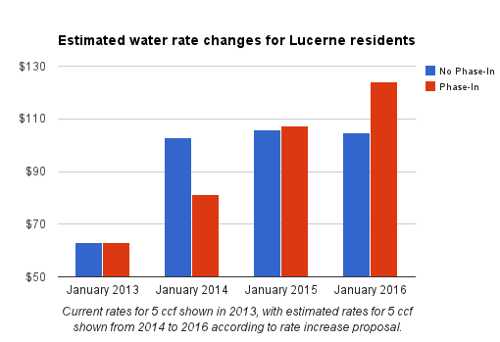
In Lucerne the phased-in rates would total $430,250, or 30 percent, in 2014; followed by an increase in revenue by $430,250, or 23.1 percent, in 2015; and $430,250, or 15.8 percent, in 2016.
If rates were not phased in, they would be $818,000 beginning in January 2013; $48,700 in January 2015; and -$27,400 in January 2016.
It’s estimated that the bill for a typical customer using 5 CCF of water per month – one CCF is 100 cubic feet – would rise from the current rate of $62.85 to $124.22 under the phased-in plan and would top out at $104.59 under the plan with no phase-in.
Cal Water is seeking the rates to cover the following expenses, according to the application:
- $136,000 – district operations and maintenance costs;
- $108,000 – employees;
- $103,000 – water infrastructure improvements between 2013 and 2016;
- $43,000 – increased purchased water expenses due to an increase in the unit cost of power;
- $38,000 – to retain the same level of employee health care, pensions and retiree health care benefits for general office personnel, which the company said has increased faster than inflation.
An administrative law judge will preside over the hearing in order to take community comment on the proposed rate hikes.
Additional details about the proposed increases can be found at www.calwater.com/rates/grc or at https://www.calwater.com/bill_inserts/luc/20130325_Notice_of_public_participation_hearing_-_Lucerne.pdf .
Cal Water customers who are unable to attend the hearing or who wish to file comments directly with the Public Advisor’s Office can send an email to
All comments will be circulated to the commissioners, assigned administrative law judge and other CPUC staff working on the Cal Water proceeding.
A copy of Cal Water’s application and further information may be obtained from the company’s local offices by calling 707-274-6624, visiting http://www.calwater.com/rates/grc or contacting Cal Water’s headquarters at 1720 N. First St., San Jose, telephone 408-367-8200.
Email Elizabeth Larson at
LAKE COUNTY, Calif. – Lake County Animal Care and Control is offering three new cats for adoption this week.
These three males have all been altered and have had their shots in preparation for joining your home. They range in age from 2 to 3 years.
In addition to spaying or neutering, cats that are adopted from Lake County Animal Care and Control are microchipped before being released to their new owner. License fees do not apply to residents of the cities of Lakeport or Clearlake.
If you're looking for a new companion, visit the shelter. There are many great pets there, hoping you'll choose them.
The following cats at the Lake County Animal Care and Control shelter have been cleared for adoption (other cats pictured on the animal control Web site that are not listed here are still “on hold”).
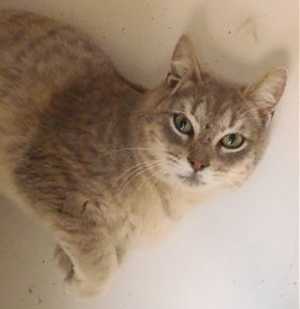
Gray male tabby
This gray male tabby is 2 years old.
He weighs 8 pounds, has a short coat and gold eyes, and has been neutered.
He’s in cat room kennel No. 20, ID No. 35866.
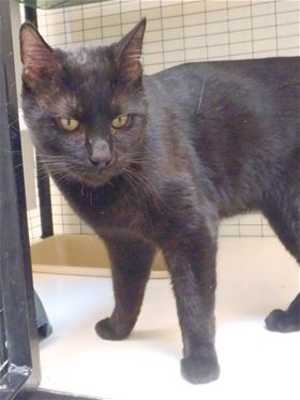
Black male cat
This black male cat is 2 years old.
He weighs 8 pounds, has a short coat and gold eyes, and has been altered.
Find him in cat room kennel No. 49, ID No. 35862.
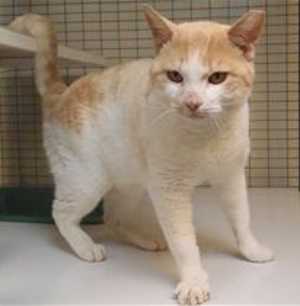
Male domestic short hair
This male domestic short hair mix is 3 years old.
He has a white and orange coat, weighs 14 pounds and has gold eyes, and has been altered.
He’s in cat room kennel No. 105, ID No. 35839.
Adoptable cats also can be seen at http://www.co.lake.ca.us/Government/Directory/Animal_Care_And_Control/Adopt/Cats_and_Kittens.htm or at www.petfinder.com .
Please note: Cats listed at the shelter's Web page that are said to be “on hold” are not yet cleared for adoption.
To fill out an adoption application online visit http://www.co.lake.ca.us/Government/Directory/Animal_Care_And_Control/Adopt/Dog___Cat_Adoption_Application.htm .
Lake County Animal Care and Control is located at 4949 Helbush in Lakeport, next to the Hill Road Correctional Facility.
Office hours are Monday through Friday, 8 a.m. to 5 p.m., and 1 p.m. to 3 p.m., Saturday. The shelter is open from 10:30 a.m. to 4:30 p.m. Monday through Friday and on Saturday from 1 p.m. to 3 p.m.
Visit the shelter online at http://www.co.lake.ca.us/Government/Directory/Animal_Care_And_Control.htm .
For more information call Lake County Animal Care and Control at 707-263-0278.
Email Elizabeth Larson at

One of the most economical ways to start a garden is to start your plants from seed. This will open up a whole new world of varieties other than the normal selection of plants normally found at the “big box” stores.
To get an early start on the season, it is best to start many of your plants indoors. Determine which seeds you will start indoors and which you will direct-seed outdoors. Then follow these steps.
Fill the containers
Moisten your medium before filling your planting containers. Use a dishwashing tub or wheelbarrow to hold the planting medium and slowly add water until the mix is thoroughly moistened but not soggy.
The best way to prevent uneven filling in seedling trays is to pile the mix in the center of the tray and gently sweep it into the cells in an outward motion with your hands.
Sow carefully
Mist the mix with a spray bottle just before you place the seeds. This gives the seeds a better chance to maintain contact with the moisture they need to sprout.
Drop the seeds onto the surface of the mix, spacing them as evenly as possible. Cover them with more moist mix to the required depth as stated on the seed package.
In the case of seeds that need light to germinate, sprinkle some dry mix on the surface of the moist mix, drop the seeds on top, then mist with the spray bottle.
Large seeds should be pushed into the mix to the required depth with your finger. Maintain consistent moisture with regular and thorough misting.
Space correctly
Sow seeds close together in case some of them fail to germinate successfully. Once the emerging seedlings are tall enough to grasp, remove the extra ones so those remaining are evenly spaced and not crowded.
The correct spacing between seedlings depends on how much room the mature plant needs. Most of the time you want to thin to one healthy plant per container for transplanting.
To prevent damage to the root system of the remaining plant(s), thin by cutting with nail scissors at soil level instead of by pulling.
Keep seeds warm and moist
Cover the flats with plastic wrap, tray domes, or glass to keep the environment humid and place them near a heat vent or on a heat mat made especially for seed starting.
Most seeds germinate well at about 70 degrees F. To prevent the seeds and seedlings from drying out, keep the soil damp but not wet, until the seedlings are several inches tall, then gradually taper off watering.
Mist with a spray bottle or set the trays into water so the mix wicks up the moisture from below.
Give them light
At the first signs of sprouting, uncover and move the containers to a bright spot – a sunny window, greenhouse, or beneath a couple of ordinary fluorescent shop lights (4-footers with two 40-watt bulbs).
Lights provide a steady source of high-intensity light. Short days (especially a problem for north-facing windows) restrict window light, and your seedlings need 12 to 16 hours of light a day.
Suspend the lights to 2 inches above the plants, gradually raising them as the seedlings mature. If plants have to stretch or lean toward the light, they can become weak and spindly. Turn the lights on and off at the same time each day, or hook them up to an electric timer.
Decrease heat
Seedlings can stay cooler than germinating seeds. Move them away from radiators and air vents, or off the heating mat, as soon they have germinated.
Apply fertilizer
If you are using a soil-less mix without compost, begin to fertilize your seedlings as soon as they get their first true leaves; these emerge after the small, round cotyledon leaves.
Water with a half-strength solution of liquid fish or seaweed fertilizer every week or two. Use either a spray bottle or add the fertilizer to the water you set the trays in if you're using the wick-up method described above.
Give them more space
If the seedlings outgrow their containers or crowd one another, repot them into larger containers filled with a mix that includes compost.
Extract the seedlings with a narrow fork or flat stick, and handle by their leaves and roots to avoid damaging the fragile stems. Tuck the seedlings gently into the new pots, and water them to settle the roots.
Pet your seedlings
Lightly ruffling seedlings once or twice a day with your hand or a piece of cardboard helps them to grow stocky and strong. Or, set up a small fan to gently, continuously blow on your seedlings.
Toughen them up
About one week before the plants are to go outside, start acclimating them to the harsh conditions of the big world. Gardeners call this “hardening off.”
On a warm spring day move the containers to a shaded, protected place, such as a porch, for a few hours.
Each day – unless the weather is horrible – gradually increase the plant’s exposure to sun and breeze. At the end of the week leave them out overnight; then transplant them into the garden.
To learn which seeds to sow in Lake County gardens, contact the Lake County U.C. Master Gardeners.
For even more detailed information regarding seed starting, soil “recipes,” when to plant, and how deep to sow, attend the Spring Garden Event on May 5 at the Agricultural Center, 883 Lakeport Blvd., Lakeport. The event will take place from 9 a.m. to 1 p.m.
For more information on the event, contact University of California Cooperative Extension at 707-263-6838 or at http://celake.ucanr.edu/Master_Gardener/Educational_Events_6/ .
U.C. Master Gardeners are a group of selected, trained residents who work as volunteer staff for the U.C. Cooperative Extension (UCCE), the public service arm of the University of California Division of Agriculture and Natural Resources. U.C. Master Gardeners provide accurate horticultural information on vegetable gardening, trees, soils, lawns, ornamental horticulture, insects, diseases, use of pesticides, and other related topics based on research of the University of California and other recognized research institutions.
Dianne Kaufman is a University of California Master Gardener.
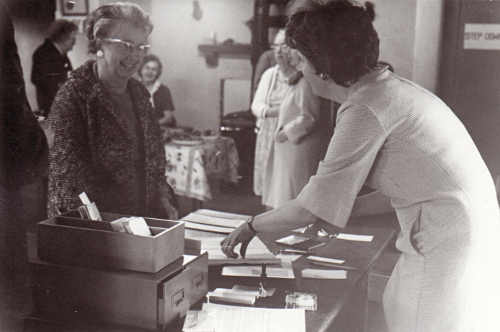
MIDDLETOWN, Calif. – Middletown’s Gibson Library has a sibling – the Montclair Branch of the Oakland Public Library.
The Montclair Branch Library displays the Storybook architecture common in that part of Oakland, but the interior bears similarities to Middletown’s Mission-style library.
The libraries share an L-shaped floor plan, an open beamed ceiling, a fireplace, a large picture window and the odd interior shingled ledge over the window. The libraries are the offspring of one man’s charity to the communities where he lived.
Renowned library benefactor Andrew Carnegie made his money in steel; lesser-known library benefactor Chauncey W. Gibson made his money in banking, soap and carbon dioxide.
Carnegie donated more than 2,500 hundred libraries in the United States and other countries; Gibson donated three libraries in Northern California. Middletown doesn’t have a Carnegie Library, but it does have a Gibson.
Chauncey Walstein Gibson was born in 1838 in Grand Blanc, Michigan, to Charles and Artemisia Gibson.
As a young man, Gibson migrated to Southern California, where he began his business empire. He succeeded in several enterprises, including building 32 carbon dioxide factories around the country.
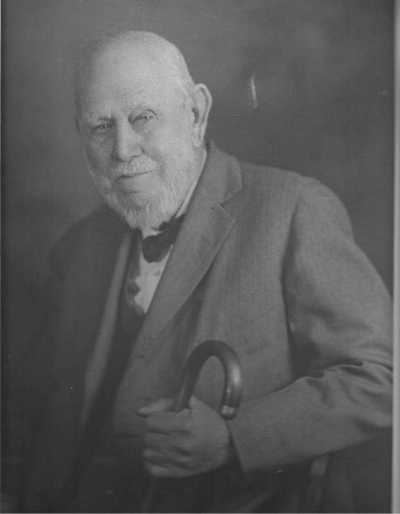
After he retired Gibson devoted himself to charity. The deaths of his son Houdd in 1919 and his wife Lovina in 1921 left him with no living immediate family, two other sons having died in childhood. He began to donate his extensive estate to benefit his hometown, Oakland, and his vacation home, Middletown.
In the 1920s Gibson donated his own home in Oakland to the Children’s Home Society and he donated another home for poor women in Oakland. In 1928 he donated Castle Hot Springs Resort, renamed Camp Houdd Gibson in memory of his son, near Middletown to the Salvation Army.
Gibson valued books and libraries, and favored them in his charitable contributions. Throughout the 1920s he donated thousands of dollars to buy books for various branch libraries in Oakland. More than 3,400 books from Houdd Gibson’s personal collection went to Oakland’s Melrose branch library, and in 1929 more books from Houdd’s collection seeded Middletown’s first library, which was dedicated on May 20, 1929.
Local organizations contributed funds to the Chauncey Gibson Library which opened in Middletown’s Justice Court building. By late September a library association had formed and Retta Reynolds was ensconced at the librarian’s desk.
Not content with donating books and money to libraries, Gibson progressed to building libraries. Thanks to Chauncey Gibson’s generosity, both Oakland and Middletown received funds to build libraries just as the Great Depression struck.
In early November, 1929, Chauncey Gibson offered to fund the construction of a permanent library building in Middletown, if the citizens would provide the land.
The newly-formed Middletown Luncheon Club began a search for property and in December “The Gibsons” (probably Chauncey Gibson and other relatives from the Bay Area) selected a site at the corner of Calistoga and Callayomi streets. Construction began in January and the library was finished in the spring.
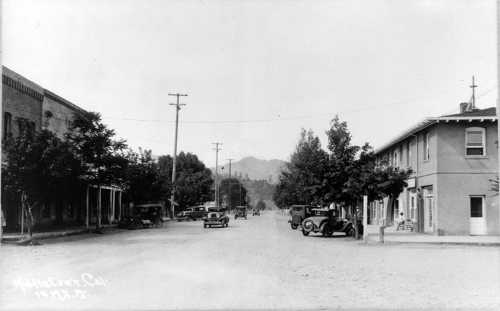
Townspeople elected Irene Liquorish, “Sim” Chapman, L.J. Gamble, Fannie Poston, William Abercrombie, Robert Cannon and Ed Runyon, with alternates Cora Herrick, Harry Sandahl and James Reese as the first library board of directors in April, 1930.
Middletown residents attended the dedication of the permanent Chauncey W. Gibson Library en masse over the first weekend in May 1930. Heavy rain forced some events indoors, but did not prevent two days of festivities including a grand ball, a concert and dedication exercises in the Middletown pavilion.
The Salvation Army band traveled from Lytton Springs in Sonoma County for the occasion. Charles W. Fisher of the Oakland library board represented Chauncey Gibson and spoke about Mr. Gibson’s many charitable causes.
Chauncey Gibson died in June 1930 and was buried in Grand Blanc, Michigan, beside his wife Lovina and their three sons.
Gibson had planned to set up an endowment fund to maintain and support the Middletown library, but he died before accomplishing that task. The library suffered for that lack for many years and the townspeople worked hard to support it.
Community organizations including the Native Daughters of the Golden West (NDGW), the Social Seniors (also called the “Over 60 Club”) and the Middletown Luncheon Club funded the library with concerts, teas, card parties and other events.
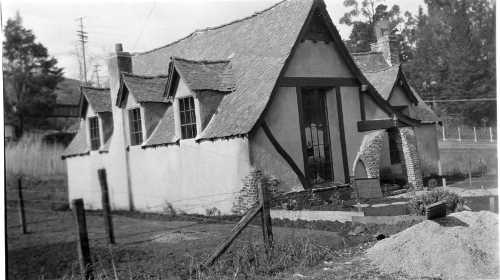
In the middle 1950s, the Over 60 Club agreed to pay for utilities and insurance, to maintain the grounds and to keep the library open one day a week in exchange for meeting space. The library’s board of trustees managed to raise money to replace the library’s leaky roof in 1960.
The Middletown Library participated in the state-run, federally-funded Lake County Library Demonstration Project which operated 1971-74. The Library Project installed many new books and a telephone in the library. Under the Library Project, paid employees replaced the NDGW volunteers who had run the library.
In 1974 Middletown joined the newly-established Lake County Library system. The county of Lake assumed the burdens of funding all public libraries in Lake County, but that has not guaranteed vast amounts of money.
All county services suffered drastic cuts and library hours were reduced at all branches following the passage of Proposition 13 in 1978. Periodic bad economic times have limited the Gibson Library’s funding over the years, but the county’s careful fiscal management has kept the library open through the hard times.
In 2000 volunteers and the county working together created a children’s room in a back room of the library. Public computers with Internet access were installed in the Gibson Library in the same year. The Lake County Library system automated in 2001, which allows access to the online catalog shared among Lake, Sonoma and Mendocino counties.
Library supporters formed the Friends of the Middletown Gibson Library in 2000 to celebrate the library’s 70th anniversary, to raise money for the library and to publicize the library. This active organization continues to provide valuable assistance for Middletown’s library with money earned from book sales.
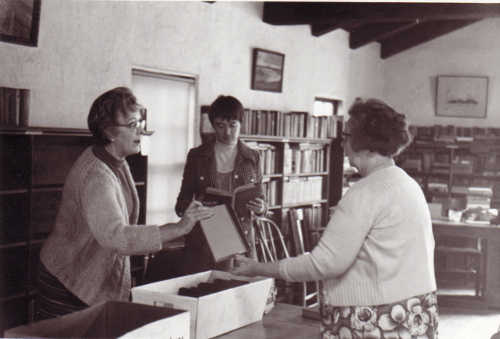
Middletown’s historic library is showing its age, and with an increasing population and expanding library services, the too-small library is being replaced.
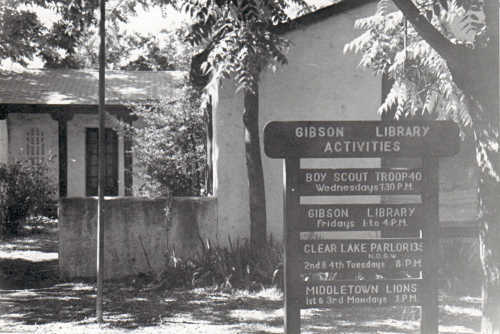
The county of Lake began preparing in 2000 for a new library. The Kappe and Du architectural firm of San Rafael designed the building that will house both the new library and a new senior center at 21256 Washington St. Construction began in September 2011 and is nearly complete.
Opening day ceremonies are scheduled for 3:30 p.m. to 5 p.m. Friday, April 12.
With Middletown’s new library opening soon, the future of the Gibson Library remains uncertain. The Montclair library is still operating, but Oakland’s other Gibson Library is now a day care center.
Time will tell if Chauncey Gibson’s gift to Middletown may one day have a second career.
Acknowledgements
The Lake County Library’s collection of microfilmed local newspapers provided much information for this story.
The Oakland Library’s Oakland History Room contributed information about Chauncey Gibson and his Oakland philanthropic ventures.
The Web site of the Friends of the Oakland Public Library has more history of the Montclair branch; http://www.fopl.org/wordpress/?page_id=90 .
Harry Gibson, Chauncey Gibson’s great-great nephew, contributed some genealogical information and Chauncey’s portrait.
Jan Cook has lived in Lake County for about 40 years. She works for the Lake County Library, is the editor of the Lake County Historical Society's Pomo Bulletin and is a history correspondent for Lake County News. If you have questions or comments please contact Jan at
LAKE COUNTY, Calif. – With the arrival of spring, it’s a good time to bring home a new friend to share your home and spend time with in the great outdoors.
This week adoptable dogs from Lake County Animal Care and Control and the SPCA of Clear Lake are featured. A number of breed mixes are available.
In addition to the animals featured here, all adoptable animals in Lake County can be seen here: http://bit.ly/Z6xHMb .
SPCA OF CLEAR LAKE
‘Bruiser’
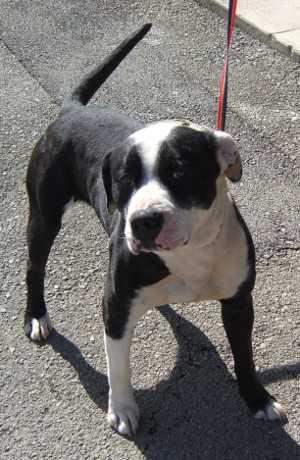
“Bruiser” is a pit bull/mastiff mix.
He is a very loving and affectionate guy who loves to play fetch and is ready to go home with you.
Bruiser is neutered, microchipped and current on all his vaccinations.
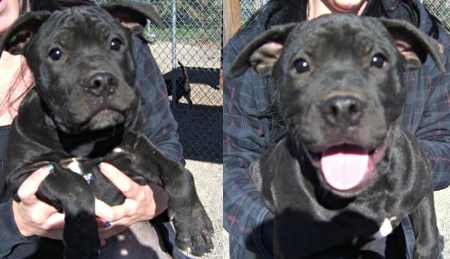
Ramon and Ralph
“Ramon” and “Ralph” are heeler/lab mix puppies.
These boys are lovable goofballs. They have been at the SPCA a long time, and they are ready for a forever home.
They both are neutered, microchipped and current on all vaccinations.
LAKE COUNTY ANIMAL CARE AND CONTROL
Dogs that are adopted from Lake County Animal Care and Control are either neutered or spayed, microchipped and, if old enough, given a rabies shot and county license before being released to their new owner. License fees do not apply to residents of the cities of Lakeport or Clearlake.
If you're looking for a new companion, visit the shelter. There are many great pets hoping you'll choose them.
The following dogs at the Lake County Animal Care and Control shelter have been cleared for adoption (additional dogs on the animal control Web site not listed are still “on hold”).
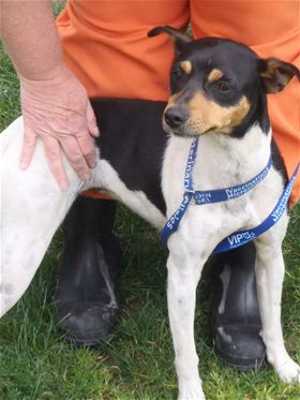
Female terrier mix
This female terrier mix is 1 year old.
She has brown eyes, a short black and white coat, a docked tail, weighs 20 pounds and has been spayed.
She’s in kennel No. 5, ID No. 35882.
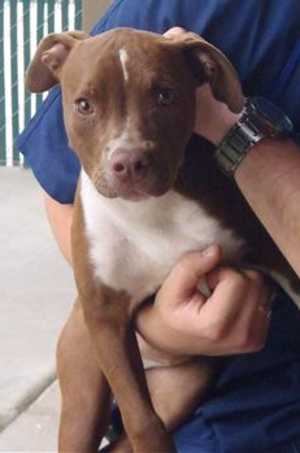
Female pit bull mix
This female pit bull mix is 5 months old.
She has a short brown and white coat, gold eyes, weighs nearly 26 pounds and has not yet been spayed.
Find her in kennel No. 7, ID No. 35880.
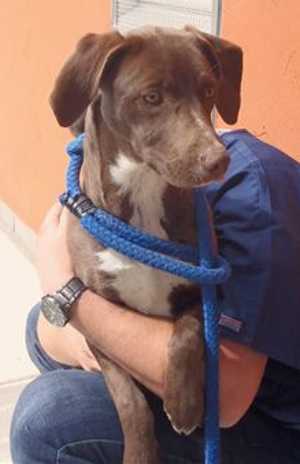
Labrador Retriever-pointer mix
This female Labrador Retriever-pointer mix is 1 year old.
She has a short chocolate coat, a green and a gold eye, weighs nearly 49 pounds and has not yet been spayed.
She’s in kennel No. 14, ID No. 35876.
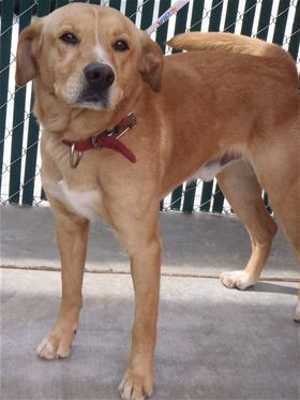
Male retriever mix
This male retriever mix is 4 years old.
He has a short yellow coat and brown eyes, weighs 46 pounds and has been neutered.
Shelter staff reported that he’s a very mellow, gentle and well-mannered dog. He gets along great with older, mellow dogs.
Find him in kennel No. 16, ID No. 35734.
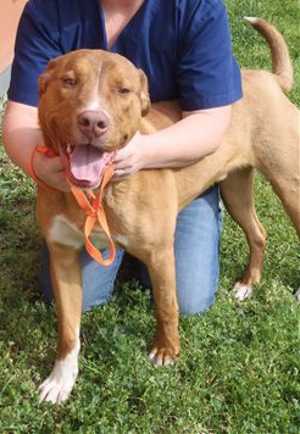
Hound-Doberman Pinscher mix
This male hound-Doberman Pinscher mix is 1 year old.
He has a short gold coat and brown eyes, weighs 46 pounds and has been altered.
According to shelter staff he’s great with other dogs and has a moderate energy level. He also has good leash manners, and loves to play and chase his shadow.
He’s in kennel No. 17, ID No. 35733.
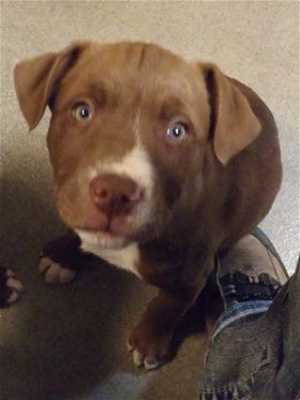
Female border collie mix pup
This female border collie mix puppy is 12 weeks old.
She has blue eyes, a short brown and white coat, and weighs 9 pounds.
Find her in kennel No. 18c, ID No. 35706.

Female border collie mix pup
This female border collie mix puppy is 12 weeks old.
She has blue eyes, a short brown and white coat, and weighs 9 pounds.
Find her in kennel No. 18d, ID No. 35707.
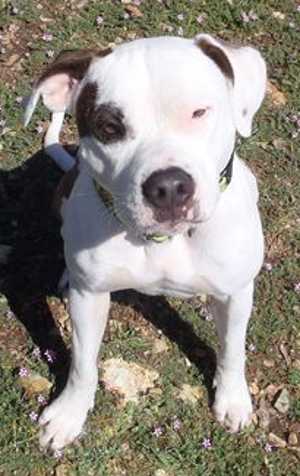
Pit bull terrier mix
This female pit bull terrier mix is 2 years old.
She weighs nearly 42 pounds, has a short white and brown brindle coat, and has been spayed.
Shelter staff said she’s a very sweet dog and is great with other dogs. She doesn't appear to have been given much attention but she loves a lap to crawl into, and has a low energy level.
She’s in kennel No. 33, ID No. 35823.
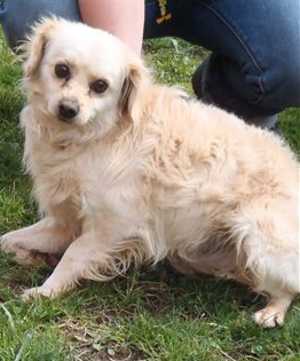
‘Chino’
“Chino” is a 4-year-old male cocker spaniel mix.
He has a long buff-colored coat and brown eyes, weighs 16 pounds and has been altered.
He’s in kennel No. 34, ID No. 35740.
Please note: Dogs listed at the county shelter's Web page that are said to be “on hold” are not yet cleared for adoption.
To fill out an adoption application online visit http://www.co.lake.ca.us/Government/Directory/Animal_Care_And_Control/Adopt/Dog___Cat_Adoption_Application.htm .
Lake County Animal Care and Control is located at 4949 Helbush in Lakeport, next to the Hill Road Correctional Facility.
Office hours are Monday through Friday, 8 a.m. to 5 p.m., and 1 p.m. to 3 p.m., Saturday. The shelter is open from 10:30 a.m. to 4:30 p.m. Monday through Friday and on Saturday from 1 p.m. to 3 p.m.
Visit the shelter online at http://www.co.lake.ca.us/Government/Directory/Animal_Care_And_Control.htm .
For more information call Lake County Animal Care and Control at 707-263-0278.
Email Elizabeth Larson at
Ozone stinks. People who breathe it gag as their lungs burn. The EPA classifies ground-level ozone as air pollution.
Yet without it, life on Earth would be impossible.
A fragile layer of ozone 25 km above Earth’s surface is all that stands between us and some of the harshest UV rays from the sun. The ozone molecule O3 blocks radiation which would otherwise burn skin and cause cancer.
On Mars, which has no ozone layer to protect it, solar UV rays strafe the surface with deadly effect, leaving the apparently lifeless planet without the simplest of organic molecules in the upper millimeters of exposed Martian soil.
To keep track of our planet’s ozone layer, NASA is about to launch the most sophisticated space-based ozone sensor ever: SAGE III, slated for installation on the International Space Station in 2014.
“The ISS is in the perfect orbit for SAGE III,” says Joe Zawodny, Project Scientist for the instrument at the Langley Research Center. “It will be able to monitor ozone all around the Earth during all seasons of the year.”
SAGE III works by using the Sun and Moon as light sources. When either one rises or sets behind the edge of the Earth, SAGE III analyzes the light that passes through Earth’s atmosphere. Ozone and other molecules absorb specific wavelengths that reveal their density, temperature and location.
“SAGE III is, essentially, analyzing the colors of the sunset to track ozone,” says Zawodny. “It sounds romantic, but this is hard science.”
Researchers began to worry about ozone in the early 1970s when University of California chemists Frank “Sherry” Rowland and Mario Molina testified before Congress that manmade CFCs, a key ingredient of common aerosol sprays, could destroy ozone in the stratosphere. Their fears were soon realized.
In 1985, researchers with the British Antarctic Survey announced abnormally low ozone concentrations above Halley Bay near the South Pole. Our planet had an “ozone hole,” and it was rapidly growing.
In a remarkable display of international cooperation, an ozone treaty was negotiated only two years later. The Montreal Protocol regulates the production of CFCs and other ozone-destroying chemicals. First signed in September 1987, it has since been ratified by every member of the United Nations.
Because of this agreement, ozone is now on the mend. Ozone holes still open every year above the South Pole, but thanks to the treaty, ozone-destroying chemicals have either leveled off or decreased. At this rate, the ozone layer could recover almost fully by 2050.
To insure that ozone really is recovering--and to alert the world if it is not--NASA has been flying ozone sensors in Earth orbit for decades.
The first of the SAGE sensors rode to space on Earth observing satellites in the late-1970s and early-80s. SAGE II data helped confirm the decline of the ozone layer and measured the effect of the Mt. Pinatubo eruption on the stratosphere. A SAGE III sensor onboard the Russian Meteor-3M satellite extended the ozone record into the 2000s with higher precision than ever.
It is not unusual for researchers to refer to SAGE as “the gold standard” in ozone monitoring. “The SAGE ozone product has a high accuracy, better than 1% in the mid-to-lower stratosphere, and a very high vertical resolution of 1km or better,” says Zawodny.
When SAGE III reaches the space station, it will measure ozone deeper into the atmosphere than ever before, reaching all the way down into the troposphere where planes fly and people live.
“From ISS, SAGE III will get a global picture of tropospheric ozone,” says Zawodny. “I suspect there will be a few surprises in those measurements.”
Zawodny is eager to learn what SAGE III finds in the lower stratosphere over the tropics. “The recovery of ozone there is tied to changes in greenhouse gases like CO2. Given what we know about recent increases in greenhouse emissions, it is possible that ozone in the tropics will never return to 1980s levels.”
SAGE III probes Arctic regions, too. Using the Moon as a light source, SAGE III can to detect ozone during the darkness of polar winter where other satellites have trouble seeing.
It’s enough to make a hard-nosed researcher wax eloquent: “Images of the moon and sun rising and setting are dramatic and spectacular,” says Zawodny. “The interplay between the source of light and the environment delights the senses and stirs the imagination. The ability for SAGE III to turn those perceptions into something meaningful is a great pleasure.”
In other words, stay tuned for some beautiful ozone data.
Dr. Tony Phillips works for the National Aeronautics and Space Administration.