 How to resolve AdBlock issue?
News
The California Highway Patrol, Impact Teen Drivers and the California Office of Traffic Safety joined together on Tuesday to raise awareness of a public health epidemic: reckless and distracted driving.
Reckless and distracted driving is the No. 1 killer of teens in the United States, and in California alone, 20 percent of collisions are caused by distracted drivers.
According to the National Highway Traffic Safety Administration, 535 young adults between the ages of 16-24 were killed in traffic collisions in California in 2010, representing nearly 20 percent of the total number of people killed on the state’s roadways.
Nationally, drivers ages 16 to 19 are three times more likely than older drivers to be involved in a fatal collision, according to statistics from the Centers for Disease Control and Prevention.
In 2010, collisions in which distracted driving was a factor killed about 2,700 people between the ages of 16 to 19 – more than seven per day.
“Driving a vehicle is a task that requires a driver’s full attention. Inattention, combined with the inexperience of our young drivers, can be deadly,” said CHP Commissioner Joe Farrow. “The consequences of distracted and reckless driving are real. The moment we step into a vehicle, we have to ask ourselves if sending that text or dialing that phone number or any behavior that takes our focus off the road is worth the risk.”
During National Distracted Driving Month, law enforcement agencies across the country are raising awareness of the dangers of distracted driving, and in California, officials are emphasizing the need for a strong combination of education and enforcement to change driving attitudes and behaviors. They also emphasize that distracted driving injuries and fatalities are 100 percent preventable.
“We lose sight of the fact that everyday behaviors we see on the roadways are a threat to all motorists,” said Impact Teen Drivers Executive Director Dr. Kelly Browning. “Texting, eating, applying makeup, reaching for an object – these split-second decisions take our focus away from the act of driving, and create the perfect condition for potential distracted driving crashes.”
As part of the kick-off for California Teen Safe Driving Week (April 1-7), parents, educators, elected officials, affected families and partnering agencies gathered at John Burroughs High School in Burbank to witness firsthand the dangers of distracted driving.
On a closed-course track set up by the Mercedes-Benz Driving Academy, teens tried to navigate around cones while experiencing the impairment caused by everyday distractions.
“It’s always an eye-opening experience for teens to see the tremendous impact distracted driving has on their ability to handle the wheel and the vehicle,” said Carolyn Duchene, director of the Mercedes-Benz Driving Academy. “The trail of knocked over cones the teens leave behind on the course gives a pretty clear visual of what might happen if they drive distracted out on the roadway.”
Following the event, teens also had the opportunity to meet with family members who have lost loved ones in distracted driving collisions.
“If the knocked over cones aren't visually impactful enough, the sorrow and grief of a mother or father who lost a teenage daughter or son definitely is,” acknowledged Browning. “We don’t do this to scare teens or the driving public. We do it to show the reality of decisions we all make behind the wheel. Our hope is to change behavior and make people recognize the very real consequences of their actions.”
The event was made possible by a grant from the California Office of Traffic Safety.
Impact Teen Drivers was created through the combined effort of the California Association of Highway Patrolmen, the California Teachers Association, and California Casualty to raise awareness among teens, parents, and communities about the consequences of poor decision making while driving.
For more information about Impact Teen Drivers, or to find out how you can become involved, e-mail
On Tuesday the National Rifle Association released its own proposal to address gun violence, focusing on safety at the nation’s schools.
The NRA’s National School Shield Program offered a number of findings and recommendations, with the task force completing the report explaining that it has “done its work by providing best practices in school security, new tools for security assessments, recommendations for funding and a private sector program model.
“It is our hope that the NRA looks favorably on these recommendations, commits its enormous political will and energy behind this effort, and devotes sufficient resources to properly fund the program, pilots and continued support for school safety,” the report stated.
Congressman Mike Thompson (D-St. Helena), who chairs the House Gun Violence Prevention Task Force, had concerns about the proposal.
“School safety is an important component of any comprehensive plan to reduce and prevent gun violence,” he said. “That’s why my task force recommended that Congress take steps to enhance school safety nearly two months ago. We should do everything we can to keep our kids safe, and that includes having school resource officers in those schools that want them, and urging our communities to develop safety plans in case of emergencies. However, arming school personnel and training them for shootouts will only exacerbate problems.”
The National School Shield Task Force’s findings included the following:
– There has been insufficient attention paid to school security; the greatest security gap falls within the medium- to smaller-size schools, which do not have the level of resources of the larger school districts.
– Many schools do not have a formal, written security plan, and even for those that do, they are often either inadequate or not properly exercised.
– A properly trained armed school officer, such as a school resource officer, has proven to be an important layer of security for prevention and response in the case of an active threat on a school campus.
– Local school authorities are in the best position to make a final decision on school safety procedures, specifically whether an armed security guard is necessary and supported by the education and citizen community.
– Many public and non-public schools are financially unable to include armed security personnel as part of the school security plan and have resorted to school staff carrying firearms in order to provide an additional level of protection for the students and staff in the event of a violent incident on school property.
– While the local school leadership should make all final decisions regarding the elements of the school security plan, the individual states, with few exceptions, have not made school security an element of adequacy in school standards.
– School officials are not generally trained in security assessments or the development of comprehensive safety and security plans.
– Federal funding for the personnel costs of SROs has served as a pathway for increased security in our schools, but federal funding has proved unreliable as a long-term solution to the school safety and security needs of our nation.
– There are numerous federal agencies and programs that provide valuable school safety resources; however, there is a lack of coordination between the federal agencies resulting in gaps, duplication and inefficiencies.
– In most violent attacks at a school, there are multiple early warning signs, called pre-incident indicators, of a student or outside person who exhibits threatening behavior and poses a risk to the school.
The task force then offered the following recommendations:
– A model-training program has been developed by the NSS Task Force for the professional training of armed personnel in the school environment.
– Many states prohibit anyone other than a sworn law-enforcement officer or licensed security guard to carry a firearm in a public or non-public school. In order for a selected school staff member to be designated, trained and armed on school property, the states will have to change current legal restrictions.
– Each school that employs a school resource officer should have a memorandum of understanding, or an “interagency agreement,” between the appropriate law-enforcement agency and the school district. This contract should define the duties and responsibilities of the SRO, as well as the applicable laws, rules and regulations.
– An Internet-based self-assessment tool has been created to allow any school (whether public, private or parochial) to have secure access to comprehensively evaluate and assess the security gaps and vulnerabilities of each school.
– State standards related to school security vary from non-existent to stringent. Although state responses to school security will naturally vary, there should be a common element that requires all public schools to participate in an assessment and develop a security plan based on the unique
requirements of that particular institution.
– Either through legislation or executive action, a lead agency should be designated to coordinate the federal programs and funding of local school safety efforts. The Department of Homeland Security should be designated as the lead, supported by the Department of Education and Department of Justice.
– Because of the limitations of federal, state and local funding for school safety, there is an important role that can be filled by a private non-profit advocacy and education organization. The National School Shield is in a position with adequate funding and support from the NRA to fulfill this important national mission.
– As part of its comprehensive security plan, each school should develop a threat assessment team, which will work in coordination with mental health professionals. The purpose is to create a positive school environment that encourages sharing information on early warning signs and reducing incidences of bullying or other antisocial behavior.
The full NRA task force report can be seen at http://www.nraschoolshield.com/NSS_Final.pdf .
“While school safety must be part of any comprehensive gun violence prevention plan, it cannot be the only part,” said Thompson, a hunter, gun owner and Vietnam veteran. “We need to invest in mental health and other preventive efforts. We need to enforce the laws that are on the books by cracking down on gun trafficking and straw purchasing. And, we need to keep guns out of the hands of criminals and the dangerously mentally ill by making sure everyone purchasing a gun gets a background check.
Thompson’s task force recommended in early February that Congress help all schools implement evidence-based strategies that support safe learning environments tailored to the unique needs of students and local communities. The task force also recommended that Congress work with schools to develop emergency response plans.
A full report of the policy principles released by the task force can be seen here: http://mikethompson.house.gov/news/documentsingle.aspx?DocumentID=319295 .
“Passing legislation that enhances school safety is not an acceptable alternative to passing other gun violence prevention measures such as background checks. Congress can and should do both,” Thompson said.
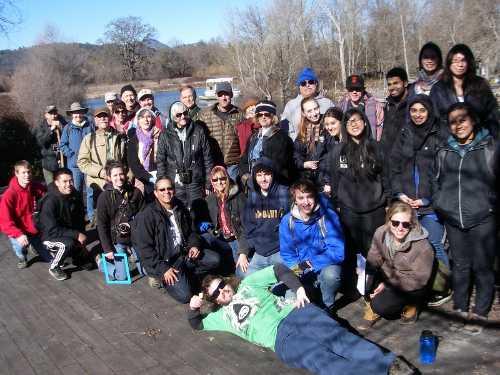
LOWER LAKE, Calif. – Anderson Marsh State Historic Park recently was the subject of a series of proposed “interventions” designed by students in a UC Davis advanced landscape design studio class.
In May of 2011, the Department of Parks and Recreation released a list of 70 state parks slated for closure to reduce the budget deficit. While many of these parks are currently in operation under a temporary reprieve, their future remains uncertain.
Visiting Lecturer Emily Schlickman focused her class assignment on Anderson Marsh State Historic Park after learning it was one of the 70 parks scheduled to be closed.
“The studio seeks to speculate upon the future of state parks in California,” said Schlickman. “The aim of the project is to develop strategies to increase attendance rates while enhancing the ecological capacity of the park.”
After doing research about Anderson Marsh, the students in February attended the monthly nature walk held at the park to gain firsthand knowledge.
Led by Park docents and Anderson Marsh Interpretive Association volunteers, the participants on the walk explored the three histories that are protected by the park: natural, American Indian and European settler.
Also attending the walk were State Parks Environmental Scientist Jim Dempsey and Paul Aigner, resident co-director of the UC Davis McLaughlin Reserve, who led a discussion of native and non-native plants. After the walk, the students spent time exploring at the park on their own.
“The students were asked to propose a very small design intervention for the park that is both economically and ecologically sustainable,” said Schlickman.
On Monday, March 18, the completed projects were presented at the UC Davis campus. The students received feedback and suggestions from members of the UC Davis faculty, two Anderson Marsh Interpretive Association Board members who were present and the former director of the Department of Parks and Recreation, who also attended the presentation.
The potential projects presented varied and creative approaches, including a expanding a presently existing “vernal pool,” restoring portions of the native plant life, installing an ADA-compliant kayak launching dock and a plan to build a large “bat tower” that would house a bat population and allow visitors to learn about the benefits of having resident bats.
Anderson Marsh Interpretive Association Board Member Henry Bornstein, who attended the project presentations at UC Davis, was impressed by the inventiveness of the proposals.
“Although there may be issues about implementing the proposals at this time due to funding and other constraints, the proposals provide a fresh look at what is possible to do at the park and should be studied further,” said Bornstein.

LUCERNE, Calif. – The Lucerne Alpine Senior Center received some good news last week.
At a meeting on Thursday, March 28, the board of directors for the Area Agency on Aging of Lake and Mendocino Counties voted to overturn a decision made a month before to terminate its provider contract with the center.
That original decision came about after the California Department of Aging determined that the center was a “high risk” nutrition services provider, as Lake County News has reported.
That meant the center was facing the loss of an annual $66,084 contract, of which $60,805 went for nutrition programs and $5,279 for outreach.
However, at the March 28 meeting the AAA board rescinded the contract termination, according to AAA Program Coordinator Mike Parkinson.
Parkinson said the center’s new executive director, Rae Eby-Carl, told the AAA board that the center had addressed all of the health and safety issues, and was continuing to work on fiscal issues and data processing.
On Thursday Parkinson will make a followup monitoring visit to the center to confirm that the changes have been made. If he confirms all corrective actions have been taken, the termination will be rescinded, Parkinson said.
Eby-Carl confirmed that the center is expecting Parkinson’s visit on Thursday. If all goes well, the center will still be able to offer its Meals on Wheels program, which in a seven-month period had served nearly 16,000 meals to area seniors, according to statements at the Feb. 28 AAA meeting.
Initially, the AAA board had indicated a special appeal board was to be assembled to consider the center’s appeal, but Parkinson said that the appeal ended up being heard by the AAA board itself.
Had the contract termination gone forward, the matter ultimately would have gone to the California Department of Aging for a final appeal, said Parkinson.
The senior center is paid on a monthly basis on the contract, he said. There has been no interruption in payments to the center, as the contract was to have terminated on April 5, 30 days after the center received the termination notification by certified mail.
His monitoring visit will take place on April 4. “If everything is OK they will have had a day to spare,” said Parkinson.
Eby-Carl took over as executive director just days after the initial contract termination vote.
“When I had arrived nothing had been done yet, but now all health and safety issues have been dealt with,” she said.
Parkinson credited her with getting a lot done in a short amount of time.
“I’m starting to get a handle on it,” said Eby-Carl.
She said the Lucerne Alpine Senior Center’s employees and volunteers are “a wonderful team” determined to keep a quality nutrition program intact.
Parkinson said hiring Eby-Carl – who has extensive experience with nonprofits – was a “good, progressive move” for the center to make.
He said he was heartened based on his discussions with her about the work she’s committed to doing at the center.
“This is about as good as we could hope for in that short a period of time,” said Parkinson.
Email Elizabeth Larson at
LAKE COUNTY, Calif. – Organizers said plans are well under way for the seventh annual Art and Science Camp sponsored by the Children's Museum of Art and Science (CMAS).
This free camp will be held at the Ely Stage Stop and the Taylor Observatory on Saturday, May 4.
This year the Redbud Audubon Society is sponsoring a one-hour raptor show as part of the camp. Native Bird Connections, a rescue and educational organization, will bring raptors and provide students with an up close experience with these amazing creatures. The show will take place in the newly constructed barn at Ely Stage Stop.
In addition to the raptor show, students will rotate through stations at the two venues.
At Ely, they will dissect owl pellets, hear about the stage stop history from Lake County Historical Society docents, and learn about local American Indian culture from anthropologist Doug Prather.
At Taylor Observatory they will see a planetarium show, have hands-on time with microscopes, and produce music with bells and percussion instruments.
The Kelseyville Rotary Club will organize lunch for all participants with the support of other Rotary clubs throughout the county.
CMAS greatly appreciates the help and support of businesses like Foods, Etc., teen helpers from Interact Clubs at Carlé and Kelseyville High School, as well as the many adults who volunteer to work in so many capacities.
The Lake County Office of Education, the Lake County Historical Society, the Redbud Audubon Society and the Konocti and Kelseyville school districts are partnering with CMAS to make this an exciting, educational and fun day for Lake County children.
One hundred and 20 fourth to sixth graders from throughout the county will be invited to attend. Parent information letters and permission slips will be delivered to schools on Monday, April 8. Permission slips are due back by April 22.
Each school district is alloted slots based on their enrollment. Public school students who are interested in attending should ask their teacher for a permission slip.
In addition, slots are set aside for home school, private school and charter school students. These students can call Carolynn Jarrett at 707-994-2878 to obtain a permission slip. Slots for these students are awarded in a random lottery.
CLEARLAKE, Calif. – A Clearlake woman was arrested over the weekend after she allegedly assaulted her ex-boyfriend and was found driving drunk with their young son in the vehicle.
Sandra Lee Gonsalves, 42, was arrested late Saturday night, according to Sgt. Nick Bennett of the Clearlake Police Department.
At 10:30 p.m. Saturday Clearlake Police were dispatched to Meadowbrook Drive on a report of a female who had consumed a large amount of alcohol and was attempting to leave a residence in a vehicle with her 5-year-old son inside, Bennett said.
Arriving near the residence, officers observed a vehicle leaving the scene at a high rate of speed, according to Bennett.
He said officers eventually caught up to the vehicle on Highlands Harbor Drive east of Harbor Drive. Inside the vehicle was the driver, identified as Gonsalves, and her 5-year-old son.
It was determined that Gonsalves was intoxicated and was subsequently arrested for driving under the influence of alcohol and child endangerment, Bennett said.
Additional investigation indicated that Gonsalves and her ex-boyfriend, the father of the 5-year-old boy, had been in an argument prior to the officers arriving at the call, Bennett said.
Bennett said the ex-boyfriend had visible signs indicating he had been battered by Gonsalves, who also was charged with domestic violence.
During the investigation it was determined the father of the child also had a warrant for his arrest and he was taken into custody. The child was released to relatives after both parents were taken into custody, Bennett said.
Gonsalves was booked into the Lake County Jail for misdemeanor driving under the influence of alcohol, and felony child endangerment and domestic violence, according to jail records. Bail was set at $75,000.
Jail records indicated that she remained in custody on Monday morning.