 How to resolve AdBlock issue?
News
This story has been updated with the name of the man who died; the California Highway Patrol also reported that the man was from Eureka, not McKinleyville, as the agency originally had reported.
UPPER LAKE, Calif. – A man from Eureka died on Wednesday morning after the semi truck he was driving was involved in a crash with another big rig.
The California Highway Patrol issued a Wednesday afternoon report detailing the crash that killed 45-year-old Robert Lee Wagner.
The report from CHP Officer Mark Crutcher explained that the crash occurred at approximately 5:55 a.m. on Highway 20, west of Irvine Avenue near Blue Lakes.
Donald Morton, 58, of Cotati was driving a 2009 Freightliner three-axle semi tank trailer westbound on Highway 20, traveling at about 45 to 50 miles per hour, Crutcher said. Wagner resident was driving the second vehicle, a 2011 Kenworth refrigerated food truck, eastbound.
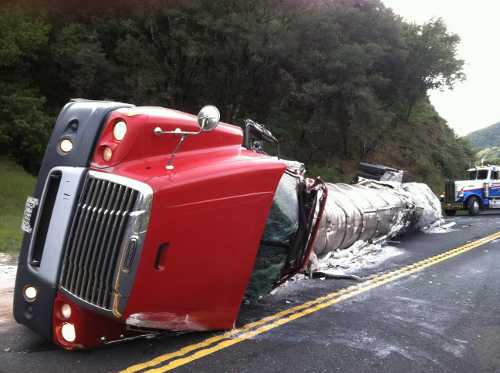
As Morton was negotiating a righthand turn in the roadway, he lost control of the semi, which overturned on the driver’s side, Crutcher said.
Morton’s truck went into the eastbound lane and sideswiped the Kenworth, which Crutcher said traveled to the right of the roadway and hit a large tree head-on.
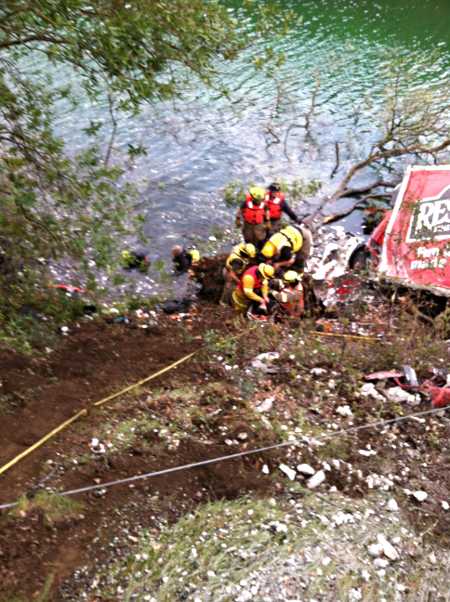
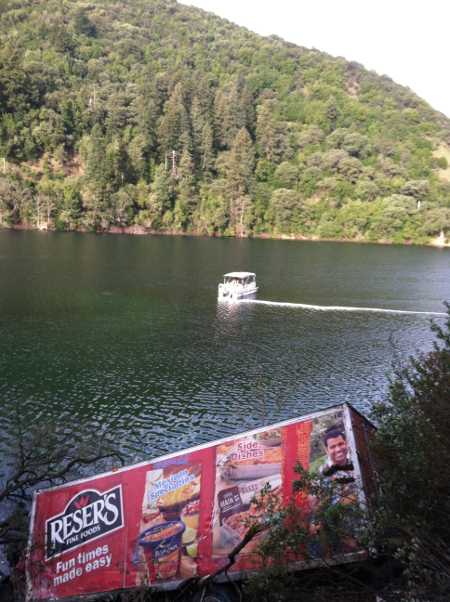
After hitting the tree, Wagner's Kenworth semi went down a steep embankment and came to rest partially submerged in the lake, Crutcher said.
Crutcher said Wagner was pronounced dead at the scene. A juvenile passenger in the Kenworth was flown to UC Davis Medical Center for treatment of moderate injuries.
Morton, who also suffered moderate injuries, also was flown by air ambulance to UC Davis Medical Center, Crutcher said.
All three individuals were wearing safety equipment, according to Crutcher’s report.
Highway 20 near the crash scene remained closed for the rest of the morning and into the afternoon, according to CHP Officer Kory Reynolds.
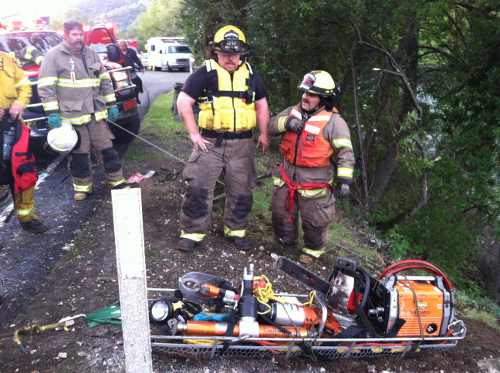
Firefighters worked at the scene for several hours, as did CHP officers and other first responders, according to reports from the scene.
One-way controlled traffic was opened up about 2:30 p.m., with the highway not expected to fully reopen until about 6 p.m. Wednesday, Reynolds said.
Email Elizabeth Larson at
UPPER LAKE, Calif. – A stretch of Highway 20 closed early Wednesday following a fatal big rig crash has partially reopened, with a full opening not anticipated until evening.
The crash, which claimed the life of one semi driver and sent another to a regional trauma center, occurred at about 6 a.m. near Blue Lakes Lodge, closing down the highway as emergency responders worked at the scene, according to the CHP.
At about 2:30 p.m. the highway reopened with one-way controlled traffic, according to CHP Officer Kory Reynolds.
He estimated that the one-way controlled traffic would be in effect until about 6 p.m.
Reynolds said a full report on the incident is still being completed.
UPPER LAKE, Calif. – The California Highway Patrol said one person died in a big rig crash near Blue Lakes early Wednesday.
CHP Officer Kory Reynolds said the crash occurred on Highway 20 east of Blue Lakes Lodge at about 6 a.m.
A big rig was heading westbound when the driver lost control in a curve and overturned, causing the trailer to enter the eastbound lane, according to Reynolds.
Another semi traveling eastbound hit the other truck's trailer and careened into Blue Lakes, Reynolds said.
He said the person who died had not yet been identified.
Highway 20 was expected to remain closed until 11 a.m., followed by several hours of controlled traffic, Reynolds said.
Reynolds said the roadway is estimated to reopen at approximately 2 p.m.
More information will be released as it becomes available, Reynolds said.
This story has been updated with the new date and time for the hearing.
LAKEPORT, Calif. – A hearing set for early next month will decide whether the county’s sheriff can move forward with a lawsuit over his placement on a list of officers with credibility issues by the district attorney.
On Tuesday District Attorney Don Anderson filed a demurrer in the suit brought at the end of February by Sheriff Frank Rivero.
A demurrer is a formal objection to an opposing party’s case. It disputes the sufficiency of a case and argues that, even if the facts are true as alleged, the lawsuit lacks legal merit.
Anderson is seeking to have the matter dismissed, to have Rivero and the Jones and Mayer law firm sanctioned, and to force Rivero to personally repay the county for the legal fees it has paid for his independent counsel in the matter so far.
Anderson argues that Rivero’s suit lacks sufficient facts to justify causes of action and that the local court has no jurisdiction.
A hearing is tentatively scheduled for 1:30 p.m. Tuesday, May 7, in Lake County Superior Court before retired Butte County Judge William Lamb.
Rivero did not immediately respond to a request for comment. His response to the demurrer is expected to be filed with the court in the weeks before the May 6 hearing.
In February, at the end of a nearly two-year-old investigation, Anderson concluded that Rivero had lied to investigators about his actions during a February 2008 shooting.
Rivero, then a deputy sheriff, shot at a man holding a can of pepper spray, a violation of sheriff’s office policy. The man was not injured.
In March 2011, a complaint about Rivero lying to investigators about the shooting was made to Anderson’s office. Based on an initial review, Anderson said he “formed the opinion that there was substantial information Rivero lied during the 2008 investigation,” according to case documents.
At the end of the investigation, Anderson said he “continued to hold the opinion that there was substantial information that exceeded a clear and convincing evidence standard that Rivero did not tell the truth on February 19, 2008 regarding the investigation.”
It was then, and still remains, Anderson’s opinion that the District Attorney’s Office has the obligation to place Rivero on a “Brady” list of officers with credibility issues and to disclose this to criminal defendants when Rivero is to be a material witness in a case.
“Brady” refers to the 1963 US Supreme Court case Brady v. Maryland, which requires that prosecutors release to criminal defendants any information that could clear them, including credibility issues of peace officers involved in their cases.
Rivero filed suit against Anderson in an effort to prevent him from divulging the materials to criminal defendants. In a March 4 hearing, which Rivero also had wanted to be closed, Lamb ruled the materials – and the hearing – were to be public.
The week prior, retired Lake County Superior Court Judge David Herrick already had ruled the materials were to be released to three Sonoma County Hells Angels members facing prosecution for a June 2011 fight with a rival gang member.
In Anderson’s demurrer filing, he seeks to have the suit dismissed, noting that in his case Rivero “asserts four causes of action in his campaign to judicially and radically change both State and Federal statutes and well settled case law.”
The filings state, “Plaintiff is requesting this court change current and well settled law by ordering the District Attorney to conceal and not disclose exculpatory evidence of an officer’s lack of credibility, until the officer has a due process hearing and judicial review, which would include appellate rights. This suggested process could take several years to complete. If plaintiff is successful, in many cases a criminal defendant would not receive valuable impeachment evidence before or during his trial, thus depriving him of a fair trial.”
Anderson maintains in his filings, “The responsibility for Brady compliance lies solely and exclusively with the prosecution and that duty is non-delegable, not even to the police or the courts. The prosecution must disclose material exculpatory evidence whether the defendant makes a specific request.”
While Rivero has argued that his due process rights were violated and the procedures Anderson used to make his Brady determination inadequate, Anderson writes, “There is no known authority that a peace officer has any right to a hearing or evidentiary hearing regarding a Brady determination being made. To the contrary all authority clearly states that decision is at the sole discretion of the District Attorney.”
Anderson quotes extensive case law that appears to settle the matter – and establish the responsibility of district attorneys in disclosing Brady materials – with many of the case rulings coming in recent years in higher state and federal courts.
In the 1997 case Roe v. City and County of San Francisco, filed by a plaintiff placed on a Brady list, the court ruled that the district attorney had absolute prosecutorial immunity because the decisions involved “are intimately associated with the judicial phase of the criminal process,” Anderson wrote.
“Whether their assessment is accurate or not is immaterial,” according to that 1997 ruling. “This kind of witness evaluation falls entirely within a prosecutor’s judicial function … Just as a prosecutor’s professional evaluation of the evidence assembled by the police is entitled to absolute immunity, a prosecutor’s professional evaluation of a witness is entitled to absolute immunity, even if that judgment is harsh, unfair, or clouded by personal animus …”
A 2009 case from Washington state, Laskey v. Lewis, ruled that a deputy sheriff suing over his Brady listing “failed to identify any law that recognizes a police officer’s right to a name-clearing hearing after a Brady determination is made.”
A 2010 US District Court case Neri v. County of Stanislaus found that district attorneys in California serve both state and county functions and possess Eleventh Amendment immunity when acting in their prosecutorial capacity. The plaintiff, Neri, was placed on a Brady list, and that action, as well as disclosure of Neri’s Brady material, were done in a prosecutorial capacity and while acting as a state agent, again giving the prosecutor immunity.
A US District Court ruled in the 2011 case Nazir v. County of Los Angeles that creating a Brady determination procedure, evaluating a witness’s credibility, determining what constitutes Brady material and decisions on whether to use a police officer as a witness in the future are prosecutorial functions of the district attorney acting as a state officer.
“Therefore, the allegations against the District Attorney are against the state and are barred by Eleventh Amendment immunity,” Anderson wrote.
Anderson also argued in his filing that the action Rivero is seeking from a state court would infringe on Anderson’s responsibilities under federal law and that the state court, ultimately, has no jurisdiction in the matter.
In addition, he said Rivero is seeking a writ of mandate, which case law establishes cannot be used to control a matter of discretion. Placing an officer on the Brady list, Anderson stated, is not ministerial, but discretionary, and solely up to the district attorney.
“Therefore, the plaintiff must show in the pleading that the defendant’s conduct by placing the plaintiff of the Brady List was fraudulent or so palpably unreasonable and arbitrary as to indicate an abuse of discretion,” Anderson wrote. “In this matter, the plaintiff has made no such showing.”
Anderson is asking the court for attorney fees and sanctions against Rivero and his attorney, with Anderson asking that his fee be set at $300 based on the “Lodestar” method for determining attorney’s fees, and that Rivero and his attorney also be sanctioned the amount in which the county of Lake has paid – or will have to pay – Rivero’s attorney for litigating what Anderson called a “frivolous” lawsuit.
In addition, Anderson wants any attorney fees or sanctions placed against Rivero to be awarded against him personally and found not to be the county’s obligation.
Email Elizabeth Larson at
030413 Lake County District Attorney's Final Report Regarding Sheriff Rivero Brady determination by LakeCoNews
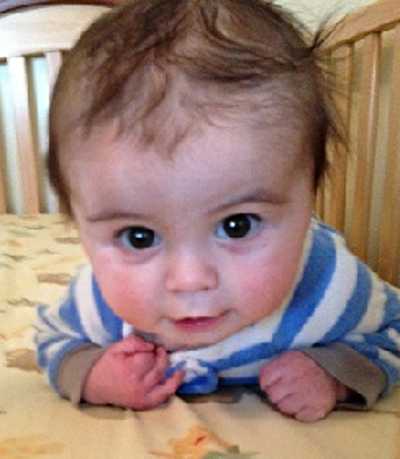
LAKE COUNTY, Calif. – A match for a little boy needing a bone marrow transplant has been found in his own family, with the lifesaving procedure set to begin later this month.
Ryland Joseph, who will be 6 months old this month, was diagnosed in February with a rare disorder called Wiskott-Aldrich Syndrome, which primarily affects boys, as Lake County News has reported.
Without a bone marrow transplant, Ryland isn’t expected to live beyond 5 to 8 years, as the form of Wiskott-Aldrich Syndrome makes him susceptible to autoimmune deficiencies, leukemia, lymphoma and other deadly conditions.
On Monday afternoon, Ryland’s parents, Rodd and Kellie Joseph, were contacted by the University of California San Francisco Medical Center, which informed them that their 21-month-old daughter is the best match for her baby brother.
Trina Brajkovich, an account executive Be the Match, the National Marrow Donor Program, told Lake County News in an interview last month that finding a match amongst siblings or close family members isn’t common, so the discovery that their daughter is a match was an exciting piece of news for the Josephs.
Rodd Joseph told Lake County News that Ryland will begin the “long and vigorous” bone marrow transplant process on April 17, with the transplant itself taking place on May 1. Ryland is expected to remain at UCSF for anywhere between six to 12 weeks.
Due to the high costs of a bone marrow transplant – it could cost $1 million or more – The Ryland Robert Joseph Be The Match Fund has been set up at Mendo Lake Credit Union in Clearlake to help with medical bills.
Visit any Mendo Lake Credit Union branch and make a deposit to The Ryland Robert Joseph Be The Match Fund account, 7XXX2080.
Other efforts to raise funds include an event from 10 a.m. to 2 p.m. Saturday, April 20, at Lake County Fire Protection District’s Station 70, 14815 Olympic Drive in Clearlake.
There will be a raffle and community members can sign up a the event to be bone marrow donors or can go online to register at www.bethematch.org .
Although Ryland has a match, his family is encouraging everyone to register at Be the Match for others who desperately need bone marrow donors.
“Please continue to send prayers our way as this long and dangerous journey is only beginning for our family,” the Josephs said in a message to friends and supporters.
Email Elizabeth Larson at
NORTH COAST, Calif. – Mendocino County officials are searching for a 75-year-old Ukiah woman who went missing from her home sometime this past weekend.
A “Silver Alert” – a new alert system for missing and endangered seniors – was issued for Elna Jean Koopman, according to Lt. Greg Van Patten of the Mendocino County Sheriff’s Office.
At 9 p.m. Monday Mendocino County Sheriff’s deputies were dispatched to the 400 block of Kenwood Drive in Ukiah regarding an elderly missing person report, Van Patten said.
Van Patten said that when deputies arrived at the residence they spoke with missing person’s son and he informed them that his elderly mother was missing from her residence.
The son stated that Koopman, his mother, was suffering from early stages of dementia and that she had a difficult time remembering things and events, Van Patten said.
The son informed the deputies that he had not spoken to his mother for more than 24 hours so he decided to check on her to make sure she was doing well, according to Van Patten.
He said the son drove up from the Santa Rosa area and when he arrived at his mother’s residence on Monday morning he noticed her vehicle was missing, so he entered the residence to see if she was inside.
The son did not locate his mother in the residence, so he searched the surrounding area, checked with local friends and neighbors, with no success, Van Patten said. The son then notified the sheriff’s office that his mother was missing.
During the investigation it was learned by the deputies that Koopman also had a residence in the Dallas, Texas area and it was believed by the son that Koopman, because of her dementia, may be confused and attempt to drive to Texas thinking she still lives there.
Deputies contacted the California Highway Patrol and requested a statewide Silver Alert be issued for Koopman and her vehicle, Van Patten said.
Koopman is reported to be driving a White 2004 Toyota “Sienna” van with a California license plate of 5HGN279.
Koopman has brown/gray hair and blue eyes, is approximately 5 feet, 7 inches tall and weighs 160 pounds.
Anyone who sees or has any information on the whereabouts of Koopman is asked to contact their local law enforcement agency or the Mendocino County Sheriff’s Office at 707-463-4086.