How to resolve AdBlock issue?
News
LUCERNE, Calif. – Lucerne residents gathered at Lucerne Harbor Park on Saturday to stage a protest against their climbing water rates.
California Water Service Co., which services the town, is currently in negotiations to raise rates across the state, is seeking a 57 percent rate increase in 2014, with the potential for additional increases in 2015 and 2016, according to the corporation's general rate case.
The county of Lake has become a party in the case in an effort to get lower rates for the town, which has seen a number of significant rate hikes since Cal Water took over the system in 2000.
Town residents at the Saturday rally reported paying increasingly large rates for their basic needs.
Hear their stories in the video above.
LAKE COUNTY, Calif. – Jobless rates dropped across the state in May, with Lake County's rate also showing improvement.
The California Employment Development Department's latest report on unemployment trends showed that Lake County's May unemployment rate was 11.6 percent, down from 12.7 percent in April and 14.8 percent in May 2012.
California's jobless rate for May was 8.6 percent, down from 9 percent in April and 10.7 percent the previous May, according to the report.
The Employment Development Department said nonfarm jobs in California totaled 14,612,500 in May, an increase of 10,800 jobs over the month, and an increase of 252,100 jobs over the past year.
The nationwide unemployment rate for May was 7.6 percent, up slightly from the 7.5 percent the month before but improved from the 8.2 percent rate reported in May 2012, according to the US Bureau of Labor Statistics.
Dennis Mullins of the Employment Development Department's North Coast Region Labor Market Information Division said total Lake County wage and salary employment took a seasonal uptick of 420 jobs between April and May.
However, Mullins said Lake County's jobs are down 140 over the year with tourism accounting for 86 percent of the overall net cutbacks.
Six industry sectors gained or remained unchanged and five declined for the period, Mullins said.
He said year-over job growth occurred in farm (+10) and government (+10), with manufacturing, information, professional and business services, and other services showing no change.
Industry sectors with decline over the year included mining, logging and construction (-20); trade, transportation and utilities (-10); financial activities (-10); private educational and health services (-10); and leisure and hospitality (-120), Mullins said.
Mullins said Lake ranked No. 48 among California's 58 counties for its May unemployment rate.
Marin had the lowest unemployment rate in the state in May – 5.2 percent – and Imperial had the highest, 22.8 percent, the state reported.
Lake's neighboring counties registered the following unemployment rates for May, according to the Employment Development Department: Colusa, 15.8 percent; Glenn, 11.3 percent; Mendocino, 7 percent; Napa, 5.3 percent; Sonoma, 6.1 percent; and Yolo, 7.9 percent.
Email Elizabeth Larson at
LAKE COUNTY, Calif. – Several new calico kittens, an orange tabby and Siamese are waiting for adoption at Lake County Animal Care and Control this week.
The cats range in age from 16 weeks to 6 years and will be altered and vaccinated before they are sent home with their new families.
In addition to spaying or neutering, cats that are adopted from Lake County Animal Care and Control are microchipped before being released to their new owner. License fees do not apply to residents of the cities of Lakeport or Clearlake.
If you're looking for a new companion, visit the shelter. There are many great pets there, hoping you'll choose them.
The following cats at the Lake County Animal Care and Control shelter have been cleared for adoption (other cats pictured on the animal control Web site that are not listed here are still “on hold”).

'Puzzle'
“Puzzle” is a 6-year-old female lilac point Siamese mix.
She has had treatment for injuries and is now available for adoption.
She has a short coat, a docked tail and blue eyes,
Shelter staff said she is very sweet and friendly. Puzzle is fine with bigger dogs, but doesn't get along with any animals smaller than her.
Puzzle's identification number is 19.
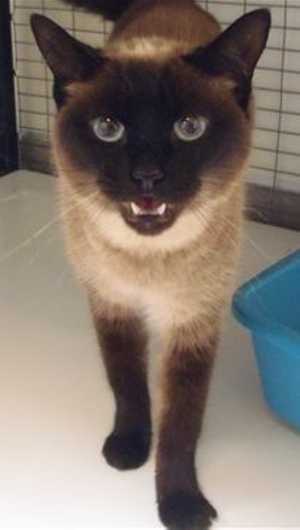
Seal point Siamese
This female seal point Siamese is 2 years old.
She has a short coat and blue eyes. Shelter staff did not report if she had been altered.
Find her in cat room kennel No. 32, ID No. 36762.
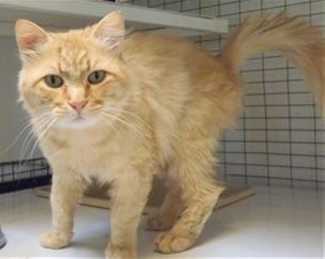
Orange tabby
This male orange tabby is 3 years old.
He has a medium-length coat and gold eyes. It was not reported if he had been altered.
He's in cat room kennel No. 61, ID No. 36800.
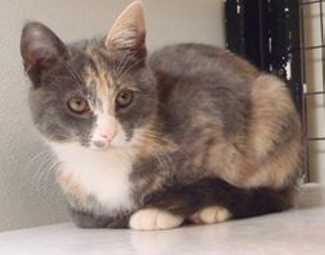
Calico kitten
This female calico kitten is 16 weeks old.
She has a short dilute calico coat and green eyes, weighs 3 pounds and has been spayed.
She's in cat room kennel No. 66a, ID No. 36705.
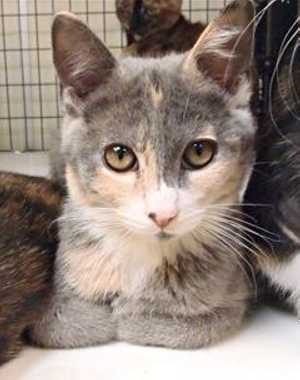
Calico kitten
This female calico kitten is 16 weeks old.
She has a short dilute calico coat and green eyes, weighs 3 pounds and has been spayed.
She's in cat room kennel No. 66b, ID No. 36706.
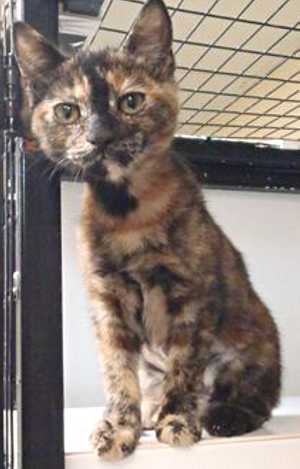
Calico kitten
This female calico kitten is 16 weeks old.
She has a short dilute calico coat and green eyes, weighs 3 pounds and has been spayed.
She's in cat room kennel No. 66c, ID No. 36707.
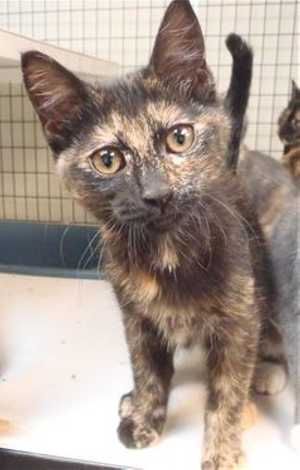
Calico kitten
This female calico kitten is 16 weeks old.
She has a short tortie calico coat and green eyes, weighs 3 pounds and has been spayed.
She's in cat room kennel No. 66d, ID No. 36708.
Adoptable cats also can be seen at http://www.co.lake.ca.us/Government/Directory/Animal_Care_And_Control/Adopt/Cats_and_Kittens.htm or at www.petfinder.com .
Please note: Cats listed at the shelter's Web page that are said to be “on hold” are not yet cleared for adoption.
To fill out an adoption application online visit http://www.co.lake.ca.us/Government/Directory/Animal_Care_And_Control/Adopt/Dog___Cat_Adoption_Application.htm .
Lake County Animal Care and Control is located at 4949 Helbush in Lakeport, next to the Hill Road Correctional Facility.
Office hours are Monday through Friday, 8 a.m. to 5 p.m., and 1 p.m. to 3 p.m., Saturday. The shelter is open from 10:30 a.m. to 4:30 p.m. Monday through Friday and on Saturday from 1 p.m. to 3 p.m.
Visit the shelter online at http://www.co.lake.ca.us/Government/Directory/Animal_Care_And_Control.htm .
For more information call Lake County Animal Care and Control at 707-263-0278.
Email Elizabeth Larson at

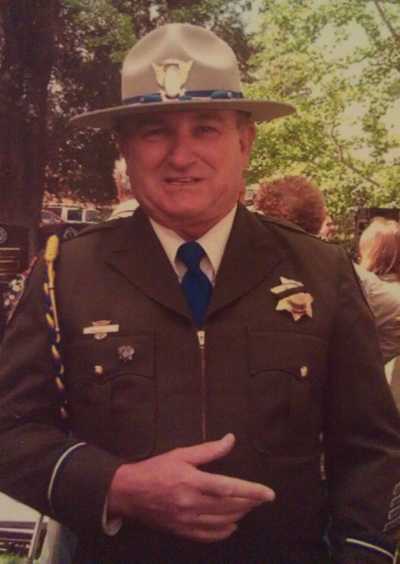
LAKE COUNTY, Calif. – Sitting in his hilltop house that overlooks Clear Lake, it would seem Steve Davis – 15 years into retirement from the California Highway Patrol – is a well-settled man. Don't be fooled, because in quite another context, his way is still the highway.
After three decades in pursuit of law-breaking drivers, Davis, along with wife Elizabeth, has for the last 20 years pursued his interests.
They are numerous.
To begin with, his travels have taken him to every state in the U.S., with the single exception of Rhode Island. He will also has traveled much of the world. This is the year for Barcelona for he and Elizabeth, who is a Realtor.
But other trips, these to disadvantaged locations, for Steve and Elizabeth have had a deeper significance that was far from recreational.
As devoted members of the Rotary International Lakeport Rotary Club over the past two decades – Steve Davis was the Rotary chair in 2008-09 and has long standing in the club's international project committee – the Davises have made missions of mercy at their own expense to:
... Guatemala, where as members of a Rotaplast team of doctors, nurses and volunteers, they aided in cleft palate deformity surgery for children. County Supervisor Rob Brown and Marty Diesman, also of Lake County, also were members of the team;
... Belize, to aid in the delivery of hospital equipment and supplies to a small rural hospital; and
... El Salvador, to outfit a clinic for patients undergoing radiation and chemotherapy.
“We (Rotary) are looking forward to doing something more for the hospital in Belize,” are said Davis, who, it was suggested, might have more enjoyed, say, a tropical vacation in Tahiti.
“That's not what I'm about,” he said.
The Guatemala and are trip, made 10 years ago, had the greatest impact on Davis, as it might anyone who has seen so many children with cleft deformities which, according to numerous sources, are “the silent scourge of most third-world countries.”
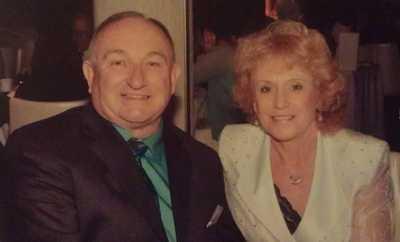
“It was a life-changing event,” Davis said of the 10 days of fast-paced surgery in Guatemala during which he aided in sterilizing surgical equipment while Elizabeth served in the recovery room.
The children, from a widespread area, he added, “got there any way they could – on the back of pickup trucks or rickety old buses. Some came on horses and mules.
“It was devastating to walk into a room with all those children and know that you can't help them all,” said Davis, shaking his head sadly over the recollection. “You just have to help certain ones, the worst 100 cases. At the end of the 10 days when all the children who had surgery came back for check ups it was moving to see all them (who previously had) horrible disfigurements look like they just fell off a bicycle. The surgeons were that good.”
The Lakeport Rotary Club-aided cancer clinic in El Salvador, which provided patients quarters that enabled them to stay near the hospital during treatment, was a critical project.
“Our Rotary club teamed up with a Rotary club in Ciudad and Merliot, El Salvador, which was where the cancer clinic was,” he added. “Without this clinic, patients would have had to go to and from their homes every day, which often meant riding 40 miles in the back of a pickup truck.
“On another project, we delivered two fetal heart monitors to a rural village in Belize on the Guatemalan border. They had a high incidence of infant mortality from not being able to monitor a child's heart rate,” Davis said.
“We had to smuggle the monitors into Belize in order to give them to the hospital in a little village. The problem was that medical supplies are so rare in places like Belize that if you tried to bring them in through the front door, so to speak, they would get circumvented to the larger hospital in Belize City,” he said.
The Lakeport Rotary has continued to aid the Belize hospital, Davis said, “by providing it with a whole truckload of surplus equipment,” including a portable x-ray machine donated by the Lake County Tribal Health Clinic.
“A desire to serve,” as Davis calls it, has been a motivation through much of his life, including becoming a CHP officer.
“You have to have that in the CHP ... There's a lot of demand for it,” he said. “You've got to want to help people.”
But also motivating him was his “lust for adventure” and Davis had those adventures in spades, beginning with several high-speed chases.
“The fastest was 143 miles per hour on an open freeway in Southern California,” he recalled. “It was somebody who had fixed up his car and wanted to see how fast it would go. The guy wasn't on anything and he wasn't reckless. When I finally stopped him, he said 'You got me!' He went to jail, of course.”
Davis downplays the chases and apprehension of individuals who were combative. Did he have to physically restrain some of them?
“Oh absolutely,” he said. “When you're working the night shift – especially graveyard – you're arresting people for drugs and alcohol and you're going to get into your share of scuffles. Some were only lightweight, but some were very physical.”
He was never seriously injured, he said. “Nothing that would cause me to lose some time, but everybody who has done law enforcement work has had chases and all those things.”
If Davis had his way, drive training in California would be much more extensive before licenses are issued.
“I think the written test is a joke. Your first driver's license test ought to be as hard to pass as it is an algebra test. You don't have to look too far to see drivers who shouldn't be driving.”
But, after making his share of stops, Davis doesn't feel that drivers resented him.
“Amazingly,” he said, “most of the time after I wrote somebody a ticket and walked away they said 'thank you.'”
Another of Davis' latest pursuits is his authoring of a book which he said dates to an idea he had 20 years ago.
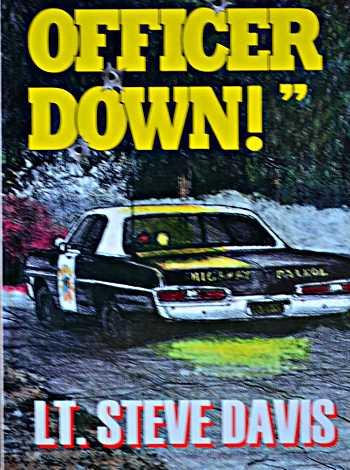
The characters in his recently published whodunit, entitled “22E ... Officer Down,” are only composites. But the dangers faced down by CHP officers on a routine basis in his book are real enough.
“It was always a kind of a bucket list thing,” Davis, who is 68, said of his book. “I've met a few authors going through my life and career and I thought it might be a nice thing to kind of leave behind. I wanted to try to give the reader the feel that they were there during the whole time and were part of the case.”
Davis described his plot for a second book book he's writing, “Perfect Alibis.” “In this one you know who's doing the crime, but you're wondering if they're going to get away with it or not.”
Yet another of his pet projects is his prize-winning classic 1955 Chevy Bel Air, which has a long history in his family. When the two were teenagers, Steve's brother bought the car and rebuilt its blown engine.
“We used to drag race in it all over my hometown of Riverside. I bought a '55 Chevy convertible the same year,” he said. “His car was fixed up for hotrodding and mine was a cruiser. We used to drag race all over Riverside in his car and then go cruising in mine. We had the best of both worlds.”
After his brother died, Davis bought the car from his widow and last year showed it for the first time during the massive “Hot August Nights” classic car event in Reno.
“It was one of 6,000 vehicles entered and won 'best of show,'” he said proudly.
Indicative of the gypsy in his soul, Davis confides that the house overlooking Clear Lake is the first place he has ever lived for more than five years.
“I had considered going into police or sheriff work,” he said. “They have adventure, but a lot of their calls are very mundane and I wanted the freedom to go all over California.”
And essentially that's what he did, shifting locations a dozen times. Among areas in which he served were Riverside, San Bernardino, Eureka, Sacramento, Stockton, Oakland, Stockton again and finally Lake County, where he was assigned as area commander until his retirement.
He chose to spend his final years with the CHP in Lake County, essentially because he fell in love with the area.
“What's not to love about Clear Lake?” he questions. “You have this beautiful lake, the cleanest air in the United States and the weather's nice, though it gets a little hot for me in the summertime.”
Steve Davis' book, “22E Officer Down,” is available through www.amazon.com or by logging on to www.davismedia.us .
Email John Lindblom at
LAKE COUNTY, Calif. – Ham radio operators from all around Lake County were on hand Saturday for their annual field day.
Field day operations headquarters were set up at the Lake County Chamber of Commerce offices at Vista point, 875 Lakeport Blvd.
Community members had a chance to see local ham radio operators in action.
In the video above, ham radio enthusiasts discuss their hobby and how it helps the community during local emergencies.
The field day will continue until 11 a.m. Sunday.
For more information about the local ham radio groups, visit http://lcarsofca.yolasite.com/ , https://sites.google.com/site/narcradioclubbiz/ and www.arrl.com .

It is a calm, cold fall morning. The sounds of a barking dog and the voices of children echo across the lake.
From somewhere, the low pitched drumming of a stone pestle pounding soft nuts can be heard. Wisps of smoke are seen rising from dome-shaped houses that cover the south end of Rattlesnake Island (though it will be 500 years before it will have the name “Rattlesnake Island”).
In 1500 AD, it is called ‘Elem and for 5,000 years, this island has been the political center for the Kaogóma (Cow-goo-mah) tribe (Southeastern Pomo).
Standing with us on the shore is Wokox. He lives at the ‘Elem village on the island. As we are visitors, he explains that his people live on and fish the lake year-round.
Each tribe in his area has its political and religious center on an island (‘Kamdot, on Anderson Island and ‘Koi on Indian Island).
He says his island village contains 20 homes where most of the Elem people live. These people represent the four extended families in his tribe.
There are two overflow villages on the mainland where the rest of the ‘Elem people live. The one closest to ‘Elem Island is called Xuna-dai.
His island village also contains a large ceremonial building (dance house) that can seat the entire village and a smaller sweathouse where the leaders and many of the village men spend much of the winter.
Wokox explains the ‘Elem Tribe has no “single” chief, but four leaders with equal rank; one from each extended family. These leaders (Balakui) are not wealthy, but hold their positions of leadership based on family ties and the general agreement of the whole community.
He tells us these leaders are civil and ceremonial officials, spending their time instructing the community on the honorable way to live. They settle disputes between families, plan and officiate ceremonial gatherings, and negotiate agreements with neighboring tribes. Their families hunt, fish, and gather food for them, so they can conduct civic duties.
Though the island belongs to the whole community, each family owns a private tract of land on the mainland. Each tract extends from the lakeshore to the uplands. These tracts contain acorn bearing oak trees, manzanita, willow, tule and other food plants owned by the family.
Each villager knows the boundaries of each family’s tract. Wokox says tribal members can hunt and fish on anyone’s land, but collecting stationary resources from another's tract is forbidden unless permission has been granted.
Everyone knows how to hunt, fish, make stone tools, baskets, nets and other implements. However, in each extended family there are one or more professionals who excel in these trades.
If food is needed to feed guests at a wedding, a professional hunter or fisherman is hired to get the food and paid in shell-bead money. If someone is sick, a professional doctor is hired.
Though food resources are traded for other food resources, payment for professional service or manufactured items is usually made with shell-bead money.
The ‘Elem people of Rattlesnake Island and others around Clear Lake were the money-makers for Northern California.
Washington clams gathered on the shores of Bodega Bay were traded inland to Clear Lake where local artisans cut, ground, and drilled the shell into small disks. Strings of beads were the money used throughout the state for at least 5,000 years.
In addition to being the money-makers, the Clear Lake people controlled the Borax Lake obsidian flow, one of the richest stone tool material sources in Northern California. These two distinctions insured that the Clear Lake Pomo had a prominent place in the California trade and exchange network.
Fourteen thousand years of human experience in the Clear Lake Basin led to the culture described above. For further reading try “Clear Lake Pomo Society” by Edward Winslow Gifford and “Pomo Geography by Fred Kniffen.
Tuleyome Tales is a monthly publication of Tuleyome, a conservation organization with offices in Woodland and Napa, California. For more information go online to www.tuleyome.org . For 42 years, Tuleyome supporter and archaeologist Dr. John Parker has been studying Lake County's prehistory. To learn more, go to www.wolfcreekarcheology.com .