 How to resolve AdBlock issue?
News
Summer in California is officially under way and the warm temperatures bring increased outdoor activities, with July 4 being no exception.
Many Californians and tourists will be celebrating our nation’s independence with fireworks, and Cal Fire wants to stress the importance of fireworks safety and the State’s zero tolerance against illegal fireworks.
“Every year Cal Fire and fire departments across California respond to hundreds of fireworks-related fires that result in millions of dollars in damage,” said State Fire Marshal Tonya Hoover, Cal Fire – Office of the State Fire Marshal. “If you are going to use fireworks, check first with your local fire department to make sure they are allowed in your area. If they are, use only fireworks that carry the State Fire Marshal’s ‘Safe and Sane’ seal.”
California has a zero tolerance for the sale and use of illegal fireworks. Illegal fireworks include sky rockets, bottle rockets, roman candles, aerial shells, firecrackers and other types that explode, go into the air, or move on the ground in an uncontrollable manner.
It is illegal to sell, transport, or use fireworks that do not carry the “Safe and Sane” seal, as well as possess or use any fireworks in a community where they are not permitted.
If convicted, a violator could be fined up to $50,000 as well as sent to jail for up to one year. There are nearly 300 communities within California that allow “Safe and Sane” fireworks.
“Even with a temporary cool down and rain in parts of Northern California, our fire activity remains significantly higher than average,” said Chief Ken Pimlott, director of Cal Fire. “With how dry conditions are, if fireworks are used illegally or in an unsafe manner, they can easily spark a fire or cause injuries; the consequences to our communities can be devastating.”
Cal Fire is asking Californians to prepare for wildfires by taking these actions:
- Check that fireworks are allowed in the area of use;
- Make sure the firework has the State Fire Marshal “Safe and Sane” seal;
- Purchase only from legitimate organizations authorized to sell;
- Have a bucket of water, sand or garden hose available at firing site;
- Read all instructions before use;
- Dispose of used fireworks in water;
- Never alter, modify or enhance fireworks;
- Make sure fireworks have proper clearance from flammable materials including dry grass and brush.
For more information about safe fireworks use, visit the Cal Fire web site at www.fire.ca.gov .
LAKE COUNTY, Calif. – Lake County Animal Care and Control this week has a full house of mixed breed puppies needing new homes.
The pups, with ancestry including shepherds, labs and pit bulls, are spayed and neutered, vaccinated and ready to start a new life with a loving new family of their own.
Dogs that are adopted from Lake County Animal Care and Control are either neutered or spayed, microchipped and, if old enough, given a rabies shot and county license before being released to their new owner. License fees do not apply to residents of the cities of Lakeport or Clearlake.
If you're looking for a new companion, visit the shelter. There are many great pets hoping you'll choose them.
In addition to the animals featured here, all adoptable animals in Lake County can be seen here: http://bit.ly/Z6xHMb .
The following dogs at the Lake County Animal Care and Control shelter have been cleared for adoption (additional dogs on the animal control Web site not listed are still “on hold”).
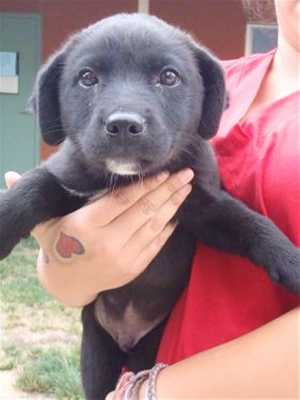
Labrador Retriever mix pup
This Labrador Retriever mix puppy is 11 weeks old.
He has a short solid black coat, weighs 12 pounds and has been neutered.
You can find him in kennel No. 2, ID No. 36818.
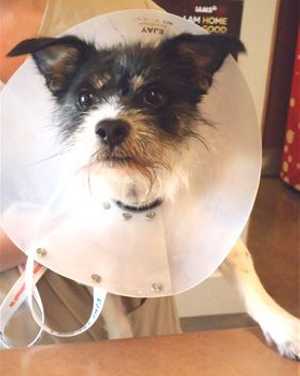
Male terrier mix
This male terrier mix is 1 year old.
He has a short black and white coat, weighs 14 pounds and has been neutered.
Find him in kennel No. 3, ID No. 36726.
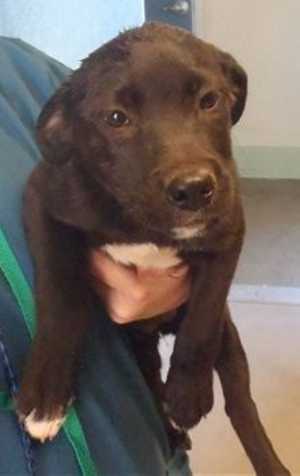
Labrador Retriever-shepherd mix pup
This female Labrador Retriever-shepherd mix pup is 15 weeks old.
She has a short brown coat, weighs 14 pounds and has been spayed.
She's in kennel No. 5a, ID No. 36713.

Labrador Retrievers-shepherd mix pup
This female Labrador Retriever-shepherd mix pup is 15 weeks old.
She has a short brown coat, weighs almost 15 pounds and has been spayed.
She's in kennel No. 5b, ID No. 36714.
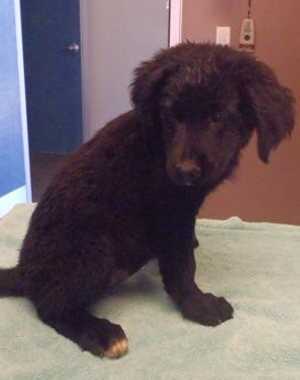
Labrador Retriever-shepherd mix pup
This female Labrador Retriever-shepherd mix pup is 15 weeks old.
She has a short brown coat, weighs 14 pounds and has been spayed.
She's in kennel No. 5c, ID No. 36715.

Labrador Retriever-shepherd mix pup
This male Labrador shepherd retriever mix pup is 15 weeks old.
He has a short tan and brown coat, weighs almost 18 pounds and has been altered.
He's in kennel No. 5d, ID No. 36716.

Chihuahua-terrier mix
This male Chihuahua-terrier mix is 2 years old.
He has a short white and brown coat and weighs almost 9 pounds. Shelter staff did not report if he had been altered.
Find him in kennel No. 9, ID No. 36857.

Female Chihuahua mix
This female Chihuahua mix is 3 and a half years old.
She has a short black and white coat, weighs almost 11 pounds and has been spayed.
She's in kennel No. 17, ID No. 35315.

Dachshund mix
This female dachshund mix is 2 and a half years old.
She has a short red coat, weighs 13 pounds and has been spayed.
You can find her in kennel No. 18, ID No. 36873.

Pit bull terrier mix pup
This male Pit bull terrier mix pup is 15 weeks old.
He has blue eyes, a short blue and white coat, weighs nearly 18 pounds and has been neutered.
He's in kennel No. 19a, ID No. 36803.

Pit bull terrier mix pup
This pit bull terrier mix pup is 12 weeks old.
He has a short blue coat, weighs 15 pounds and has been neutered.
Find him in kennel No. 19b, ID No. 36683.

Female shepherd mix pup
This female shepherd mix is 14 weeks old.
She has a short tan and black coat, weighs nearly 17 pounds and has been spayed.
She's in kennel No. 20a, ID No. 36612.

Female shepherd mix pup
This female shepherd mix is 14 weeks old.
She has a short tan and black coat, weighs 17 pounds and has been spayed.
She's in kennel No. 20b, ID No. 36613.
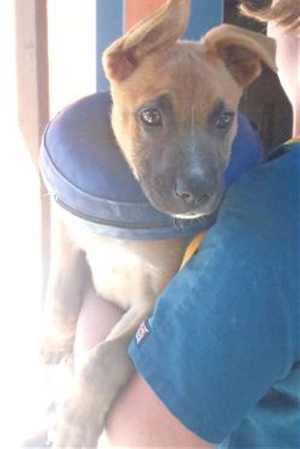
Female shepherd mix pup
This female shepherd mix is 14 weeks old.
She has a short tan and black coat, weighs 17 pounds and has been spayed.
She's in kennel No. 20c, ID No. 36614.

'Bella'
“Bella” is a 2-year-old Pomeranian-dachshund mix.
She has a long black and white coat, weighs 11 pounds and has not yet been altered.
Shelter staff said Bella is great with women and children but needs a home with no men.
Find her in kennel No. 23, ID No. ID: 36294.

Labrador Retriever-shepherd mix pup
This male Labrador Retriever-shepherd mix pup is 15 weeks old.
He has a short brown coat, weighs almost 16 pounds and has been neutered.
He's in kennel No. 24a, ID No. 36717.
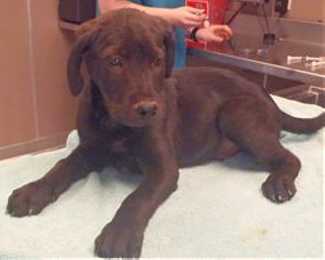
Labrador Retriever-shepherd mix pup
This male Labrador Retriever-shepherd mix pup is 15 weeks old.
He has a short brown coat, weighs nearly 18 pounds and has been neutered.
He's in kennel No. 24b, ID No. 36718.
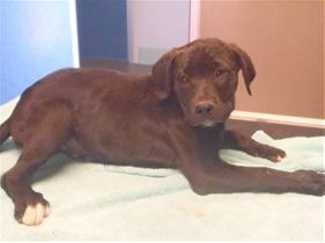
Labrador Retriever-shepherd mix pup
This male Labrador Retriever-shepherd mix pup is 15 weeks old.
He has a short brown coat, weighs nearly 17 pounds and has been altered.
He's in kennel No. 24c, ID No. 36719.
To fill out an adoption application online visit http://www.co.lake.ca.us/Government/Directory/Animal_Care_And_Control/Adopt/Dog___Cat_Adoption_Application.htm .
Lake County Animal Care and Control is located at 4949 Helbush in Lakeport, next to the Hill Road Correctional Facility.
Office hours are Monday through Friday, 8 a.m. to 5 p.m., and 1 p.m. to 3 p.m., Saturday. The shelter is open from 10:30 a.m. to 4:30 p.m. Monday through Friday and on Saturday from 1 p.m. to 3 p.m.
Visit the shelter online at http://www.co.lake.ca.us/Government/Directory/Animal_Care_And_Control.htm .
For more information call Lake County Animal Care and Control at 707-263-0278.
Email Elizabeth Larson at
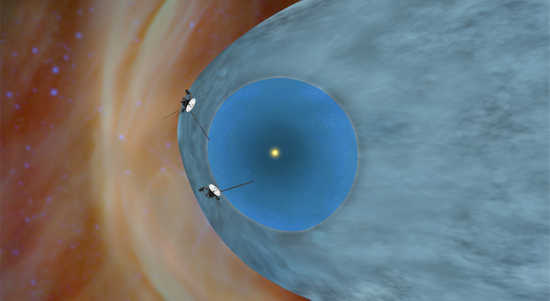
Data from Voyager 1, now more than 11 billion miles from the sun, suggest the spacecraft is closer to becoming the first human-made object to reach interstellar space.
Research using Voyager 1 data and published in the journal Science June 27 provides new detail on the last region the spacecraft will cross before it leaves the heliosphere, or the bubble around our sun, and enters interstellar space.
Three papers describe how Voyager 1's entry into a region called the magnetic highway resulted in simultaneous observations of the highest rate so far of charged particles from outside heliosphere and the disappearance of charged particles from inside the heliosphere.
Scientists have seen two of the three signs of interstellar arrival they expected to see: charged particles disappearing as they zoom out along the solar magnetic field, and cosmic rays from far outside zooming in.
Scientists have not yet seen the third sign, an abrupt change in the direction of the magnetic field, which would indicate the presence of the interstellar magnetic field.
“This strange, last region before interstellar space is coming into focus, thanks to Voyager 1, humankind's most distant scout,” said Ed Stone, Voyager project scientist at the California Institute of Technology in Pasadena. “If you looked at the cosmic ray and energetic particle data in isolation, you might think Voyager had reached interstellar space, but the team feels Voyager 1 has not yet gotten there because we are still within the domain of the sun's magnetic field.”
Scientists do not know exactly how far Voyager 1 has to go to reach interstellar space. They estimate it could take several more months, or even years, to get there.
The heliosphere extends at least 8 billion miles beyond all the planets in our solar system. It is dominated by the sun's magnetic field and an ionized wind expanding outward from the sun. Outside the heliosphere, interstellar space is filled with matter from other stars and the magnetic field present in the nearby region of the Milky Way.
Voyager 1 and its twin spacecraft, Voyager 2, were launched in 1977. They toured Jupiter, Saturn, Uranus and Neptune before embarking on their interstellar mission in 1990. They now aim to leave the heliosphere. Measuring the size of the heliosphere is part of the Voyagers' mission.
The Science papers focus on observations made from May to September 2012 by Voyager 1's cosmic ray, low-energy charged particle and magnetometer instruments, with some additional charged particle data obtained through April of this year.
Voyager 2 is about 9 billion miles from the sun and still inside the heliosphere. Voyager 1 was about 11 billion miles from the sun Aug. 25 when it reached the magnetic highway, also known as the depletion region, and a connection to interstellar space.
This region allows charged particles to travel into and out of the heliosphere along a smooth magnetic field line, instead of bouncing around in all directions as if trapped on local roads.
For the first time in this region, scientists could detect low-energy cosmic rays that originate from dying stars.
“We saw a dramatic and rapid disappearance of the solar-originating particles. They decreased in intensity by more than 1,000 times, as if there was a huge vacuum pump at the entrance ramp onto the magnetic highway,” said Stamatios Krimigis, the low-energy charged particle instrument's principal investigator at the Johns Hopkins University Applied Physics Laboratory in Laurel, Md. “We have never witnessed such a decrease before, except when Voyager 1 exited the giant magnetosphere of Jupiter, some 34 years ago.”
Other charged particle behavior observed by Voyager 1 also indicates the spacecraft still is in a region of transition to the interstellar medium.
While crossing into the new region, the charged particles originating from the heliosphere that decreased most quickly were those shooting straightest along solar magnetic field lines.
Particles moving perpendicular to the magnetic field did not decrease as quickly. However, cosmic rays moving along the field lines in the magnetic highway region were somewhat more populous than those moving perpendicular to the field. In interstellar space, the direction of the moving charged particles is not expected to matter.
In the span of about 24 hours, the magnetic field originating from the sun also began piling up, like cars backed up on a freeway exit ramp. But scientists were able to quantify that the magnetic field barely changed direction – by no more than 2 degrees.
“A day made such a difference in this region with the magnetic field suddenly doubling and becoming extraordinarily smooth,” said Leonard Burlaga, the lead author of one of the papers, and based at NASA's Goddard Space Flight Center in Greenbelt, Md. “But since there was no significant change in the magnetic field direction, we're still observing the field lines originating at the sun.”
NASA's Jet Propulsion Laboratory, in Pasadena, Calif., built and operates the Voyager spacecraft. California Institute of Technology in Pasadena manages JPL for NASA. The Voyager missions are a part of NASA's Heliophysics System Observatory, sponsored by the Heliophysics Division of the Science Mission Directorate at NASA Headquarters in Washington.
For more information about the Voyager spacecraft mission, visit: http://www.nasa.gov/voyager and http://voyager.jpl.nasa.gov .
MIDDLETOWN, Calif. – A structure fire destroyed a Middletown home late Friday night.
The fire, reported in the 21000 block of Barnes Street, was dispatched at about 11:30 p.m. Friday, according to radio reports.
Cal Fire Battalion Chief Greg Bertelli said the homeowners had been away from home for the evening and when they returned, they found the residence engulfed in flames and called 911.
Bertelli said South Lake County Fire and Cal Fire responded to the scene, finding the structure fully involved by the time they arrived.
Because of the threat to wildland, Cal Fire initially sent a full wildland dispatch of five engines, two dozers and two handcrews, said Bertelli.
He said firefighters had to work to protect surrounding structures, including a second residence about 20 feet away, as well as outbuildings.
No firefighters were injured, said Bertelli.
However, he said the homeowners lost two cats and a dog that were in the house at the time of the fire.
Bertelli said fire officials worked with Red Cross to get accommodations set up for the home's displaced family.
Because of the threat to wildland and nearby structures that the fire had posed, firefighters and four Cal Fire engines remained on scene throughout the night, finally returning to quarters at about 7:30 a.m., according to Bertelli.
A fire investigator was at the scene during the night, said Bertelli.
“It's still under investigation,” he said.
Email Elizabeth Larson at
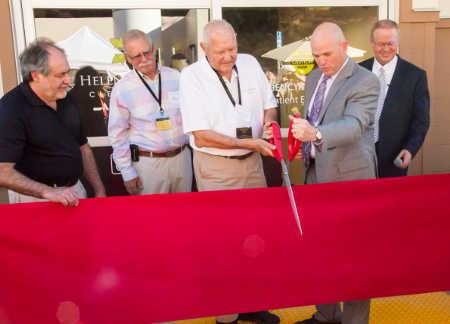
CLEARLAKE, Calif. – After nearly two years of construction, community members got a chance to see the newly completed multimillion-dollar, state-of-the-art emergency department at St. Helena Hospital Clear Lake during a Thursday evening reception.
The emergency department has been in need of more room for some time. Hospital officials said St. Helena Hospital Clear Lake is one of the smallest – yet busiest – emergency departments in the state, and sees more patients than the other emergency room in the hospital's St. Helena region.
When work began in October 2011 on the $12 million project, there were seven patient rooms in the department. Today, there are 12, with plans to expand by another four beds in another of the project's three phases, according to Project Manager Oliver Dibble.
The expansion project added 4,100 square feet of space to the hospital's busy emergency department, which serves between 50 and 60 patients a day, according to St. Helena Hospital Clear Lake officials at the Thursday event.
The reconfigured department also includes a new and larger waiting room and nurses station, private patient care rooms, new entrances, cutting-edge equipment, support systems upgrades, a redesigned triage area and easier access to private beds from the emergency department, St. Helena Hospital Clear Lake reported.
Adventist Health, St. Helena Hospital’s parent organization, provided initial funds for the project, and challenged the hospital to fund the remainder from within the community. The community responded with generosity, with gifts large and small from hundreds of donors providing the needed funds, hospital officials reported.
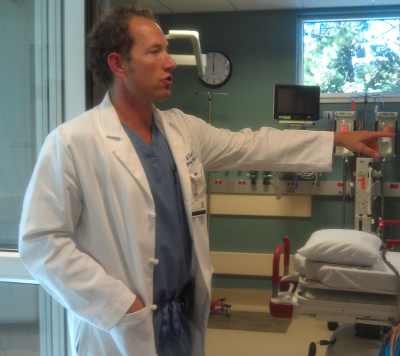
The new department isn't yet open, but is expected to be fully operational within the next 30 days. Dibble said a state inspection is still required and will take place next month.
“This is a big, big deal for our county and community,” said Supervisor Jim Comstock, who along with board colleague Jeff Smith was at the Thursday evening dedication and ribbon cutting.
Comstock called Dr. Rodney Look, MD, of the hospital’s emergency department “a huge asset.”
David Santos, the hospital's vice president for operations, said the hospital partnered with the community to improve the medical services offered there.
“This was truly a community celebration,” said Santos. “This new emergency room has been one of the most needed and anticipated developments in health care for Lake County. Everyone has worked together to make it possible, and this was a wonderful opportunity to acknowledge the tireless effort and generous donations involved. Improved access to these critical services is a legacy gift that will impact this community for decades.”
Guests arriving at the red carpet event – which included music by the Lake County Diamonds – were greeted individually and given “backstage passes” as well as commemorative first aid kits.
During a brief ceremony, Terry Newmyer, president and chief executive officer of St. Helena Hospital, spoke on how building this new emergency room was so important to the community.
Santos reviewed the project’s highlights and expressed gratitude to the community, then cut an oversized ribbon, officially opening the new facility for a sneak peak. Guests were then taken on tours of the patient rooms.
“The energy was amazing,” says Melissa Kinsel, St. Helena Hospital Clear Lake development officer. “This community has worked hard for a long time for this moment, and it was wonderful to see everything finally come together.”
The fundraising is still under way; Adventist Health reported that it's raised 84 percent of the funds needed to cover the project.
For more information, visit http://www.newerforyou.com/ .
Email Elizabeth Larson at
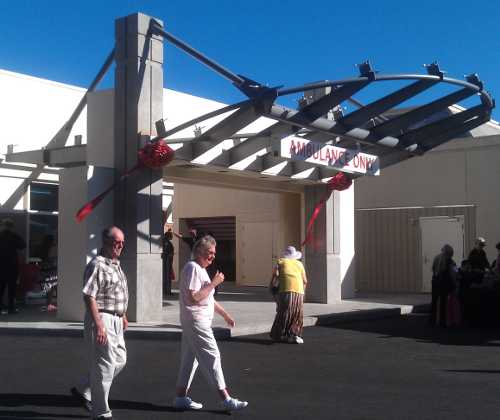
NORTHERN CALIFORNIA – In response to forecasts for excessive heat through the middle of next week throughout much of California, state emergency and public health officials are urging Californians to drink plenty of water, wear lightweight, loose-fitting clothing and take other actions that will reduce their risk of death or heat-related illness.
The National Weather Service issued an excessive heat watch due to a prolonged period of hot temperatures for most of Lake County, beginning at 2 p.m. Saturday, June 30, and extending through 6 p.m. Wednesday, July 3.
Temperatures could reach the 105 to 112 degree range, officials said.
“Prolonged exposure to excessive temperatures can be extremely dangerous, if not deadly, particularly for infants, small children seniors and those with health problems,” said Dr. Ron Chapman, director of the California Department of Public Health. “Last year was the hottest year on record in the United States. Heat waves in California are projected to occur earlier in the season, be more intense and last longer.”
He noted that at on average heat-related emergencies cause 56 deaths in Californians each year and prompt 3,800 people to seek treatment at hospital emergency rooms for heat-related symptoms, with approximately 500 cases per year requiring hospitalization.
At least 136 Californians died due to illnesses prompted by the 13-day heat wave that struck the state in July 2006.
In addition, pets and livestock need special care during the heat. Make sure they have plenty of water and a cool place to rest during the day.
”Cal EMA and its partner agencies have been preparing for excessive heat in many areas of the state this summer and fall by reviewing internal procedures, updating cooling center data bases, identifying state fairgrounds and facilities that serve as cooling centers and taking other actions to help cities and counties throughout the state ensure the safety of their residents, but it’s important that every Californian who is able do the simple, but important things that can make the difference between life and death,” said California Emergency Management Agency (Cal EMA Secretary Mark Ghilarducci.
Key actions to take to reduce risk of heat-related death and injury include:
- Monitoring local media for the latest weather forecasts and information from local officials;
- Learning the signs of heat-related illness;
- Staying out of the sun;
- Drink plenty of liquids and reducing physical activity;
- Using air conditioning and fans or getting to a location that is air conditioned such as the mall, the theater or a designated cooling center;
- Using cool compresses, misting and baths to lower body temperatures;
- Wearing lightweight, loose fitting clothing;
- Taking shelter and breaks periodically, as well as staying hydrated, if you must work outside.
The recommendations from state emergency and health officials come as state agencies implement the “Heat Alert” phase of the state’s Contingency Plan for Excessive Heat Emergencies.
Additional information on preparing for heat-related emergencies is available at http://www.calema.ca.gov/PlanningandPreparedness/Pages/Heat.aspx , http://www.bepreparedcalifornia.ca.gov/beinformed/naturaldisasters/extremeheat/Pages/ExtremeHeat.aspx and http://www.dir.ca.gov/dosh/HeatIllnessInfo.html .