 How to resolve AdBlock issue?
News
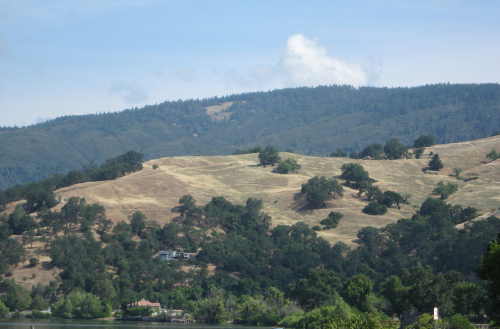
LAKE COUNTY, Calif. – Nothing says “Lake County” more than our prominent oak woodlands.
Covering millions of acres in California, oaks have played an important part in both our county and state's cultural and natural histories.
For thousands of years oaks provided acorns, an important staple for Lake County's American Indian tribes, and could easily be referred to as their “bread of life,” being nutritious, abundant and high in fat content.
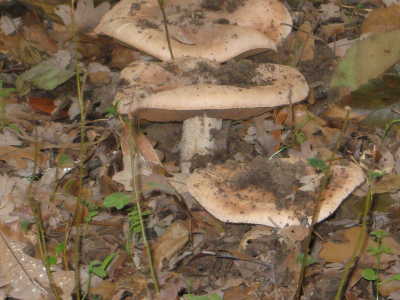
Then, nearly every part of the oak could be utilized by tribes. Fallen wood could be used for firewood to keep warm and cook with. Arrows could be fashioned from the wood, and the tree's mistletoe, mushrooms and galls each had their uses as well.
Oaks were well-tended by native peoples, and it was common practice for the health of the oak woodlands for the occupants of a region to set frequent surface fires. This practice occurred not only in California, but in Oregon and Washington as well.
With thousands of years of practice, they learned to get the most out of the oaks. Burning not only helped them capitalize on acorn production, but helped in the collection of acorns as well.
Harmful fungi that could damage oaks was dealt with during a burn, and plants which were beneficial to their culture stood a better chance of proliferating after a burn.
According to “Fire in California's Oak Woodlands” by the University of California Cooperative Extension, “Unlike most coniferous species, oaks have evolved mechanisms to survive periodic burning. Moderate and even low-intensity fires can scorch all the leaves on woody plants. For most conifers, such damage is usually lethal. Oaks, on the other hand, suffer little long-term damage from the burning of their foliage. If fires occur in the summer the oaks usually will not produce a complete crop of new leaves until the following spring. Following such fires, the trees can appear dead, since all leaves are brown and brittle and the boles may be blackened. But many of these trees will survive and it is important that landowners understand this since some may want to cut these trees down, believing they will not recover. It is therefore generally a good practice to wait at least a year after the fire to determine if a tree has been killed and should be removed.”
Botanists say that there are at least 18 species of oak in California, which are then divided into about 30 separate varieties. Worldwide there are 300 to 500 species of oak.
Fossils show that in ancient times California had even more oak species than now, and they dotted millions of acres of mountains and valleys.
Technically, oaks are a flowering plant and belong to the genus Quercus. They start out as a dormant embryo inside the acorn, with a root and shoot on either end. Cotyledons or seed leaves are present which store important foods like proteins and fats for the germination process.
The compact food capsules attract birds, insects and mammals. Many oak trees will live a lifespan long enough to produce tens of thousands of acorns.
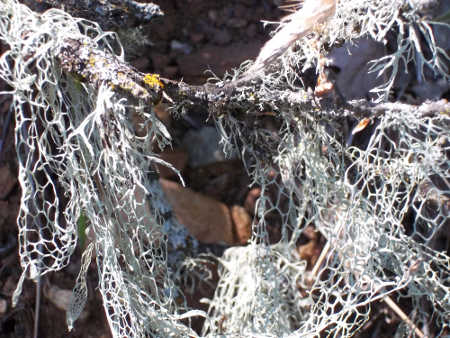
Many forms of plant life flourish in an oak. Lichens, those garlands of netting that adorn many trees are comprised of both a fungus and an alga and prosper due to a symbiotic relationship. Lichens, not parasitic, become dormant during the dry season.
Some fungi can be destructive to oaks. Around 200 known species of fungi colonize and cause disease to California oaks. Some attack stems and roots, while some species of fungi go after leaves and acorns.
Beneficial fungi in an oak woodland help protect the oak's roots from disease, and some also help decompose the annual carpet of leaves- nature's recyclers.
Oak's wood, sap, leaves and acorns provide nourishment for innumerable birds, mammals and insects. Deer and bear dine on acorns, while amphibians and reptiles feed on insects that dine on oaks or its by-products.
Oaks provide a variety of support for wildlife with their sheltering branches, nesting spots and hideouts.
The oaks' corresponding understory growth, with various shrubs and flowers also create mini habitats for other wildlife species.
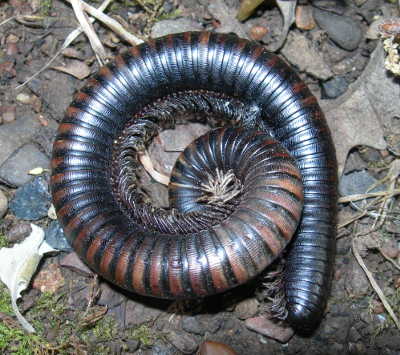
Woodrats and millipedes enjoy the shelter of oak's leaf litter, as do termites, beetles and fly larvae. Sowbugs, slugs and earthworms make use of the abundance in the leaf litter, while western gray squirrels depend on the acorns and even nest in some oaks.
Acorn woodpeckers store their cache of acorns in granaries high up in the trees. Scrub jays dine on acorns, while mice eat bits of oak bark. Pocket gophers enjoy young oak roots and seedlings.
At least seven species of gall-forming wasps deposit their eggs in oaks.
You can bask under some fantastic old, oak specimens in almost any of our county parks, such as Anderson Marsh State Historic Park, Clear Lake State Park, Middletown Trailside Park and more.
For more information about oaks see the University of California's site on oaks http://ucanr.edu/sites/oak_range/Californias_Rangeland_Oak_Species/ .
Kathleen Scavone, M.A., is an educator, potter, writer and author of “Anderson Marsh State Historic Park: A Walking History, Prehistory, Flora, and Fauna Tour of a California State Park” and “Native Americans of Lake County.” She also writes for NASA and JPL as one of their “Solar System Ambassadors.” She was selected “Lake County Teacher of the Year, 1998-99” by the Lake County Office of Education, and chosen as one of 10 state finalists the same year by the California Department of Education.
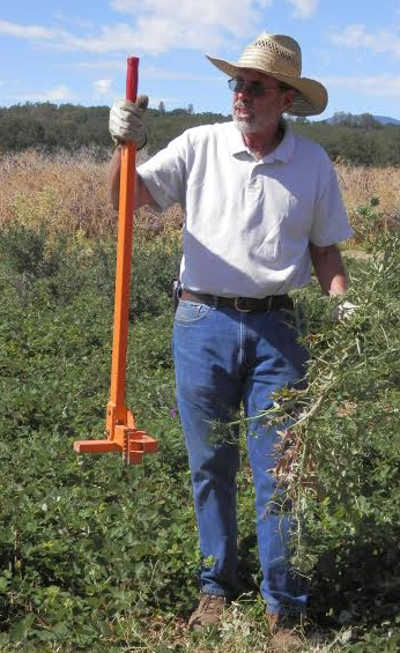
LOWER LAKE, Calif. – About two dozen people joined in the 11th annual Invasive Weeds Tour hosted by Lake County Weed Management Area on Tuesday.
This year's tour, conducted at Anderson Marsh Historic State Park in Lower Lake, was the first to be presented in a single location.
Participants engaged in a 2.1-mile walk that offered identification and conversation about various invasive plants that are present throughout the area.
The tour took guests through the flatlands of the park and across the boardwalk over the marsh lands, which are currently dry, that ends along the edge of Cache Creek.
Paul Aigner, director of McLaughlin Reserve – a former gold-mining location on Morgan Valley Road east of Lower Lake – identified several plants in the pasture area in the northwest portion of the park.
He said the area is dominated by non-native species, many of which were introduced as forage when the land was used for raising cattle.
Others, Aigner said, may have been introduced unintentionally by way of contaminated hay and other livestock feeds.
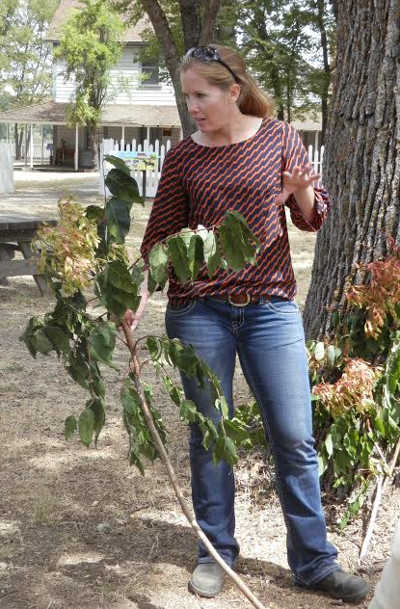
Aigner said the park's 10-year adaptive management plan contains strategies to control different non-native weeds while stimulating the growth of native species.
The feathery “medusahead,” which is prominent in the northwest quarter of the park, presents considerable difficulties, he said, in that it forms thick thatches that prevent native growth underneath.
Aigner said the durability of the thatches is evident in that they remain despite control burn eradication strategies.
He said the plant's abundance contributed to a decision to postpone native seeding after the last control burn, which was conducted about a year and a half ago.
Gae Henry, president of the Anderson Marsh Interpretive Association, said she noticed an abundance of native wildflowers after the last control burn. Aigner said the trouble is there are broad categories of weeds and few tools that can be used without damaging the native species.
Aigner added the main limitation is a lack of dedicated funding. The goal, he said, is to increase the proportion of native plants and eradicate the most noxious.
Along the creek shore, guests got a lesson in blackberries, both native and non-native.
Victoria Brandon of the Sierra Club said that the Himalayan blackberry was introduced intentionally. It can be identified by its five-leaf formation compared to the native species' three.
She said the non-native plant also has more thorns than the native version. Brandon said the both species thrive where is plenty of water, such as the bank of the creek.
Brandon said the blackberries are easily spread by birds dropping seeds and other natural occurrences. She suggested eradication when the plant is small and advised against intentionally planting it.
“This is a classic example of what invasive plants do,” Katherine Blyleven of the Lake County Department of Agriculture, pointing out that the blackberries in particular impede animals' access to water.
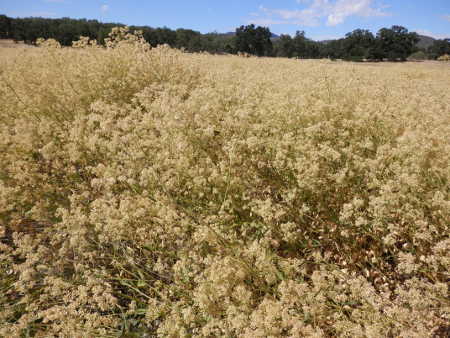
Another species prominent in the park is perennial pepperweed, which is abundant in the west quarter of the park and non-native to the area.
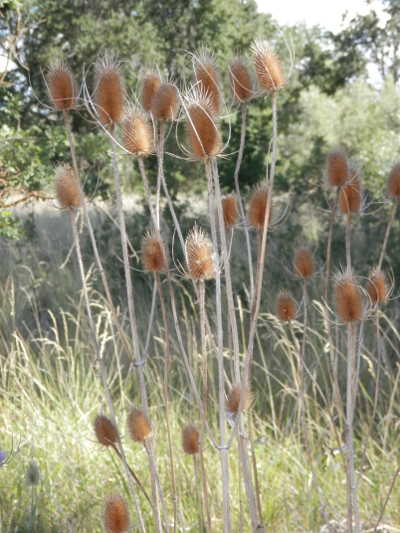
Other species identified on the tour included teasel, cocklebur, reed canary grass and bull thistle.
Greg Dills, manager of East Lake and West Lake Resource Conservation District, demonstrated use of a “weed wrench” on the bull thistle, which he lifted easily from the dirt at its roots with the tool.
Following the walk through the park, guests heard a bit about aquatic weeds while they were treated to lunch.
Dills said eradication to remove Arundo, or “giant reed” throughout Lake County, has been ongoing for the past 10 years. It is a tall, green-bladed plant.
Dills also identified salt cedar, with is a feathery plant with purple flowers. He said the salt cedar not only poisons the ground it grows in but it also consumers 300 gallons of water daily.
Other aquatic species discussed included Spanish broom, French broom and tree of heaven.
Blyleven said state legislators designated the third week in July as “Invasive Weed Awareness Week.”
The program is designed to educate citizens about the undesirable effects and impacts of non-native invasive weeds.
The tour was sponsored by the Lake County Department of Agriculture, Lake County Department of Water Resources and East Lake and West Lake Resource Conservation Districts.
Email Denise Rockenstein at
NORTHERN CALIFORNIA – On Thursday a Lake County-based Cal Fire helicopter and crew rescued four hikers near Lake Berryessa.
The crew of Cal Fire's Copter 104, which serves the Sonoma-Lake-Napa Unit and is based at the Boggs Mountain Helitack, assisted Vacaville Fire Protection District in locating the four hikers, Cal Fire reported.
The hikers, who had possible heat stress and dehydration, were found on the south side of Monticello Dam at Lake Berryessa, according to Cal Fire.
At 3:50 p.m. Thursday Copter 104 arrived at scene and was advised the hikers were near the ridgeline on the Blue Ridge Trail, officials said.
Cal Fire reported that Copter 104 located the four hikers approximately two miles up the ridgeline. They had been hiking up the steep trail, with the temperature at 97 degrees and they had run out of water.
The crew from Copter 104 lowered one rescuer to evaluate and triage the patients, Cal Fire said. Due to the hiker’s unstable condition, all four hikers were extracted via the hoist.
The hikers were flown to a nearby landing zone, where their medical care was transferred to a Vacaville ambulance crew for further evaluation, Cal Fire reported.
As the European Space Agency's Rosetta probe approaches Comet 67P/Churyumov-Gerasimenko (67P) for an August rendezvous, the comet's core is coming into sharper focus.
The ESA has released a new set of images and a striking 3D model of 67P's nucleus.
For a revolving image of the comet, visit http://www.nasa.gov/jpl/rosetta/pia18419/#.U9NeGPjoRrG .
The resolution of the latest images taken by the spacecraft's OSIRIS imaging system on July 20 is 330 feet (100 meters) per pixel.
At that resolution, 67P appears to consist of two parts: a smaller head connected to a larger body. The connecting region, the neck, is proving to be especially intriguing.
“The only thing we know for sure at this point is that this neck region appears brighter compared to the head and body of the nucleus,” said OSIRIS Principal Investigator Holger Sierks from the Max Planck Institute for Solar System Research in Germany.
This collar-like appearance could be caused by differences in material or grain size, or could be a topographical effect – no one knows.
The appearance of 67P reminds mission scientists of comet 103P/Hartley, which was visited in a flyby by NASA’s EPOXI mission in 2010.
While Hartley’s ends show a rather rough surface, its middle is much smoother. Scientists believe this waist to be a “gravitational low.”
Because it contains the body’s center of mass, material kicked up by, say, meteoroid impacts, that cannot leave the comet’s gravitational field is most likely to be re-deposited there.
Whether this also holds true for 67P’s neck region is still unclear. Another explanation for the high reflectivity could be a different surface composition.
In coming weeks, the OSIRIS team hopes to analyze the spectral data of this region obtained with the help of the imaging system’s filters.
These can select several wavelength regions from the reflected light, allowing scientists to identify the fingerprints of certain materials and compositional features.
Rosetta will be the first mission in history to rendezvous with a comet, escort it as it orbits the sun, and deploy a lander to its surface.
ESA said the next high-resolution OSIRIS image will be published on July 31.
Stay tuned!
Dr. Tony Phillips works for the National Aeronautics and Space Administration.

LAKEPORT, Calif. – Lake County Animal Care and Control is holding a special pit bull adoption event on Saturday, July 26.
All pit bulls at the shelter will cost $100 to adopt, according to Director Bill Davidson.
Davidson said that cost covers adoption, heartworm testing, vaccines, neutering or spaying, microchips and licensing.
The shelter currently has many pit bulls available for adoption, Davidson said.
Lake County Animal Care and Control is located at 4949 Helbush in Lakeport.
Saturday hours are 11 a.m. to 3 p.m.
Call 707-263-0278 for more information.
Email Elizabeth Larson at
LAKEPORT, Calif. – Police have taken a Lakeport man and his girlfriend into custody for allegedly hitting and injuring the man's 5-year-old daughter.
Charles Anthony Dougherty, 31, and Jennifer Lynn Elsa, 32, were arrested Thursday evening, according to Lakeport Police Chief Brad Rasmussen.
At 1 p.m. Thursday Lakeport Police officers were dispatched to investigate the report of child abuse, Rasmussen said.
Rasmussen said officers met with reporting family members who advised and presented evidence that a 5-year-old female juvenile was abused while in the custody of her father and father's girlfriend at a residence in the city of Lakeport.
Officers immediately began an investigation and contacted the Lake County Department of Social Services-Child Protective Services Department, the Lake County District Attorney's Office and District Attorney Victim-Witness Program for assistance, Rasmussen said.
At approximately 3:30 p.m. Thursday, Lakeport Police officers and a Victim-Witness advocate located and interviewed the alleged victim at a residence in south Lakeport, outside of the city, according to Rasmussen's report.
Rasmussen said information obtained during the interview with the child was consistent with the original report and officers immediately ordered the victim to be taken into protective custody, under the authority of the California Welfare and Institutions Code. She was turned over to CPS for care pending the outcome of the investigation.
Rasmussen told Lake County News that the child had multiple bruises and welts, and the evidence indicated that both Dougherty and Elsa were involved in the alleged abuse.
At about 5:30 p.m. Thursday, officers located and interviewed Dougherty and Elsa, and Rasmussen said it was determined that sufficient facts existed to charge both with felony unlawful corporal punishment to a child causing injury.
Rasmussen said that officers determined that the abuse occurred on July 4 at a residence on N. Main Street in Lakeport, during the city fireworks show on Clear Lake off Library Park – which was reported to be visible from the residence.
The child was advised that she was being disciplined and could not watch the fireworks show, Rasmussen said. However, while the suspects were outside, they saw the victim looking out the window and then returned inside and struck her, which resulted in injury.
Just after 6 p.m. Thursday, Dougherty and Elsa were both arrested for felony corporal injury to a child and transported to the Lake County Jail, where they were booked, Rasmussen said.
Bail for both was set at $75,000. Jail records indicated both Dougherty and Elsa remained in custody on Friday, with tentative court appearances set for Monday, July 28.
Lakeport Police's followup investigation on the case is expected to continue throughout Friday, with Rasmussen reporting that on Monday they plan to file the case with the Lake County District Attorney's Office for review regarding charges.