 How to resolve AdBlock issue?
News
Parents with dependent adult children with disabilities or mental illnesses are naturally concerned about who will care for their children when they can no longer do so themselves.
Dependent children, after all, often live at their parents’ home, receive substantial personal care and financial assistance from their parents and rely on their parents to manage their income and expenses.
Often a dependent adult child receives money from the Department of Social Security, like Social Security Disability or SSI that the parent manages as the child’s representative payee.
Hopefully, the parent, where possible, is also the child’s agent for financial, legal and property management, under a power of attorney, and also for health care decisions, under an advance health care directive.
These documents provide the parent with much broader authority. Otherwise, in the case of an incompetent and/or uncooperative adult child, the parent may become the child’s conservator.
Who will assist the child when the parent is incapacitated or eventually dies? If the adult child is competent and has a power of attorney and advance health care directive then alternatives agents, such as a trusted family member or friend, can be nominated.
But what if the child is not competent, is uncooperative, or there is no available friend or family to act as an alternative agent?
If the child is competent but there is no alternative family or friends who are qualified and willing to assist then a possible solution may be a relevant not for profit organization that assists such persons or a professional private fiduciary.
If the child is incompetent or uncooperative, however, then perhaps establishing a conservatorship while the parent is alive may provide a solution. A successor conservator can be appointed with less trouble once a conservatorship is already in place.
How will the parent’s own resources remain available to assist a dependent adult child when the parent is incapacitated or after the parent dies?
In case of the parent’s own incapacity, the parent’s own power of attorney and living trust, if relevant, should expressly provide that the parent’s resources are to be used to assist the adult child.
For example, the parent may wish to allow the child may continue to reside at home, even if the parent is in hospital or a nursing home, and that the child’s food and utilities are to be paid.
Further elaboration as to particulars can be provided in a letter of instructions by the parent to the alternative agent.
What happens when the parents eventually die and the estate is divided? Simply giving assets directly to the dependent child is a bad approach. Instead such assets should be held in a discretionary trust, and typically a special needs trust.
Why? Simply giving the child the assets outright will not only disqualify the child from any needs based government assistance but may likely result in the assets being squandered and the necessary care not being provided.
The right pooled special needs trust can receive and use the inheritance to hire a personal care advisor to visit the dependent adult, see that the child is taking care of him or herself, has food, transportation, and ensure proper living conditions.
One such pooled trust that specializes in caring for persons with mental illnesses and other brain disorders and operates here in California is proxy parent.
A pooled trust alone may not be the entire solution because pooled special needs trusts will not want to own and manage real estate.
Real property may need to be held in a separate special needs trust for the dependent child’s benefit managed by a relative, friend or private fiduciary acting as trustee. That way, the child can continue to reside in the residence.
Dennis A. Fordham, attorney (LL.M. tax studies), is a State Bar Certified Specialist in Estate Planning, Probate and Trust Law. His office is at 870 S. Main St., Lakeport, California. Fordham can be reached by e-mail at
Every year, sky watchers and summertime campers circle on their calendars a few key August nights – 11, 12 and 13.
These are the dates of the annual Perseid meteor shower, which rarely fails to please those who see it.
This year they're adding a note: “supermoon.”
During the second week of August, the biggest and brightest full moon of the year will face off against everyone's favorite meteor shower – and the outcome could be beautiful.
The source of the Perseid meteor shower is Comet Swift Tuttle. Every 133 years the huge comet swings through the inner solar system and leaves behind a trail of dust and grit.
When Earth passes through the debris zone, specks of comet-stuff hit the atmosphere at 140,000 miles per hour and disintegrate in flashes of light.
These meteors are called Perseids because they fly out of the constellation Perseus.
In a normal year, dark-sky observers typically count more than 100 Perseids per hour. But this is no normal year.
On Aug. 10, just as the Perseids are set to peak, the moon will become full. Moreover, it will become full just as it reaches the place in its orbit (perigee) that is closest to Earth.
The perigee full moon of Aug. 10 – also known as a supermoon – will be as much as 14 percent closer and 30 percent brighter than other full moons of the year.
“This is bad news for the Perseids,” said Bill Cooke of NASA's Meteoroid Environment Office. “Lunar glare wipes out the black-velvety backdrop required to see faint meteors, and sharply reduces counts.”
But there's good news, too.
The debris stream of Comet Swift-Tuttle is broad, and it is possible to see Perseids as early as late July, well before the Moon becomes full.
Also, noted Cooke, “The Perseids are rich in fireballs as bright as Jupiter or Venus. These will be visible in spite of the glare.”
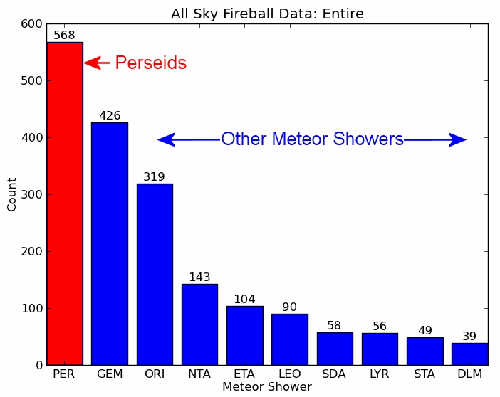
Using a network of meteor cameras distributed across the USA, Cooke's team has been tracking fireball activity since 2008, and they have built up a database of hundreds of events to analyze.
Their data show the Perseids are the undisputed 'fireball champion' of annual meteor showers. “We see more fireballs from Swift-Tuttle than any other parent comet,” he said.
A warm summer night, a moonlit landscape, and an occasional fireball cutting past a supermoon: that's an ensemble with a special beauty all its own. Enjoy the show.
For the ScienceCast, visit http://youtu.be/JkKzMAzT5fs .
Dr. Tony Phillips works for the National Aeronautics and Space Administration.

LOWER LAKE, Calif. – Konocti Unified School District announced that its new mobile app is available for use at the county's largest school district.
Parents will have instant access to their child’s academic information from the palm of their hand.
Any time, anywhere, KUSD parents can stay updated on their students’ progress. Community members can download the app to stay informed of school district events and activities.
KUSD's app is uniquely customized to meet the needs of each parent. Not only can parents view their student’s grades, assignments, attendance history, and account balances, they can set triggers to receive an instant notification when their student’s grade drops below a certain level, or a student receives an assignment score below a predefined threshold.
“Now, more than ever, our parents will have the ability to monitor their student’s performance as it happens,” said KUSD Superintendent Donna Becnel. “Gone are the days of surprise after receiving a report card at the end of a semester. This application gives our parents the opportunity to react at the right time, giving our students additional support and the opportunity to succeed.”
The application comes at a critical point when transitional changes are taking place in information consumption.
According to the most recent Pew Research Report on smartphone usage, more than 70 percent of American’s now own a smartphone, with over 35 percent identifying their smartphone as their sole source of Internet connectivity.
“We recognize and are adapting to these new trends in information exchange,” said Becnel. “Our smartphone application for parents provides that necessary source of information to the many parents who rely on their cell phone for Internet usage. We know that when parents are involved with their children's education, students do better in school. We are committed to finding innovative ways to support KUSD families."
The Konocti Unified School District app is available immediately and is free to download from both the iPhone App Store and Google Play.
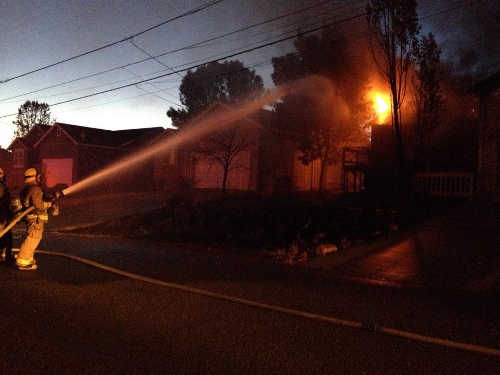
HIDDEN VALLEY LAKE, Calif. – A Thursday night fire left a Hidden Valley Lake home badly damaged.
Fire crews were dispatched to the fire in the single family residence on Ravenhill Road at approximately 8:16 p.m., according to Cal Fire Battalion Chief Mike Wink.
Wink said no one was at home at the time the fire first broke out, with the neighbors calling to report it. No injuries were reported.
He said South Lake County Fire and Cal Fire sent a total of three engines, one rescue unit, one ambulance, two battalion chiefs, a water tender and two utility vehicles.
Power lines were down and arcing when firefighters arrived, so Pacific Gas and Electric also responded, Wink said.
In addition, Hidden Valley Lake security personnel, the California Highway Patrol and the Lake County Sheriff's Office were on hand to help keep people away from the fire, close the road and control traffic, according to Wink.
Wink said the fire was contained in approximately 30 minutes, with no damage to neighboring homes.
He said the home sustained significant fire and water damage – in particular, the roof burned off – and it isn't inhabitable. The residents indicated they would stay with friends and family in the area.
Wink estimated the property loss and damage totaled about $220,000.
The cause of the fire is under investigation, he said.
Fire crews were expecting to be on scene until about midnight, and will return on Friday morning to check the fire area, Wink said.
PG&E crews also remained on scene late as damaged service lines needed to be replaced. Wink said some area residents were out of power as a result.
The PG&E online outage center reported early Friday that power was expected to be restored to one remaining customer by 7 a.m.
Email Elizabeth Larson at

LAKEPORT, Calif. – The Lake County Rodeo Association has announced the winners of the 2014 queen and princess competition.
Karissa Huggins of Kelseyville was named the 2014 Lake County rodeo queen and Kia Kohler of Kelseyville is the 2014 Lake County rodeo princess.
The competition is open to all young women and girls in High School Rodeo District 2, which includes Humboldt, Del Norte, Mendocino, Lake, Sonoma, Marin and Napa counties.
Complete information on the 2015 competition will be available at www.lakecountyrodeo.com by Dec. 1.
Chair of the competition is Rodeo Director Greg Scott, who can be reached at 707-263-5350.
NORTH COAST, Calif. – A complex of fires sparked by lightning early Wednesday near Laytonville grew by hundreds of acres on Thursday.
The three-fire Lodge Lightning Complex is located in the Wilderness Lodge area on Bell Springs Road, two miles west of Highway 101.
Cal Fire reported that the complex was 83 acres early Thursday, but by nighttime the fires had ballooned to 550 acres.
The fires are burning in heavy timber with steep, rugged terrain and difficult access, with firefighters being challenged by dry fuel conditions, above-normal temperatures and low daytime relative humidity, according to Cal Fire.
As a result, Cal Fire said firefighters were deploying aggressive air and ground strategies.
No structures are threatened and no injuries have occurred, Cal Fire said.
On Thursday 10 fire engines, 19 fire crews, four bulldozers, three air tankers, five helicopters, three water tenders and 452 personnel were assigned to the Lodge Complex, according to Cal Fire.
Cal Fire said still more resources are expected to be on scene on Friday.
Email Elizabeth Larson at