 How to resolve AdBlock issue?
News
NICE, Calif. – A fire reported late Thursday night burned a home in Nice.
The fire in the 4100 block of Lakeview Drive was first reported just before 11:45 p.m., according to radio reports.
Firefighters arriving on scene reported finding a doublewide trailer with an addition that was on fire, radio reports indicated.
Power lines also were down, units on scene said.
Northshore Fire, Cal Fire and Lakeport Fire were among the agencies responding, according to radio reports.
The fire was reported contained just after 1 p.m.
A fire that occurred last Saturday night in Nice burned two homes and a garage, as Lake County News has reported.
Additional details will be posted as they become available.
Email Elizabeth Larson at

HIDDEN VALLEY LAKE, Calif. – Julianne Carter, a homeschooled student from Hidden Valley Lake, will be honored as one of the brightest young students in the nation at a nationwide awards ceremony for academically advanced children conducted by Johns Hopkins University Center for Talented Youth (CTY).
Julianne will attend a grand award ceremony in Baltimore in October.
Johns Hopkins will honor Julianne, a participant in the CTY Talent Search, for her exceptional performance on a rigorous, above-grade-level test given to academically talented students.
During the CTY Talent Search, advanced young learners take above-grade level tests designed for older students as a means of gaining insight into their abilities.
Julianne took a test called the School and College Ability Test (SCAT), an above-level test owned by the Johns Hopkins University.
She underwent testing on May 16 and received a score in the 99th percentile.
Approximately 1,668 female seventh graders took the test worldwide, and Julianne tied with one other girl for the second highest score in the world for her grade level.
“Julianne has always enjoyed taking tests,” said Angela Carter, her mom. “She first qualified for this program when she was at Coyote Valley Elementary School and they had the GATE program (Gifted and Talented Education). Julianne had to requalify for 7th grade. It shows how great things can come out of a GATE program. Unfortunately, Coyote Valley Elementary did not continue with GATE. It's a shame because gifted kids need enrichment to reach their full potential. We do that at homeschool all the time now.”
“I just did my very best,” said Julianne. “I like taking tests and this one was challenging because of the time limits but it was a good experience. I am really looking forward to going to Baltimore and maybe seeing Washington D.C. on the same trip.”
Julianne, was one of more than 40,000 students from over 120 countries who participated in the CTY Talent Search.
Because of the difficulty of the tests, only a very small percentage of students who participated earned an invitation to a CTY Grand Awards Ceremony where they are individually honored for their academic performance and potential.
“Today we face critical global problems that require the best minds of the future to solve using discipline, creativity, and innovation,” said Elaine Tuttle Hansen, executive director of CTY. “It's inspiring and reassuring to see this group of some of the best and brightest students emerging and to know that they will become tomorrow's thought leaders and innovators.”
A member of the Lake County Youth Symphony and the Sonoma County Preparatory Orchestra – she plays piano, viola and violin – Julianne recently returned from a summer program at Interlochen Arts Camp in Michigan.
In April, she received a national honor for the WordMasters Challenge, achieving a perfect score. She was one of only 32 sixth grade students to do so nationwide.
The Johns Hopkins University Center for Talented Youth (CTY) is a global leader in gifted education since 1979. CTY ( www.cty.jhu.edu ) is focused on recognizing academic talent in exceptional K through twelve students and supporting their growth with courses, services, and resources specifically designed to meet their needs.
Education Weekly called CTY, “one of a set of remarkable nonpublic institutions dedicated to the discovery and nurture of the most talented young people for the highest levels of accomplishment.”
CTY draws students from 50 states, the District of Columbia, and some 120 countries, and provided more than $5.5 million in financial aid to more than 11,000 students in 2011-12.

UPPER LAKE, Calif. – The service of a search warrant this week resulted in two arrests and the seizure of methamphetamine and marijuana.
Detectives arrested Upper Lake residents Reid Lyndon Bruce, 56, and 45-year-old Crystal Lynn Pulido, according to Lt. Steve Brooks of the Lake County Sheriff's Office.
On Tuesday narcotics detectives secured a search warrant for a residence located in the 4000 block of West State Highway 20 in Upper Lake, serving the warrant just before 8 a.m. Thursday, Brooks said.
As detectives were approaching the front door, they saw a male subject – later identified as Bruce – look out through a sliding glass door at the detectives, according to Brooks.
Brooks said Bruce immediately turned and detectives could hear him running through the house. The detectives pursued Bruce through the residence as he attempted to run out the back door. When Bruce opened the door he was immediately contacted by additional detectives who were in the backyard and promptly taken into custody.
Inside the residence detectives also contacted Pulido, who Brooks said was detained without incident.
During the search detectives located and eradicated 259 marijuana plants which were growing in four hoop-style greenhouses, Brooks said.
He said the detectives also noticed that the garage area had been constructed for the sole purpose of cultivating marijuana. The garage contained three separate rooms which all contained high pressure sodium bulbs and shrouds to grow marijuana indoors. There was no marijuana plants located inside the garage.
During a search of the living room area, detectives located and seized methamphetamine and four glass methamphetamine pipes from inside a desk drawer. Brooks said they also located and seized several Diazepam pills and a glass methamphetamine pipe from inside Pulido’s purse which was sitting on the desk.
Multiple bags of processed marijuana was located and seized from the desk drawer’s in the living room and in each of the bedrooms, Brooks said. Several items of evidence was located, indicating methamphetamine and marijuana sales.
Both Bruce and Pulido denied having any knowledge of the 259 marijuana plants growing directly behind the residence. They both also denied having a marijuana recommendation, Brooks said.
Bruce and Pulido were both arrested for possession of a controlled substance for sale, marijuana cultivation, possession of marijuana for sale and possession of controlled substance paraphernalia. Bruce was also charged with resisting arrest, Brooks said.
They were both transported to the Lake County Hill Road Correctional Facility and booked. Jail records indicated Bruce remained in custody on Friday, with bail set at $25,000, while Pulido had posted the required portion of her $25,000 bail and was released.
Brooks said the methamphetamine was later weighed and had a gross weight of 11.6 grams. The processed marijuana was also weighed and determined to have a gross weight of 21.5 pounds.
The Sheriff’s Narcotics Task Force can be reached through its anonymous tip line at 707-263-3663.

LAKE COUNTY, Calif. – In a hearing that lasted just over 45 minutes Wednesday morning, the state Fish and Game Commission approved the California Department of Fish and Wildlife's recommendation to list the Clear Lake hitch as a threatened species under the California Endangered Species Act.
The five-member commission, meeting in San Diego, unanimously approved the listing proposal. The findings are expected to be brought back at a future commission meeting, which means the listing is not in immediate effect.
The Center for Biological Diversity submitted state and federal listing petitions on the Clear Lake hitch in September 2012. In March 2013, the commission approved listing candidacy for the fish – which put in place immediate protections – and in June formally accepted the Department of Fish and Wildlife's status review on the hitch for consideration.
“This is the first aquatic listed species in the Clear Lake Basin,” Jeff Miller of the Center for Biological Diversity, who wrote the listing petition, told Lake County News following the hearing.
The hitch is a minnow native to Clear Lake. It had at one time been found in Blue Lakes as well, but disappeared sometime in the 1980s or 1990s, according to Kevin Thomas, a senior fisheries biologist who presented the Department of Fish and Wildlife's report at the Wednesday meeting.
Thomas said the hitch had fed on the Clear Lake gnat. The gnats as a food source were reduced after being sprayed with DDT.
The hitch also have been used as a cultural resource for the native Pomo, who dried the fish for food and used it as trade goods, he said.
Thomas explained that the hitch population is “highly fluctuating” due to factors including environmental impacts and stressors.
Clear Lake has more than 20 nonnative species. The largemouth bass prey on hitch, and threadfin shad and Mississippi silversides compete with the hitch for food.
In addition, environmental modifications – such as dams and culverts, and loss of wetlands – have resulted in a 92-percent reduction of the hitch spawning habitat, Thomas said.
“The historic loss is pretty great,” he said.
Clear Lake also is a federally listed water quality site, with cleanup and analysis taking place, Thomas noted.
A climate change report on fish identified the hitch as being extremely susceptible to climate change due to less rainfall and other issues, he said.
Thomas said a good population index of the fish needs to be derived, habitat restoration projects on tributaries need to be assessed, and there needs to be comprehensive monitoring of the fish, as well as coordination of research and development of outreach programs.
The state's status review was sent out to five peer reviewers, including scientists and experts on Clear Lake, Thomas said.
Commissioner Hostler-Carmesin asked if the tribes have been involved in the review process. Thomas said yes. “The tribes have played a very important role in that.”
Commission President Michael Sutton said the Clear Lake hitch is not just a natural resource but a cultural one, with Clear Lake being California's largest natural lake.
“This is an interesting issue,” he said.
Tribal representatives urge commission to approve listing
Carla Rodriguez, a member of the Big Valley Pomo tribal council, spoke to the commission in favor of the listing, following a video presentation from the tribe that looked at hitch numbers and threats to their survival.
“It is a very sacred ceremony for our people, the gathering of these fish,” she said.
Rodriguez said she has seen a drastic decline in the hitch population over her lifetime.
This year, she and her son went out to look at the spawning hitch so she could teach the tribal traditions about the fish to her grandson. Yet, they couldn't find any.
Big Valley, Habematolel and Robinson Rancheria have been working since 2008 on studying the hitch, she said.
Noting that the Pomo have been in Lake County for 11,000 years, Rodriguez said if there is no protection for the hitch, the Pomo way of life will die with it.
Paula Britton, the Habematolel Pomo's environmental director, said she has worked with the hitch since 2008, and because of the concerns about them she's received federal grant funds – even before they've received a listing status.
“We have them in two streams and we have them in Clear Lake,” she said, noting she and her staff – who are out walking the streams every day – only see the fish when it's really wet.
The 2013 spawning run was a bad one. Britton said she and her staff only saw 413 fish, with Britton reporting that one spawning passage area had been decimated by a private property owner.
Britton said that during that spawning period the water was so low that she saw vultures reaching down and snatching and killing the fish. Fish were swimming between her legs and looking for cover.
“If you wait around for all these studies to be done … there aren’t going to be any hitch left,” said Britton, who asked for a full endangered listing, not threatened status.
Sarah Ryan, Big Valley Rancheria's environmental director, said the tribe supports the listing.
The hitch have been impacted by water diversions – both legal and illegal, she said. Thousands of juveniles get stranded and die in the creeks each season due to low water levels.
Ryan said there are incomplete water use reports, an honor system for water users when it comes to reporting, questions about whether the water in county creeks is overappropriated and many environmental violations for illegal diversions being submitted to the District Attorney's Office for prosecution.
She said she has viewed well permits along Kelsey and Adobe creeks, and wells continue to be placed along those hitch-bearing waterways.
Kelseyville resident Peter Windrem, a lifelong resident along Kelsey Creek, also spoke to the commission.
Windrem chairs the Chi Council for the Clear Lake Hitch, founded in 2004, which acts as a hitch information clearinghouse and conducts monitoring of the fish, including collecting data on the spawning runs.
The group's 30 volunteers have spent hundreds of hours gathering information; it's work that Windrem said supplements what the tribes have done to study the hitch.
The council has been able to plot the hitch's status over the last 10 years, and the populations have continued to decline. Windrem said Adobe and Kelsey creeks are now the main spawning tributaries.
“The numbers have dropped drastically and they continue to decline,” said Windrem.
He called the hitch's situation an “urgent matter,” not just for the tribes but the larger Lake County community.
In his turn before the commission, Miller said, “The Clear Lake hitch is the reason we have the California Endangered Species Act.”
The hitch's population has dropped by orders of magnitude, with Miller pointing out that “2013 was the worst hitch run in recorded history, and 2014 wasn't much better.”
He said it will be a challenge to deal with climate, drought and the hitch's interaction with nonnative fishes, but more easy to address will be diversions and obstacles.
Miller suggested that the state work with the Pomo tribes – who he said have led the way in researching the hitch – to comanage the recovery work.
During the commission's discussion of the hitch listing with staff, Fisheries Branch Manager Stafford Lehr said Clear Lake is a huge component of the state's recreational fisheries.
With the many species introduced into the lake, Lehr noted that it's not just one “charismatic recreational fish” that is driving the problems.
He said the tribe’s presentation highlighted that everything in the Clear Lake watershed is out of balance.
“I think there is a collective understanding of what is going on,” Lehr said.
Commissioner Jim Kellogg, who pointed out that he had voted against the commission majority in March 2013 regarding whether the hitch's threatened listing was warranted, said he had grown up spending a lot of time in Lake County, as his parents owned a home in Soda Bay.
He said he had been concerned about the impact of a listing on sport fisherman, particularly black bass fisherman, but added that he put a lot of stake in the studies the tribes and state officials had done.
“It’s disgusting to me that the state of California has allowed that lake to get in the condition it is today,” he said.
For the first time in 20 years, Kellogg visited Lake County this summer to see Clear Lake, adding he was “devastated” to see its condition. He said something needs to happen to fix the problem.
Commission Executive Director Sonke Mastrup read the motion to accept the threatened listing for the hitch and publish the public notice.
Commission Vice President Jack Baylis moved to approve the listing, with Hostler-Carmesin seconding and the rest of the commission joining in for a 5-0 vote.
Miller said after the meeting that he expects the listing may attract state and federal funding to aid in restoration projects.
The Center for Biological Diversity will remain involved with monitoring the progress ahead. Along with the tribes the organization will work to address issues like illegal water diversions and remediating barriers to fish passage, and will try to get a minimum flow prescribed for spawning streams, Miller said.
With the state listing moving forward, Miller said he will be monitoring the federal listing. US Fish and Wildlife still has not taken any action on it, but he added, “The state listing alleviates that concern a little bit.”
Email Elizabeth Larson at
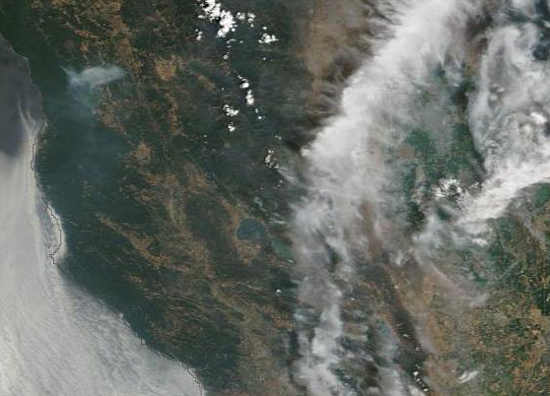
LAKE COUNTY, Calif. – Wildland fires burning around Northern and Central California and Southern Oregon are the sources of the smoke and haze over the Lake County air basin in recent days.
Lake County Pollution Control Officer Doug Gearhart said the main fires generating the smoke impacting Lake County include the Lodge Fire in Mendocino County, and – during specific meteorological conditions – the El Portal and Dark Hole Fires in Mariposa County.
The Lodge Complex of wildland fires, burning in steep terrain near Laytonville, had reached 4,300 acres and 20 percent containment as of Wednesday night, according to Cal Fire's Mendocino Unit.
The fire, which began July 30, has more than 1,500 firefighting personnel on scene, with an estimated cost so far of $7 million.
Gearhart said current weather forecasts indicate west winds should set up through the end of the week, helping to clear the smoke out of the basin, though smoke is expected to follow drainages and fan out into areas of the Northshore in the overnight and morning hours.
The current one hour average measurement in Lakeport is less than 50-percent of allowed federal health-based ultrafine particulate standards, designed to protect sensitive groups of the population from potentially harmful, respirable particulate and the ultrafine, inhalable particulate, according to Gearhart.
These levels are expected to increase at times and in localized areas with potential to reach levels that are unhealthy for sensitive individuals in areas of the county until the fires are contained, Gearhart said.
Though conditions are still in the good to moderate air quality range in Lakeport, Gearhart said isolated areas throughout Lake County may experience air quality in the moderate to unhealthy for sensitive individuals range as the smoke settles.
He said regional weather patterns suggest continued smoke impacts for the next couple days, with relief possible by late this week as a west/southwest wind pattern develops.
Lake County Public Health Officer Dr. Karen Tait advised area residents to be cautious in resuming normal outdoor activities.
“Variable weather conditions and ongoing fire activity may result in localized areas of reduced air quality, which could still pose health risks to people with underlying health conditions. Since we can’t always predict when and where ‘pockets’ of poorer air quality may occur, it is prudent to be careful until conditions stabilize,” Tait said.
Smoky conditions can cause irritation of the eyes, nose and air passages, which officials said can be hazardous in young children, the elderly, individuals with heart conditions or chronic lung disease such as asthma, bronchitis and other respiratory conditions.
Individuals with asthma, bronchitis, emphysema and other lung or heart diseases should carefully adhere to their medical treatment plans and maintain at least a five-day supply of prescribed medications, officials said. They should limit outdoor activity and unnecessary physical exertion. Air conditioning that recirculates indoor air should be used, when available.
Drinking plenty of water to avoid drying of the airways is recommended, unless restricted for medical reasons, local officials said.
Dust masks are not protective against the most harmful pollutants caused by wildfire smoke that drifts to nearby areas, Gearhart said. They are useful in filtering out the ash and larger particles that are encountered in burn areas.
Air purifying respirators, such as N-95 filtering face pieces, may be effective in reducing harmful particulate matter, but also increase the work of breathing, can lead to physiologic stress, and are not recommended as a general protective measure, Gearhart said.
Gearhart said regional haze and particulate from these fires are expected to continue throughout Lake County until the fires are out.

LAKEPORT, Calif. – The Old Time Bluegrass Jamboree set for Sept. 12 and 13 at the Soper Reese Theatre in Lakeport will benefit the Anderson Marsh State Historic Park while providing two great evenings of entertainment.
“We are currently inviting sponsors for this event,” noted Anderson Marsh Interpretive Association (AMIA) president Roberta Lyons, “and here is your chance to get great reserved seats for some wonderful entertainment while at the same time supporting our park.”
The event opens on Friday night with a concert and old fashioned country dance, followed by more entertainment on Saturday starting at 1 p.m.
Headliner for the show is the Blue and Lonesome band, which will be playing Saturday night.
There will be jamming sessions, workshops, and snacks and drinks as well as a dinner intermission on Saturday night so those attending can grab a bite at one of Lakeport’s excellent eateries.
Sponsorship categories are as follows:
- $100 – two tickets to either Friday or Saturday show.
- $200 – four tickets to either Friday or Saturday show.
- $500 – eight tickets to the entire event both Friday and Saturday.
Sponsors receive a reserved table up front, with wine and snacks at the table.
Ticket prices are $30 for the entire two-day event; Friday-only tickets are available for $15 and Saturday only tickets are $20.
To sponsor this event, contact the Anderson Marsh Interpretive Association at 707-995-2658 or