 How to resolve AdBlock issue?
News
Caltrans and the California Department of Fish and Wildlife (CDFW) are reminding motorists to remain alert for wildlife near roadways during “Watch Out for Wildlife Week,” which runs from Sept. 15 to 21.
“It’s important that motorists, when driving through areas frequented by deer, elk and other animals, be alert to protect themselves as well as California’s wildlife,” said Caltrans Director Malcolm Dougherty.
Defenders of Wildlife (Defenders), a national nonprofit organization dedicated to protecting native species and their natural communities, reports more than 200 people are killed nationally in collisions with deer, elk and other large mammals each year with an estimated 1.5 million animals hit annually.
The Watch Out for Wildlife campaign is supported by Caltrans, CDFW, Defenders and the Road Ecology Center at the University of California, Davis.
“It’s a shame that many animals and people are injured and killed on our roads every year,” said Craig Stowers, CDFW's Game Program Manager. “Many injuries, deaths and costly vehicle repairs can be avoided if drivers would pay more attention when animals are most active, and be prepared to react safely if an animal moves onto the road.”
Caltrans, CDFW and Defenders offer a few tips for motorists:
– Be particularly alert when driving in areas frequented by wildlife and give yourself more time to react safely by reducing your speed.
– Pay particular attention when driving during morning and evening, as wildlife are most active during these times.
– If you see an animal cross the road, know that another may be following.
– Don’t litter. The odors may entice animals to venture near roadways.
On Monday Caltrans announced a new department-wide mission, vision and goals as part of its ongoing efforts to modernize operations and improve performance and accountability across California.
“Adopting a new mission, vision and goals is a critical step toward aligning Caltrans with state transportation planning and policy goals and better serving all Californians,” said Caltrans Director Malcolm Dougherty. “This key change helps focus everyone at Caltrans on improved department performance, employee accountability and communications. The next step will be to set specific performance metrics to communicate honestly and transparently about our progress in meeting our goals.”
In coordination with the California State Transportation Agency (CalSTA), and on the heels of an external review that called for bold reforms and a more modern department, Caltrans crafted a new mission and vision that is fully consistent with California's planning and policy objectives.
Caltrans' old mission was to “improve mobility,” which did not capture state efforts to clean up the environment, improve quality of life and strengthen California's economy:
– MISSION: Provide a safe, sustainable, integrated and efficient transportation system to enhance California's economy and livability.
– VISION: A performance-driven, transparent and accountable organization that values its people, resources and partners, and meets new challenges through leadership, innovation and teamwork.
“Caltrans is embracing reform and transforming into a modern transportation agency, equipped to handle today's challenges and those of tomorrow,” said CalSTA Secretary Brian P. Kelly in a recent letter notifying the California State Legislature of the new mission at Caltrans. “Next, we will develop new performance measures, which will objectively measure progress toward achieving our goal of transforming into the transportation department we envision for the future.”
In order to achieve this mission and vision and give Californians the most efficient transportation system possible, Caltrans also laid out five new goals:
– Safety and health: Provide a safe transportation system for workers and users, and promote health through active transportation and reduced pollution in communities.
– Stewardship and efficiency: Money counts. Responsibly manage California's transportation-related assets.
– Sustainability, livability and economy: Make long-lasting, smart mobility decisions that improve the environment, support a vibrant economy, and build communities, not sprawl.
– System performance: Utilize leadership, collaboration and strategic partnerships to develop an integrated transportation system that provides reliable and accessible mobility for travelers.
– Organizational excellence: Be a national leader in delivering quality service through excellent employee performance, public communication, and accountability.
Adopting a new mission, vision and goals for Caltrans concludes the department's implementation of four “early action” recommendations made by the State Smart Transportation Initiative (SSTI) in January, when it called for bold reform and a more modern department:
1) Develop a new mission consistent with state planning and policy goals;
2) Organize teams to develop implementation plans;
3) Work toward successful implementation of SB 743; and
4) Modernize state transportation design guidance.
Caltrans will now work with the CalSTA to develop new performance measures, which will objectively measure progress toward achieving state goals.
NORTH COAST, Calif. – Firefighters are getting closer to fully containing a Mendocino County wildland fire that has destroyed numerous structures and burned several hundred acres.
Cal Fire said Monday evening that the Black Fire is 80-percent contained, with the size estimate rolled back slightly to 403 acres due to more accurate mapping.
The fire broke out late Saturday afternoon off of Black Bart Trail, north of Lake Mendocino and between Redwood Valley and Potter Valley. Cal Fire said the cause remains under investigation.
The fire has burned a total of 11 structures – six of them outbuildings – and resulted in three injuries, Cal Fire reported.
No structures remained threatened as of Monday evening, according to Cal Fire.
Despite challenging conditions, firefighters on Monday made great progress on strengthening control lines and mopping up hot spots around the fire perimeter, with the fire suppression repair and rehabilitation phase beginning, Cal Fire said.
On Monday evening, 220 firefighting personnel remained assigned to the incident, along with 20 fire engines, six fire crews, one bull dozer and seven water tenders, according to Cal Fire's report.
Cal Fire said firefighting resources have started the demobilization process and are becoming available to support new incidents or return to their home units.
Email Elizabeth Larson at
LAKE COUNTY, Calif. – Lake County Animal Care and Control's shelter this week has several tabbies and a calico cat needing homes.
The two males and three females range in age from a kitten to adults, with a variety of coat lengths and colors.
In addition to spaying or neutering, cats that are adopted from Lake County Animal Care and Control are microchipped before being released to their new owner. License fees do not apply to residents of the cities of Lakeport or Clearlake.
If you're looking for a new companion, visit the shelter. There are many great pets there, hoping you'll choose them.
In addition to the animals featured here, all adoptable animals in Lake County can be seen here: http://bit.ly/Z6xHMb .
The following cats at the Lake County Animal Care and Control shelter have been cleared for adoption (other cats pictured on the animal control Web site that are not listed here are still “on hold”).

Male gray tabby
This male gray tabby has a short coat.
He is in cat room kennel No. 20, ID No. 676.

Gray tabby kitten
This female gray tabby kitten has a short coat.
She is in cat room kennel No. 30, ID No. 706.

Female orange tabby
This female orange tabby has a medium-length coat.
She is in cat room kennel No. 57, ID No. 660.
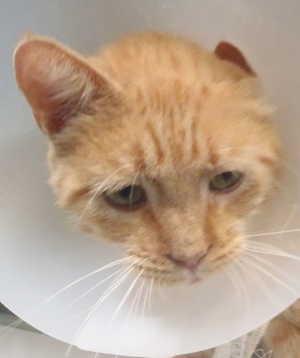
'Bob'
“Bob” is a 3-year-old orange tabby.
He has a short coat and gold eyes, and has been neutered. Staff said he would make a great outdoor cat.
He's in cat room kennel No. 66, ID No. 625.

Domestic short hair mix
This female domestic short hair mix has a calico coat.
She is in cat room kennel No. 72, ID No. 703.
Adoptable cats also can be seen at http://www.co.lake.ca.us/Government/Directory/Animal_Care_And_Control/Adopt/Cats_and_Kittens.htm or at www.petfinder.com .
Please note: Cats listed at the shelter's Web page that are said to be “on hold” are not yet cleared for adoption.
To fill out an adoption application online visit http://www.co.lake.ca.us/Government/Directory/Animal_Care_And_Control/Adopt/Dog___Cat_Adoption_Application.htm .
Lake County Animal Care and Control is located at 4949 Helbush in Lakeport, next to the Hill Road Correctional Facility.
Office hours are Monday through Friday, 8 a.m. to 5 p.m., and 1 p.m. to 3 p.m., Saturday. The shelter is open from 10:30 a.m. to 4:30 p.m. Monday through Friday and on Saturday from 1 p.m. to 3 p.m.
Visit the shelter online at http://www.co.lake.ca.us/Government/Directory/Animal_Care_And_Control.htm .
For more information call Lake County Animal Care and Control at 707-263-0278.
Email Elizabeth Larson at
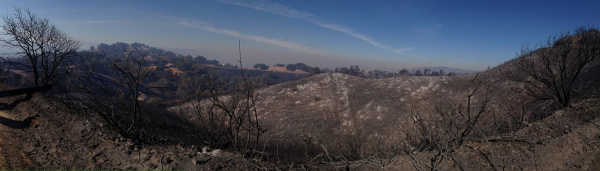
NORTH COAST, Calif. – The Black Fire in Mendocino County grew in acreage on Sunday, and while a number of homes remain threatened officials have canceled an evacuation order.
As of Sunday evening, the fire has burned approximately 417 acres since beginning shortly before 4 p.m. Saturday off of Black Bart Trail between Redwood Valley and Pottery Valley. Cal Fire said the fire is 50-percent contained.
The fire has destroyed five structures and five outbuildings, and resulted in three injuries, Cal Fire reported.
While 10 structures remain threatened, the evacuation order for areas from Hell's Delight Canyon and northeast toward Potter Valley has been canceled, and the evacuation shelter at Eagle Peak Middle School has been closed. Red Cross representatives can reopen the shelter if needed, according to Cal Fire.
Approximately 332 firefighting personnel, 30 fire engines, 10 fire crews, four bulldozers, two helicopters and five water tenders are assigned to the fire, Cal Fire said.
Firefighters are working to construct containment lines, extinguish hot spots near the containment lines and defend structures.
Cal Fire said the Black Fire is burning in a mix of grass, brush, oak and pine trees.
The agency said firefighters are working in extreme conditions, dealing with high heat and low humidity, and facing the potential for erratic winds.
Black Bart Trail East is closed while firefighters work in the area, Cal Fire said.
Cal Fire said the fire's cause remains under investigation.
Email Elizabeth Larson at
NORTHERN CALIFORNIA – The Napa earthquake that occurred at 3:20 a.m. Aug.24, 2014, will certainly be remembered in the years to come.
The earthquake, described as a “sudden release of energy,” definitely shook many of us awake here in Lake County. Thankfully, little, or no damage was reported here.
I spoke with local geologist, Dr. Dean Enderlin (who was sorry he'd missed it!) about the quake.
When asked about the specific fault on which this earthquake occurred, he answered, “The epicenter was located along what appears to be a splay of the 'West Napa Fault,' which is known to be an active fault. This is the largest earthquake that has been measured along that fault zone. There was an M5.0 earthquake along it back in 2000 that also damaged parts of Napa, but not to this degree.”
Asked about the earthquake's aftershocks Enderlin stated, “Yes, aftershocks are continuing up to about M3.0. It takes time for the rock around the initial earthquake to adjust to the new stresses.”
Regarding the occurrence of other quakes this size or larger in Lake County, aside from the Loma Prieta 25 years ago, Enderlin said, “There was a large earthquake (actually a series of earthquakes) centered in Santa Rosa in 1969 that was felt over our region. It damaged buildings in Calistoga, and may have done a little damage in Middletown. The pair of earthquakes measured 5.6 and 5.7, and were centered on the Rodgers Creek Fault Zone (the largest and most dangerous fault zone in our area).”
The tool of choice for earthquake measurement is a seismometer. The word comes from the Greek, “seismos.” The term was first used by David Milne-Home in 1841.
Seismometers take the measurements of ground motions, and are utilized in both earthquakes and volcanic eruptions.
Seismologists generally record magnitude 5 or larger earthquakes. Those which are smaller than a 5 are measured by seismological observatories take their measurements from a scale called “the local magnitude scale” and are measured on a Richter scale.
The Richter scale, also known as the 'Richter Magnitude Scale', was designed from a base-10 logarithmic scale.
It was developed in 1935 by seismologists Charles Francis Richter and Beno Gutenberg, who were both based at the California Institute of Technology.
Kathleen Scavone, M.A., is an educator, potter, writer and author of “Anderson Marsh State Historic Park: A Walking History, Prehistory, Flora, and Fauna Tour of a California State Park” and “Native Americans of Lake County.” She also writes for NASA and JPL as one of their “Solar System Ambassadors.” She was selected “Lake County Teacher of the Year, 1998-99” by the Lake County Office of Education, and chosen as one of 10 state finalists the same year by the California Department of Education.