How to resolve AdBlock issue?
News

KELSEYVILLE, Calif. – Saw Shop Gallery Bistro’s 13th annual benefit dinner for Habitat for Humanity Lake County will be held on Monday, Nov. 3.
The event will begin at 6 p.m. at the restaurant, 3825 Main St. in Kelseyville.
The funds received will go towards improving the lives of Lake County military veterans by keeping their homes safe, decent and accessible.
This is the main funding annual event for Habitat for Humanity Lake County.
The dinner will be a multi-course, sit-down meal.
All costs of the dinner are donated to Habitat for Humanity including the food, wine and the staff hours of the Saw Shop Gallery Bistro.
Tickets are $100 each and table sponsorships for $800 also are available.
Please call the Saw Shop Bistro at 707-278-0129 for reservations.
For further information, call the Habitat for Humanity office at 707-994-1100.
Traffic collisions remain the leading cause of death for teenagers in the United States and California. Each year, thousands of young drivers and their passengers are killed in collisions.
To help bring awareness to this national problem, the California Highway Patrol (CHP) will participate in National Teen Driver Safety Week, Oct. 19 to 25.
“This week is dedicated to focusing attention on setting rules for your teen driver before letting them get behind the wheel,” said CHP Commissioner Joe Farrow. “By setting these ground rules for new drivers early on, you can provide them with the information needed to become a safe driver and thus help to prevent future tragedies from ever happening.”
The CHP and the National Highway Traffic Safety Administration encourage parents to use the following five rules to help their teens be safe behind the wheel:
– Avoid distractions when behind the wheel, especially cell phones.
– Be responsible with passengers in the car and do not allow them to hinder your ability to drive responsibly.
– Follow the posted speed limit and never drive at a speed unsafe for the conditions of the roadway.
– Never drink and drive or ride with a driver who has been drinking.
– Always wear your seat belt and ensure your passengers are buckled up before hitting the road.
According to the CHP’s Statewide Integrated Traffic Records System for 2012, the most recent year that finalized data is available, there were more than 19,000 drivers between the ages of 16 to 19 involved in collisions in California.
A teen driver was determined to be at fault in 66 percent of those collisions, which resulted in more than 140 people killed.
To address the issue, CHP partners with Impact Teen Drivers which endeavors to change the culture of teen driving through a nationwide educational program that confronts the dangers and consequences of reckless and distracted driving.
“We focus on teens because their inexperience places them at the greatest risk, and because they are forming life-long driving habits,” said Dr. Kelly Browning, executive director of Impact Teen Drivers. “But it is also important that we don’t lose sight of the fact that parents are the primary influencer of their teen’s driving habits. It will take all of us, educators, law enforcement, parents, and communities, to change the driving culture to one that is distraction-free.”
The CHP also offers a free Start Smart class as an opportunity to unite parents and teens in a two-hour driver safety education class that is available throughout the state.
Parents or guardians are encouraged to contact their local CHP office for additional details and information on when classes are scheduled for both Start Smart and Impact Teen Drivers.
The CHP's Clear Lake Area office can be reached at 707-279-0103.

Waking up before sunrise is a good way to get a head start on the day.
On Oct. 21, waking up before sunrise could stop you in your tracks.
Blame Halley’s Comet.
Every year in mid-to-late October, Earth passes through a stream of dusty debris from Comet Halley, and the pre-dawn sky can light up with a pretty display of shooting stars.
“We expect to see about 20 meteors per hour when the shower peaks on Tuesday morning, Oct 21,” said Bill Cooke, the head of NASA's Meteoroid Environment Office. “With no Moon to spoil the show, observing conditions should be ideal.”
Because these meteors streak out of the constellation Orion, astronomers call them “Orionids.”
“The Orionid meteor shower is not the strongest, but it is one of the most beautiful showers of the year,” noted Cooke.
The reason is its setting: The shower is framed by some of the brightest stars in the heavens.
Constellations such as Taurus, Gemini and Orion provide a glittering backdrop for the display.
The brightest star of all, Sirius, is located just below Orion's left foot, a good place to point your camera while you're waiting for meteors.
To see the show, Cooke suggests going outside one to two hours before sunrise when the sky is dark and the constellation Orion is high overhead. Lie down on a blanket with a broad view of the heavens.
Although Orionids emerge from a small area near the shoulder of Orion, they will spray across the entire sky.
“Be prepared for speed,” he added. “Meteoroids from Halley’s Comet strike Earth's atmosphere traveling 148,000 miles per hour. Only the November Leonids are faster.”
Speed is important because fast meteors have a tendency to explode.
Occasionally, Orionid fireballs will leave incandescent streams of debris in their wake that linger for minutes.
Such filaments of “meteor smoke” twisted by upper atmospheric winds into convoluted shapes can be even prettier than the meteors themselves.
“It really is a wonderful morning to be awake,” said Cooke. “Just don't plan on going anywhere in a hurry.”
Dr. Tony Phillips works for the National Aeronautics and Space Administration.
LAKE COUNTY, Calif. – State and local health officials say they are working together to make sure that if the Ebola virus shows up in California, health care workers are prepared to meet the potential danger safely.
California Department of Public Health officials told reporters Wednesday that there are no cases of Ebola – or suspected cases – in the state.
Two patients – one in Los Angeles County, the other in Sacramento County – had been tested for the virus as a precaution since the outbreak began in West Africa.
“Ebola infection was ruled out in both patients,” said Dr. Gil Chavez, MD, deputy director and state epidemiologist for CDPH's Center for Infectious Diseases.
However, while it's not in California, it's become a nationwide concern.
In recent weeks Ebola has infected two Texas nurses who had cared for a patient who traveled from Liberia to Dallas, where he began showing symptoms and later died at Texas Health Presbyterian Hospital. The Centers for Disease Control and Prevention said the two nurses have since been isolated.
On Wednesday, the White House said those two transmissions of Ebola do not amount to an outbreak.
Additionally, President Barack Obama said the chance of an Ebola outbreak in the United States “is extremely low,” and guaranteed that he and his administration are doing everything they can to make sure Americans are safe.
Obama's statement came the same day that National Nurses United called on him to invoke his executive authority to order all hospitals in the United States to meet the highest uniform, national standards and protocols to protect patients, health care workers and the public, according to a letter the nurses union sent the president.
National Nurses United has reported that surveys of its members across 46 states and the District of Columbia indicates hospitals and health care workers are seriously unprepared – in terms of training, planning in supplies – to deal with Ebola.
The Ebola virus causes severe, often fatal illness in humans – the average fatality rate is running at 50 percent, and has been as high in some outbreaks as 90 percent – with an incubation period from infection to the manifestation of symptoms ranging between two and 21 days, according to the World Health Organization.
The virus spreads through human-to-human contact, specifically, body fluids. It is not airborne.
Symptoms include sudden onset of fever, intense weakness, muscle pain, headache and sore throat, which a World Health Organization fact sheet on the virus said are followed by vomiting, diarrhea, rash, impaired kidney and liver function. In some cases, Ebola causes both internal and external bleeding.
Patients must be isolated. Health officials report that there is no specific treatment for the disease, but victims often need intravenous fluids or other rehydration measures.
The World Health Organization said that widespread infection in the general population “is highly unlikely” in countries with well-developed health systems.
Officials: Ebola poses 'low risk' to California
Dr. Ron Chapman, California Department of Public Health director and state health officer, said this week that a team of state agency leaders are monitoring the situation and working on preparedness, a process that includes being in contact with health facilities and health care workers across the state. Chapman said the state's emergency operations center also has been activated.
“These conversations, discussion and preparedness will be ongoing,” Chapman said, adding that his agency is continuing to monitor the developments in Texas as they unfold.
While Chavez said it wouldn't be a surprise if Ebola eventually was found in California, he emphasized that Californians needed to know that Ebola doesn't pose a significant health risk to the state at this time.
“We believe the risk of the spread of Ebola in California is very low,” Chavez said.
Health officials said people cannot contract Ebola through air, food or water, and that people who have no symptoms are not contagious.
Ebola is not very hardy, Chavez said. It doesn't live for very long in dry conditions, so can't survive on impervious surfaces like doorknobs and desks.
He said it lives longer in moist conditions and can only be passed through body fluids – such as blood, urine and vomit – and contaminated objects like needles, meaning that health care workers, caregivers and family members are most at risk.
The CDC maintains control of key aspects of the Ebola situation, including the final decision on where samples testing takes place, Chavez said.
The decision about which US airports should have screening implemented for travelers from West Africa also is a federal decision, according to Chavez.
The CDC and Department of Homeland Security had the enhanced screenings implemented for all travelers coming from Ebola-affected countries at John F. Kennedy International Airport in New York; Washington Dulles International Airport in Washington, D.C.; Newark Liberty International Airport in New Jersey; Chicago O'Hare International Airport; and Hartsfield-Jackson Atlanta International Airport.
The agencies said those five airports receive more than 94 percent of travelers coming to the United States from the Ebola-affected nations of Guinea, Liberia and Sierra Leone.
Chavez said CDPH would like to have California's international airports added to the list, and is continuing to have discussions with the federal government about the airport list.
A major focus for state health officials is the effort to ensure preparedness at hospitals around California, with each facility being encouraged to develop and test a plan specific to its needs.
With every hospital unique – and with there existing within each facility areas with differing levels of potential exposure – state officials said a “one size fits all” approach won't work, thus the need for individual planning and training.
Chapman said the goal is that if a person with Ebola went into an emergency room anywhere in the state, the protocols would be in place to make sure the patient was properly screened, isolated and treated.
CDPH is working with the California Department of Industrial Relations and Cal/OSHA, which is tasked with developing policies and guidelines for personal protective equipment for health care workers, he said.
Chapman said CDPH's federally funded hospital preparedness program, which has been around since the September 2001 terrorist attacks, is making funds available for training, staffing and stockpiling of supplies.
Chavez added that California has very strong worker protection rules, and adhering to Cal/OSHA regulations will go a long way to ensuring protection against Ebola.
Local hospitals, agencies work on preparedness
Dr. Karen Tait, Lake County's public health officer, said she's been involved in the process of preparing for the possibility of Ebola.
“There have been numerous conference calls and distribution of a large quantity of guidelines. It is a very fluid situation, with lots of updates,” she said.
“Although Lake County is not likely to be a destination for many people at-risk for Ebola, we do have some international travelers who come here, so having to deal with a possible case of Ebola isn't outside the realm of possibility,” she explained.
As part of her continuing work on preparation, Tait said that on Wednesday she participated in another state conference call and discussed Ebola planning with local ambulance providers and hospital representatives at the regularly scheduled Emergency Medical Care Committee.
“I believe that everyone agrees that we'd like to see additional guidance from CDC and the state, taking into account the experience and expertise of those who have dealt directly with Ebola virus infections,” Tait said. “In the meantime, our hospitals and ambulance providers are aware of the recommended precautions they should take and have been refreshing their personnel on them. I'm pleased to see the calm, professional approaches being taken.”
A similar process is under way in neighboring Mendocino County, where this week the Health and Human Services Agency reported that it is working closely on a daily basis with health care providers, health care facilities – including local hospitals – along with emergency medical services providers and CDPH.
Mendocino County officials said they are working to make sure that all health care providers from the front lines to the hospitals are trained, equipped and drilled on all proper CDC guidelines and protocols to ensure safe and efficient handling of any suspected or confirmed Ebola cases that may occur there.
Lake County's two hospitals say they already have protocols in place to deal with the Ebola potential, and are continuing to plan and monitor developments.
Colleen Assvapisitkul, RN, the Chief Nursing Officer for St. Helena Hospital Clear Lake said the hospital is following current recommendations from the CDC for the management of Ebola, including infection prevention and control protocols and procedures.
“The Infection Prevention and Control team and the Emergency Preparedness team are taking all precautions and have been developing site-specific plans and 'Ebola suspect' policies and procedures,” Assvapisitkul said. “Emergency Department and other key clinical staff are in the process of being trained on the proper screening of patients and will continue to do training on a regular basis.”
Assvapisitkul said hospital officials also are in contact with the local health department for developing information and further guidance, and hospital staff will be conducting an Ebola drill following the state Department of Public Health Ebola scenario and template for hospital drill.
On the other side of the lake, “Sutter Lakeside Hospital’s preparedness efforts have been ongoing for the past several months,” said Sutter Health spokesman Dean Fryer.
“We have worked closely with our Sutter Health Emergency Management System Ebola Virus Response Planning Team to develop comprehensive and specific workplace and patient care guidelines for our hospitals regarding the Ebola virus. We’ve developed protocols detailing screening and care of patients, safety guidelines for staff and other practices such isolation procedures, hand washing and the use of personal protective equipment,” Fryer said.
“Our work continues with ongoing training and will continue weekly going forward. Word of the first confirmed Ebola diagnosis of a health care worker in the United States reconfirms our commitment to ensuring patient and employee safety,” he added.
Fryer said preventing the spread of any infectious disease is ongoing in Sutter's care centers. “Our hospital emergency department screens and monitors for the Ebola virus and we follow procedures established by the Centers for Disease Control and Prevention and the California Department of Public Health.”
Tait said that, as a small county, Lake is fortunate to have close working relationships in its health care community, and the many partners are continuing to work together to prepare.
Within the next week, Tait said results are expected from a statewide survey of hospitals that will help determine which hospitals are best prepared to offer the type of care Ebola patients would need.
“As a small community served by two critical access hospitals, we feel that we could safely handle a patient suspected to have an Ebola infection, yet would anticipate transferring such patients to a facility able to offer the specialty care that would be needed,” she said.
Tait said Lake County Public Health is using its Hospital Preparedness Partner grant to do public health planning with acute care hospitals, skilled nursing facilities and outpatient clinics on the public health aspects of emergency and disaster planning.
“This is an ongoing process which supports our ability to keep them apprised of current guidelines for response and maintains open lines of communication locally,” she said.
Email Elizabeth Larson at
LAKE COUNTY, Calif. – Obtaining personal and family health coverage and gaining access to Medi-Cal benefits is now easier than many people think.
On Sept. 30, the Lake County Department of Social Services was awarded $77,500 in grant funds through the County Medical Services Program Medi-Cal Outreach and Enrollment Pilot Project.
The Lake County Department of Social Services has partnered with North Coast Opportunities, the Lake County Probation Department and the Lake County Sheriff’s Office in a two-year project to increase awareness of and enrollment in low and no-cost health coverage through California’s Medi-Cal program.
“NCO and Lake County Department of Social Services have a strong history of working together to address the needs of our community, and we will continue this relationship as we work together to increase enrollment and participation … in the Medi-Cal program,” said Patty Bruder, executive director of North Coast Opportunities.
Medi-Cal is California’s Medicaid health care program.
With the implementation of the Affordable Care Act in January, more people than ever qualify for Medi-Cal coverage.
Anyone can apply for Medi-Cal benefits and, if determined eligible, this program will pay for a variety of medical services for children and adults with low to moderate incomes.
In Lake County, where more than 63,000 people reside, approximately 20 percent or 12,800 residents report that they have no health insurance.
Many individuals and families who need medical coverage are unaware that they may in fact qualify for benefits.
Currently, the annual income limit for a single adult is $16,105, and the annual income limit for a family of four is $63,441.
There also are many special programs that may assist people with income levels above these to qualify for Medi-Cal.
The Department of Social Services also can assist with enrollment in subsidized and unsubsidized health insurance through California’s health insurance exchange, Covered California.
Much of this project will focus on informing and enrolling particularly underserved and at risk populations through outreach at community events, such as farmer’s markets, health and wellness fairs and food pantries. Look for the outreach worker at your local community event.
The Medi-Cal application process is confidential and easy. Applications may be completed online or submitted by mail.
For more information, visit www.c4yourself.com or www.coveredca.com , call the Lake County Department of Social Services at 707-995-4200, or apply in person at 15975 Anderson Ranch Parkway, Lower Lake.
NORTHERN CALIFORNIA – With people across the nation wondering what the winter weather will hold, the National Oceanic and Atmospheric Administration this week issued its winter outlook for 2014 and 2014.
Mike Halpert with the National Oceanic and Atmospheric Administration's Climate Prediction Center reports that the strong El Niño that forecasters have predicted has not materialized.
There is at least a two-in-three chance that wintertime precipitation will be near or above average throughout the state, according Halpert, although complete recovery from dry conditions is unlikely.
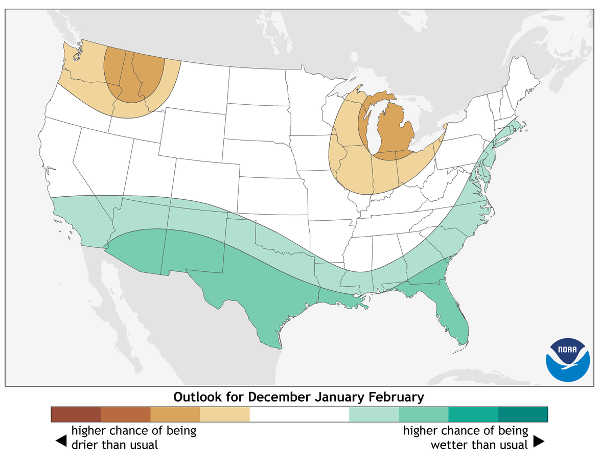
Forecasters are predicting a wetter-than-average winter across southern Alaska, across the southern part of the nation and along the East Coast, while it's expected to be a drier-than-average season in the Midwest and the Pacific Northwest.
The agency's weather maps indicate that much of California – including Lake County – is looking at having average rainfall for the months of December through February, while conditions are expected to be wetter-than-normal in Southern California for that same time period.
The temperature outlook favors a warmer-than-average winter in Alaska and also in a band extending from the West Coast through most of the Intermountain West, and across the US-Canadian border to New England.
Colder-than-average conditions are favored in the south-central and southeastern states.
For the full report, see the video above.