How to resolve AdBlock issue?
News
LAKE COUNTY, Calif. – The recent volcanic activity of Kilauea in Hawaii, near Hilo where my family owns a home, led me to think of our very own local volcano, Mount Konocti.
Standing at 4, 300 feet in elevation, Mount Konocti holds the distinction of being a visible landmark throughout most of Lake County.
Mount Konocti County Park, a recent acquisition, encompasses an area of 1,520 acres at the historic mountain's top.
Docent-led hikes occur throughout the year, when they offer interesting information on the mountain's geology, history, flora, fauna and even folklore.
A Konocti Trails brochure ( http://www.konoctitrails.com/trails-information/mt-konocti-regional-park ) tells us that the unique park came about due to geothermal royalty funds.

The property is maintained with cell tower leases. A climb to the summit rewards you with breathtaking views of our beautiful county.
Much of the mountain is covered by dense chaparral, but a fine grove of massive Canyon Live Oak trees points the way up.
Mount Konocti is a dormant volcano, with its last eruption occurring about 300,000 to 600,000 years ago.
Lava covers nearly 13 cubic miles around the volcano. At Clear Lake's deepest area, in the vicinity of the Lower and Oak Arms there can be found volcanic debris.
Mount Konocti and its submerged tubes, along with our county's various hot springs and cinder cones are all together known as Clear Lake volcanics.
The Clear Lake volcanics encompasses the land from Lower Lake all the way to the Geysers Geothermal Fields among the Mayacamas Mountains, almost a dozen miles west of Lower Lake.
Local legend has it that a vent at the mountain's peak was dynamited to close it off during the pioneer days, when the volcano was known as Uncle Sam Mountain. Experts have stated that the mountain is riddled with tunnels and caves that open under the lake.
American Indians told stories of specially carved wood pieces being tossed into a crater and then found, later, floating in the lake.
Mount Konocti is considered a sacred site for local tribes, and played a large part in their mythologies and religion. In one of the Pomo languages Konocti translates as “Mountain Lady.”
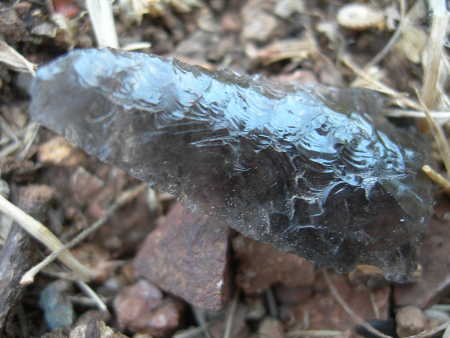
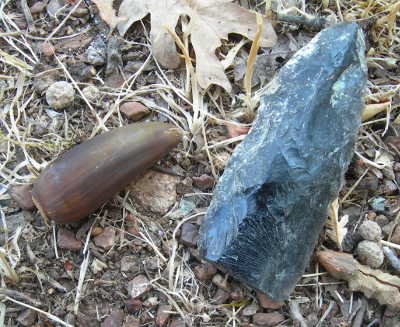
The vast quantities of obsidian created by the volcano was used for thousands of years by American Indians for projectile points and tools for both their own use, as well as trading.
Kathleen Scavone, M.A., is an educator, potter, writer and author of “Anderson Marsh State Historic Park: A Walking History, Prehistory, Flora, and Fauna Tour of a California State Park” and “Native Americans of Lake County.” She also writes for NASA and JPL as one of their “Solar System Ambassadors.” She was selected “Lake County Teacher of the Year, 1998-99” by the Lake County Office of Education, and chosen as one of 10 state finalists the same year by the California Department of Education.
LAKEPORT, Calif. – Families visited the Lake County Fairgrounds on Saturday to see the dinosaur display put on by “T. Rex Planet.”
The life-size animatronic dinosaur display offers a look at the Jurassic, Triassic and Cretaceous periods, along with a fossil dig, bounce house, dinosaurs children can ride and a visit with “Tracey,” a baby T-Rex.
In the video above, local children check out the variety of activities on Saturday.
The exhibit continues on Sunday at the fairgrounds, 401 Martin St., from 11 a.m. to 7 p.m.
For more information visit www.trexplanet.com .
LAKEPORT, Calif. – A Yuba City man took top honors in a weekend bass tournament, with two Lake County men finishing in the top 10.
Aaron Britt of Yuba City weighed a five-bass limit totaling 22 pounds, 5 ounces Saturday to win the Rayovac FLW Series Western Division event.
Britt had a three-day total of 15 bass weighing 70 pounds even in the event, presented by Evinrude on Clear Lake.
For his victory, Britt earned $32,448.
Also finishing in the top 10 were Mark Crutcher of Lakeport, who brought in 15 bass weighing 65 pounds, 3 ounces, and won $7,301; and Kelseyville resident Paul Bailey, who had 11 bass weighing 45 pounds, 7 ounces, and won $4,056.
“I fished a crankbait all week,” said Britt, discussing his performance in his first FLW win. “I practiced for four days prior to the tournament and found some fish shallow on a squarebill crankbait, but on the last day of practice I found some cranking fish deep.
“The first day of the tournament I went with my gut and cranked deep,” Britt continued. “I caught a big bag on day one and that made me stick with that pattern for the duration of the tournament. On day two I had some really big fish on that came off, but that just told me I needed to keep doing what I was doing.
“I had three spots that I just rotated through all day,” said Britt. “One of the spots was a rock ledge that runs along Highway 20, and the other two were very popular spots on the lake.”
Britt said that he threw Spro Little John DD, Bill Norman DD 22 and Damiki DC-400 crankbaits in 9 to 15 feet of water all week, starting the day with crawfish colors and changing to shad patterns as the sun rose higher.
“Generally the water temperature this time of year in Clear Lake is about 4 degrees lower than it is now,” Britt explained. “A lot of the fish are suspending and still out deep in their summer haunts and they haven’t moved shallow. That’s why stuck to my spots so much, because I knew the fish would move up and I wanted to be there when they did.
“This win is very emotional for me,” said Britt. “To be able to come out and compete with guys I grew up watching like Brett Hite, Ish Monroe and Jared Lintner is a great feeling. I put so much hard work and effort into this, and I’m very, very happy.”
The top 10 pros on Clear Lake were:
First: Aaron Britt, Yuba City, Calif., 15 bass, 70-0, $32,448;
Second: Patrick Spencer, Penn Valley, Calif., 15 bass, 67-3, $12,574;
Third: Justin Kerr, Simi Valley, Calif., 15 bass, 66-3, $9,734;
Fourth: Kyle Grover, Trabuco Canyon, Calif., 15 bass, 65-3, $8,112;
Fifth: Mark Crutcher, Lakeport, Calif., 15 bass, 65-3, $7,301;
Sixth: Dan Sweat, Pleasant Hill, Calif., 15 bass, 62-10, $6,490;
Seventh: Jerred Jennings, Stockton, Calif., 13 bass, 56-0, $5,678;
Eighth: Clayton Meyer, Henderson, Nev., 14 bass, 54-11, $4,867;
Ninth: Paul Bailey, Kelseyville, Calif., 11 bass, 45-7, $4,056;
10th: Toshitada Suzuki, Tokyo, Japan, 12 bass, 43-7, $3,245.
Complete results can be found at www.FLWOutdoors.com .
Jennings caught the biggest bass of the tournament in the pro division Friday – a 9-pound, 7-ounce bass – that earned him the day’s Big Bass award of $212.
Todd Kline of San Clemente won the co-angler division and a Ranger Z117C with an Evinrude or Mercury outboard motor, with a three-day total of 15 bass weighing 56 pounds, 10 ounces.
The top 10 co-anglers on Clear Lake were:
First: Todd Kline, San Clemente, Calif., 15 bass, 56-10, Ranger Z117C with a 90-horsepower outboard;
Second: Dante Ray, Sparks, Nev., 13 bass, 50-7, $4,098;
Third: Gary Haraguchi, Redding, Calif., 15 bass, 42-1, $3,278;
Fourth: Andrew Schadegg, Reno, Nev., 10 bass, 37-3, $2,869;
Fifth: Scott Bern, San Rafael, Calif., 13 bass, 35-9, $2,459;
Sixth: Doug Hutchison, Santa Rosa, Calif., 10 bass, 32-9, $2,049;
Seventh: Parker Wright, Laguna Niguel, Calif., 12 bass, 31-14, $1,639;
Eighth: Sunny Hawk, Salt Lake City, Utah, 12 bass, 31-10, $1,434;
Ninth: Blake Dyer, Tempe, Ariz., 12 bass, 31-4, $1,229;
10th: Tony Zanotelli, Redding, Calif., 10 bass, 30-12, $ $1,024.
Ray caught the biggest bass of the tournament in the co-angler division Friday – an 8-pound, 10-ounce bass – that earned him the day’s Big Bass award of $141.
The Rayovac FLW Series consists of five divisions – Central, Northern, Southeast, Texas and Western.
Each division consists of three tournaments and competitors will be vying for valuable points in each division that could earn them the opportunity to fish in the no-entry-fee Rayovac FLW Series Championship.
The 2014 Rayovac FLW Series Championship is being held Oct. 30 to Nov.1 on Wheeler Lake in Rogersville, Alabama.
The Rayovac FLW Series tournament on Clear Lake was hosted by Konocti Vista Casino Resort & Marina and was the third and final regular-season Western Division event in 2014. For a complete schedule, visit www.FLWOutdoors.com .
For complete details and updated information visit www.FLWOutdoors.com .
For regular updates, photos, tournament news and more, follow FLW on Facebook at www.Facebook.com/FLWFishing and on Twitter at www.Twitter.com/FLWOutdoors .
LAKE COUNTY, Calif. – Lake County Animal Care and Control has four dogs ready for adoption as the week begins, from big dogs to small canines.
The dogs this week are beagle, dachshund, Labrador Retriever and German Shepherd. The three males and one female come in a variety of ages and temperaments making them promising additions to your family.
Dogs that are adopted from Lake County Animal Care and Control are either neutered or spayed, microchipped and, if old enough, given a rabies shot and county license before being released to their new owner. License fees do not apply to residents of the cities of Lakeport or Clearlake.
If you're looking for a new companion, visit the shelter. There are many great pets hoping you'll choose them.
In addition to the animals featured here, all adoptable animals in Lake County can be seen here: http://bit.ly/Z6xHMb .
The following dogs at the Lake County Animal Care and Control shelter have been cleared for adoption (additional dogs on the animal control Web site not listed are still “on hold”).
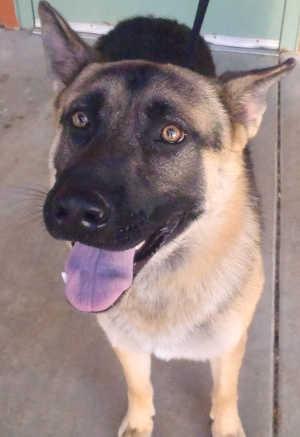
German Shepherd
This male German Shepherd needs a loving home.
He is very energetic and would do best with an active family and a large yard to run and play.
While he has some training, shelter staff said he would benefit from more training in obedience and basic manners. He is said to be good with all nondominant dogs.
He's in kennel No. 24, ID No. 975.
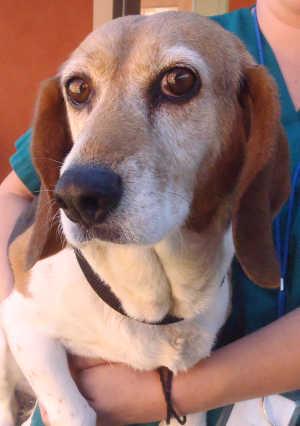
Female beagle
This female beagle is looking for a couch of her own where she can snuggle.
Shelter staff said she doesn't mind other dogs but she is not playful. She would do great in a home with kids of all ages, and is very mellow.
She's in kennel No. 30, ID No. 923.
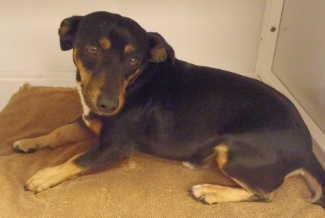
Male dachshund
This male dachshund is 5 years old and has a short tricolor coat.
Shelter staff said he is very friendly and social, and good with other dogs. He would make a great family pet and would be good with kids. He still acts like a puppy.
He's in kennel No. 32, ID No. 792.
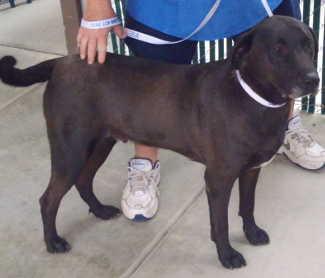
Male Labrador Retriever
This male Labrador Retriever mix has a short black coat.
He's good with other dogs prefers and prefers to be around other males.
Shelter staff said he has a mellow energy level. He appears to have been an outside dog and is a bit jumpy about being indoors, but will adjust well if given the chance.
He's in kennel No. 34, ID No. 779.
To fill out an adoption application online visit http://www.co.lake.ca.us/Government/Directory/Animal_Care_And_Control/Adopt/Dog___Cat_Adoption_Application.htm .
Lake County Animal Care and Control is located at 4949 Helbush in Lakeport, next to the Hill Road Correctional Facility.
Office hours are Monday through Friday, 8 a.m. to 5 p.m., and 1 p.m. to 3 p.m., Saturday. The shelter is open from 10:30 a.m. to 4:30 p.m. Monday through Friday and on Saturday from 1 p.m. to 3 p.m.
Visit the shelter online at http://www.co.lake.ca.us/Government/Directory/Animal_Care_And_Control.htm .
For more information call Lake County Animal Care and Control at 707-263-0278.
Email Elizabeth Larson at
NORTHERN CALIFORNIA – Authorities on Saturday arrested a man in connection to a devastating fire in Siskiyou County in September.
Cal Fire said the Weed Police Department arrested Ronald Beau Marshall, 24, of Weed, in connection with the Boles Fire.
The fire broke out on the afternoon of Sept. 15 in the city of Weed, located in Siskiyou County.
The Boles Fire destroyed 516 acres and 157 homes, and forced the evacuation of 4,000 people. More than 1,000 firefighters were assigned to the incident, Cal Fire said.
After a three-week joint investigation between the Weed Police Department, Siskiyou County Sheriff's Department and Cal Fire, Marshall was arrested and booked into the Siskiyou County Jail on a felony warrant with charges of arson of an inhabited structure or property, arson to forest land, and arson of property of another, according to Cal Fire.
Cal Fire said Marshall's bail was set at $250,000.
Cal Fire works diligently in arson cases to aggressively investigate and prosecute those suspected of intentionally starting fires.
“As fire danger remains extreme across California, arson puts life, property and natural resources at risk and we will continue to dedicate as many resources as needed to track down and prosecute those who purposely threaten our state,” said Chief Ken Pimlott, director of Cal Fire.
Fire officials said state residents should be vigilant in their preparedness and aware of suspicious persons when a fire does start.
If you witness someone suspicious make note of the time, his or her physical description, as well as any vehicle description, including the license plate number.
Always contact law enforcement, never approach a suspicious person.
Anyone with information about arson is urged to contact the Cal Fire Arson Hotline at 800-468-4408. Callers can remain anonymous.
NASA’s extensive fleet of science assets, particularly those orbiting and roving Mars, have front row seats to image and study a once-in-a-lifetime comet flyby on Sunday, Oct. 19.
Comet C/2013 A1, also known as comet Siding Spring, will pass within about 87,000 miles (139,500 kilometers) of the Red Planet – less than half the distance between Earth and our moon and less than one-tenth the distance of any known comet flyby of Earth.
Siding Spring’s nucleus will come closest to Mars around 2:27 p.m. EDT, hurtling at about 126,000 mph (56 kilometers per second).
This proximity will provide an unprecedented opportunity for researchers to gather data on both the comet and its effect on the Martian atmosphere.
“This is a cosmic science gift that could potentially keep on giving, and the agency’s diverse science missions will be in full receive mode,” said John Grunsfeld, astronaut and associate administrator for NASA’s Science Mission Directorate in Washington. “This particular comet has never before entered the inner solar system, so it will provide a fresh source of clues to our solar system's earliest days.”
Siding Spring came from the Oort Cloud, a spherical region of space surrounding our sun and occupying space at a distance between 5,000 and 100,000 astronomical units.
It is a giant swarm of icy objects believed to be material left over from the formation of the solar system.
Siding Spring will be the first comet from the Oort Cloud to be studied up close by spacecraft, giving scientists an invaluable opportunity to learn more about the materials, including water and carbon compounds, that existed during the formation of the solar system 4.6 billion years ago.
Some of the best and most revealing images and science data will come from assets orbiting and roving the surface of Mars.
In preparation for the comet flyby, NASA maneuvered its Mars Odyssey orbiter, Mars Reconnaissance Orbiter (MRO), and the newest member of the Mars fleet, Mars Atmosphere and Volatile EvolutioN (MAVEN), in order to reduce the risk of impact with high-velocity dust particles coming off the comet.
The period of greatest risk to orbiting spacecraft will start about 90 minutes after the closest approach of the comet's nucleus and will last about 20 minutes, when Mars will come closest to the center of the widening trail of dust flying from the comet’s nucleus.
“The hazard is not an impact of the comet nucleus itself, but the trail of debris coming from it. Using constraints provided by Earth-based observations, the modeling results indicate that the hazard is not as great as first anticipated. Mars will be right at the edge of the debris cloud, so it might encounter some of the particles – or it might not,” said Rich Zurek, chief scientist for the Mars Exploration Program at NASA's Jet Propulsion Laboratory (JPL) in Pasadena, Calif.
The atmosphere of Mars, though much thinner that Earth's, will shield NASA Mars rovers Opportunity and Curiosity from comet dust, if any reaches the planet. Both rovers are scheduled to make observations of the comet.
NASA’s Mars orbiters will gather information before, during and after the flyby about the size, rotation and activity of the comet's nucleus, the variability and gas composition of the coma around the nucleus, and the size and distribution of dust particles in the comet's tail.
Observations of the Martian atmosphere are designed to check for possible meteor trails, changes in distribution of neutral and charged particles, and effects of the comet on air temperature and clouds.
MAVEN will have a particularly good opportunity to study the comet, and how its tenuous atmosphere, or coma, interacts with Mars' upper atmosphere.
Earth-based and space telescopes, including NASA’s iconic Hubble Space Telescope, also will be in position to observe the unique celestial object.
The agency’s astrophysics space observatories – Kepler, Swift, Spitzer, Chandra – and the ground-based Infrared Telescope Facility on Mauna Kea, Hawaii – also will be tracking the event.
NASA’s asteroid hunter, the Near-Earth Object Wide-field Infrared Survey Explorer (NEOWISE), has been imaging, and will continue to image, the comet as part of its operations. And the agency’s two Heliophysics spacecraft, Solar Terrestrial Relations Observatory (STEREO) and Solar and Heliophysics Observatory (SOHO), also will image the comet.
The agency’s Balloon Observation Platform for Planetary Science (BOPPS), a sub-orbital balloon-carried telescope, already has provided observations of the comet in the lead-up to the close encounter with Mars.
Images and updates will be posted online before and after the comet flyby. Several pre-flyby images of Siding Spring, as well as information about the comet and NASA’s planned observations of the event, are available online at http://mars.nasa.gov/comets/sidingspring .
Dr. Tony Phillips works for the National Aeronautics and Space Administration.