 How to resolve AdBlock issue?
News
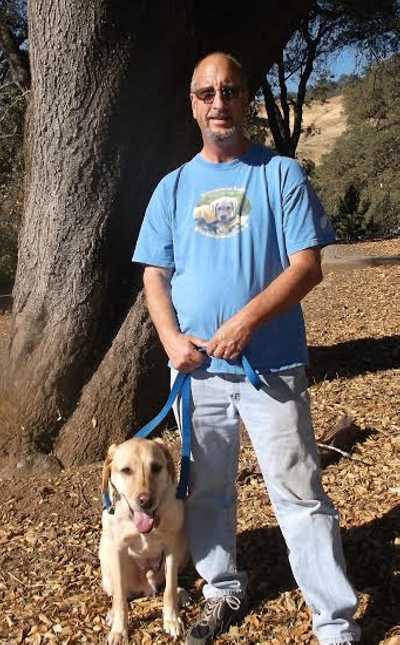
LAKE COUNTY, Calif. – A Lakeport man and his facility dog will take part in a fundraiser walk this weekend to benefit the efforts of Canine Companions for Independence.
Mike Curran and his canine partner, Eddie, will participate in the Dog Fest Walk n Roll in Roseville this Saturday, Oct. 25.
Curran said there will be hundreds of people – many of then connected to Canine Companions for Independence – walking with their dogs to raise money to help the organization with its mission of providing highly trained assistance dogs to adults, kids, and military veterans with disabilities.
Canine Companions for Independence, based in Santa Rosa, has placed thousands of dogs like Eddie since it began in 1975.
The dogs are valued in excess of $40,000 by virtue of the training they receive, after which they are matched with their human partner – at no cost – at a team training, he said.
Curran and Eddie were matched by Canine Companions for Independence in 2012, graduating from the program in May of that year. A video of the graduation can be seen below.
The two years since receiving Eddie, a golden retriever/Labrador mix, have been among the best of his life, said Curran.
“These dogs do truly change the lives of their human partners and those of their partner's family,” said Curran. “The doors that these dogs open – sometimes literally – is nothing short of amazing.”
Curran, a retired sergeant with the Lake County Sheriff's Office, has used Eddie in a variety of ways to help children.
Eddie has helped calm child victims of crime during interviews, been used in drug court and at Juvenile Hall, participates in local “Reading with Rover,” provided a steady presence at “Every 15 Minutes” and was a favorite with children in the Lakeport Library's summer reading program.
Curran said $500 will pay the cost to send two puppies to their puppy raisers, some of them out of state. That was the case with Eddie, who was raised by a Washington family.
Curran, who participated in a Dog Fest Walk n Roll event in Santa Rosa last year, set up a fundraiser page and quickly surpassed his modest original goal of $300. He's now seeking to increase his goal to offer a greater benefit for Canine Companions for Independence.
To support Curran and Eddie at the fundraiser walk, visit http://www.kintera.org/faf/donorReg/donorPledge.asp?ievent=1113515&supId=361630744&extSiteType=1 .
Email Elizabeth Larson at
NORTHERN CALIFORNIA – Attorney General Kamala D. Harris on Monday announced the takedown of a transnational criminal organization based in Contra Costa County, including the arrest of 22 individuals and the seizure of 500 pounds of methamphetamine and over $700,000 in U.S. currency.
The takedown, named Operation Road Trip, represents the culmination of several related investigations targeting California-based Drug Trafficking Organizations (DTO) connected to Mexico’s Sinaloa Federation drug cartel.
These investigations – which were led by California Department of Justice task forces that include federal, state and local law enforcement partners – have to date resulted in 67 arrests and the seizure of $40 million of methamphetamine and $1.82 million in U.S. currency over the past six years.
“This operation demonstrates our continuing commitment to focus on the connection between transnational criminal organizations and organized street gangs in California,” Attorney General Harris said. “We will do whatever is necessary with our federal and local partners to dismantle these violent, insidious organizations.”
Operation Road Trip is the merger of two long-term investigations led by the West Contra Costa County Narcotic Enforcement Team (“West-NET”) Task Force, the Los Angeles Interagency Metropolitan Police Apprehension Crime Task Force (“LA IMPACT”), and associated local, state and federal partners.
During the Operation Road Trip investigation, the task forces revealed that methamphetamine from Mexico was being delivered to the Nitro gang, a DTO based in Southern California.
The Nitro gang would make regular “road trips” to Contra Costa County in order to distribute to other DTOs, including the Urtiz gang based in Northern California.
Over the past year, Operation Road Trip resulted in the service of 16 search warrants, the seizure of 500 pounds of methamphetamine, one firearm, four vehicles, $723,635 in U.S. currency, and the arrests of 22 individuals for drug and firearms related violations.
In May of 2011, Attorney General Harris along with the FBI and other law enforcement partners announced the conclusion of the first of the two long-term investigations, named Operation Red Reach.
This operation, a two-year coordinated sweep led by West-NET, shut down a network of local and transnational gangs, including a Nortenos gang in western Contra Costa County.
The case resulted in the seizure of 135 pounds of methamphetamine, 26 illegal firearms, approximately $150,000 in U.S. Currency and federal and state convictions of 26 individuals. Information and intelligence gained from this operation led to the identification of the Urtiz DTO.
West-NET’s subsequent investigation, named Operation Crystal Lens, revealed that the Urtiz DTO’s methamphetamine was being supplied by the Southern California-based Nitro DTO, which was also separately under investigation by LA IMPACT.
In total, the three linked investigations, Operation Red Reach, Crystal Lens and Road Trip, have resulted in the total seizure of 1109 pounds of methamphetamine, for a street value of $40,242,504, the seizure of 48 firearms, 10 vehicles, $1.82 million in U.S. currency and the total arrests of 67 individuals for drug, and firearms related violations.
In March, Attorney General Harris called the trafficking of methamphetamine a growing threat to the state and a top priority for law enforcement in a report, Gangs Beyond Borders: California and the Fight Against Transnational Organized Crime, which is the first comprehensive report analyzing the current state of transnational criminal organizations in California.
Transnational criminal organizations have made California the single biggest point of entry for methamphetamine into the United States, with 70 percetn entering through the San Diego Port of Entry.
The report also outlined recommendations to address this problem, which include increased funding for state anti-narcotics trafficking task forces and additional coordination between federal, state, and local law enforcement agencies in combatting transnational criminal organizations.
The report is available at https://oag.ca.gov/transnational-organized-crime .
Following the release of the report, Attorney General Harris led a delegation of state attorneys general to Mexico to strengthen working relationships between the governments of both countries and enhance efforts to combat transnational crime.
The delegation met with Mexican state attorneys general and federal officials to discuss the issues of drug, human and firearms trafficking, money laundering and high-tech crime.
Earlier this month, Attorney General Harris announced that the California Department of Justice will create a new anti-methamphetamine team of Special Agents based in Los Angeles funded by a $1 million federal grant.
The team will be comprised of six special agents assigned to investigate illicit activities related to the manufacture and distribution of methamphetamine in California and will work in a coordinated effort with the other 18 existing California Department of Justice task forces.
The noted investigative accomplishments would not have come to a successful conclusion without the assistance and support of the following law enforcement partners: Alameda County Narcotics Task Force, Antioch Police Department, California Department of Corrections & Rehabilitation - Special Service Unit, California Highway Patrol, Concord Police Department, Contra Costa County Animal Services Department, Contra Costa County District Attorney’s Office, Contra Costa County Probation Department, Contra Costa County Sheriff’s Office, El Cerrito Police Department, Fairfield Police Department, Federal Bureau of Investigation, Hercules Police Department, Kensington Police Department, Los Angeles Interagency, Metropolitan Police Apprehension Crime Task Force, Northern California High Intensity Drug Trafficking Area (HIDTA), Northern California Regional Intelligence Center (NCRIC), Organized Crime Drug Enforcement Task Force, Pinole Police Department, Pittsburg Police Depart ment, Richmond Police Department, San Francisco Police Department, San Pablo Police Department, Solano County District Attorney’s Office, U.S. Department of Homeland Security, U.S. Drug Enforcement Administration, U.S. Marshal Service, U.S. Postal Inspection Service, U.S. Secret Service, Vacaville Police Department, Western States Information Network, Yolo County Narcotic Enforcement Team.
As concerns continue about the Ebola virus – which so far has not reached California – the California Department of Public Health is reiterating the notification process in the event someone is believed to be showing symptoms of the virus.
The agency said there are no confirmed cases of Ebola in California and are currently no suspect cases.
“There are protocols in place throughout the state public health system to protect Californians from the spread of this disease. As the situation evolves, protocols may change,” said Dr. Ron Chapman, CDPH director and state health officer.
The protocols for individuals, health care providers, public agencies or private establishments, emergency medical personnel, local health officers and the California Department of Public Health itself are outlined as follows.
Individuals
If you have traveled to a Liberia, Sierra Leone or Guinea, or have been exposed to someone infected with Ebola within the last 21 days and are experiencing fever, headache, weakness, muscle pain, vomiting or diarrhea you should call your health care provider right away or go to the emergency room.
You should make clear to the health care providers your travel history, Ebola exposure and your symptoms.
Health care providers
If you are contacted by a patient or treat a patient with a travel history or other exposure to Ebola and they are experiencing fever or other Ebola symptoms, you should isolate the patient, notify the local health officer immediately, and treat the patient following Centers for Disease Control and Prevention protocols and guidelines.
The Department of Industrial Relations has also issued guidelines for workers.
Public agencies or private establishments (Schools, day care centers, libraries, grocery stores, shopping malls, etc.)
If a person is experiencing Ebola like symptoms and states that they are at risk of exposure to Ebola due to travel to Liberia, Sierra Leone or Guinea within the last three weeks or exposure to an Ebola patient, you should isolate the person, contact the local hospital and call 911 for transport.
The hospital should contact the local health officer immediately and treat the patient as described.
Ebola is not easily transmitted and the general public is not at risk. There is no need to evacuate a facility, school, day care center, etc., if there is no direct contact with a person who is affected and has symptoms or the bodily fluids of an affected person.
Emergency medical personnel
Emergency medical personnel who come into contact with an Ebola patient or a patient at risk of Ebola, should take appropriate precautions following CDC guidelines which are currently under revision in treating and transport of the suspect patient and contact the local health officer.
The local emergency medical service agency will work with the local health department to provide advice on the best place to take a suspect patient. Transportation and treatment equipment should be cleaned according to CDC protocols.
The Department of Industrial Relations also has issued guidelines for workers.
Local health officers
The local health officer is the main contact for reporting of suspect Ebola patients.
Local health officers will investigate, screen, order testing of specimens and report to the California Department of Public Health.
California Department of Public Health
CDPH will work with the CDC to arrange specimen testing, to investigate the case and monitor the situation.
CDPH also is supporting the local health officers in tracing of individuals who may have had contact with an Ebola patient and continue to monitor the situation.
It is important to note that Ebola is not spread through casual contact and people who do not have symptoms are not contagious.
The virus has an incubation period of two to 21 days, health officials said.
For more information and frequently asked questions about Ebola visit the CDPH Web site at www.cdph.ca.gov or http://www.cdph.ca.gov/Documents/Ebola%20FAQs.pdf .
CLEARLAKE, Calif. – On Monday Clearlake Police officers arrested a Hidden Valley Lake man who witnesses said left the scene of a crash and later led police on a high-speed pursuit in what was determined to be a stolen pickup.
Donald Leos, 19, was arrested on charges including felony evading, felony evading-wrong way driver, felony possession of stolen property, felony stolen vehicle, misdemeanor resisting arrest, misdemeanor hit and run with property damage, and misdemeanor driving under the influence of a combination of drugs and alcohol.
Sgt. Rodd Joseph said officers were dispatched to a report of a property damage hit-and-run collision near the intersections of Old Highway 53 and Saroni Parkway just before 5 a.m. Monday.
Witnesses described the suspect vehicle as a large white diesel pickup truck, Joseph said.
Clearlake Police Officer Chris Reagan, who was heading to the call, observed a lifted white Ford diesel pickup slide into the intersection of Old Highway 53 and Lakeshore Drive, Joseph said.
The truck matched the description of the suspect vehicle and also had what appeared to be fresh front end damage, according to Joseph.
Joseph said the truck backed up and fled from Reagan, heading on Lakeshore Drive toward Highway 53. Reagan activated his emergency lights and siren and began to pursue the pickup.
The truck headed south on Highway 53 then south onto Highway 29, with speeds ranging between 65 and 110 miles per hour. Joseph said the Lake County Sheriff’s Office also joined the pursuit.
As the pursued vehicle neared the community of Hidden Valley Lake, the truck crashed through a fence near the main entrance gate and drove out onto the golf course. Joseph said the pickup became disabled and the driver then fled on foot.
The driver, later identified as Leos, jumped into one of the ponds on the golf course in an attempt to evade capture, a move that proved unsuccessful, Joseph said.
The truck Leos had been driving was discovered to be a stolen vehicle out of Hidden Valley Lake, Joseph said.
Joseph said Leos was exhibiting symptoms of being under the influence of alcohol and controlled substances and was confrontational with officers.
Leos was transported to Saint Helena Hospital Clear Lake for medical evaluation and later booked into the Lake County Jail, according to Joseph.
LAKEPORT, Calif. – The Committee to Save the Lake, Measure S, is hosting an information summit on Wednesday, Oct. 22.
The summit will take place from 6 to 8 p.m. at the Soper Reese Theatre, 275 S. Main St. in Lakeport.
Titled “What is Fact, What is Fiction,” the summit will provide voters an opportunity to learn more about the half-cent sales tax measure.
Information about Clear Lake's unique ecology, its interconnection with the Lake County economy, and specific details about what Measure S is – and is not – meant to do will be provided.
Questions will be taken from the audience and answered by a panel of experts.
The panel will include District 4 Supervisor Anthony Farrington; District 3 Supervisor Denise Rushing; Sarah Ryan, environmental director for Big Valley Rancheria; retired wildlife biologist Jim Steele; and Dr. Harry Lyons, professor of biology and ecology at the Yuba College Clear Lake Campus.
Lake County News Editor and Publisher Elizabeth Larson will serve as the moderator.
For more information about Measure S visit www.savethelake.info .
LAKE COUNTY, Calif. – There are tuxedo and calico kitties and an adult cat available at Lake County Animal Care and Control this week.
The adult is a cool black cat, with the kittens being two female and a male.
In addition to spaying or neutering, cats that are adopted from Lake County Animal Care and Control are microchipped before being released to their new owner. License fees do not apply to residents of the cities of Lakeport or Clearlake.
If you're looking for a new companion, visit the shelter. There are many great pets there, hoping you'll choose them.
In addition to the animals featured here, all adoptable animals in Lake County can be seen here: http://bit.ly/Z6xHMb .
The following cats at the Lake County Animal Care and Control shelter have been cleared for adoption (other cats pictured on the animal control Web site that are not listed here are still “on hold”).

Domestic short hair
This adult male domestic short hair cat has an all-black coat.
He is in cat room kennel No. 67, ID No. 894.

Male tuxedo kitten
This male kitten has a short tuxedo coat.
Find him in cat room kennel No. 95a, ID No. 918.

Female tuxedo kitten
This female kitten has a short tuxedo coat.
She's in cat room kennel No. 95c, ID No. 920.
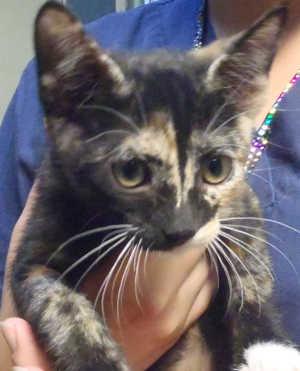
Calico kitten
The female kitten has a short coat with calico markings.
She is in cat room kennel No. 95d, ID No. 921.
Adoptable cats also can be seen at http://www.co.lake.ca.us/Government/Directory/Animal_Care_And_Control/Adopt/Cats_and_Kittens.htm or at www.petfinder.com .
Please note: Cats listed at the shelter's Web page that are said to be “on hold” are not yet cleared for adoption.
To fill out an adoption application online visit http://www.co.lake.ca.us/Government/Directory/Animal_Care_And_Control/Adopt/Dog___Cat_Adoption_Application.htm .
Lake County Animal Care and Control is located at 4949 Helbush in Lakeport, next to the Hill Road Correctional Facility.
Office hours are Monday through Friday, 8 a.m. to 5 p.m., and 1 p.m. to 3 p.m., Saturday. The shelter is open from 10:30 a.m. to 4:30 p.m. Monday through Friday and on Saturday from 1 p.m. to 3 p.m.
Visit the shelter online at http://www.co.lake.ca.us/Government/Directory/Animal_Care_And_Control.htm .
For more information call Lake County Animal Care and Control at 707-263-0278.
Email Elizabeth Larson at