 How to resolve AdBlock issue?
News
The extended Thanksgiving weekend is one of the busiest travel periods of the year. This raises the risk of a potentially serious or even deadly traffic collision.
As families and friends gather for the holiday, the California Highway Patrol, along with the National Highway Traffic Safety Administration (NHTSA), wants to encourage travelers to always buckle up, avoid driving distracted, obey the posted speed limit, and never drink and drive.
“Something as simple as buckling up before your trip can save your life and avoid turning a non-injury collision into a tragedy,” said CHP Commissioner Joe Farrow.
Thanksgiving is a Maximum Enforcement Period for the CHP.
The Thanksgiving holiday reporting period begins Wednesday, Nov. 26, at 6 p.m. and runs through Sunday, Nov. 30, at 11:59 p.m.
The Thanksgiving MEP also coincides with NHTSA’s annual “Click It or Ticket Campaign.”
While collisions decreased during last year’s Thanksgiving holiday travel period, tragically, 33 people lost their lives on California’s roadways due to a collision; this was down from the 44 killed during Thanksgiving 2012. Sadly, 88 percent of those killed in 2013 were not wearing a seat belt.
“Protect yourself and those you love through the simple action of buckling a seat belt,” added Commissioner Farrow. “Seat belts are the single most effective piece of equipment in a vehicle that will prevent loss of life or injury.
The CHP also would like to remind motorists to avoid distracted driving, to travel at a speed that is safe for conditions, and also designate a non-drinking driver for the safety of everyone on the road.
Last year during the Thanksgiving holiday, the CHP arrested more than 1,200 people for driving under the influence.
The public is encouraged to report unsafe or impaired drivers by calling 911.
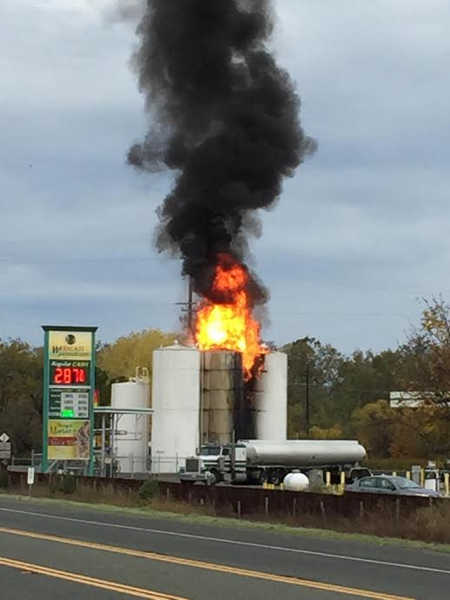
LAKEPORT, Calif. – Firefighters from several agencies are on the scene of a gas storage tank fire outside of Lakeport.
The fire at Westgate Petroleum, located at 3740 Highland Springs Road, was first dispatched shortly before 9 a.m. Sunday.
Lakeport Fire units arriving at scene found one of the business' storage tanks burning with others threatened.
Additional units from Northshore Fire, Kelseyville Fire and Cal Fire were dispatched, with every fire truck in the county that has Class B fire suppression foam also requested, based on radio traffic.
Incident command also asked that Pacific Gas and Electric respond due to nearby high transmission traffic, according to reports from the scene.
Reports from the scene indicated the fire was still active shortly before 10 a.m., with Cal Fire units still en route.
Just before 10:10 a.m., the fire was reported to be knocked down.
Traffic detours are being put in place. The California Highway Patrol reported that Caltrans is closing Highway 29 at Highway 175 Hopland, with other closures at Ackley and Argonaut roads on the northbound side. Highland Springs Road also is being closed by county roads staff.
Additional information will be posted as it becomes available.
Email Elizabeth Larson at
MIDDLETOWN, Calif. – A bicyclist died late Saturday night after being hit by two vehicles near Middletown.
The 62-year-old St. Helena man, whose name has not been released by the California Highway Patrol pending notification of family, was hit on Highway 29 south of Central Park Road, officials reported.
The CHP's report said that at approximately 10:12 p.m. Saturday 62-year-old Alma Louise Cross of Clearlake was driving her 1992 Chevrolet Blazer northbound on Highway 29 at 50 miles per hour, with the bicyclist traveling southbound at an unknown speed on a NEXT La Jolla bike.
For reasons that the CHP said are yet to be determined, the man allowed his bicycle to veer into the northbound lane, where he collided with Cross' Blazer.
As a result of the crash, the man was thrown from his bike and landed in the highway's southbound lane, the CHP said.
Aria Dawn Mulvihill, 21, of Hidden Valley Lake, who was driving a 2006 Volvo S60 southbound on Highway 29 at approximately 50 miles per hour, hit the bicyclist while he was lying in the roadway, the CHP said.
The man died of his injuries at the scene, according to the report.
The CHP said Cross, her passengers Daniel David Wilder, 59, and Douglas Ray Alexander, 52, both of Clearlake, as well as Mulvihill and her passenger, 23-year-old Zach Montana Strickler of Hidden Valley Lake, were all uninjured.
The two drivers and three passengers were wearing their seat belts. The CHP said the bicyclist was not wearing a helmet.
Drugs and alcohol were not factors for Cross and Mulvihill, according to the report, but the CHP added that it is unknown at this point if they were contributing factors for the bicyclist.
The crash is under investigation by CHP Officer Ryan Erickson.
Email Elizabeth Larson at
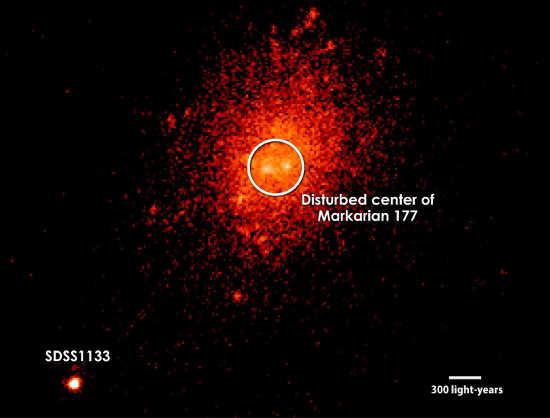
An international team of researchers analyzing decades of observations from many facilities, including NASA's Swift satellite, has discovered an unusual source of light in a galaxy some 90 million light-years away.
The object's curious properties make it a good match for a supermassive black hole ejected from its home galaxy after merging with another giant black hole. But astronomers can't yet rule out an alternative possibility.
The source, called SDSS1133, may be the remnant of a massive star that erupted for a record period of time before destroying itself in a supernova explosion.
“With the data we have in hand, we can't yet distinguish between these two scenarios,” said lead researcher Michael Koss, an astronomer at ETH Zurich, the Swiss Federal Institute of Technology. “One exciting discovery made with NASA's Swift is that the brightness of SDSS1133 has changed little in optical or ultraviolet light for a decade, which is not something typically seen in a young supernova remnant.”
In a study published in the Nov. 21 edition of Monthly Notices of the Royal Astronomical Society, Koss and his colleagues report that the source has brightened significantly in visible light during the past six months, a trend that, if maintained, would bolster the black hole interpretation.
To analyze the object in greater detail, the team is planning ultraviolet observations with the Cosmic Origins Spectrograph aboard the Hubble Space Telescope in October 2015.
Whatever SDSS1133 is, it's persistent. The team was able to detect it in astronomical surveys dating back more than 60 years.
The mystery object is part of the dwarf galaxy Markarian 177, located in the bowl of the Big Dipper, a well-known star pattern within the constellation Ursa Major.
Although supermassive black holes usually occupy galactic centers, SDSS1133 is located at least 2,600 light-years from its host galaxy's core.
In June 2013, the researchers obtained high-resolution near-infrared images of the object using the 10-meter Keck II telescope at the W. M. Keck Observatory in Hawaii.
They reveal the emitting region of SDSS1133 is less than 40 light-years across and that the center of Markarian 177 shows evidence of intense star formation and other features indicating a recent disturbance.
“We suspect we're seeing the aftermath of a merger of two small galaxies and their central black holes,” said co-author Laura Blecha, an Einstein Fellow in the University of Maryland's Department of Astronomy and a leading theorist in simulating recoils, or “kicks,” in merging black holes. “Astronomers searching for recoiling black holes have been unable to confirm a detection, so finding even one of these sources would be a major discovery.”
The collision and merger of two galaxies disrupts their shapes and results in new episodes of star formation.
If each galaxy possesses a central supermassive black hole, they will form a bound binary pair at the center of the merged galaxy before ultimately coalescing themselves.
Merging black holes release a large amount of energy in the form of gravitational radiation, a consequence of Einstein's theory of gravity.
Waves in the fabric of space-time ripple outward in all directions from accelerating masses. If both black holes have equal masses and spins, their merger emits gravitational waves uniformly in all directions.
More likely, the black hole masses and spins will be different, leading to lopsided gravitational wave emission that launches the black hole in the opposite direction.
The kick may be strong enough to hurl the black hole entirely out of its home galaxy, fating it to forever drift through intergalactic space. More typically, a kick will send the object into an elongated orbit.
Despite its relocation, the ejected black hole will retain any hot gas trapped around it and continue to shine as it moves along its new path until all of the gas is consumed.
If SDSS1133 isn't a black hole, then it might have been a very unusual type of star known as a Luminous Blue Variable (LBV).
These massive stars undergo episodic eruptions that cast large amounts of mass into space long before they explode.
Interpreted in this way, SDSS1133 would represent the longest period of LBV eruptions ever observed, followed by a terminal supernova explosion whose light reached Earth in 2001.
The nearest comparison in our galaxy is the massive binary system Eta Carinae, which includes an LBV containing about 90 times the sun's mass.
Between 1838 and 1845, the system underwent an outburst that ejected at least 10 solar masses and made it the second-brightest star in the sky. It then followed up with a smaller eruption in the 1890s.
In this alternative scenario, SDSS1133 must have been in nearly continual eruption from at least 1950 to 2001, when it reached peak brightness and went supernova.
The spatial resolution and sensitivity of telescopes prior to 1950 were insufficient to detect the source.
But if this was an LBV eruption, the current record shows it to be the longest and most persistent one ever observed.
An interaction between the ejected gas and the explosion's blast wave could explain the object's steady brightness in the ultraviolet.
Whether it's a rogue supermassive black hole or the closing act of a rare star, it seems astronomers have never seen the likes of SDSS1133 before.
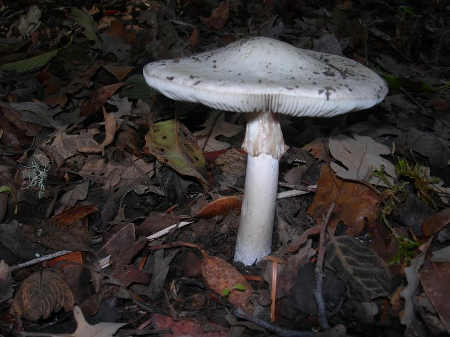
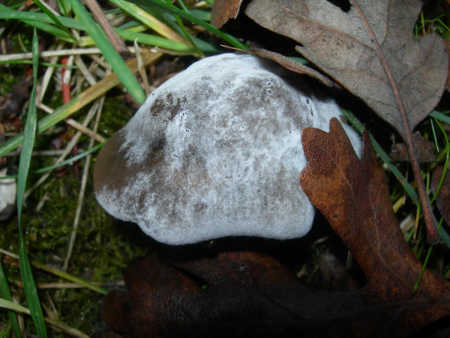
LAKE COUNTY, Calif. – After even the briefest of rainfall the woods and forests of Lake County come alive in a fantasyland of fungi, or decomposers.
After fall's first rains and the subsequent sunshine an astonishing array of fungi pops up under leaves on downed limbs, and in all sorts of nooks and crannies.
The Greeks of antiquity thought that because of mushroom's ability to magically materialize after a rain, that Zeus' lightning was the cause.
During Medieval times those ring-shaped patterns of ground mushrooms which form were called “fairy rings.” The belief was that magic and dances were performed into the wee hours by the “little people.”
Today we know that mushrooms can be not only beautiful in their own right, but some are toxic while others are edible.
As far back as the Roman times mushrooms, such as chanterelles, morels and truffles have been prized delicacies.
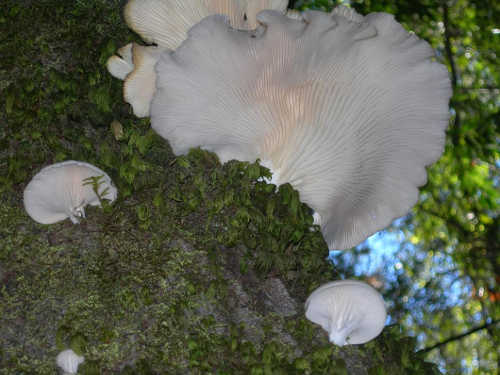
Although we can't always see them, mushrooms are always present, secluded under the soil or hiding beneath bark.
Some, like bracket fungi are highly visible, and form ladders, ascending a dead tree trunk: beauty from death.
Decomposers come in all shapes and sizes. If you were a science fiction writer you couldn't dream up these strange-looking, mysterious life-forms! From enormous bracket fungi to small, slimy jelly fungi.
Fungi are veritable living paradoxes, containing the strength to push up through the soil, while at the same time being comprised of such delicate tissue.
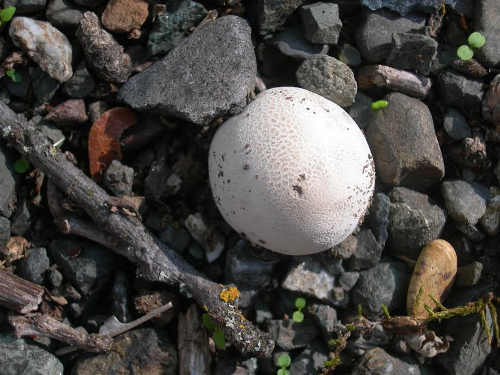
Some, like the puffball, are beautifully spherical: white wonders. While others, like Western Jack 'O Lantern mushrooms (Omphalotus olivascens) are bioluminescent and glow in the dark!
Mushrooms are comprised of roots, a base, stalk, gills, ring and a cap.
A fun art project is a “spore print.” First, lay a cap mushroom on a sheet of paper, and later, discover the spore print pattern it leaves behind.
Fungi are nature's recyclers. Some fungi are plant decomposers, some are carrion decomposers, while still others are waste decomposers that break down droppings from carnivores and omnivores.
Other recyclers in nature are scavengers, such as turkey vultures, beetles and flies.
Earthworms are foremost in the world of recycling, digesting soil, then releasing precious minerals to nourish the soil. Without their work, topsoil would be devoid of these minerals and infertile.
There is much to be learned from the mighty mushroom.
According to “Bay Nature” magazine a fungi experiment to digest E. coli is looking very promising.
Near the town of Orinda King Stropharia and oyster mushroom mycelium, or vegetative filaments are grown in burlap bags filled with wood chips and other natural matter.
They are tended by members of mushroom enthusiasts who work along with the East Bay Municipal Utility District who are learning that the watershed can be cleaned up from toxic human waste, along with oil derived pollutants, plastics and more.
Those amazing mushrooms!
Kathleen Scavone, M.A., is an educator, potter, writer and author of “Anderson Marsh State Historic Park: A Walking History, Prehistory, Flora, and Fauna Tour of a California State Park” and “Native Americans of Lake County.” She also writes for NASA and JPL as one of their “Solar System Ambassadors.” She was selected “Lake County Teacher of the Year, 1998-99” by the Lake County Office of Education, and chosen as one of 10 state finalists the same year by the California Department of Education.
LAKE COUNTY, Calif. – Lake County Animal Care and Control has seven dogs waiting to go to loving homes this week.
Dogs available this week include mixes of boxer, Chihuahua, hound, pit bull and shepherd.
Dogs that are adopted from Lake County Animal Care and Control are either neutered or spayed, microchipped and, if old enough, given a rabies shot and county license before being released to their new owner. License fees do not apply to residents of the cities of Lakeport or Clearlake.
If you're looking for a new companion, visit the shelter. There are many great pets hoping you'll choose them.
In addition to the animals featured here, all adoptable animals in Lake County can be seen here: http://bit.ly/Z6xHMb .
The following dogs at the Lake County Animal Care and Control shelter have been cleared for adoption (additional dogs on the animal control Web site not listed are still “on hold”).

Male Chihuahua mix
This male Chihuahua mix has a short white coat.
He's in kennel No. 2a, ID No. 1202.

Male pit bull mix
This male pit bull mix has a short tan and white coat.
Shelter staff said he is a very friendly dog with no food aggression or food guarding issues.
He was introduced to other dogs and never showed any aggression but was a little nervous until he got to know them better. They said he is a great boy who could use some socialization.
He's in kennel No. 7, ID No. 1233.

Female boxer mix
This female boxer mix has a short tan and white coat.
She's in kennel No. 8, ID No. 1247.
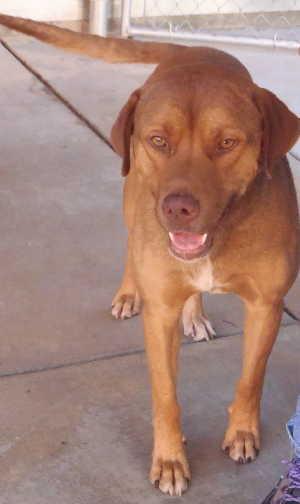
Hound-shepherd mix
This male hound-shepherd mix has a short brown coat.
Shelter staff said he is a very sweet dog that walks well on a leash and does not appear to be interested in cats.
He needs more socialization with other dogs; he does well with female dogs but caution is suggested around other males.
He has no signs of food aggression.
He's in kennel No. 13, ID No. 1107.

'Gizmo'
“Gizmo” is a male Chihuahua mix with a short tan and white coat.
Shelter staff reports that Gizmo is a very sweet and loving dog who is full of energy. He appears to be good with children. His ideal home will have an owner willing to spend time training and teaching him.
He's in kennel No. 17, ID No. 1229.

Male pit bull terrier-shepherd mix
This young male pit bull terrier-shepherd mix has a short tan coat.
He's in kennel No. 25, ID No. 1135.
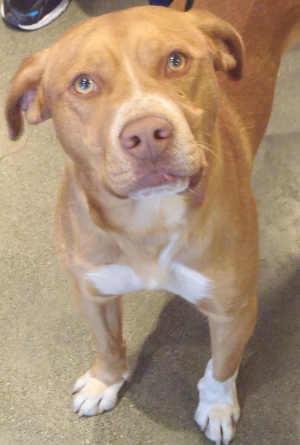
Male pit bull terrier mix
This male pit bull terrier mix has a short tan and white coat.
He's described as a sweet and friendly dog that walks well on a leash and has no signs of food aggression.
Shelter staff said he gets along well with both male and female dogs, but he would be best in a home with no cats and with children age 10 and above.
He's in kennel No. 30, ID No. 1201.
To fill out an adoption application online visit http://www.co.lake.ca.us/Government/Directory/Animal_Care_And_Control/Adopt/Dog___Cat_Adoption_Application.htm .
Lake County Animal Care and Control is located at 4949 Helbush in Lakeport, next to the Hill Road Correctional Facility.
Office hours are Monday through Friday, 8 a.m. to 5 p.m., and 1 p.m. to 3 p.m., Saturday. The shelter is open from 10:30 a.m. to 4:30 p.m. Monday through Friday and on Saturday from 1 p.m. to 3 p.m.
Visit the shelter online at http://www.co.lake.ca.us/Government/Directory/Animal_Care_And_Control.htm .
For more information call Lake County Animal Care and Control at 707-263-0278.
Email Elizabeth Larson at