 How to resolve AdBlock issue?
News
NORTHERN CALIFORNIA – You might think that during the winter months, when all the pretty flowers are gone, grasses are going dormant and wildlife is in migration or hibernation mode, that there’s not a lot to see in the wild areas in northern California, but you’d be wrong.
Weather permitting (the wetter the better), December, January and February are some of the best months for viewing the local region’s fungi and lichen.
Some are crusty, some are gelatinous, others tough as leather, and they come is a huge variety of shapes and colors: everything from pure white to purple and even bright orange!
Fungi are those members of the kingdom that includes everything from mushrooms to slime molds. They don’t produce chlorophyll, can’t fix carbon, and use spores to reproduce.
Of the common fungi in the area, some of the most interesting ones include sulfur shelf fungus (Laetiporus sulphureus) also called the “Chicken of the Forest.”
It is a kind of bract fungus that grows on trees. It’s most notable and recognizable for its bright orange and yellow color.
When it first starts out, it looks like a painful orange swelling on the tree and sometimes weeps orange-gold “tears.”
Eventually, though, the swelling reforms itself into one or more half-moon shaped plates that protrude out from the tree like shelves.
As the plates age, they lose their distinctive coloring and become very leathery.
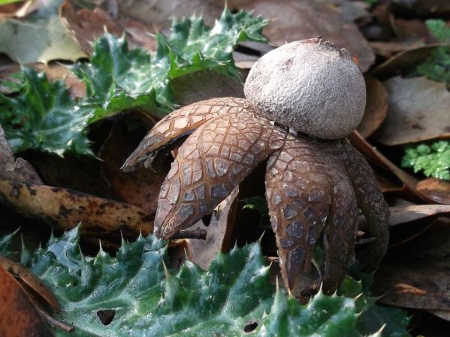
Earth stars (Geastrales) are one of the more interesting forms of fungi we can find especially in riparian (river’s edge) areas.
There are about 64 different species of these beasties, but they all have a similar look: a puff ball belly surrounded by a leathery petals that form a star shape when they open.
I usually find these in areas where the grass and leaf litter on the forest floor is thin; places where the stars can lift themselves up to the surface without having to fight through too much overgrowth.
The petals of the Earth Stars are hard and leathery in the dry months and clutch up tightly like a fist around the puff ball center.
After a rain, though, the petals unfurl and allow the puff ball in the middle to release its cache of spores.
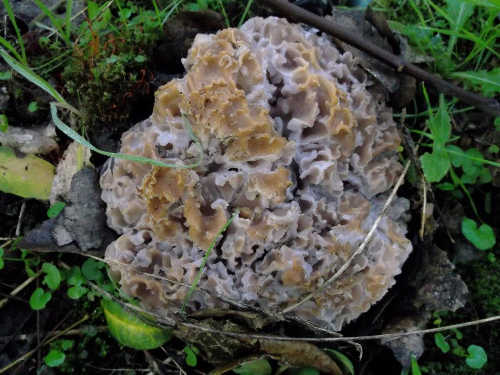
One kind of fungus I found recently, that I hadn’t seen in the area before, was a large specimen of Cauliflower Fungus (Sparassis radicata).
These fungi look like large, roundish, gray-colored brain or cauliflower floret. The one I saw was about the size of a softball, but they can get up to half a meter in size and weigh up to 30 pounds!
Cauliflower Fungus is parasitic and likes to grow where the roots of oaks and fir trees come close to the surface.
Although often misidentified as a fungus, lichen is actually a “symbiotic” union between fungus cells and algae cells.
The fungus cells help to keep the algae protected during times of heat and low moisture, and the algae cells help the fungus to get the carbon and carbohydrates it needs.
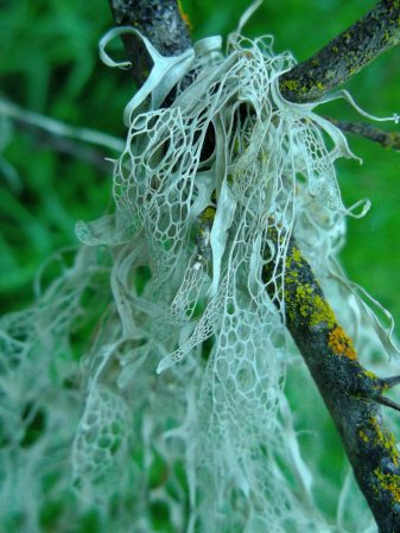
Of the local lichen the most recognizable one – especially in Napa County – is Lace Lichen (Ramalina-menziesii), often called Spanish Moss (even though it’s not moss at all).
In the dry months, it looks like scraggly, dead “hair”, but when the rains come it shows off how incredibly lovely it really is: a pale green lace-work pattern of branching loops and lines.
Go outside and see how many different kinds of fungi and lichen you can spot in a day.
Have fun – but be careful. Don’t eat any of the mushrooms you find; many of them are poisonous.
Also, remember that fungi play an important role in the ecosystem. They are a necessary component of any habitat because they help to break down and recycle organic matter (dead plants and animals).
So, leave the fungi where they are, and take home photos of them instead.
Tuleyome Tales is a monthly publication of Tuleyome, a nonprofit conservation organization based in Woodland and Napa, Calif. For more information about Tuleyome go to www.tuleyome.org . Mary K. Hanson is an amateur naturalist and photographer and author of The Chubby Woman’s Walkabout blog.
A recent study produced by the San Francisco Estuary Institute-Aquatic Science Center and funded by the California Department of Fish and Wildlife (CDFW) identifies the dramatic ecological transformation of the Delta over the past 150 years.
Developed by a group of scientists and resource managers, “A Delta Transformed” explains the relationship between specific landscape features and ecological functions, and compares historic conditions with the present.
It identifies the restoration framework needed to design landscapes that will support native wildlife and hold up to the threats presented by climate change and invasive species.
The complete report can be found at http://sfei.li/deltametrics .
Clear Lake is linked to the Bay-Delta through waterways including Cache Creek and the Yolo Bypass.
“The Delta no longer functions as a delta and is now a network of deep, engineered channels with declining abundances of native wildlife, particularly fish species, and increasing numbers of invasive species,” said Carl Wilcox, CDFW Policy Advisor to the Director for the Bay-Delta. “This critical report contributes a missing dimension to Delta planning by providing a landscape-scale perspective that illustrates how restoration in the Delta should be implemented to support native habitat and species.”
Presently, the Delta estuary is in a highly altered condition and struggling.
Study participants identified a variety of landscape changes in the Delta that have impacted its ecological function over the years.
These primary changes include loss of connectivity among habitat, degradation of habitat quality and loss of complexity.
The knowledge gained from this project will be used to identify specific elements of the landscape that can be restored to meet the needs of native species.
The Sacramento-San Joaquin Delta is part of the largest natural estuary on the west coast of North America. It is home to more than 750 native species and supplies water to more than 25 million Californians as well as 3 million acres of farmland.
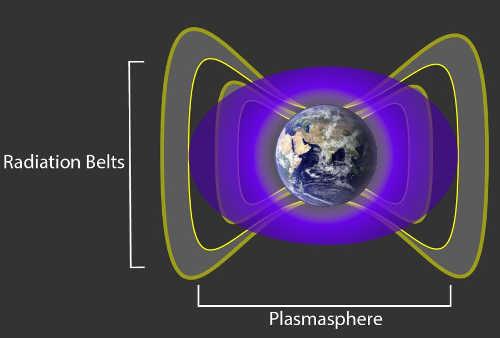
Two donuts of seething radiation that surround Earth, called the Van Allen radiation belts, have been found to contain a nearly impenetrable barrier that prevents the fastest, most energetic electrons from reaching Earth.
The Van Allen belts are a collection of charged particles, gathered in place by Earth's magnetic field.
They can wax and wane in response to incoming energy from the sun, sometimes swelling up enough to expose satellites in low-Earth orbit to damaging radiation.
The discovery of the drain that acts as a barrier within the belts was made using NASA's Van Allen Probes, launched in August 2012 to study the region.
A paper on these results appeared in the Nov. 27 issue of Nature magazine.
“This barrier for the ultra-fast electrons is a remarkable feature of the belts,” said Dan Baker, a space scientist at the University of Colorado in Boulder and first author of the paper. “We're able to study it for the first time, because we never had such accurate measurements of these high-energy electrons before.”
Understanding what gives the radiation belts their shape and what can affect the way they swell or shrink helps scientists predict the onset of those changes.
Such predictions can help scientists protect satellites in the area from the radiation.
The Van Allen belts were the first discovery of the space age, measured with the launch of a US satellite, Explorer 1, in 1958.
In the decades since, scientists have learned that the size of the two belts can change – or merge, or even separate into three belts occasionally.
But generally the inner belt stretches from 400 to 6,000 miles above Earth's surface and the outer belt stretches from 8,400 to 36,000 miles above Earth's surface.
A slot of fairly empty space typically separates the belts. But, what keeps them separate? Why is there a region in between the belts with no electrons?
Enter the newly discovered barrier. The Van Allen Probes data show that the inner edge of the outer belt is, in fact, highly pronounced.
For the fastest, highest-energy electrons, this edge is a sharp boundary that, under normal circumstances, the electrons simply cannot penetrate.
“When you look at really energetic electrons, they can only come to within a certain distance from Earth,” said Shri Kanekal, the deputy mission scientist for the Van Allen Probes at NASA's Goddard Space Flight Center in Greenbelt, Maryland and a co-author on the Nature paper. “This is completely new. We certainly didn't expect that.”
The team looked at possible causes. They determined that human-generated transmissions were not the cause of the barrier.
They also looked at physical causes. Could the very shape of the magnetic field surrounding Earth cause the boundary?
Scientists studied but eliminated that possibility. What about the presence of other space particles? This appears to be a more likely cause.
The radiation belts are not the only particle structures surrounding Earth.
A giant cloud of relatively cool, charged particles called the plasmasphere fills the outermost region of Earth's atmosphere, beginning at about 600 miles up and extending partially into the outer Van Allen belt.
The particles at the outer boundary of the plasmasphere cause particles in the outer radiation belt to scatter, removing them from the belt.
This scattering effect is fairly weak and might not be enough to keep the electrons at the boundary in place, except for a quirk of geometry: The radiation belt electrons move incredibly quickly, but not toward Earth. Instead, they move in giant loops around Earth.
The Van Allen Probes data show that in the direction toward Earth, the most energetic electrons have very little motion at all – just a gentle, slow drift that occurs over the course of months.
This is a movement so slow and weak that it can be rebuffed by the scattering caused by the plasmasphere.
This also helps explain why – under extreme conditions, when an especially strong solar wind or a giant solar eruption such as a coronal mass ejection sends clouds of material into near-Earth space – the electrons from the outer belt can be pushed into the usually-empty slot region between the belts.
“The scattering due to the plasmapause is strong enough to create a wall at the inner edge of the outer Van Allen Belt,” said Baker. “But a strong solar wind event causes the plasmasphere boundary to move inward.”
A massive inflow of matter from the sun can erode the outer plasmasphere, moving its boundaries inward and allowing electrons from the radiation belts the room to move further inward too.
The Johns Hopkins Applied Physics Laboratory in Laurel, Maryland, built and operates the Van Allen Probes for NASA's Science Mission Directorate.
The mission is the second in NASA's Living With a Star program, managed by Goddard.
For more information about the Van Allen Probe, visit http://www.nasa.gov/vanallenprobes .
CLEARLAKE OAKS, Calif. – The effort to bring a cell phone tower to the Spring Valley community is getting closer to completion.
Spring Valley resident Bob Hendrickson, who also chairs the community's safety committee and is on the advisory board for County Service Area No. 2 – which covers the Spring Valley Lakes subdivision – has been one of the people helping move the cell tower forward.
He told Lake County News that the new tower is about to be installed by Verizon.
The 4G cell tower, which is being designed to look like a water tower, is to be located at 2589 Indian Hill Road.
While it’s a Verizon project, it will use some AT&T phone lines, Hendrickson said.
Following a failed effort about a decade ago, the push to get a cell tower gained ground after the 2012 Walker and Wye fires.
The fires, located east of Clearlake Oaks, damaged phone lines to the community.
First responders reported that during that incident – as well as in other cases where they’ve responded to the Spring Valley area – they were challenged by a lack of cell coverage.
The result was that Northshore Fire, Cal Fire, Lake County Fire and county Supervisor Denise Rushing joined forces with residents to get the project on track.
A community meeting and vote of Spring Valley's residents were held earlier this year, as Lake County News has reported.
Hendrickson said 98 percent of the community – which includes about 900 property owners – was in favor of the project.
“It was really remarkable how few people voted against it,” he said.
At the February community town hall meeting, a Verizon representative had reported that the goal was to have the tower completed by August at the latest.
However, work to construct the tower began later, with the digging of the foundation starting on Oct. 22, Hendrickson said.
About two weeks ago the foundation was poured, with Hendrickson noting that the process used a lot of concrete.
Hendrickson said the foundation is now in place, and the electrical and electronic work is done.
He's anticipating that the tower will arrive and be craned into place early next week, at which point the Verizon crew will install the microwave antenna.
Once the tower is installed, Hendrickson said it's expected that Verizon will be able to offer a more accurate estimate of when the project may be completed.
Hendrickson said he anticipates that Spring Valley's residents will be able to make cell phone calls by the end of January.
While Hendrickson is looking forward to the project's completion, he noted, “One isolated cell tower doesn't mean you're suddenly going to have super duper cell service.”
He said more cell towers will be needed to improve the services to Spring Valley, and officials have reported that Spring Valley's tower is part of a larger plan to increase cell phone service all along the Highway 20 corridor.
With the cell tower project nearing completion, Hendrickson said the community's next big project is working with the county of Lake to establish a community emergency response team.
So far, 25 Spring Valley residents have indicated a desire to get involved, which includes becoming certified following a training set to begin in January.
He said Lake County Office of Emergency Services Manager Marisa Chilafoe has acquired the money for training and other needs for the group.
“It's an exciting project to get going,” he said.
Email Elizabeth Larson at
LAKE COUNTY, Calif. – The 2014 Lake County burn ban will be lifted on Monday, Dec. 1, with Cal Fire declaring an end to fire hazard season.
Lake County’s joint fire and air quality management district’s open burning program has incorporated both fire safety and air quality management since 1987, and officials said it has greatly contributed to the community’s superior fire safety and air quality.
Burn permits are required for all burning in the Lake County Air Basin. Contact your local fire protection agency for a burn permit, or the Lake County Air Quality Management District to obtain a smoke management plan.
A smoke management plan is required for all burns over 20 acres in size, multiday burns, standing vegetation burns, whole tree or vine removals over one acre, and other burns where significant smoke impacts may occur or sensitive receptors may be impacted.
A fee is required for all burn permits, payable at the time the permit is issued. Burn permits (agricultural and residential) and smoke management plans are each $24, while land development/lot clearing burn permits are $73 each.
Only clean dry vegetation that was grown on the property may be burned. Residential burn permits require a one-acre or larger lot, a burn location that is located at least 100 feet from all neighbors, and a burn location at least 30 feet from any structure.
Lot clearing burns require special permits available at your local fire agency. Burn only the amount of material that can be completely consumed during the allowed burning hours. Read your burn permit carefully and follow all the conditions.
Each day of the burning season is designated as a “no burn day,” a “limited burn day” or an “extended burn day.” On “no burn days” all open burning is prohibited, unless an economic exemption has been given for a specific burn. Contact the Lake County Air Quality Management District for details, 707-263-7000.
On all permissive burn days, burning is generally allowed from 9 a.m. to 3 p.m. only.
Extended burn days allow burning during daylight hours for certain agricultural burn permit holders with specific approval for extended hours. Read your permit for allowed hours of burning.
You can determine the daily “burn day” status by calling the phone numbers found on your burn permit.
Consider using the vegetative waste pickup provided with your waste collection services or composting as an alternative to burning leaves. Improper leaf burning can produce excessive smoke creating a health hazard and potentially a public nuisance.
Contact your local fire safe council for chipping information. For residents of the South Lake Fire Protection District, go to www.southlakefiresafecouncil.org or your local fire station. For all other areas of the county, call 707-263-4180, Extension 106, or your local fire station.
The law requires that an able-bodied adult supervise all fires. Burning even a small amount of illegal material can result in toxic ash and smoke that contain cancer-causing substances and contribute to other health problems.
Burning prohibited materials can also result in significant fines. Some people have smoke allergies and/or respiratory problems and their health is degraded by even small amounts of smoke.
Please be considerate of your neighbors. A permit does not allow you to create health problems for others and you can be liable for health care costs, fines and other costs resulting from your burning.
NORTH COAST, Calif. – A Fort Bragg man who was the suspect in a Wednesday robbery died after two deputies and a California Highway Patrol officer used Tasers to take him into custody.
Daniel Cedar Saulsbury, 39, died at the scene of the confrontation with law enforcement, according to a report from Capt. Greg Van Patten of the Mendocino County Sheriff's Office.
Van Patten reported that just after noon on Wednesday the Mendocino County Sheriff's Office was contacted by a person who wanted to report that they had been the victim of a robbery in the 200 block of Main Street in Point Arena.
Deputies in the Fort Bragg area called the victim before responding to Point Arena, Van Patten said.
During the phone conversation the deputies learned the victim had been confronted by a white male adult while standing in a business parking lot in the 200 block of Main Street, according to Van Patten's report.
During the confrontation the white male adult robbed the victim of a diaper bag in his possession and threw large rocks that almost struck the victim, Van Patten said.
Van Patten said the information of the incident was broadcast to the CHP, which had an officer working near Point Arena.
The CHP officer located the white male adult, later identified as Saulsbury, near the scene of the robbery, Van Patten said.
When the CHP officer attempted to detain Saulsbury a foot chase ensued mixed with moments of active resistance by Saulsbury. Van Patten said the CHP officer requested emergency assistance via the radio while deputies were responding to Point Arena.
Van Patten said the deputies arrived in Point Arena several minutes later and assisted in apprehending an actively resisting Saulsbury on Mill Street in Point Arena.
During the attempts to apprehend Saulsbury the CHP officer and two deputies deployed their issued Taser weapons, Van Patten said.
Shortly after Saulsbury was apprehended, Van Patten said he began to show signs of medical distress.
Medical aid was immediately rendered by medical personnel who had been summoned to the scene just after Saulsbury's apprehension. However, Van Patten said Saulsbury subsequently was pronounced dead after lifesaving efforts were unsuccessful.
As a result of Saulsbury’s death, Van Patten said the Mendocino County Officer Involved Fatal Protocol was initiated.
Van Patten said the Mendocino County District Attorney's Office has now assumed jurisdiction over the investigation into the incident.