 How to resolve AdBlock issue?
News
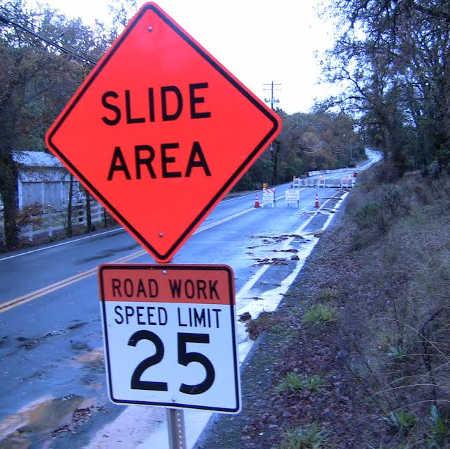
LAKE COUNTY, Calif. – This week's heavy rains have backed up stormwater systems, led to falling rocks and trees, and kept local road and public works officials in cleanup mode.
The National Weather Service reported that rainfall totals around the county for the 72-hour period ending Wednesday at 10:30 a.m. averaged about 2 inches, while totals in Clearlake and Lakeport were around 2.5 inches.
Lake County Public Works road crews have been busy cleaning up over the last few days, responding to backed up drainages, and downed trees and debris in roadways.
On Tuesday, the agency also closed a portion of Hill Road East near the Lakeside Heights subdivision in the north Lakeport area due to landslide concerns, as Lake County News has reported.
“We're getting some local flooding in some streets,” but “nothing major,” County Road Superintendent Lyle Swartz said Wednesday.
He said road crews have been out late working in locations around the county to clear debris from roads, culverts and ditches.
“Everybody's going all directions,” Swartz said. “They're not able to keep up with everything.”
In addition to road flooding, the wet conditions have caused small rockslides along area roadways. In one case, Swartz said a large boulder fell into Soda Bay Road.
However, besides Hill Road East, there were no other road closures Wednesday, Swartz said.
Residents in Clearlake reported some flooding on the city's dirt roads due to the extended rainfall.
Clearlake Public Works Director Doug Herren didn't immediately return a call for comment about possible issues in the city.
In Lakeport, Public Works Superintendent Doug Grider said there also had been localized street flooding due to the rain.
Grider said that flooding occurred about halfway down Lakeshore Boulevard, on First Street between High and Brush streets, in the area of Martin Street in front of the fairgrounds, and at the intersection of Lakeport Boulevard and Main Street.
The heavy rain overwhelmed the stormwater system, which Grider said temporarily reached capacity and backed up.
While Grider's crews also were cleaning leaves out of grates, it was the water – not the leaves – causing the issues, he said.
Forbes Creek also was running from bank to bank, he said. However, with the break in the rain, water levels were receding.
“At this point in time I think we're going to be OK,” Grider said Wednesday.
Another storm may be coming in on Thursday, with Grider noting that the forecast was changing by the hour. That next storm isn't forecast to be as heavy as what the county has had this week so far.
“The thing that's really saving us right now, believe it or not, is the low lake level,” Grider said.
Late Wednesday Clear Lake had risen to about -0.26 feet Rumsey, up from -0.40 feet Rumsey at the start of the day, according to the US Geological Survey.
Grider said if there is more heavy rainfall, there could be more street flooding. “So long as the lake's down, it should go away very quickly.”
He urged motorists to use caution during the wet weather.
“Be alert and pay attention, watch the roadway for standing water,” Grider said.
Email Elizabeth Larson at
Following one of the driest years on record when groundwater resources have provided an increasing percentage of California’s water supply, the Department of Water Resources has released an updated report on groundwater basins that details groundwater level changes, potential water shortages, land subsidence, farmland fallowing and gaps in groundwater monitoring.
Drought conditions typically result in an increase in groundwater well activity and pumping to compensate for surface water supply shortages.
Collectively, groundwater basins are the state’s largest reservoir, 10 times the size of all its surface reservoirs combined.
More than 80 percent of Californians rely, in part, on groundwater for their drinking water.
Directed by Gov. Edmund G. Brown Jr.’s Proclamation of a State of Emergency in April and following a previous DWR report on groundwater in April, the report shows groundwater basins in most areas of the state at historically low levels.
In September, Gov. Brown signed a package of three bills which together create a framework for sustainable, local groundwater management for the first time in state history.
The legislation, known as the Sustainable Groundwater Management Act, allows local agencies to tailor groundwater sustainability plans to their regional economic and environmental needs.
For more information about the legislation, visit www.groundwater.ca.gov .
“If we fail to manage our groundwater basins sustainably, we risk losing the water supply savings account that can help cities, farms, and businesses survive drought with minimal disruption,” said DWR Director Mark Cowin. “The Sustainable Groundwater Management Act will help us head off problems such as subsidence and overdraft, which may damage aquifers permanently, and allow local agencies to establish groundwater pumping levels that yield reliable supplies for generations to come.”
State and local agencies will be working together over the next several years to craft local sustainability plans in regions where groundwater basins are vulnerable to overdraft.
Groundwater accounts for approximately 40 percent of the state’s total annual water supply, and in some regions of the state, as much as 60 percent of the supply during dry or drought years.
In the meantime, as documented in the report released today, California's three-year-long drought is taking a heavy toll on many groundwater basins.
Basins with notable decreases in groundwater levels are in the Sacramento River, San Joaquin River, Tulare Lake, San Francisco Bay, Central Coast and South Coast hydrologic regions.
Key findings of the report include:
– Based on data received this year through September, more than 350 new water supply wells are reported in Fresno and Tulare counties, the most in the state. More than 200 new water supply wells were reported in Merced County and more than 100 were reported in Butte, Kern, Kings, Shasta, and Stanislaus counties.
– As of Oct. 7, 2014, 34 of California's 127 high- and medium-priority basins and sub basins are either partially or fully unmonitored under the California Statewide Groundwater Elevation Monitoring Program.
– While the collection and evaluation of both seasonal and long-term groundwater level data are critical to assess conditions of alluvial groundwater basins, significant data monitoring gaps exist in the San Joaquin River, Tulare Lake and Central Coast hydrologic regions.
– Subsidence is occurring in many groundwater basins of the state, especially in the southern San Joaquin River and Tulare Lake hydrologic regions.
– Due to ongoing decline of groundwater levels, areas with a higher potential for future subsidence are in the southern San Joaquin, Antelope, Coachella and western Sacramento valleys.
– A multi-agency research project led by National Atmospheric and Space Administration estimated that peak summer acreage of farmland idled in California in 2014 was 1.7 million acres, almost 700,000 acres more than in 2011, a recent wet year.
To review the report, visit http://www.water.ca.gov/waterconditions/index.cfm .
DWR is developing strategies for implementation of the various components of the legislation and will work with local agencies throughout the process.
Geographic, geologic, and hydrologic differences exist across the state and the SGMA allows for flexibility in groundwater stewardship.
DWR will seek input from local agencies and the public to develop regulations that ensure groundwater management plans result in sustainable groundwater management statewide.
Groundwater management is a critical element of the governor's California Water Action Plan. Developed by the Natural Resources Agency, California Environmental Protection Agency and Department of Food and Agriculture and released in January 2014, the action plan recognizes that all of California's water resources are interconnected.
Besides sustainable groundwater management, the plan's five-year goals include making conservation a way of life, expanding water storage capacity, and protecting and restoring important ecosystems.
The plan can be accessed by clicking here or visit http://resources.ca.gov/california_water_action_plan/ .
As directed by the January drought emergency declaration, DWR is working to update monitoring of land subsidence in the Central Valley. DWR has also been working with county agencies to ensure that water well drillers submit required well logs for newly constructed and deepened wells in a timely manner to facilitate tracking of areas that are experiencing drought-related groundwater problems.
Additional groundwater information is available at the DWR Groundwater Information Center located here or by visiting http://www.water.ca.gov/groundwater/ .
To learn more about the state’s efforts to improve groundwater management, visit www.Groundwater.CA.Gov .
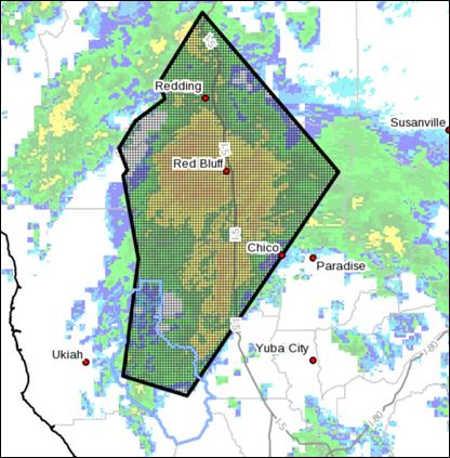
LAKE COUNTY, Calif. – The National Weather Service in Sacramento has issued an urban and small stream flood advisory for minor flooding of poor drainage areas until 11:45 p.m. Wednesday.
Affected areas include western Colusa County, northwestern Butte County, Glenn County, northern Lake County, western Shasta County and Tehama County.
Moderate rain showers with pockets of heavy showers are expected to continue over the northern and western Sacramento Valley, resulting in reports of street flooding in many urban areas.
Rain is expected to continue through the day, heavy at times, which will continue the urban flooding. Rainfall amounts up to 1.5 inches will be possible over the next several hours.
The National Weather Service reminds motorists not to drive vehicles into areas where the water covers the roadway. The water depth may be too great to allow your car to cross safely. Move to higher ground.
Additionally, residents can protect their homes and property from flooding by using sandbags, which are available for purchase at the following Lake County locations.
Rainbow Agricultural Services
1975 Argonaut Road, Lakeport
707-279-0550
Plastic bags: $0.49 each
NO SAND
Open:
Monday through Friday, 7:30 a.m. – 6 p.m.
Saturday, 9 a.m. – 5 p.m.
Sunday, 9 a.m. – 3 p.m.
Pivniska Trucking Inc.
85 W. Highway 20, Upper Lake
707-275-3203
Sand only; no bags
Open:
Monday through Friday, 7 a.m. – 5 p.m.
Mendo Mill
2465 S. Main St., Lakeport
707-263-8400
Sand: 70 pound bags
Sandbags: $11.99 package of 25 or one for $0.67
Open:
Monday through Friday, 7 a.m. – 6 p.m.
Saturday, 8 a.m. – 6 p.m.
Sunday, 8 a.m. – 5 p.m.
Kelseyville Lumber & Supply Co.
3555 N. Main St., Kelseyville
707-279-4297
Bags: $.49 each (not filled)
Filled: $2.98
Open:
Monday through Friday, 7 a.m. – 6 p.m.
Saturday to Sunday, 8 a.m. – 6 p.m.
Mendo Mill & Lumber Co.
5255 Old Highway 53, Clearlake
707-994-1014
Bags: $0.67 each / $11.99 for bundle of 25
50 pound bags of sand
Open:
Monday through Friday, 7:30 a.m. – 6 p.m.
Saturday, 8 a.m. – 6 p.m.
Sunday, 8 a.m. – 5 p.m.
Yard closes at 5 p.m. during winter hours
Layne Paving & Trucking
3700 Old Highway 533, Clearlake
707-994-6324
SAND ONLY
Open:
By appointment only
Lake Builders Supply Co.
3694 E. Highway 20, Nice
707-274-6607
Bags bundle of 25: $11.99
$11.49: 100-pound bags of sand
Open:
Monday through Friday, 7:30 a.m. – 5:30 p.m.
Saturday through Sunday, 8 a.m. – 4 p.m.
Clearlake Lava
14572 E. Highway 20, Clearlake Oaks
707-998-1115
SAND ONLY
Open:
Monday through Friday, 6 a.m. – 5 p.m.
Four Corners Builders
14975 Old Highway 53, Clearlake
707-994-6277
Sandbags: $0.89 per bag
50 pound bags of sand
Open:
Monday through Saturday, 7:30 a.m. – 5:30 p.m.
Sunday, 8 a.m. – 4:30 p.m.
Hardester’s Market
21088 Calistoga Road, Middletown
707-987-2325
Sandbags: $0.55 each or $12.99 for bundle of 25
60 pound paper bag: $4.32
Open:
Monday through Sunday, 7 a.m. – 9 p.m.
*Prices are subject to change. The county does not pay for sand or sandbags.
LAKE COUNTY, Calif. – The National Weather Service is predicting heavy Wednesday rainfall around Lake County, with as much as 2 inches possible in some parts of the county.
The National Weather Service is forecasting rain through Friday, with chances of showers over the weekend and into next week.
However, the heaviest precipitation is expected on Wednesday, with showers, thunderstorms and wind gusts into the 20s and 30s, with the highest winds – at around 37 miles per hour – expected in the Lucerne area.
Northshore areas including Clearlake Oaks, Lucerne and Upper Lake, as well as Cobb are expected to have the most rainfall on Wednesday, with the possibility of between 1 to 2 inches in the forecast, according to National Weather Service estimates.
In other parts of the county – including Kelseyville, Lakeport, Lower Lake and Middletown – forecasters said rainfall totals are expected to be between three-quarters of an inch and 1 inch during the day Wednesday.
On Wednesday night, rainfall totals across the county are expected to be between a tenth of an inch and a quarter of an inch, the National Weather Service reported.
National Weather Service rain station totals for the 72-hour period ending at 6 p.m. Tuesday had totals ranging from between 1 inch at Cow Mountain to more than an inch and a half in Lakeport, with Boggs Mountain coming in on top with 2.23 inches.
An average of about half an inch fell across the county between 6 p.m. Tuesday and 12 a.m. Wednesday, with more than an inch in the Whispering Pines area, based on additional National Weather Service rain tracking data.
The rain continues to benefit the level of Clear Lake, which rose to -0.51 feet Rumsey early Wednesday, up from -0.58 feet Rumsey on Tuesday, according to the US Geological Survey.
Email Elizabeth Larson at
After leveling off in September, statewide residential water conservation in California receded in October to just a 6.7 percent reduction in year-over-year water use, according to a new report from the State Water Resources Control Board.
In the most recent survey of nearly 400 urban water retailers, the State Water Board learned that while residential water use per person continues to decline this year, the rate at which water conservation has been occurring in each community compared to water use last year declined for the second straight month.
Year over year monthly residential water savings statewide dropped from 10.3 percent in September, to 6.7 percent in October, although residents used less water in October 2014 compared to September 2014.
The decline in year-over-year monthly savings raises questions about whether efforts are slacking off or whether it is just that residents tend to use less water as the weather cools.
Nonetheless, the numbers prompted concern that state residents won’t be prepared if California faces a fourth year of drought conditions in 2015.
“Recent rains are no reason to let up on our conservation efforts,” said Felicia Marcus, chair of the State Water Board. “It will take many sustained storms to get us out of this horrible drought. This latest report raises questions whether some residents have slowed on water conservation efforts, whether conditions like temperature made a big difference in different areas, or whether it is just time to direct agencies to find additional conservation opportunities in day-to-day water use.”
As an example, the South Coast exhibited a decline in monthly water savings dropping to 1.4 percent savings in October as compared to 7.5 percent savings during September.
With 56 percent of all the residential water customers statewide, this decline in conservation significantly impacted the state average for October residential water savings.
Other areas held steady or even increased their conservation efforts in October compared to September.
The State Water Board announced a half-day Southern California water conservation workshop to be held on Dec. 17, when the State Water Board travels to the Los Angeles region for its second December board meeting. The workshop is intended to solicit suggestions on what, if any, additional conservation measures should be adopted in 2015 to increase water conservation statewide.
“Heading into 2015, our reservoirs remain at historic lows and our snowpack is a fraction of what we need, so the stakes are even higher than this time last year,” Marcus said. “We’ll hope for sustained rain and snow, especially snow, but have to plan as if it will be another dry year – until it’s not. Every drop saved today will be a treasure later if it doesn’t rain enough.”
Water conservation efforts reached a peak of 11.6 percent of water savings in August, compared with August 2013 water use. Statistically, California urban water use is generally the highest June through October.
Decline in per capita daily water use is promising
A new reporting requirement, called residential gallons per-capita per day (R-GPCD), which estimates daily water use by residential customers for nearly 400 urban water agencies statewide alongside the monthly conservation data, indicates communities continue to use less water.
Data for September showed statewide average use of 123 gallon per person, per day. October data indicates the statewide average dropped to 109 gallons per person, per day, which is most likely due to lower outdoor water use as the state moves into cooler fall months.
The water use reports are a requirement of the Emergency Water Conservation Regulation adopted by the State Water Board in July and will be provided to the board monthly by urban water suppliers, along with total water conservation for each month.
The complete report is posted at http://www.waterboards.ca.gov/waterrights/water_issues/programs/drought/conservation_reporting_info.shtml .
According to the R-GPCD data, water use varies widely by hydrologic region and showed consistent declines in water use, during this second month of reporting.
At the low end, the North Coast region averaged 72 gallons per person per day. On the high end, the Colorado River region averaged 211 gallons per person per day.
Statewide water conservation rate declines in October
Water conservation statewide monthly year over year percentage has declined in September and October after a steady rise since June.
The water conservation rate climbed to 11.6 percent in August, a substantial increase from 7.5 percent conservation in July and 4 percent in June.
But for September, the conservation rate dipped to 10.6 percent and dropped again to just 6.7 percent in October.
The water conservation rate is a comparison of the amount of water produced in the reporting month with the same month one year ago.
Compliance with the mandatory reporting requirement is steady, with 399 (97 percent) of urban water suppliers, representing about 34 million Californians, now reporting.
The report also found that in October, 91 percent of the water agencies reporting had instituted outdoor water use restrictions, a three percentage point increase from the September reporting period.
Outdoor water use restrictions are a key requirement for urban water suppliers under the Emergency Water Conservation Regulation because outdoor watering accounts for as much as 80 percent of urban water use in some areas.
Between June and October, about 90 billion gallons, or 276 thousand acre feet of water, were saved compared to last year.
Collectively that’s about enough water to supply 1.2 million Californians for an entire year. An acre foot of water can supply the annual average water needs for two families a year.
In his Jan. 17, 2014, Emergency Drought Proclamation, Governor Brown called for Californians to voluntarily reduce their water use by 20 percent.
The trend of increasing reductions and specific local data shows that many California communities have met and exceeded the call to conserve, but more can and must be done to protect water supplies should the drought persist.
Current forecasts indicate that Californians cannot count upon a wet winter to end the drought.
The State Water Board will closely monitor the implementation of the regulations and the weather over the coming months to determine if further restrictions are needed.
The Emergency Water Conservation Regulation will be in effect until April 25, 2015, and may be extended if drought conditions persist.
Visit www.SaveOurWater.com to find out how everyone can do their part, and visit www.Drought.CA.Gov to learn more about how California is dealing with the effects of the drought.
LOWER LAKE, Calif. – Highway 29 near Lower Lake has reopened following a vehicle crash that knocked down a power pole and power lines.
The minor injury crash occurred shortly after 1:30 p.m. Tuesday on Highway 29's Glasgow Grade, near Seigler Canyon Road, according to the California Highway Patrol.
CHP Officer Kory Reynolds said the highway had closed temporarily at the crash site, but a short time later the CHP said the roadway was open to one-way traffic.
Pacific Gas and Electric, Caltrans and CHP have been on scene throughout the afternoon.
The CHP reported just after 3 p.m. that it was expected to take PG&E about three hours to replace the downed power pole.
Just after 3:30 p.m., PG&E's online outage center attributed two outages – in the Kelseyville and Lower Lake areas – to the crash. The number of affected customers at that point had been reduced to approximately 112.
Reports from the scene indicated the crash was a hit and run, with the vehicle later seen in Clearlake, according to the CHP.
Email Elizabeth Larson at