 How to resolve AdBlock issue?
News
The California State Treasurer’s Office has released a study of affordability for the water facility construction proposed in the public review draft Bay Delta Conservation Plan, or BDCP.
“The Bay Delta Conveyance Facility: Affordability and Financing Considerations,” is an independent study requested by the California Natural Resources Agency and commissioned by the California Debt and Investment Advisory Commission (CDIAC), which is chaired by State Treasurer Bill Lockyer.
The study finds that the cost of the Delta conveyance facility is within the range of urban and agricultural users’ capacity to pay.
Officials said the BDCP would modernize California’s existing water supply system – the State Water Project (SWP) and Central Valley Project (CVP) located in the Sacramento-San Joaquin Delta – and protect water users across the state from water supply disruption due to regulatory restrictions and seismic risks.
The state preferred alternative identified in draft environmental documents calls for the construction of three new intakes in the northern Delta on the Sacramento River and twin tunnels of a combined 9,000 cubic-feet-per-second capacity to protect and transport supply to the existing aqueduct systems in the southern Delta. The participating public water agencies would fund the water system improvements.
However, the plan has come under heavy criticism from officials including Congressman John Garamendi, who represents a portion of Lake County in the US House of Representatives.
Garamendi has called the plan a “boondoggle” and has introduced legislation to block it.
Water from Clear Lake travels to the Bay-Delta through waterways including Cache Creek and the Yolo Bypass.
The treasurer’s report is one more step in the ongoing BDCP development. It estimates the annual debt service cost for SWP and CVP water contractors and identifies steps that will need to be undertaken in order to successfully finance the project over a 50-year period. The report also identifies common risks inherent in financing large infrastructure projects.
The report also illustrates that the cost of the Delta conveyance facility is within the range of urban and agricultural users’ capacity to pay.
The report provides illustrative cost ranges for Metropolitan Water District, Santa Clara Valley Water District, Westlands Water District, and Kern Water District, which have been major funders of the BDCP planning effort. The independent analysis was funded solely by CDIAC.
Examining peak costs over the lifetime of debt financing, the report estimates that the peak annual debt service costs, defined as the average annual costs for the highest 10 years, would be $1.58 billion per year (base case), $1.08 billion per year (best case), and $2.50 billion per year (worst case), all in year-of-expenditure dollars.
These debts would be financed via revenue bonds and repaid by revenues from the SWP and CVP contractors and their ratepayers, not California’s taxpayers.
The treasurer’s report identifies certain commitments that would need to be undertaken by SWP and CVP contractors to enable bonds to be sold for the project.
More than 60 percent of the estimated financial responsibility of SWP contractors’ share of the bonds would be derived from contractors rated Aa3 or AA-higher by Moody’s Investors Service and Standard & Poor’s.
California Department of Water Resources (DWR) and SWP contractors currently use “take or pay” contracts to finance the SWP. Among other issues discussed, the report indicates that BDCP bond contracts for CVP contractors would need to adopt this “take or pay” structure to finance the Delta conveyance. This requires annual fixed payments even when water deliveries fluctuate year to year due to changes in hydrologic conditions.
This approach, along with other requirements, has resulted in very strong credit ratings of AAA/Aa1 on DWR’s bonds and is expected to strengthen the credit ratings for BDCP-related bonds.
The report identifies potential risks to bond financing, such as construction cost overruns and delays, regulatory uncertainty, and unforeseen changes due to climate change. It also cites studies on so-called “megaprojects,” and their potential for cost overruns.
According to the report, bridge and tunnel projects experience cost overruns of 34 percent on average. Currently the BDCP construction budget has a contingency of 36 percent to account for this uncertainty.
To read a copy of the report, visit http://www.treasurer.ca.gov or http://www.baydeltaconservationplan.com .
In related news, the California Department of Water Resources announced that next month it will begin negotiations with SWP contractors on proposed amendments that would modify SWP water supply contracts.
DWR Director Mark Cowin said the objective of the negotiations is to develop terms and conditions for proposed amendments to DWR’s water supply contracts with the 29 public agencies that purchase SWP water for distribution to their customers.
The proposed amendments would define the rights and obligations of DWR and the contractors who would benefit from the BDCP, should the BDCP be implemented.
Cowin stressed that the negotiations are not a forum for making decisions about approving the BDCP. “These negotiations are entirely separate from other BDCP planning activities and the ongoing BDCP evaluation process,” he said.
DWR will open the negotiations to the public to observe and provide comments to DWR at the end of each negotiating session.
Members of the public also may submit written comments within seven calendar days following the negotiating sessions.
The first session will be from 10 a.m. to 3 p.m. Wednesday, Dec. 10, in Room 1131 of the California Natural Resources Building, 1416 Ninth Street, Sacramento.
Seating is limited, but the public can listen to the negotiations by calling 1-719-359-9722, passcode 138000#. Public parking will be available in the parking garage at 10th and O streets.
Cowin said the first session will focus primarily on ground rules and other negotiation-related processes and will not address substantive amendment issues. As such, it may adjourn early if the agenda items have been addressed or by mutual agreement of DWR and the SWP Contractors.
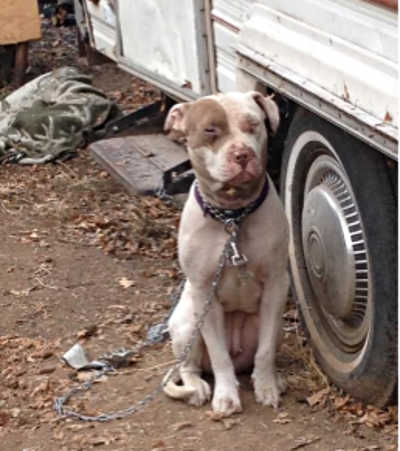
LAKE COUNTY, Calif. – On a Thursday in September, one life would be saved and three lives would be changed forever.
This is the story of “Honey” – today, known as “Anna” – a dog whose story might have had a sad ending had it not been for a number of people who cared enough to help her get a new home and a new life.
During her second time in Clearlake, Special Agent Jill Brenny was assigned to an enforcement sweep of gang offenders and was accompanied by two additional Special Agents in the Gang Unit of Homeland Security Investigations, along with Clearlake Police officers and a Lake County Probation agent.
The group came upon a trash-filled lot with a filthy and forlorn female pit bull chained to a fire-charred and dilapidated RV with busted out windows.
The dog's eyes were crusted with infection and open sores that appeared to be burn marks covered her ears and neck.
Her head hung low, though she stirred when she heard voices.
“There was no way I was leaving that dog there,” said Brenny.
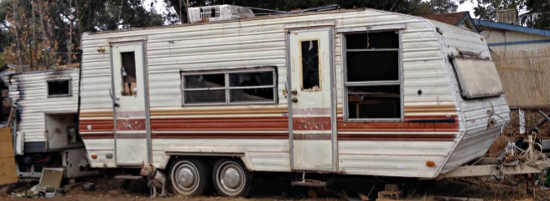
Little did she realize that she would put in motion a rescue effort that would span four states.
Det. Tom Riley of the Clearlake Police Department called Clearlake Animal Control, and Officer Jenna Tuller responded.
As she was approached by Tuller, the dog held up her injured leg in a silent plea for help.
Due to her deplorable condition, the dog was confiscated by Clearlake Animal Control and named “Honey.” She was taken to the SPCA of Clear Lake.
Agent Brenny – who lives in San Francisco – knew she could not leave Honey behind. What would become of her?
Brenny started emailing and texting fellow dog lovers who she thought might be looking for an addition to their family.
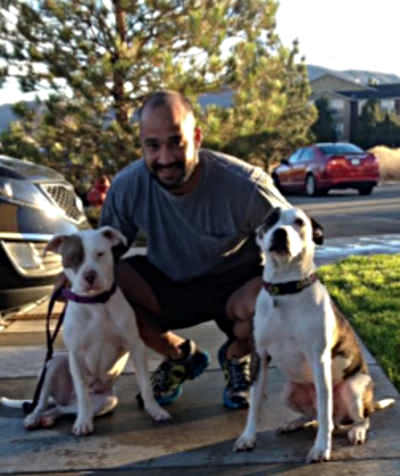
She found the one – Hence Williams, a US Probation Officer and EMT in Vernal, Utah.
Brenny kept calling the SPCA to let them know that Honey would have a home when she was ready to leave.
She and Williams kept in close touch and they decided that she would pick up Honey at the SPCA and drive her to meet Williams in Reno.
In addition to potty breaks, Brenny pulled over several times during the six-hour ride to comfort Honey.
“I couldn't believe that, after all she had been through, she was so sweet and just wanted to be in my lap the whole time I was driving,” Brenny said.
Williams was waiting in Reno when Brenny and Honey arrived.
He had brought along his other rescued pit bull, named Cooper. Both girls look like twins separated at birth. They bonded immediately and have been inseparable, even sleeping cuddled up together.
Williams has renamed Honey “Anna.”
He decided to take Anna to his old vet in New Mexico, with whom he had a longstanding relationship.
After a thorough exam and x-rays, it became apparent that Anna had sustained a broken humerus during her years of abuse and neglect and that the bones had healed offset, which was causing her pain.
That vet offered his opinion that the leg could not be saved, and an amputation was performed on Nov. 19.
Anna has taken the surgery in stride and quickly learned to navigate on three legs. She is currently undergoing a period of rehabilitation.
Her spirits are good. She will be spending this Thanksgiving in a home filled with love and on her special dog bed.
The SPCA of Clear Lake extended a deep and heartfelt thank you to Brenny and Williams for their selfless commitment to rehoming a badly abused pit bull. Their selfless acts have given Anna a happy ending.
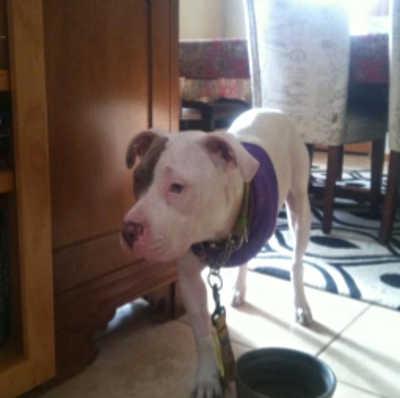
Animal cruelty charges have been filed against the previous owner, and the SPCA said it would provide an update as more information becomes available.
Others can share that wonderful feeling of saving a life, of being a hero to that animal, by helping support other animals that are in desperate need of care.
If you would like to help with the cost of medical treatment for Anna or for other injured pets at the shelter, please make a donation to the SPCA of Clear Lake's Fund For Injured Pets.
Contributions are tax-deductible and can be sent to Mary Jane Montana, 8025 Highway 29, Kelseyville, CA 95451, or can be called in to 707-279-1400.
The SPCA of Clear Lake is a nonprofit charitable corporation. It's supported by volunteers and staff striving to find homes for all of its needy dogs and cats. They're focused on educating owners about responsible pet care to try to prevent future Honeys in Lake County.
Laura Pierce is a volunteer with the SPCA of Clear Lake, headquartered in Kelseyville, Calif.

LAKE COUNTY, Calif. – The Lake County Sheriff's Office has identified the man killed Saturday night while riding his bicycle in Middletown.
William Terrence Mullen, 62, died in the crash, according to Lt. Steve Brooks.
Mullen was riding his bicycle southbound on Highway 29 south of Central Park Road shortly after 10 p.m. Nov. 22 when, according to witnesses, he veered into the northbound lane and was hit by a 1992 Chevrolet Blazer driven by Alma Cross, 62, of Clearlake, according to the California Highway Patrol.
The CHP said that Mullen, who was thrown from his bike by the impact of the crash, landed in Highway 29's southbound lane and was hit by a 2006 Volvo driven by Aria Mulvihill, 21, of Hidden Valley Lake. He died at the scene.
The CHP initially identified Mullen as a St. Helena resident. However, Brooks said Mullen, who had a Calistoga address, was a transient. Brooks said it's not clear how long he had been living in Lake County.
An autopsy was conducted on Mullen on Wednesday morning, Brooks said.
Brooks said that as part of the forensics examination, blood alcohol and toxicology testing is being completed.
He said it could take as long as six to eight weeks for those results to come back.
Email Elizabeth Larson at
LAKE COUNTY, Calif. – Recent rains and cooler temperatures across the region have lowered the threat of wildfires, allowing Cal Fire’s Sonoma-Lake-Napa Unit to transition out of another busy fire season.
Effective at 8 a.m. Monday, Dec. 1, fire season will end in Sonoma, Lake, Napa, Colusa, Yolo and Solano counties.
This year's fire season is ending a few weeks earlier than was the case in 2013. Last year, Cal Fire declared the end of the season on Dec. 16.
“The recent rainfall has been welcomed in the North Bay Area, yet the area still remains under serious drought conditions,” said Unit Chief Scott Upton.
Upton reminds homeowners that the winter months provide the best weather patterns for homeowners to create or maintain their defensible space around their homes.
One hundred feet of defensible space has proven to save homes during a wildland fire incident
and is a mandatory California State Law (Public Resource Code 4291).
With the transition out of fire season on Dec. 1, Cal Fire burn permits – for the State Responsibility Area – are not required until May 1, 2015.
However, burn permits are required throughout Lake County. Call Lake County Air Quality Management District at 707-263-7000 for more information.
As drought conditions continue to have a hold on California, Cal Fire is maintaining staffing that meets
the current threat, as well as strategically moving resources to areas that remain at a higher threat level.
Cal Fire reported that it also will continue to monitor weather conditions closely and still has the ability to increase staffing should the weather conditions change or if there is a need to support wildfires in other areas of the state.
The 2014 fire season has been an extremely active year. Statewide, Cal Fire and firefighters from many
local agencies battled more than 5,500 wildfires within the State Responsibility Area that burned nearly 91,000 acres. This number is more than 1,000 more wildfires this year than normal.
In the Sonoma-Lake-Napa Unit, Cal Fire responded to 346 wildfires that charred 11,327 acres, compared to 902 fires and 536 fires during the peak of the 2013 and 2012 seasons, respectively, according to historical data.
Cal Fire's Sonoma-Lake-Napa Unit urges residents within its six-county area to still take precautions outdoors in order to prevent sparking a wildfire.
A leading cause of wildfires this time of year is from escaped landscape debris burning, officials said.
Before you burn, ensure it’s a permissive burn day by contacting your local air quality district and then make sure you have any and all required burn permits.
During burning, make sure that piles of landscape debris are no larger than four feet in diameter, provide a 10-foot clearance down to bare mineral soil around the burn pile and that a responsible adult is in attendance at all times with a water source and a shovel.
For more ways to prevent sparking a wildfire visit www.ReadyForWildfire.org .
For addition fire prevention tips visit http://www.preventwildfireca.org/ .
LAKE COUNTY, Calif. – The National Weather Service's update forecast expects a rainy Thanksgiving night, with more precipitation likely through the weekend and into the coming week.
The agency on Tuesday issued a special weather statement for Lake County that's in effect through noon on Wednesday due to the expectation of rain and, in higher elevations, snow.
The forecast also predicts patchy fog after 10 p.m. Wednesday.
Forecasters reported that high pressure will keep conditions dry and mild through Thanksgiving day, with precipitation from the first of a series of storms expected to arrive late Friday. Heaviest rain and snow is expected late Sunday to Monday.
Around Lake County, the rain could come sooner.
While the day will be clear on Thanksgiving, that night there is a 30-percent chance of showers around the county, according to the specific forecast.
During the day on Friday, chances of precipitation around the county are expected to hold at 30 percent and increase to as much as 80 percent at night.
Rain also is likely from Saturday through Tuesday, according to the forecast.
Light winds also are in the forecast, with daytime temperatures ranging from the low 50s to mid 60s, with nighttime lows in the 40s.
Email Elizabeth Larson at
The California Highway Patrol's communications centers – which answer approximately seven million 911 calls per year – have been formally accredited by the Commission on Accreditation for Law Enforcement Agencies Inc. (CALEA) under the Public Safety Communications Agencies Accreditation Program.
“The CHP received this prestigious award after ensuring our policies and procedures meet or exceed standards set by law enforcement professionals from across the nation,” said CHP Commissioner Joe Farrow. “This accreditation demonstrates our commitment to public safety and means that CHP’s 911 call centers meet national standards of excellence.”
To meet accreditation standards, the CHP implemented a statewide quality assurance program for its 25 communications center.
Supervisors review audio tapes of 911 calls and analyze performance according to several performance measurements, including the dispatcher’s speech, prioritizing of information, and accuracy documenting calls.
Dispatchers receive constructive feedback and are given an opportunity for self-assessment.
By receiving accreditation for its communications centers, the CHP became one of the first two agencies in California to receive the CALEA TRI-ARC award, which recognizes concurrent accreditation for law enforcement, public safety communications, and public safety training activities.
The CHP was awarded initial accreditation in 2010 and was reaccredited in 2013, the same year the CHP Academy in West Sacramento was also accredited.
CALEA was established in 1979 as a law enforcement credentialing authority through the joint efforts of the International Association of Chiefs of Police, National Organization of Black Law Enforcement Executives, National Sheriffs’ Association, and the Police Executive Research Forum. To maintain accreditation, CHP must undergo a comprehensive assessment every three years.
For more information on accreditation process and the CALEA TRI-ARC Award visit www.calea.org .