 How to resolve AdBlock issue?
News
At any given moment, our sun emits a range of light waves far more expansive than what our eyes alone can see: from visible light to extreme ultraviolet to soft and hard X-rays.
Different wavelengths can have different effects at Earth and, what's more, when observed and analyzed correctly, those wavelengths can provide scientists with information about events on the sun.
In 2012 and 2013, a detector was launched on a sounding rocket for a 15 minute trip to look at a range of sunlight previously not well-observed: soft X-rays.
Each wavelength of light from the sun inherently carries information about the kind of process that emitted the light, so looking at soft X-rays provides a new way to figure out what is happening on our closest star.
For example, the sun's atmosphere, the corona, is 1,000 times hotter than its surface, and scientists do not yet understand the details of why.
The soft X-ray detector brought home data showing that a significant amount of soft X-rays – more than expected – were seen when there are even a small amount of magnetically complex sunspots.
Identifying what process within these magnetically active regions contributes to the great increase in soft X-rays could hold clues for what's helping to heat the corona.
A paper on these results appeared in the Astrophysical Journal Letters on March 18, 2015.
“Not only did we gather measurements that haven't been made routinely,” said Amir Caspi, first author on the paper and a solar scientist at Southwest Research Institute in Boulder, Colorado, who worked at the University of Colorado in Boulder during the course of this study. “The detector we used also allowed us to gather the best measurements so far made in this energy range.”
This soft X-ray detector hitched a ride into space on a NASA sounding rocket. During a 15 minute total flight, sounding rockets have about six minutes of time to gather data from space.
The soft X-ray detector and its related components are only about the size of a pack of cards, so it could easily fly on board a rocket carrying another experiment – in this case, one that helps calibrate the Extreme Ultraviolet Variability Experiment, or EVE, on NASA's Solar Dynamics Observatory.
Sounding rockets and combining missions on a single launch vehicle provide an opportunity to conduct world-class science with a lower price tag.
The soft X-ray detector flew first on June 23, 2012, and again on Oct. 21, 2013.
During both flights, there were only a few complex active regions on the sun's surface – indeed, very few during the 2012 flight.
Yet, in both flights the detector saw 1000 times more soft X-rays than had been seen by another experiment in 2009.
Even a slight extra amount of solar activity in the form of these active regions, led to substantially more output in the soft X-ray wavelengths.
Wavelengths of light correlate to particular temperatures of material on the sun, and this abundance of soft X-rays points to clouds of hot – 5 to 10 million degrees – gases above the active regions that wasn't present during the 2009 measurements when there were no active regions on the sun.
That kind of information makes it clear that different heating mechanisms occur on the quiet sun and active regions, opening the door to determining the differences.
One theory for the source of this mysterious heating is that numerous tiny explosions called nanoflares are constantly erupting on the sun. Nanoflares are too small to be seen by our telescopes, but powerfully energetic nonetheless.
The soft X-rays might well be a result of nanoflares, thus giving us a way of investigating them.
The new soft X-ray data differed from previous data studies in another respect as well. By parsing out the amounts of each individual wavelength of light gathered, the team could identify what elements were present in the corona.
Typically, the abundance of some of these atoms in the corona is greater than at the sun's surface. But not so in these recent observations.
The mix of material in the corona was more similar to the mix seen at the solar surface, suggesting that some material from the surface was somehow rising up higher into the atmosphere.
“The difference we see in the abundances of the elements compared to previous studies suggest there may be a link between the heating mechanism and the coronal composition,” said Caspi.
Untangling the elements present on the sun's surface and in its atmosphere during different events on the sun could offer another set of tools for interpreting what heats the corona.
Discovering that the soft X-ray emission was brighter than supposed has effects for understanding space weather events near Earth as well.
Different wavelengths of light from the sun penetrate to different layers of Earth's atmosphere, causing different effects.
“The solar soft X-rays are deposited lower in Earth's atmosphere than the sun's extreme ultraviolet radiation,” says Tom Woods, a co-author on the paper and the principal investigator for this experiment at the University of Colorado in Boulder. “The soft X-rays cause almost instantaneous changes in the ionosphere that can disturb radio communications and the accuracy of GPS navigation systems.”
Such changes in the ionosphere happen during large explosions on the sun called solar flares. As humans attempt to better understand – and predict – the sun's effects on the space through which our communication signals travel, it's crucial that we have accurate models to simulate what the sun is sending our way and when.
The soft X-ray results so far are based on what amounts to only 10 minutes worth of data. However, this early data clearly shows the value of observing the previously understudied soft X-ray emissions.
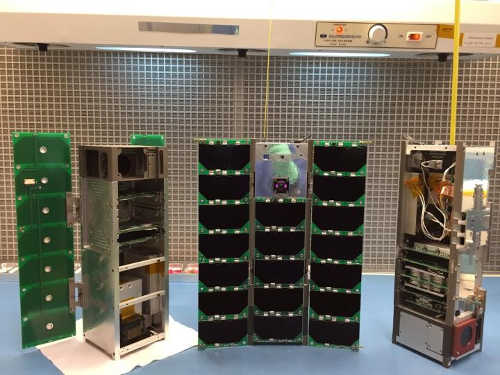
In the hopes of getting a longer data record – and of observing soft X-rays from solar flares – the team has been working to place the same kind of detector into the NASA-funded Miniature X-ray Solar Spectrometer, or MinXSS, CubeSat, currently scheduled to launch in late 2015.
About the size of a loaf of bread, the MinXSS is part of NASA's CubeSat program, which started in October 2013. CubeSats are small satellites that ride along with larger missions to take advantage of yet another low cost way to perform experiments in space.
MinXSS will provide 6-12 months of observations to advance our understanding of soft-X-ray emissions from the sun both from solar flares and during quiescent periods.
The soft X-ray detector used for this experiment was an Amptek X123-SDD.
For more on NASA's sounding rocket program visit http://www.nasa.gov/soundingrockets .
LAKE COUNTY, Calif. – Check out Lake County News' live stream of the lunar eclipse.
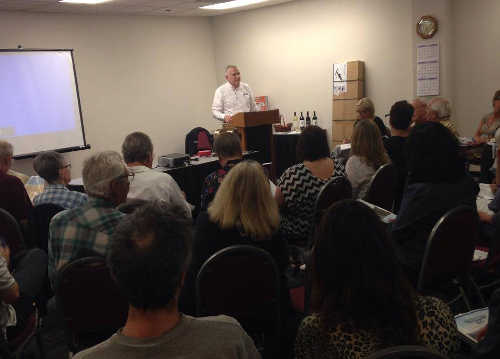
UKIAH, Calif. – Mendo Lake Credit Union (MLCU) reported on another year of growth and service to the community at its 56th annual meeting in Ukiah.
In addition, elections for the MLCU Board of Directors and supervisory committee were conducted at the March 26 session.
Highlights of MLCU’s accomplishments and services from 2014 were outlined by Robert Scott, chairman of the board of directors; Richard Cooper, president/chief executive officer; Carolyn Welch, supervisory committee chairperson; and Jamey Gill, marketing and community outreach director.
In welcoming attendees to the meeting, Scott said, “We represent you, the members of the credit union. Our volunteer leadership is one of the most significant differences between your member-owned credit union and other for-profit financial institutions.”
MLCU is governed by the nine-member board of directors and five members of the supervisory committee, representing “over 125 years of volunteer service to the MLCU membership,” stated Scott.
The credit union’s assets increased from $174 million to $188 million last year, Cooper reported. A record $51.6 million in new loans were granted to members in 2014, with $31.8 million sourced direct from local auto dealers.
“As a community development financial institution, providing access to low cost loans is one of our primary missions,” said Cooper, who added that the automobile loan numbers continued to make MLCU the number one source for auto loans in the Mendocino and Lake county area.
Among new services offered by MLCU in 2014 were a VISA credit card program, a renewed mortgage lending program, and a mobile banking platform called “SPRIG” that includes an option to deposit via smart phones.
Continuing its tradition of supporting the community, more than $80,000 was invested in local nonprofits and service organizations, said Cooper.
Among many other programs, the credit union administers the Arlene Colombini Scholarship for college financial aid, and staff conducts financial literacy programs aimed at all ages.
MLCU increased its membership by more than 4,000 in 2014, peaking at 26,193 members at the end of its 55th year. Additionally, Cooper noted, there was greater use of CoOp ATMs and shared branch facilities.
Among its notable achievements was the credit union’s selection as 2014 Stars of Lake County Large Business of the Year, an award sponsored by the Lake County Chamber of Commerce.
During the annual meeting, Gill presented a video entitled “Why Mendo Lake Credit Union?” featuring comments by members and staff talking about the things that make Mendo Lake Credit Union different from other financial institutions.
Gill was pleased to debut the video during the meeting and invites individuals to view the video on the MLCU Web site at www.mlcu.org .
Completing the business portion of the meeting, elections to the board of directors were conducted for three spots.
Carolyn Welch, Arlene Colombini and Madelin Holtkamp each were elected to serve a three-year term. Leslie Banta and Ginger Kite were elected to the MLCU Supervisory Committee.
Appetizers for the annual meeting were provided by Kerri Barnett of “Come to Your Senses Catering,” and door prizes were contributed by several member businesses including Grocery Outlet, Running Creek Casino, Studio Fit in Ukiah, Black Oak Coffee, and Lovers Lane Farms.
MLCU’s published Annual Report for 2014 acknowledges the work of its board of directors which includes: Scott, Vice Chairman Larry Myers, Treasurer/Secretary Colombini, and Directors John Burke, Karen Christopherson, Monte Hill, Holtkamp, Cameron Reeves, Dale Simpson, and Emeritus Director Jack Daniels.
Also recognized for their service are the members of MLCU’s supervisory committee for 2014: Chairperson Carolyn Welch and members Tami Bartolomei, Dave Goodman, Kite, and John Kuhry.
“I am extremely thankful for the members of our dedicated volunteer group for their commitment to our mission in the community,” said Cooper. “I would also like to express my personal appreciation for the 68 team members who serve our members and their myriad of service needs every day. Most importantly, my thanks go out to all of our 26,000-plus members for their continued trust and confidence. Your support allows MLCU to provide a viable local option for crucial financial services.
“We appreciate the opportunities that the last 55 years have brought us, and we look forward to serving our community for many years to come,” Cooper concluded.
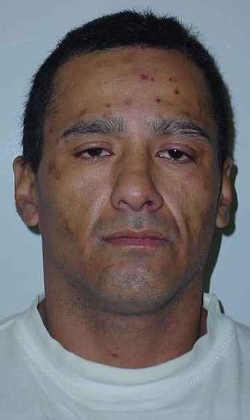
LAKEPORT, Calif. – A Hopland man who shot at two California Highway Patrol officers following an attempted vehicle stop in October 2013 is facing life in prison after being convicted of the officers' attempted murders and involuntary manslaughter for the death of a man who jumped from his vehicle.
A jury returned the verdict Friday afternoon in the trial of William Edward Steele, 41.
The jury found Steele guilty of 22 felony charges, including four counts of attempted murder, four counts of assault with a firearm, four counts of assault with a deadly weapon, two counts of discharging a firearm from a vehicle, being a felon in possession of a firearm and ammunition, violating a restraining order by possessing a gun, shooting at an inhabited car, reckless evading, evading a peace officer causing death or serious injury, and more than 30 special allegations relating primarily to firearm use as well as causing great bodily injury.
He was found not guilty of murder but convicted of involuntary manslaughter for the death of Jeremy John, and not guilty of the kidnapping of Gavina Delgadillo, but convicted of her unlawful imprisonment. The jury deadlocked on a charge of hit and run, which was dismissed.
Senior Deputy District Attorney Art Grothe prosecuted the case, with Fort Bragg attorney Patrick Pekin representing Steele.
At about 2:30 a.m. Oct. 19, 2013, CHP Officers Shane Roach and Glen Thomas pulled over Steele, who was driving a Chevy Tahoe, in the area of Highway 29 and Cruickshank Drive in Kelseyville because they were concerned he was driving under the influence.
According to the investigation, Steele panicked and pulled a .380-caliber semiautomatic handgun and shot at the officers before taking off.
In the area of Live Oak Drive, not far from the CHP headquarters, Steele pulled over, made a U-turn and shot at the officers again.
Riding with Steele at the time were John and Delgadillo. In an attempt to get away from Steele, authorities said John jumped from the SUV and hit his head on the pavement, never regaining consciousness and dying several days later at Santa Rosa Memorial Hospital.
Deputies took Steele into custody later that morning, finding him in the area of Wilkinson Road and Highway 29. He had ditched the SUV on Highway 29 and Sand Hill and attempted to flee on foot.
Steele, found to be exhibiting symptoms of chronic methamphetamine use, told investigators “somewhat elaborate alleged conspiracies of law enforcement officers involving ritualistic murders,” alleging that law enforcement officers previously had taken $16,000 from him and threatened his life, according to court records.
According to court records, Steele is a member of the Lytton Band of Pomo Indians of Healdsburg, which owns the San Pablo Lytton Casino. He received $480,000 in per capita payments from the casino in 2013, according to Grothe. Steele claimed to have had $30,000 on him at the time of his arrest, telling investigators he usually carried even more cash.
Grothe previously had dealt with Steele while a deputy district attorney in Mendocino County. In 1992, he successfully prosecuted Steele for assault with a deadly weapon.
In separate cases, Steele had felony convictions in Mendocino County in 2004 and 2005 for assault with a deadly weapon and battery with serious bodily injury, respectively, and in 2012 in Lake County was convicted of violating a domestic violence restraining order.
Those previous felony convictions played a part in this case, as Steele was charged for being a felon in possession of a firearm and ammunition.
Grothe said the trial began March 4, with the jury getting the case last week and deliberating a total of about two and a half days.
He explained that Steele was charged with four counts of attempted murder – twice for each officer at the two different shooting locations.
During the trial, the prosecution presented evidence about the handgun that Steele used, which was manufactured by Ohio-based Hi-Point Firearms.
Grothe said Hi-Point makes a unique marking on every firearm, the equivalent of creating on each weapon its own fingerprint.
When investigators found the brass from the bullets at the shooting scenes, they were handed over to the Department of Justice firearms expert who looked at them and easily identified them as coming from the Hi-Point handgun Steele had used.
“I'd never seen that before,” Grothe said of that particular firearm evidence.
Grothe said that when Steele is sentenced on May 18 he's facing four life sentences for the four attempted murder charges, plus the potential for substantially more time for the numerous other convictions.
However, Grothe said just how much time Steele will face at sentencing will be determined in part by the Probation Department sentencing recommendation which will be prepared in the case and considered by the judge.
Email Elizabeth Larson at
NORTHERN CALIFORNIA – I think turkey vultures are just plain awesome.
They get a bad rap – they’re haunting to look at and they have some truly gross habits – but they actually perform a much-needed service. They clear out the dead and reduce the spread of disease.
In some ways they rather remind me of images of “cool emo kids”… or even Uncle Fester in the “Addams Family” with their huge, hulking black bodies and bald heads.
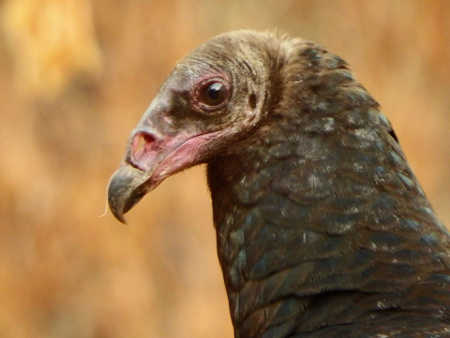
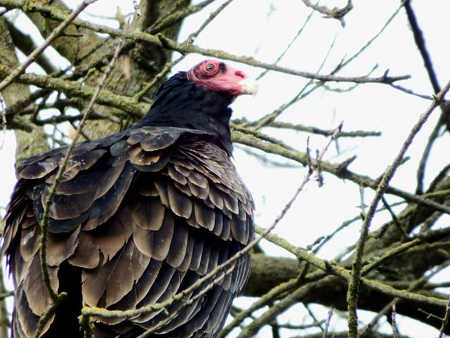
On a juvenile turkey vulture that bald head is black but turns red as the bird matures; and the head is naked for a reason.
The vulture feeds by sticking its face into the carcasses of dead animals. If the head was feathered, it would regularly be matted with gore and festering with bacteria – which wouldn’t make for a very healthy vulture.
The featherless head is easy to clean up after feeding. Turkey vultures also have an extraordinary immune system which allows them to eat prey infected with salmonella or cholera without becoming infected. They’re even believed to have some immunity to anthrax!
Turkey vultures seek out their meals by scent, not by sight. When you see them circling over something (in a winding formation known as a “kettle”) they’re zeroing in on the smell of blood and the ethyl mercaptan gas that’s produced by decaying bodies.
In fact, the part of the brain that houses the olfactory sense is actually larger and more developed in turkey vultures than in any other type of bird.
You’ll note, too, that there is no solid septum between the turkey’s vulture’s nostrils; you can see right through its ivory-colored beak. This “perforated” structure enhances the turkey vulture’s sense of smell. Old world vultures like the Indian white backed vulture don’t have that perforation.
Another difference between our new world turkey vultures and the old world vultures is that their DNA suggests they are more closely related to ancient storks than to ancient hawks like their old world counterparts.
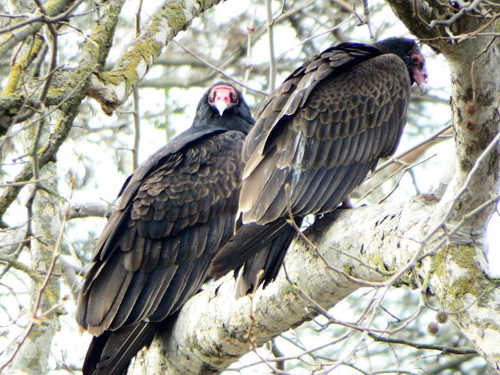
Because their feet aren’t particularly powerful or made with razor-sharp talons like hawks, turkey vultures are the only scavengers that don’t generally kill their own prey. Instead, they seek out prey that is already dead or dying.
But even vultures have their limits. They seldom eat anything that has completely putrefied. Once it’s found a meal that looks interesting, the turkey vulture will seek out the tenderest bits first, usually through some natural opening in the carcass, slicing in with a sharp beak that it can wield with the precision of a surgeon.
Some reports state that turkey vultures can deftly remove the scent glands from skunks without getting “bombed.”
Their digestive system is really remarkable. When they upchuck pellets or defecate, the droppings are actually bacteria-free! And that’s a good thing for the vultures … because they have the habit of defecating on their legs and feet in the hot summer months to help cool themselves off. There’s actually a scientific word for that: “urohydrosis.” Another yucky habit of the vultures: they sometimes vomit on intruders.
But not everything about the vulture is gross or creepy: their stances and courtship rituals are actually quite interesting.
To warm themselves up in the early morning hours, they often stand with their wings outstretched and their backs facing the sun.
If you see the vultures gathered on the ground in a circle and hopping around, you’re most likely witnessing a courtship ritual.
The breeding season for these birds starts in March and goes through June, so we’re right in the middle of it now.
These vultures don’t have voice boxes, so the only sounds you’ll hear them make are hisses or breathy grunts.
Turkey vultures are the most common and abundant vulture in the country, so they’re easy to find. The next time you come across some of them, help us celebrate these awesome birds by taking a few photos and sending them off to Tuleyome to post to our Facebook page.
Tuleyome Tales is a monthly publication of Tuleyome, a conservation organization based in Woodland, Calif., http://www.tuleyome.org/ . Mary K. Hanson is an amateur naturalist and photographer who is the author of “The Chubby Woman’s Walkabout” blog.
To save lives and educate all motorists within California, especially young drivers, about the dangers of distracted driving, the California Office of Traffic Safety (OTS), California Highway Patrol (CHP), Impact Teen Drivers, and more than 200 law enforcement agencies statewide are teaming up this month.
They will increase education and enforcement efforts for National Distracted Driving Awareness Month in April and California Teen Safe Driving Week, the first week of April.
“Driving is a complex task, requiring a motorist’s full attention,” CHP Commissioner Joe Farrow said. “Imagine driving for four or five seconds while blindfolded. That can be the effect of looking down while driving to send a text message. In the average time it takes to send a text message – less than five seconds – a car traveling 60 miles per hour will travel the length of a football field.”
Collisions caused by distraction occur daily throughout California. In 2013, there were 50 people killed and nearly 4,000 people injured as a result of driver distraction.
Throughout April, officers in each of the CHP’s eight field Divisions will focus their efforts on educating the public about the dangers of distracted driving through local media interviews, visits to schools, and traffic safety presentations.
In addition, two dates – April 1 and 15 – have been earmarked as special statewide education and enforcement days for all law enforcement agencies that are participating in the traffic safety campaign.
The urge to read and answer a text message when hearing the text notification can be enticing. The OTS has adopted the message of “Silence the Distraction” in new public service announcements aimed at getting drivers to turn off cellular telephones while driving so they will not be tempted.
In addition, an outreach event featuring texting cartoon “emojis” will be touring community colleges throughout the state to engage the most vulnerable texters – 18- to 30-year-olds.
“No text, call, or social media update is worth a crash,” said OTS Director Rhonda Craft. “With an average of less than a second to react to an urgent situation on the roadway, drivers need to have all their attention on the road.”
While distracted driving can take many forms and affects all road users, younger drivers pose a greater risk.
During California Teen Safe Driving Week, April 1-7, Impact Teen Drivers is focusing on educating teens that the number one killer of teens – reckless and distracted driving – is 100 percent preventable.
“People are realizing everyday behaviors, such as texting or reaching for a dropped item, can be lethal when done behind the wheel,” Kelly Browning, Ph.D., executive director of Impact Teen Drivers, said. “The next step is more complicated – getting people to choose to change their behavior.”
Safe driving is the responsibility of all motorists. Parents, as role models, are in the ideal position to demonstrate good behavior to their children operating a motor vehicle.
“All of us who drive are responsible for keeping the roads safe. If you have teenagers in your family who are driving, make sure they understand the laws and what their responsibilities are as well,” Commissioner Farrow added. “The collective goal with this month-long campaign is to change the behavior of all drivers to eliminate distractions behind the wheel. That change begins with education.”