 How to resolve AdBlock issue?
News
HIDDEN VALLEY LAKE, Calif. – The search for a local man who disappeared while fishing in Hidden Valley Lake on Tuesday is set to resume on Thursday morning.
Authorities have so far not released the name of the 42-year-old Hidden Valley Lake man, who went missing at about 8 a.m. Tuesday.
His overturned kayak was found anchored to the bottom of the reservoir, according to sheriff's Sgt. Don McPherson.
Lake County Sheriff's Search and Rescue and Marine Patrol, assisted by the Santa Clara County Sheriff's Office and the Northshore Dive Team, searched the lake's northeast end on Wednesday using side-scan sonar.
McPherson said that the search for the man will continue Thursday morning.
He said a cadaver dog is being brought in to begin a search in the morning. To aid the dog’s effectiveness, the dog will ride the lake's waters in a California Department of Fish and Wildlife low-profile boat.
The search, McPherson added, will be in a high-probability area of the lake.
John Lindblom contributed to this report.
Email Elizabeth Larson at
Following the lowest snowpack ever recorded and with no end to the drought in sight, Governor Edmund G. Brown Jr. on Wednesday announced actions that will save water, increase enforcement to prevent wasteful water use, streamline the state's drought response and invest in new technologies that will make California more drought resilient.
“Today we are standing on dry grass where there should be five feet of snow. This historic drought demands unprecedented action,” said Gov. Brown. “Therefore, I’m issuing an executive order mandating substantial water reductions across our state. As Californians, we must pull together and save water in every way possible.”
For more than two years, the state’s experts have been managing water resources to ensure that the state survives this drought and is better prepared for the next one.
Last year, the governor proclaimed a drought state of emergency. The state has taken steps to make sure that water is available for human health and safety, growing food, fighting fires and protecting fish and wildlife.
Millions have been spent helping thousands of California families most impacted by the drought pay their bills, put food on their tables and have water to drink.
The following is a summary of the executive order issued by the governor on Wednesday.
Save water
For the first time in state history, the governor has directed the State Water Resources Control Board to implement mandatory water reductions in cities and towns across California to reduce water usage by 25 percent.
This savings amounts to approximately 1.5 million acre-feet of water over the next nine months, or nearly as much as is currently in Lake Oroville.
To save more water now, the order also will:
– Replace 50 million square feet of lawns throughout the state with drought tolerant landscaping in partnership with local governments;
– Direct the creation of a temporary, statewide consumer rebate program to replace old appliances with more water and energy efficient models;
– Require campuses, golf courses, cemeteries and other large landscapes to make significant cuts in water use; and
– Prohibit new homes and developments from irrigating with potable water unless water-efficient drip irrigation systems are used, and ban watering of ornamental grass on public street medians.
Increase enforcement
The governor’s order calls on local water agencies to adjust their rate structures to implement conservation pricing, recognized as an effective way to realize water reductions and discourage water waste.
Agricultural water users – which have borne much of the brunt of the drought to date, with hundreds of thousands of fallowed acres, significantly reduced water allocations and thousands of farm workers laid off – will be required to report more water use information to state regulators, increasing the state's ability to enforce against illegal diversions and waste and unreasonable use of water under Wednesday’s order.
Additionally, the governor’s action strengthens standards for Agricultural Water Management Plans submitted by large agriculture water districts and requires small agriculture water districts to develop similar plans.
These plans will help ensure that agricultural communities are prepared in case the drought extends into 2016.
Additional actions required by the order include:
– Taking action against water agencies in depleted groundwater basins that have not shared data on their groundwater supplies with the state;
– Updating standards for toilets and faucets and outdoor landscaping in residential communities and taking action against communities that ignore these standards; and
– Making permanent monthly reporting of water usage, conservation and enforcement actions by local water suppliers.
Streamline government response
The order:
– Prioritizes state review and decision-making of water infrastructure projects and requires state agencies to report to the Governor’s Office on any application pending for more than 90 days.
– Streamlines permitting and review of emergency drought salinity barriers – necessary to keep freshwater supplies in upstream reservoirs for human use and habitat protection for endangered and threatened species;
– Simplifies the review and approval process for voluntary water transfers and emergency drinking water projects; and
– Directs state departments to provide temporary relocation assistance to families who need to move from homes where domestic wells have run dry to housing with running water.
Invest in new technologies
The order helps make California more drought resilient by:
– Incentivizing promising new technology that will make California more water efficient through a new program administered by the California Energy Commission.
The full text of the executive order can be seen below.
During California Teen Safe Driving Week – April 1 through 7 – the California Highway Patrol, California Office of Traffic Safety and Impact Teen Drivers will continue to emphasize the most deadly impact to teen drivers – reckless and distracted driving.
Moreover, teens will learn that their number one killer is 100-percent preventable, if drivers and passengers make good decisions.
“People are starting to understand that everyday behaviors, such as texting, eating, applying makeup, or reaching for something, can be lethal when done behind the wheel,” said Dr. Kelly Browning, executive director of Impact Teen Drivers. “In a recent study, over 98 percent of people reported that texting behind the wheel is dangerous, but 75 percent still report doing it. The propensity for people to rationalize distracted driving behavior – the ‘not me’ mentality – is a big part of the problem.”
“One of the most difficult tasks for any officer is notifying parents that their teenager was killed in a traffic collision, and it is even worse when the crash was totally preventable,” CHP Commissioner Joe Farrow said. “Young drivers may not realize the magnitude of the aftermath of a fatal collision, and the emotional toll it takes. It is up to all of us – family, friends, experienced drivers – to set the right example, avoid distractions behind the wheel, and focus on our own driving.”
Research clearly shows that it is the cognitive distraction, not the manual distraction that presents the greatest risk behind the wheel.
“We overestimate our abilities to multitask behind the wheel – the reality is our brain is not set up to do multiple tasks at once and do them well,” said Debbie Hersman, president and chief executive officer of the National Safety Council. “A moment of distraction behind the wheel – even one time – can have devastating consequences.”
Impact Teen Drivers uses a multifaceted approach to educate teens and communities about the dangers of reckless and distracted driving.
Through the What Do You Consider Lethal? program, teens are engaged and empowered to make good decisions behind the wheel and spread the safe driving message to their peers.
In parent-teen workshops, parents are taught that they are the primary influencer of their teen’s driving attitudes and behaviors – and that “Do as I say, not as I do” doesn’t work.
During California Teen Safe Driving Week, law enforcement agencies emphasize the need for a strong combination of education and enforcement to change driving attitudes and behaviors.
They also stress that distracted driving injuries and fatalities are 100-percent preventable.
“We need to make distracted driving socially unacceptable, like driving under the influence of alcohol,” said Rhonda Craft, director of the California Office of Traffic Safety. “By combining education and enforcement to prevent distracted driving, we will make the roads safer for everyone.”
California Teen Safe Driving Week marks the beginning of National Distracted Driving Awareness Month.
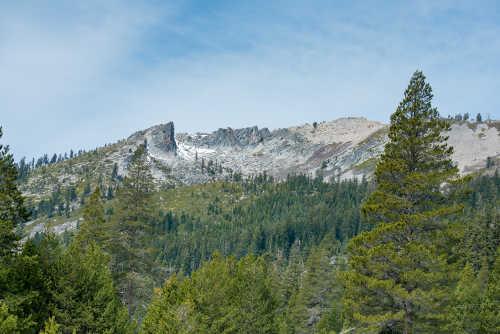
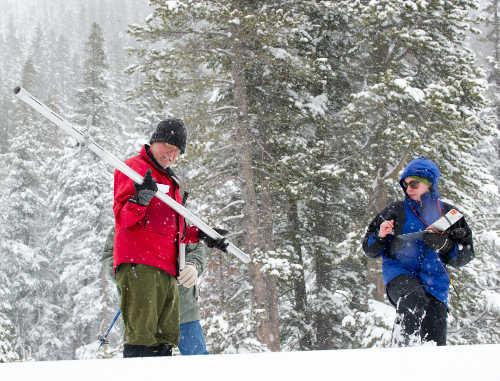
NORTHERN CALIFORNIA – The California Department of Water Resources found no snow whatsoever on Wednesday during its manual survey for the media at 6,800 feet in the Sierra Nevada.
This was the first time in 75 years of early-April measurements at the Phillips snow course that no snow was found there.
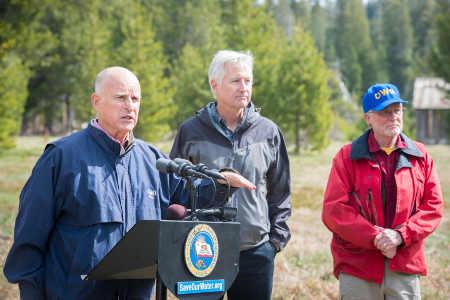
Gov. Jerry Brown observed the survey, which confirmed electronic readings showing the statewide snowpack with less water content on Wednesday than any April 1 since 1950.
Attending the survey with Gov. Brown was DWR Director Mark Cowin, who said Californians can expect to receive almost no water from the meager snowpack as it melts in the coming weeks.
“Today’s survey underscores the severity of California’s drought,” he said. “Water conservation must become a way of life during the worst drought in most Californians’ lifetimes.”
Wednesday’s readings are historically significant, since the snowpack traditionally is at its peak by early April before it begins to melt.
Electronic readings on Wednesday found that the statewide snowpack holds only 1.4 inches of water content, just 5 percent of the historical average of 28.3 inches for April 1. The previous low for the date was 25 percent in 2014 and 1977.
The Phillips snow course, which has been surveyed since 1941, has averaged 66.5 inches in early-April measurements there.
Four years ago Wednesday, the measured depth at Phillips was 124.4 inches. The deepest April 1 Phillips measurement was 150.7 inches in 1983, and the lowest previously was 1.04 inches in 1988.
Electronic readings indicate the water content of the northern Sierra snowpack on Wednesday was 1.4 inches, 5 percent of average for the date. The central and southern Sierra readings were 1.5 inches (5 percent of average) and 1.3 inches (5 percent) respectively.
Wednesday's manual survey was the fourth of the season conducted for the news media at the Phillips snow course just off Highway 50 near Sierra at Tahoe Road 90 miles east of Sacramento.
When DWR conducted the first three manual surveys on December 30, January 29 and March 3, the statewide water content in the snowpack was 50 percent, 25 percent and 19 percent, respectively, of the historical averages for those dates.
The decline reflects California’s significantly lower precipitation and the warming trend that made this winter the warmest in the state’s recorded history. What precipitation there was fell mostly as rain due to warmer temperatures.
In what were considered normal precipitation years, the snowpack supplied about 30 percent of California’s water needs as it melts in the spring and summer. The greater the snowpack water content, the greater the likelihood California’s reservoirs will receive ample runoff as the snowpack melts to meet the state’s water demand in the summer and fall.
Little precipitation has fallen in Northern California since early February.
The eight weather stations there that have been monitored for generations have recorded 31.7 inches since the beginning of Water Year 2015 on October 1. That is 76 percent of the historical average for April 1.
Further south, the five-station San Joaquin index has recorded 13.7 inches, 41 percent of normal for today’s date, and the six-station index in the Tulare Basin is similarly far below normal – 10.3 inches, or 42 percent of the April 1 average there.
California’s historically wettest winter months have already passed, and the drought is now firmly rooted in its fourth consecutive year.
The major water supply reservoirs are storing more water this year than last but are still far below the historical average for early March.
Lake Oroville in Butte County, the State Water Project’s principal reservoir, now holds 51 percent of its 3.5 million acre-foot capacity (67 percent of its historical average for the date).
Shasta Lake north of Redding and the federal Central Valley Project’s largest reservoir, is at 59 percent of its 4.5 million acre-foot capacity (73 percent of its historic average).
San Luis Reservoir, which serves both the SWP and CVP, holds much more water than it did one year ago due to recent water deliveries to the reservoir as a component of the agencies’ drought management strategy.
San Luis holds 66 percent of its 2 million acre-foot capacity (73 percent of normal for the date).
HIDDEN VALLEY LAKE, Calif. – On Wednesday morning search teams continued efforts to locate a Hidden Valley Lake man reported missing on the community's lake the previous day.
Lake County Sheriff's Search and Rescue and Sheriff's Marine Patrol were on scene early in the morning to search the lake's northeast end for the man.
Det. Kellie Joseph, who serves as Search and Rescue coordinator, said the 42-year-old man – whose name has not been released – disappeared at approximately 8 a.m. Tuesday while he was fishing.
She said the disappearance initially was reported to Hidden Valley Lake Security Services, which contacted the sheriff's office at 3 p.m. Tuesday.
Joseph said Cal Fire initially came out to help search on Tuesday, with Marine Patrol following up. The search was curtailed at 8 p.m. Tuesday, with personnel returning to the scene at around 7 a.m. Wednesday.
Sheriff's Sgt. Don McPherson said searchers found the fisherman's overturned kayak anchored to the bottom of the lake not far from where he had been fishing.
McPherson said they didn't know if the kayak – which held the man's fishing equipment – had tipped over and the anchor fell out, or if he had been anchored when the kayak tipped over.
Along with McPherson's Marine Patrol boat, the search has been joined by two boats from the Santa Clara County Sheriff’s Office, which brought sophisticated side scan sonar system to assist with the search, McPherson said.
In addition to Santa Clara's team – all of whom are divers – McPherson said the Northshore Fire Dive Team was on scene.
As of shortly after 11 a.m., McPherson said the search was using the side scan sonar, but noted that the divers were prepared to go into the water when needed.
In a post on its Facebook page, the Hidden Valley Lake Association asked that boaters remain off the lake while the search is active.
Elizabeth Larson contributed to this story.
Email John Lindblom at
HIDDEN VALLEY LAKE, Calif. – Rescue teams spent Tuesday evening searching for a missing fisherman in Hidden Valley Lake.
The Hidden Valley Lake Association issued a brief notice on its Facebook page about the situation late Tuesday night.
The association said the search was to continue on Wednesday morning at first light.
Members of Hidden Valley Lake Security Services and the Lake County Sheriff's Office Search and Rescue teams are taking part in the search, according to the association.
“Residents/boaters are requested to remain off the lake while the search is active,” the association said.
Additional details will be posted as they become available.