How to resolve AdBlock issue?
News
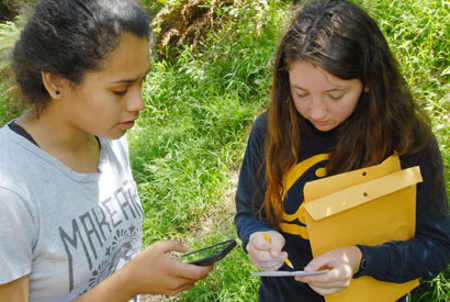
NORTHERN CALIFORNIA – Efforts to predict the emergence and spread of sudden oak death, an infectious tree-killing disease, have gotten a big boost from the work of grassroots volunteers.
A joint study reveals the power of citizen science in SOD Blitz, a survey project in which volunteers are trained to identify symptoms of sudden oak death.
Led by Matteo Garbelotto at the University of California, Berkeley, and Ross Meentemeyer at North Carolina State University, the study was published Friday in the journal Frontiers in Ecology and the Environment.
Sudden oak death is a fungus-like disease that has felled hundreds of thousands of trees in California.
Crowdsourcing the survey and sampling work allowed researchers to gather information that would otherwise be too impractical and cost-prohibitive to obtain.
Researchers then used the data to create a model that predicts the presence of the sudden oak death pathogen, Phytophthora ramorum, based upon such variables as rainfall and density of host trees.
Study authors compared the model based upon crowdsourced data gathered from the 2008-2013 blitzes with models using “pre-Blitz” research observations collected from 2000 to 2007.
They found the SOD Blitz model to be more powerful, correctly predicting the presence of the pathogen 74 percent of the time, compared with models based on other sources of data.
“This paper shows that volunteers are as proficient as professionals in collecting data after they get some initial training,” said study principal investigator Garbelotto, an adjunct professor and cooperative extension specialist at UC Berkeley's Department of Environmental Science, Policy and Management.
“The data we got from SOD Blitz resulted in the formulation of the best predictive model yet about the spread of sudden oak death in California,” Garbelotto said. “Additionally, we were able to identify new infestations and identify trees that needed to be removed. In one case, in Atherton, tree removal resulted in the only successful eradication of the pathogen in North America.”
The SOD Blitz model also revealed novel findings about the spread of the disease, finding that average population density and average maximum temperature were negatively correlated with the presence of the sudden oak death pathogen.
“The population density finding is important because of the debate about the role of humans in spreading sudden oak death disease,” said Garbelotto. “From this work we can say that humans are not currently spreading the disease, and that the pathogen is doing well spreading on its own.”
Beginning the Blitz
Jean Morrell, a retired biologist living on the Santa Lucia Preserve in Monterey County, learned about sudden oak death in 2007 through an on-site presentation and subsequent hike with Garbelotto organized for the homeowners on the preserve.
The event provided the seeds for the idea of the SOD Blitz as a way to get more people – particularly her fellow homeowners on the preserve – engaged.
For Morrell, the idea kicked off a round of phone calls and personal outreach to her neighbors.
Garbelotto launched SOD Blitz the next year, in 2008, and it has since grown into one of the largest citizen science projects in the country, incorporating 21 coastal communities in California.
Each spring researchers reach out to participants through news stories, radio announcements, community groups and other recruitment methods.
Participants go through mandatory, on-the-ground training by professionals to learn how to detect and sample infected trees.
Training workshops last about an hour, and then volunteers are provided with symptom detection guides, a mobile mapping tool and packets for storing leaf samples.
“When it comes to predictive models, the more data the better,” said study lead author Meentemeyer, a professor of forestry and environmental resources and director of the Center for Geospatial Analytics at North Carolina State University. “This is especially true in less-studied urban ecosystems and people's backyards, where research scientists typically have little to no data. But the data need to be good, otherwise researchers are left dealing with a lot of noise. Motivated people, given a minimal amount of training, are clearly able to provide information that researchers need.”
'People want to protect their trees'
In any one year, the return rate of participants ranges from 15 percent to as high as 40 percent, Garbelotto noted.
“From that first Blitz, we developed a core group of workers that have continued their interest and have followed up year to year,” said Morrell. “Sudden oak death is in all of our backyards, and it will have an effect on our neighborhoods. This is why we can engage people in the program. It not only allows a participant to monitor their own space, but also, if they so desire, they can tromp out into the woods and do work in more remote areas. One only has to give up some 'sweat equity' to participate, and the results are available to everyone at no cost. It’s a win- win.”
Many participants are attracted to SOD Blitz by a shared love of the environment.
“I am an environmentalist, and my passion is trees. I believe they are the lungs of the Earth,” said Debbie Mendelson, who recruits SOD Blitz volunteers as a member of the Woodside Sustainability and Conservation Committee. “I think first and foremost, people want to protect their trees. Then there are folks who want to do something for the good of their community.”
Mendelson noted that SOD Blitz has also provided an opportunity to engage students in science. She has given presentations at local high schools about sudden oak death and citizen science.
“I think it is a fantastic opportunity for students who have an interest in science to hear a scientist speak in an understandable and warm manner,” she said.
This year's SOD Blitz recruitment has already begun. Community meetings will be held at various locations through early June for those interested in learning more.
Once verified, data from SOD Blitz is uploaded and freely available online.
The National Science Foundation, U.S. Forest Service, Gordon and Betty Moore Foundation and PG&E Foundation helped support this work.
Sarah Yang writes for the UC Berkeley News Center.
According to projections detailed in plans released by Caltrans, the agency will need approximately $80 billion over the next 10 years to address current and future needs of the state highway system – a projected funding shortfall of nearly $60 billion with available revenue.
The 2015 Ten-Year State Highway Operation and Protection Program (SHOPP) Plan outlines a strategy for improving roads, addressing major rehabilitation work on the state highway system and supporting Caltrans’ sustainability goal through projects that bring long-lasting and smart mobility improvements.
The plan identifies approximately $8 billion annually needed to fund these necessary improvements and preventative maintenance activities over the next ten years.
However, in light of a shortfall of approximately $5.7 billion per year in funding, the plan warns that the state highway system will deteriorate and necessitate much more expensive remedies in the future.
“This funding shortfall presents a serious challenge to Caltrans and this state’s transportation system,” said Caltrans Director Malcolm Dougherty. “At Caltrans, we have a 'fix it first' mentality, putting transportation dollars where they can be most cost-effective: on preventative maintenance to our existing infrastructure. Our maintenance dollars can only go so far, however, and California is facing much more expensive repairs to its infrastructure in the future due to a growing backlog of necessary repairs.”
Excise taxes on gasoline and diesel fuel are the primary revenue source for Caltrans, funding the maintenance and operation of the state highway system as well as the administration of the department.
These revenues are declining as a result of reduced fuel consumption due to more energy-efficient vehicles and increased alternative fuel use.
California is currently evaluating funding alternatives which may include increasing the gas tax or registration fees, or switching to a mileage-based fee structure.
The State Highway Operation and Protection Program primarily funds rehabilitation projects and capital improvements along the state highway system that do not add capacity to the system.
Projects largely involve pavement and structure/bridge rehabilitation, but also encompass safety and some types of mobility improvements as well as emergency repair.
The SHOPP is based on a 10-year plan that identifies performance goal-based needs over a 10-year period, with the plan updated every two years.
Caltrans’ Maintenance Program also preserves California’s transportation infrastructure through preventative maintenance and repair of the state highway system.
Proper maintenance, as detailed in the 2015 Five-Year Maintenance Plan, can reduce the amount of the more expensive rehabilitation work done by the SHOPP.
Caltrans constructs, operates and maintains more than 50,000 lane miles of the State Highway System, the core of California’s complex, multi-modal transportation system.
This includes more than 13,000 bridges and structures, 30,000 acres of roadside landscaping, 205,000 culverts and drainage facilities and 87 roadside rest areas.
The department’s transportation infrastructure also includes maintenance stations, equipment shops, traffic management centers, transportation materials laboratories and testing facilities and office buildings.
Much of this system is over half a century old, built in the 1950s through early 1970s, to serve California’s growing population and expanding economy.
The 2015 Ten-Year SHOPP Plan can be accessed at http://www.dot.ca.gov/docs/2015_Ten-Year_SHOPP.pdf and the 2015 Five-Year Maintenance Plan at http://www.dot.ca.gov/docs/2015_Five-Year_Maintenance_Plan.pdf .
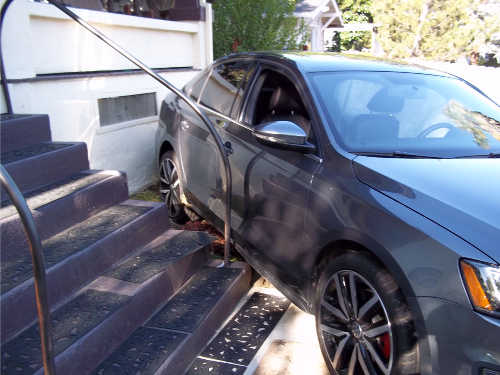
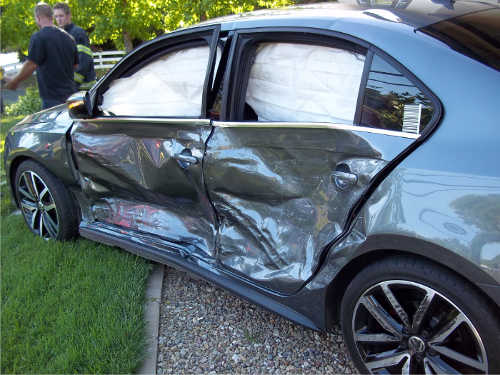
LAKEPORT, Calif. – Lakeport Police officers took a Hidden Valley Lake man into custody Saturday evening on suspicion of driving under the influence following a two-vehicle crash.
Scott Thomas Imrie, 39, was arrested following the crash, which occurred at around 5:30 p.m. Saturday, according to Lakeport Police Sgt. Michael Sobieraj.
Sobieraj said officers were dispatched to 11th Street at the intersection of North Brush Street for a two-vehicle collision with unknown injuries.
When officers arrived they found that both drivers had extricated themselves from their vehicles, he said.
Imrie, who Sobieraj said was driving a 2014 Volkswagen Jetta, was stopped at the stop sign of North Brush and 11th streets.
Sobieraj said Imrie had pulled out in front of a Dodge Durango driven by Lakeport resident Doreen McGuire-Grigg, who was traveling east on 11th Street at the posted speed limit.
McGuire-Grigg did not have time to brake or avoid Imrie and hit Imrie’s vehicle on the driver’s side. The impact sent Imrie’s vehicle across the eastbound Lane of 11th Street and up onto the property of 370 11th St., coming to rest against the front porch of the residence, Sobieraj said.
Lakeport Fire Protection District medics arrived and evaluated both Imrie and McGuire-Grigg, who Sobieraj said complained of minor injuries.
Sobieraj said the officers determined through their investigation that Imrie was impaired and driving under the influence of alcohol, with initial blood alcohol tests showing he was more than two times the legal limit of 0.08 percent.
Imrie also was found to be on active California Department of Corrections and Rehabilitation parole out of Lake County, Sobieraj said.
The collision investigation found that Imrie was at fault. Sobieraj said Imrie was arrested and booked on felony charges of driving under the influence of alcohol and driving with a blood alcohol level greater than 0.08 percent causing injury, as well as a parole violation.
Imrie is being held at the Lake County Jail on a no bail hold, according to his booking sheet.
During the investigation and traffic control, another minor traffic collision occurred in the same area, with minor vehicle damage only. Sobieraj said both drivers exchanged information with the help of the California Highway Patrol and were released.
The Lakeport Police Department reminded drivers that driving under the influence is strictly enforced with zero tolerance.
In addition, the agency urged drivers to be alert – especially in construction zones and collision sites – and always follow the directions of traffic control devices and emergency responders.
The Lakeport Police Department thanked the California Highway Patrol and the Lake County Sheriff’s Office for their help with traffic control during the incident.
Editor’s note: The original report stated that the crash occurred at around 7:30 p.m., with police later correcting that to 5:30 p.m.
LAKE COUNTY, Calif. – There is a shelter full of dogs this week waiting to join families and have new human moms of their own.
Dogs up for adoption this week include mixes of Australian Shepherd, boxer, Chihuahua, flat-coated retriever, Jack Russell terrier, McNab, pit bull and Schipperke.
Dogs that are adopted from Lake County Animal Care and Control are either neutered or spayed, microchipped and, if old enough, given a rabies shot and county license before being released to their new owner. License fees do not apply to residents of the cities of Lakeport or Clearlake.
If you're looking for a new companion, visit the shelter. There are many great pets hoping you'll choose them.
In addition to the animals featured here, all adoptable animals in Lake County can be seen here: http://bit.ly/Z6xHMb .
The following dogs at the Lake County Animal Care and Control shelter have been cleared for adoption (additional dogs on the animal control Web site not listed are still “on hold”).
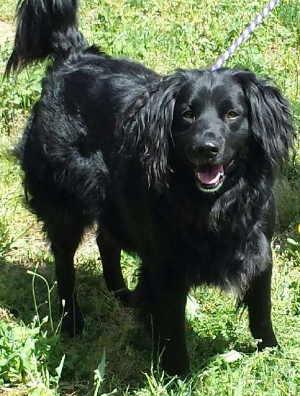
'Butch'
“Butch” is a male flat-coated retriever mix.
Shelter staff said he is heartworm-positive so he will need treatment.
They said he is a great dog, and is good with female dogs large and small, as he lived with a small female. He does not do well with dominant males, but submissive males are OK.
Butch is in kennel No. 16, ID No. 2113.
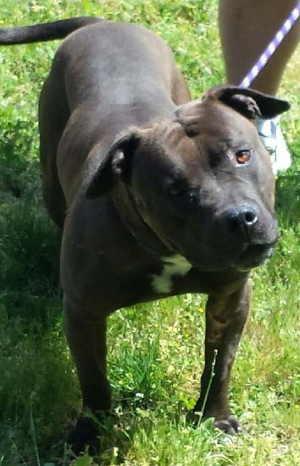
Male pit bull mix
This male pit bull mix has a short dark brown and white coat.
Shelter staff said he is pretty well behaved with a moderate to low energy level.
They said he has been through a lot he appears to have been dumped in the middle of nowhere; when he arrived he was full of punctures all on his legs, possibly from a dog fight.
Despite all of that, shelter staff said he is very social and friendly with dogs.
He's in kennel No. 15, ID No. 2094.
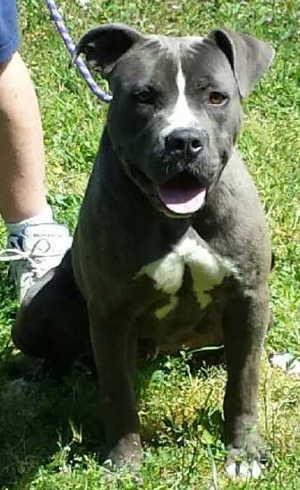
Male pit bull terrier mix
This male pit bull terrier mix has a short gray and white coat.
Shelter staff calls him a “big squishy guy” who is very gentle. They believe he would be fine with children.
He has no food aggression, gets along with other dogs both male and female, and is very appropriate in every way.
The shelter is looking for that special "pitty" lover to take him home and care for him.
He's in kennel No. 13, ID No. 2035.
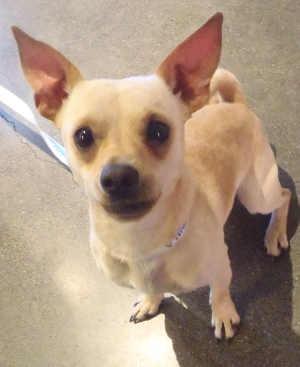
Male Chihuahua mix
This male Chihuahua mix has a short buff-colored coat.
He's in kennel No. 9, ID No. 2064.
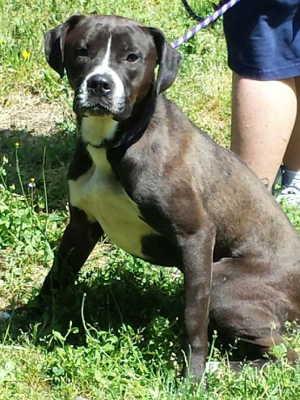
Boxer-McNab mix
This male Boxer-McNab mix has a dark brown and whit coat.
He's in kennel No. 6, ID No. 2129.
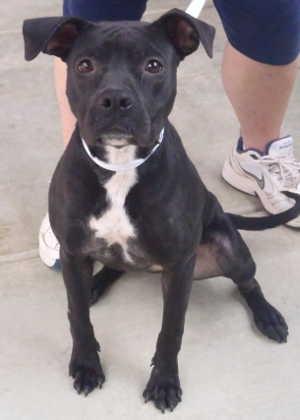
'Molly'
“Molly” is a boxer-pit bull mix with a short black coat with white markings.
Shelter staff said she's a very mellow, sweet dog, and is good with other dogs.
They said she should fit well in most household situations with children age 3 and above. She needs a very secure yard.
She's in kennel No. 4, ID No. 559.
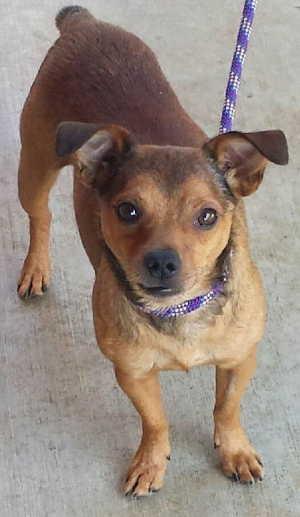
'Barney'
“Barney” is a Jack Russell Terrier-Chihuahua mix.
He has a short brown and tan coat.
He's in kennel No. 3, ID No. 2051.
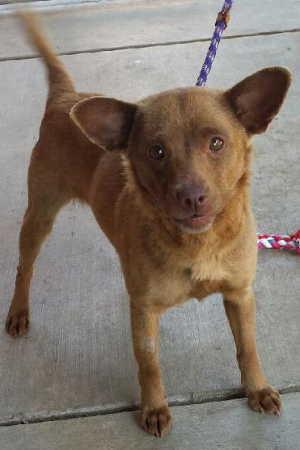
'Pokey'
“Pokey” is a terrier-Schipperke mix.
Shelter staff said Pokey is very social and friendly, and has a great personality. He loves to play with toys and is great with other dogs.
Pokey is in kennel No. 2, ID No. 2054.
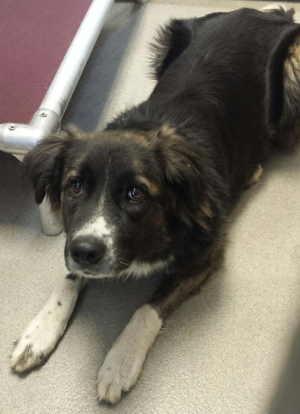
'Tippy'
“Tippy” is a female Australian Shepherd.
Shelter staff said they do not know her background, but she needs a home with women only, as she is very afraid of men.
Tippy is good with other dogs and has been fine with mellow children.
Find Tippy in kennel No. 1, ID No. 2142.
To fill out an adoption application online visit http://www.co.lake.ca.us/Government/Directory/Animal_Care_And_Control/Adopt/Dog___Cat_Adoption_Application.htm .
Lake County Animal Care and Control is located at 4949 Helbush in Lakeport, next to the Hill Road Correctional Facility.
Office hours are Monday through Friday, 11 a.m. to 5 p.m., and 11 a.m. to 3 p.m., Saturday. The shelter is open from 11 a.m. to 4 p.m. Monday through Friday and on Saturday from 11 a.m. to 3 p.m.
Visit the shelter online at http://www.co.lake.ca.us/Government/Directory/Animal_Care_And_Control.htm .
For more information call Lake County Animal Care and Control at 707-263-0278.
Email Elizabeth Larson at

A team of astronomers using ground-based telescopes in Hawaii, California, and Arizona recently discovered a planetary system orbiting a nearby star that is only 54 light-years away. All three planets orbit their star at a distance closer than Mercury orbits the sun, completing their orbits in just 5, 15, and 24 days.
Astronomers from the University of Hawaii at Manoa, the University of California, Berkeley, the University of California Observatories, and Tennessee State University found the planets using measurements from the Automated Planet Finder (APF) Telescope at Lick Observatory in California, the W. M. Keck Observatory on Maunakea, Hawaii, and the Automatic Photometric Telescope (APT) at Fairborn Observatory in Arizona.
The team discovered the new planets by detecting the wobble of the star HD 7924 as the planets orbited and pulled on the star gravitationally. APF and Keck Observatory traced out the planets' orbits over many years using the Doppler technique that has successfully found hundreds of mostly larger planets orbiting nearby stars. APT made crucial measurements of the brightness of HD 7924 to assure the validity of the planet discoveries.
The new APF facility offers a way to speed up the planet search. Planets can be discovered and their orbits traced much more quickly because APF is a dedicated facility that robotically searches for planets every clear night. Training computers to run the observatory all night, without human oversight, took years of effort by the University of California Observatories staff and graduate students on the discovery team.
"We initially used APF like a regular telescope, staying up all night searching star to star. But the idea of letting a computer take the graveyard shift was more appealing after months of little sleep. So we wrote software to replace ourselves with a robot," said University of Hawaii graduate student BJ Fulton.
The Keck Observatory found the first evidence of planets orbiting HD 7924, discovering the innermost planet in 2009 using the HIRES instrument installed on the 10-meter Keck I telescope. This same combination was also used to find other super-Earths orbiting nearby stars in planet searches led by UH astronomer Andrew Howard and UC Berkeley Professor Geoffrey Marcy. It took five years of additional observations at Keck Observatory and the year-and-a-half campaign by the APF Telescope to find the two additional planets orbiting HD 7924.
The Kepler Space Telescope has discovered thousands of extrasolar planets and demonstrated that they are common in our Milky Way galaxy. However, nearly all of these planets are far from our solar system. Most nearby stars have not been thoroughly searched for the small "super-Earth" planets (larger than Earth but smaller than Neptune) that Kepler found in great abundance.
This discovery shows the type of planetary system that astronomers expect to find around many nearby stars in the coming years. "The three planets are unlike anything in our solar system, with masses 7-8 times the mass of Earth and orbits that take them very close to their host star," explains UC Berkeley graduate student Lauren Weiss.
"This level of automation is a game-changer in astronomy," says Howard. "It's a bit like owning a driverless car that goes planet shopping."
Observations by APF, APT, and Keck Observatory helped verify the planets and rule out other explanations. "Starspots, like sunspots on the sun, can momentarily mimic the signatures of small planets. Repeated observations over many years allowed us to separate the starspot signals from the signatures of these new planets," explains Evan Sinukoff, a UH graduate student who contributed to the discovery.
The robotic observations of HD 7924 are the start of a systematic survey for super-Earth planets orbiting nearby stars. Fulton will lead this two-year search with the APF as part of his research for his doctoral dissertation. "When the survey is complete we will have a census of small planets orbiting sun-like stars within approximately 100 light-years of Earth," says Fulton.
Telescope automation is relatively new to astronomy, and UH astronomers are building two forefront facilities. Christoph Baranec built the Robo-AO observatory to takes high-resolution images using a laser to remove the blur of Earth's atmosphere, and John Tonry is developing ATLAS, a robotic observatory that will hunt for killer asteroids.
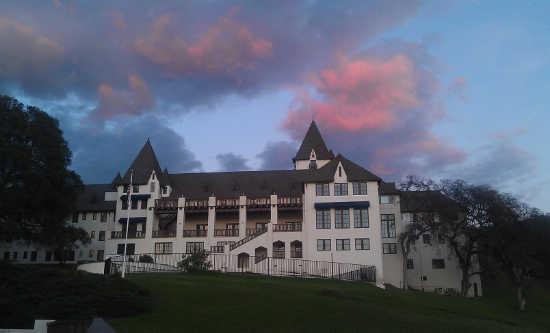
LAKE COUNTY, Calif. – Have you seen the Marymount Castle? Get your chance at the gala opening party for the 2015 Lake County Wine Adventure weekend on Friday, May 15.
Imagine yourself strolling through the Castle, sipping your favorite wines and savoring the views.
Enjoy wines from a baker’s dozen of Lake County’s finest wineries and nosh on a bountiful array of appetizers prepared by Running Creek Casino.
The BMP Swingtet will be on hand to get the party swinging. Dress in period costume is encouraged for a memorable evening of fun. And of course, don’t forget the password – shhh! The word is WINE.
The Marymount Castle sits high on the hill overlooking Lucerne with views of Clear Lake and architecture that hearkens back to the 1920s.
Formerly known as the Lucerne Hotel, it was the brainchild of two investors in the Clear Lake Beach Co.
Richard Palmer and Louis Becker founded the Lucerne Hotel Corp. and started selling stock for the hotel corporation in 1925. Construction of the hotel began in 1926 but was stopped in 1929 due to the Great Depression.
Financial troubles followed with the Clear Lake Beach Co filing bankruptcy and the hotel property taken over as payment for a construction lien.
In the spring of 1938 the hotel was finally completed. It was opened for a year before closing and being sold. The hotel had a succession of owners including a group who wanted to open it as an Adventist hospital until it was discovered that the doors were too small to accommodate a hospital gurney.
In the early 1950s the Northern California Baptist Association bought the hotel and opened it until about 1955.
The hotel was then sold and resold, and opened and closed for short periods but always went back to the Baptists for the debt.
Today the former Lucerne Hotel is home to Marymount California University and fondly referred to as the Marymount Castle.
Sponsored by the Lake County Winery Association, the Speakeasy will be open from 6 to 9 p.m. Friday, May 15.
The Marymount Castle is located at 3700 Country Club Drive in Lucerne.
The passport portion of the Wine Adventure on Saturday, May 16, and Sunday, May 17, offers a unique opportunity to explore the region and enjoy the Lake County wine experience.
Twenty-six Lake County wineries will open their doors to welcome adventurers from 11 a.m. to 5 p.m. Wineries will offer special wine tastings paired with foods to showcase the flavors of the wines.
Some locations will also offer barrel tastings, live music, and products by local artisans. The best winery contest started in 2014 will return again this year with an opportunity to vote in three categories. Many wineries will also be offering specials on wine during the weekend.
Relay for Life is returning as charity partner for the 2015 Lake County Wine Adventure. Raffle tickets will be sold during the weekend for a chance to win a very special Wine and Dine prize package.
In addition to an instant cellar of Lake County wines, the winner will receive gift certificates for dinner at selected Lake County restaurants and a wine tour for four donated by Frontier Wine Tours.
Participating restaurants include the Saw Shop Gallery & Bistro, the Blue Wing Saloon, Wild Creek Restaurant at Running Creek Casino, Park Place Restaurant and the Manzanita Restaurant at Twin Pine Casino.
Tickets will be $5 each or five for $20. All proceeds will go to the Lake County Relay for Life.
Sponsors for the 2015 Lake County Wine Adventure include Twin Pine Casino and Hotel, Lake County, Sutter Lakeside Hospital and Riley Cabs.
Tickets for the Castle Speakeasy are $55 and advanced reservations are required. Tickets for the two-day passport adventure good Saturday and Sunday are $45 in advance or $50 at the door. The Sunday only passport is $35 in advance or $40 at the door.
Designated drivers are free and will get to enjoy the food and fun as they help make it a safe event for everyone.
Tickets for the Castle Speakeasy and Passport Adventure can be purchased many local wineries, the Lake County Chamber of Commerce or online at www.lakecountywineries.org .
The Lake County Winery Association works to promote the wines of Lake County’s high elevation region.
Membership is open to wineries, winegrape growers, and individuals or businesses interested in promoting the Lake County wine industry.
For more information about upcoming events, sponsorship, or membership opportunities, call 707 357-5237 or visit www.lakecountywineries.org .