 How to resolve AdBlock issue?
News
NORTHERN CALIFORNIA – Firefighters and a California Highway Patrol helicopter rescued a hiker on Friday who had become injured while traveling along the Table Rock Trail area in Napa County.
Personnel with Cal Fire/Napa County Fire from the Sonoma-Lake-Napa Unit, Calistoga Fire Department, South Lake County Fire from Middletown and CHP helicopter H32 responded to a report of an injured hiker shortly before noon.
The hiker experienced an injury while hiking which Cal Fire officials said required an airlift evacuation.
Cal Fire and Calistoga Fire Department personnel hiked into the incident were the patient was located, approximately three quarters of a mile from the beginning of the trail.
Emergency personnel assessed the patient’s injury and the incident area where they determined that the safest method of patient transportation was by helicopter to the nearby ground ambulance.
The patient was prepared and transported to Cal Fire's Copter 104 using a Stokes basket and then air lifted to a nearby landing zone where the patient was transferred on to an American Medical Response ground ambulance. The rescue concluded just after 1 p.m.
The condition of the hiker was unknown Friday evening, according to Cal Fire.
Scientists have captured the early death throes of supernovae for the first time and found that the universe's benchmark explosions are much more varied than expected.
The scientists used the Kepler space telescope to photograph three type 1a supernovae in the earliest stages of ignition.
They then tracked the explosions in detail to full brightness around three weeks later, and the subsequent decline over the next few months.
They found the initial stages of a supernova explosion did not fit with the existing theories.
“The stars all blow up uniquely. It doesn't make sense,” said Dr. Brad Tucker from The Australian National University (ANU).
“It's particularly weird for these supernovae because even though their initial shockwaves are very different, they end up doing the same thing.”
Before this study, the earliest type 1a supernovae had been glimpsed was more than 2.5 hours after ignition, after which the explosions all followed an identical pattern.
This led astronomers to theorize that supernovae, the brilliant explosions of dying stars, all occurred through an identical process.
Astronomers had thought supernovae all happened when a dense star steadily sucked in material from a large nearby neighbor until it became so dense that carbon in the star's core ignited.
“Somewhat to our surprise the results suggest an alternative hypothesis, that a violent collision between two smallish white dwarf stars sets off the explosion,” said lead researcher Dr. Robert Olling, from the University of Maryland in the United States.
At the peak of their brightness, supernovae are brighter than the billions of stars in their galaxy. Because of their brightness, astronomers have been able to use them to calculate distances to distant galaxies.
Measurements of distant supernovae led to the discovery that some unknown force, now called dark energy, is causing the accelerated expansion of the universe.
Brian Schmidt from the ANU, Saul Perlmutter (Berkeley) and Adam Reiss (Johns Hopkins) were awarded the Nobel prize in 2011 for this discovery.
Dr. Tucker said the new results did not undermine the discovery of dark energy.
“The accelerating universe will not now go away – they will not have to give back their Nobel prizes,” he said.
“The new results will actually help us to better understand the physics of supernovae, and figure out what is this dark energy that is dominating the universe.”
The findings are published in Nature.
With great weather expected across most of the Golden State this holiday weekend, Cal Fire urges everyone to use caution as fire danger remains higher than normal due to the drought.
Memorial Day weekend is often said to be the official start of summer with everyone enjoying outdoor activities and recreation during the three-day break.
“While we hope everyone has an enjoyable holiday, we also want it to be a safe one,” said Chief Ken Pimlott, Cal Fire director. “The dry conditions throughout the state have created a situation where a fire could easily spark, so we ask everyone to be cautious as they enjoy their time outdoors.”
So far this year, Cal Fire has seen almost twice as many wildfires than average and the peak of summer is still to come.
In the midst of this severe drought, everyone is encouraged to be vigilant and remember that “One Less Spark means One Less Wildfire.”
Camping:
· Obtain a campfire permit ( www.PreventWildfireCA.org ).
· Check for local fire restrictions.
· Clear away grass, leaves and other debris within a 10-foot perimeter of any campfire.
· Have a responsible person in attendance at all times.
· Ensure all campfires are completely extinguished before leaving.
· When barbecuing, never leave the grill unattended.
Vehicle:
· Ensure your vehicle is properly maintained with nothing dragging on the ground.
· When towing, make sure trailer chains are properly secured.
· Never drive or pull over into dry grass.
Fire is not the only danger that can occur in the outdoors, as water drownings also increase dramatically during this holiday weekend.
Warm temperatures make the cool waters of California’s beautiful rivers and lakes very enticing, yet very dangerous.
In the water:
- Always wear a life jacket!
- Children should always be supervised by a responsible adult.
- Never swim alone.
- Drinking and swimming can be just as dangerous as drinking and driving.
For more ways to be safe this holiday, visit www.ReadyforWildfire.org or www.fire.ca.gov .
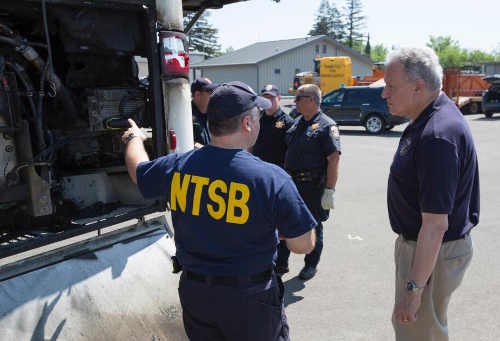
NORTHERN CALIFORNIA – The California Highway Patrol on Friday said it has completed its investigation of the deadly collision last year involving a FedEx semi and a tour bus near Orland.
The collision occurred on Thursday, April 10, 2014, at approximately 5:40 p.m., on Interstate 5 in an unincorporated area of Glenn County and claimed the lives of 10 people and injured 39, many of them Southern California high school students traveling to Humboldt State for a campus visit.
The crash killed FedEx semi driver Timothy Paul Evans, 32, of Elk Grove; bus driver Talalelei Feleni Lealao-Taiao, 53, of Sacramento; chaperones Mattison Leatrice Haywood, 25, of Chino and Michael Lee Myvett Jr., 29, of Los Angeles; Humboldt State admissions office staffer Arthur Arzola; and students Ismael Jimenez, 18, of Inglewood; Jennifer Caroline Bonilla, 17, of Los Angeles; Denise Eraina Gomez, 18, of Inglewood; and Marisa Elaine Serrato, 17, of Riverside.
The CHP concluded that the collision was caused, for unknown reasons, by Evans' violation of California Vehicle Code section 22107, unsafe turning movement.
An undetermined medical condition, sleepiness or driver fatigue may have contributed, but there was no conclusive evidence, the CHP said.
“Our investigators carefully analyzed every aspect of this collision and concluded that environmental factors, roadway conditions and vehicle maintenance were not the cause,” said CHP Northern Division Chief Ruben Leal. “The collision was caused – for unknown reasons – by the driver’s unsafe turning movement, and although fatigue or an undetermined medical condition may have contributed, there is no conclusive evidence.”
As Evans drove south on Interstate 5, for unknown reasons, he allowed the tractor-trailer to drift into and through the No. 1 lane, maintained this gradual path of travel through the median, and crossed into northbound traffic without applying the brakes or making any type of evasive steering, the CHP said.
Investigators with the CHP Multidisciplinary Accident Investigation Team, or MAIT, did not find that environmental or mechanical factors caused or contributed to this collision.
Some evidence of possible fatigue or sleepiness on the part of Evans included the long straight section of roadway, the departure angle of the tires consistent with fatigue-related collisions, that Evans was alone and did not attempt to avoid a collision and an eyewitness report that Evans was slumped toward the driver’s window as he approached oncoming traffic, the CHP said.
Throughout the yearlong investigation, the CHP said it was committed to conducting a complete and thorough investigation into this tragedy to provide answers to those involved, their families and the public.
The CHP’s Northern Division MAIT closely investigated the environmental, mechanical and human factors involved in this collision. The MAIT then carefully detailed its findings in a 541-page report and several annexes.
With the severity and intricacy of traffic collisions dictating the need for more intensive investigations to determine subtle collision and injury causes, the CHP’s MAIT Program was established in 1978.
The objective of the MAIT Program is to provide the CHP with the means to conduct in-depth investigations and analyses of major traffic collisions throughout the state.
Investigations include the reconstruction of an incident and a study of the factors that may have contributed to the incident.
The factors include environmental, human and mechanical and are associated with the three phases of a collision which are precollision, at-collision and post-collision.
For more information on the MAIT program visit https://www.chp.ca.gov/programs-services/for-law-enforcement/multidisciplinary-accident-investigation-teams-%28mait%29 .
The National Transportation Safety Board issued a preliminary report on the crash last year, but has not yet issued its final report.
California agencies combating the spread of invasive quagga and zebra mussels remind boaters to remain vigilant over the three-day Memorial Day weekend.
People who launch vessels at any body of water are subject to watercraft inspections and are encouraged to clean, drain and dry their motorized and non-motorized boats, including personal watercraft, and any equipment that comes into contact with the water before and after recreating at a waterway.
“Our state’s natural resources are facing unprecedented threats today,” said California Department of Fish and Wildlife (CDFW) Director Charlton H. Bonham. “Preventing the spread of quagga and zebra mussels, as well as other invasive species, is something everyone can take an active role in, thereby helping to protect the fish, wildlife and the habitats on which they depend.”
Quagga and zebra mussels, non-native freshwater mussels native to Eurasia, multiply quickly and encrust watercraft and infrastructure, and compete for food with native and sport fish species.
These mussels can be spread from one body of water to another attached to nearly anything that has been in an infested waterbody, or via standing water from an infested waterbody entrapped in boat engines, bilges, live-wells and buckets.
To ensure that watercraft is clean, drained and dry, many local agencies are conducting boat inspections. CDFW has posted a list of these inspections on its website (www.wildlife.ca.gov/mussels) along with additional information about the invasive mussels and what people can do to help prevent their spread in California. Boaters should call ahead to check for restrictions prior to visiting their destination.
Take the following steps before traveling to a waterbody to prevent spreading invasive mussels, to improve your inspection experience and to safeguard California waterways:
• CLEAN: Inspect exposed surfaces and remove all plants and organisms;
• DRAIN: All water, including water contained in lower outboard units, live-wells and bait buckets; and
• DRY: Allow the watercraft to thoroughly dry between launches. Watercraft should be kept dry for at least five days in warm weather and up to 30 days in cool weather.
CDFW has developed a brief video demonstrating the ease of implementing the clean, drain and dry prevention method, which can be viewed above.
In addition, a detailed guide to cleaning vessels of invasive mussels is available on the California State Parks Division of Boating and Waterways (DBW) at www.dbw.parks.ca.gov/quagga .
Travelers are also advised to be prepared for inspections at California Department of Food and Agriculture (CDFA) Border Protection Stations.
Over the past eight years, more than one million watercraft entering the state have been inspected at the Border Protection Stations.
Inspections, which can also be conducted by CDFW and California State Parks, include a check of boats and personal watercraft, as well as trailers and all onboard items. Contaminated vessels and equipment are subject to quarantine or impoundment.
Quagga mussels were first detected in the Colorado River system in January 2007 and were later found in San Diego and Riverside counties.
They are now known to be in 29 waters in California, all in Southern California. Zebra mussels were discovered in San Justo Reservoir in San Benito County in January 2008.
Both species can attach to and damage virtually any submerged surface. They can:
• Ruin a boat engine by blocking the cooling system and causing it to overheat;
• Jam a boat’s steering equipment, putting occupants and others at risk;
• Require frequent scraping and repainting of boat hulls;
• Colonize all underwater substrates such as boat ramps, docks, lines and other underwater surfaces, causing them to require constant cleaning;
• Cost the owners of these items a lot of money.
A multi-agency effort that includes CDFW, DBW, CDFA and the California Department of Water Resources has been leading an outreach campaign to alert the public to the quagga and zebra mussel threats.
A toll-free hotline at 866-440-9530 is available for those seeking information on quagga or zebra mussels.
MENDOCINO NATIONAL FOREST, Calif. – Memorial Day marks the beginning of the summer recreation season, enjoying your national forest – whether it’s taking a hike, going fishing or enjoying a camping trip and sleeping under the stars.
This weekend, the employees of the Mendocino National Forest want to remind visitors to have a safe visit and be careful with fire or anything that can throw a spark in the forest.
“Even though we have had some storms and a little rain in the mountains over the past week, overall conditions continue to be dry and there hasn’t been measurable snowpack in months,” said Forest Fire Management Officer Curtis Coots. “This means the forest is already seeing an increased risk of wildfires and this is happening earlier than usual.”
The Forest is not currently in fire restrictions, but fuel conditions are being monitored closely. As the summer continues, visitors should check the status of fire conditions before starting a trip to the forest.
While campfires are still allowed, they should be started, managed and extinguished safely.
– Flammable materials should be cleared from the ground for 5 feet in all directions from the edge of the fire and a shovel and water should be kept nearby.
– The fire should be small – roughly the size of a 2-foot cube.
– Campfires should be supervised by a knowledgeable and responsible adult until it is completely extinguished.
– The fire should be dead out and completely cold before leaving.
“Unfortunately, abandoned campfires are our biggest challenge on Memorial Day, as people head home without successfully putting out their campfire,” said Forest Supervisor Ann Carlson.
“Each year our firefighters find dozens of campfires left burning on the forest. All it takes is one to spread into a devastating wildfire, which impacts valuable natural resources and recreation opportunities for years afterwards,” Carlson said.
More information on campfire safety, as well as campfire permits, can be found at www.preventwildfireca.org .
“Remember, one less spark – one less wildfire. Whether it’s a gas stove, campfire or ensuring that you aren’t creating a spark, paying attention can help dramatically reduce the risk of human-caused fires on the Forest,” Coots said. “By doing this we can help preserve not only public and firefighter safety, but also the areas of the forest we all enjoy.”
While the weather is warming up at lower elevations, visitors should be prepared for changing conditions and cooler nighttime temperatures in the mountains. Bring layered clothing and plenty of food and water on your outdoor adventure. Tell someone where you are planning on going, which routes you plan on taking and when you plan on being back.
“We want everyone to have a safe and memorable Memorial Day weekend, especially those joining us on the Forest,” said Carlson.
For more information, please contact the Mendocino National Forest at 530-934-3316 or visit www.fs.usda.gov/mendocino .