 How to resolve AdBlock issue?
News
LAKE COUNTY, Calif. – U.S. Rep. Mike Thompson (CA-5) announced Federal Emergency Management Agency Public Assistance funds will be available to eligible applicants such as state and local governments and certain private nonprofit organizations in Lake County.
This is funding for local communities to use to repair critical public infrastructure such as roads, bridges, buildings, water infrastructure and sewage collection facilities.
The federal government covers 75 percent of the costs, and the state and locals governments split the remaining 25 percent.
“The federal response to the Valley Fire has been nothing short of spectacular,” said Thompson. “Working with FEMA and other federal agencies we have been able to rapidly secure funds to help suppress the fire, repair our towns, reopen businesses and rebuild people’s homes. We face a long and hard road back, but this assistance will help make sure we fully recover.”
The Valley fire is the third most damaging fire in California's history, according to Cal Fire.
California Office of Emergency Services Director Mark Ghilarducci had written to FEMA earlier this month to ask for the Public Assistance to be made available, as Lake County News has reported.
In particular, Ghilarducci said the state needs millions of dollars in assistance in order to carry out the massive debris removal program in Lake County – where more than 1,950 structures burned, including more than 1,300 homes – and in Calaveras County, where the Butte fire burned more than 400 hundred homes.
Late last month, as a result of President Barack Obama's presidential major disaster declaration, FEMA opened up its Individual Assistance program to help individuals rebuild, repair and replace housing and other personal property not covered by insurance.
Thompson wrote to the White House, urging President Obama to approve the Individual Assistance. Thompson also had conversations with the White House and Regional Administrator for FEMA Region IX Robert J. Fenton, Jr. about the need to quickly expedite approval of the funding.
Individuals can register with FEMA the following ways:
– Apply online at www.DisasterAssistance.gov .
– Apply via smartphone at http://m.fema.gov .
– Constituents may call the registration phone number at 1-800-621-3362; those who have a speech disability or hearing loss and use TTY, should call 1-800-462-7585 directly; for those who use 711 or Video Relay Service (VRS), call 1-800-621-3362.
Additionally, Thompson announced that low-interest Small Business Administration (SBA) loans are now available to help businesses and residents impacted by the Valley Fire.
Businesses and nonprofit organizations may borrow up to $2 million to repair or replace damaged or destroyed real estate, machinery and equipment, inventory and other business assets.
Disaster loans up to $200,000 are available to homeowners to repair or replace damaged or destroyed real estate. Homeowners and renters are eligible for up to $40,000 to repair or replace damaged or destroyed personal property.
Hazard Mitigation funds have also made available. These funds provide assistance to the state for actions taken to prevent or reduce long term risk to life and property from natural hazards.
FEMA previously approved the state of California’s request for a Fire Management Assistance Grant declaration for the Valley Fire.
The Fire Management Assistance Grant Program allows for the “mitigation, management, and control” of fires burning on publicly or privately owned forest or grasslands which threaten such destruction as would constitute a major disaster.
The FEMA grant will cover 75 percent of the costs for various fire suppression, safety and recovery needs.
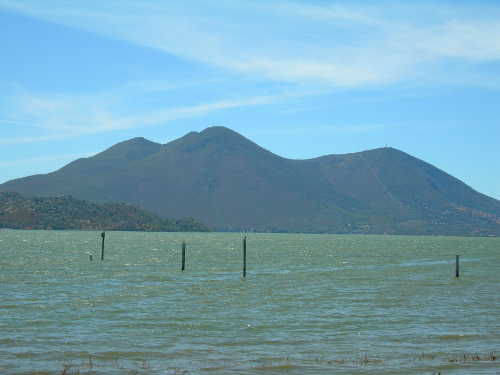
“What we call landscape is a stretch of earth overlaid with memory, expectation, and thought … Landscape is what we allow in through the doors of perception.” – Scott Russell Sanders
CLEARLAKE, Calif. – Austin Park is located at 14077 Lakeshore Drive, Clearlake.
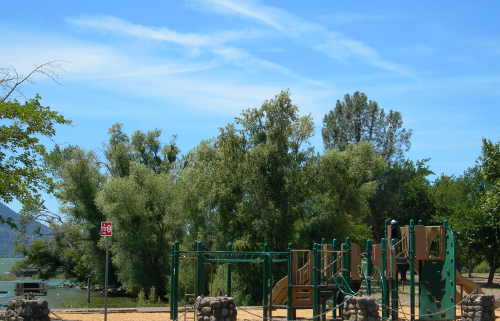
The park is 20 acres of vibrant landscape, including a playground, softball fields, restroom and a skate/biking park.
Here along Clear Lake you can take a swim, take out the kayak or canoe, or just take in the marvelous mountain views of Lake County's own volcano, Mount Konocti.
Mount Konocti presides over Clear Lake at 4,305 feet and sits amongst volcanic cones and domes that are in the range of 10,000 to more than 2 million years old.
Mighty Mount Konocti's last eruption was approximately 11,000 years ago, with the first eruption having taken place about 350,000 years ago.
The mountain's namesake comes from the Pomo Indian word, “kno” or “mountain,” and combines it with the word, “htai” for “woman.”
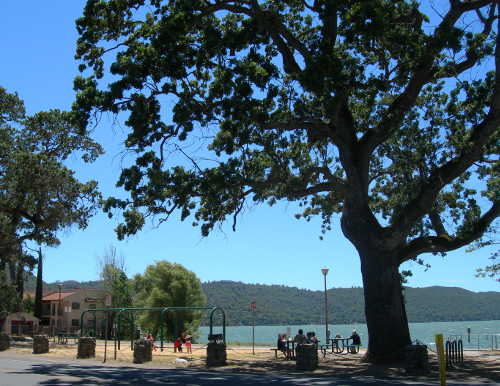
Sitting on a bench in Austin Park along the mirror-like shore of our state's largest lake is a real treat for birdwatchers.
Our lake provides hearth and home to about 300 species of birds. Grebes, American White pelicans, eagles, egrets, mergansers and herons are only a scant few of the avian species which abound here.
The lake begins to work its magic with a jubilee of color, form and movement – a Calder composition.
Lake-watching can leave you transfixed by the pattern-play on its waters.
Unlike the metaphor used for time flowing like a river, a lake, according to Professor Dave Edmunds, “Time as a river is a more Euro-American concept of time, with each event happening and passing on like a river flows downstream. Time as a pond is a more Native American concept of time, with everything happening on the same surface, in the same areas – and each event is a ripple on the surface.”
Kathleen Scavone, M.A., is an educator, potter, writer and author of “Anderson Marsh State Historic Park: A Walking History, Prehistory, Flora, and Fauna Tour of a California State Park” and “Native Americans of Lake County.” She also writes for NASA and JPL as one of their “Solar System Ambassadors.” She was selected “Lake County Teacher of the Year, 1998-99” by the Lake County Office of Education, and chosen as one of 10 state finalists the same year by the California Department of Education.
LAKE COUNTY, Calif. – Many new dogs are awaiting adoption at Lake County Animal Care and Control this week.
The dogs offered for adoption this week include mixes of Chihuahua, cocker spaniel, pit bull terrier, Shar pei and terrier.
For those looking for lost pets as a result of the Valley fire, visit the Lake County Animal Care and Control Web site, which features additional dogs and cats that officials are looking to reunite with their families.
Dogs that are adopted from Lake County Animal Care and Control are either neutered or spayed, microchipped and, if old enough, given a rabies shot and county license before being released to their new owner. License fees do not apply to residents of the cities of Lakeport or Clearlake.
If you're looking for a new companion, visit the shelter. There are many great pets hoping you'll choose them.
In addition to the animals featured here, all adoptable animals in Lake County can be seen here: http://bit.ly/Z6xHMb .
The following dogs at the Lake County Animal Care and Control shelter have been cleared for adoption (additional dogs on the animal control Web site not listed are still “on hold”).

Female pit bull terrier mix
This female pit bull terrier mix has a shot black and white coat.
She was found on Highway 29 in Kelseyville.
She's in kennel No. 3, ID No. 3556.

Chihuahua-terrier mix
This male Chihuahua-terrier mix has a short tricolor coat.
He was found on Live Oak Drive in Kelseyville.
He's in kennel No. 4, ID No. 3767.

Male pit bull terrier mix
This male pit bull terrier mix has a short gray and white coat.
He was found behind a Middletown gas station.
He's in kennel No. 5, ID No. 3720.

Male pit bull mix
This male pit bull terrier mix has a short gray and white coat.
He's in kennel No. 7, ID No. 3458.

Terrier mix
This male terrier mix has a short tan coat.
He was found on Lakeview Drive in Nice.
He's in kennel No. 8, ID No. 3693.

'Tortia'
“Tortia” is a female pit bull terrier mix.
She has a short brown coat.
Tortia is in kennel No. 9, ID No. 3760.

Shar pei-pit bull mix
This male Shar pei-pit bull mix has a short gray coat.
He was found on High Street in Nice.
He's in kennel No. 13, ID No. 3704.

Male pit bull terrier
This male pit bull terrier mix has a short brown and white coat.
He was found in Clearlake Oaks.
He's in kennel No. 17, ID No. 3719.

'Sebastian'
“Sebastian” is a buff-colored male cocker spaniel.
His owner died and now he is looking for a new home.
He's in kennel No. 18, ID No. 3270.

Male pit bull terrier mix
This male pit bull terrier mix has a short gray coat.
He was found on Lakeview Drive in Nice.
He's in kennel No. 25, ID No. 3694.

Female pit bull terrier mix
This female pit bull terrier mix has a short gray and white coat.
She is in kennel No. 26, ID No. 3280.

'Maverick'
“Maverick” is a male pit bull terrier mix with a short brindle and white coat.
He was found on Virginia Street in Lucerne.
Shelter staff said he is a very good dog, he gets along great with other dogs – both male and female.
Maverick does not have food guarding issues and is great on a leash, but shelter staff said he doesn't like cats.
He's in kennel No. 28, ID No. 3228.
To fill out an adoption application online visit http://www.co.lake.ca.us/Government/Directory/Animal_Care_And_Control/Adopt/Dog___Cat_Adoption_Application.htm .
Lake County Animal Care and Control is located at 4949 Helbush in Lakeport, next to the Hill Road Correctional Facility.
Office hours are Monday through Friday, 11 a.m. to 5 p.m., and 11 a.m. to 3 p.m., Saturday. The shelter is open from 11 a.m. to 4 p.m. Monday through Friday and on Saturday from 11 a.m. to 3 p.m.
Visit the shelter online at http://www.co.lake.ca.us/Government/Directory/Animal_Care_And_Control.htm .
For more information call Lake County Animal Care and Control at 707-263-0278.
Email Elizabeth Larson at

We have heard the Mars exploration mantra for more than a decade: follow the water. In a new paper published Oct. 9 in the journal Science, the Mars Science Laboratory (MSL) team presents recent results of its quest to not just follow the water but to understand where it came from, and how long it lasted on the surface of Mars so long ago.
The story that has unfolded is a wet one: Mars appears to have had a more massive atmosphere billions of years ago than it does today, with an active hydrosphere capable of storing water in long-lived lakes.
The MSL team has concluded that this water helped to fill Gale Crater, the MSL rover Curiosity's landing site, with sediment deposited as layers that formed the foundation for the mountain found in the middle of the crater today.
Curiosity has been exploring Gale Crater, which is estimated to be between 3.8 billion and 3.6 billion years old, since August 2012.
In mid-September 2014, the rover reached the foothills of Aeolis Mons, a three-mile-high layered mountain nicknamed “Mount Sharp” in honor of the late Caltech geologist Robert Sharp. Curiosity has been exploring the base of the mountain since then.
“Observations from the rover suggest that a series of long-lived streams and lakes existed at some point between 3.8 billion to 3.3 billion years ago, delivering sediment that slowly built up the lower layers of Mount Sharp,” said Ashwin Vasavada, MSL project scientist. “However, this series of long-lived lakes is not predicted by existing models of the ancient climate of Mars, which struggle to get temperatures above freezing.”
This mismatch between the predictions of Mars's ancient climate that arise from models developed by paleoclimatologists and indications of the planet's watery past, as interpreted by geologists, bears similarities to a century-old scientific conundrum – in this case, about Earth's ancient past.
At the time, geologists first began to recognize that the shapes of the continents matched each other, almost like scattered puzzle pieces, explains John Grotzinger, Caltech's Fletcher Jones Professor of Geology, chair of the Division of Planetary and Geological Sciences, and lead author of the paper.
“Aside from the shapes of the continents, geologists had paleontological evidence that fossil plants and animals in Africa and South America were closely related, as well as unique volcanic rocks suggestive of a common spatial origin. The problem was that the broad community of earth scientists could not come up with a physical mechanism to explain how the continents could plow their way through Earth's mantle and drift apart. It seemed impossible. The missing component was plate tectonics,” he said. “In a possibly similar way, we are missing something important about Mars.”
As Curiosity has trekked across Gale Crater, it has stopped to examine numerous areas of interest. All targets are imaged, and soil samples have been scooped from some; the rocks in a select few places have been drilled for samples.
These samples are deposited into the rover's onboard laboratories. Using data from these instruments, as well as visual imaging from the onboard cameras and spectroscopic analyses, MSL scientists have pieced together an increasingly coherent and compelling story about the evolution of this region of Mars.
Before Curiosity landed on Mars, scientists proposed that Gale Crater had filled with layers of sediments.
Some hypotheses were “dry,” implying that the sediments accumulated from wind-blown dust and sand, whereas others focused on the possibility that sediment layers were deposited in ancient streams and lakes.
The latest results from Curiosity indicate that these wetter scenarios were correct for the lower portions of Mount Sharp. Based on the new analysis, the filling of at least the bottom layers of the mountain occurred mostly by ancient rivers and lakes.
“During the traverse of Gale, we have noticed patterns in the geology where we saw evidence of ancient fast-moving streams with coarser gravel as well as places where streams appear to have emptied out into bodies of standing water,” Vasavada said. “The prediction was that we should start seeing water-deposited, fine-grained rocks closer to Mount Sharp. Now that we've arrived, we're seeing finely laminated mudstones in abundance.”
These silty layers in the strata are interpreted as ancient lake deposits.
“These finely laminated mudstones are very similar to those we see on Earth,” said Woody Fischer, professor of geobiology at Caltech and coauthor of the paper. “The scale of lamination – which occurs both at millimeter and centimeter scale – represents the settling of plumes of fine sediment through a standing body of water. This is exactly what we see in rocks that represent ancient lakes on Earth.”
The mudstone indicates the presence of bodies of standing water in the form of lakes that remained for long periods of time, possibly repeatedly expanding and contracting during hundreds to millions of years. These lakes deposited the sediment that eventually formed the lower portion of the mountain.
“Paradoxically, where there is a mountain today there was once a basin, and it was sometimes filled with water,” said Grotzinger.
“Curiosity has measured about 75 meters of sedimentary fill, but based on mapping data from NASA's Mars Reconnaissance Orbiter and images from Curiosity's cameras, it appears that the water-transported sedimentary deposition could have extended at least 150 to 200 meters above the crater floor, and this equates to a duration of millions of years in which lakes could have been intermittently present within the Gale Crater basin,” Grotzinger said.
Furthermore, the total thickness of sedimentary deposits in Gale Crater that indicate interaction with water could extend higher still – up to perhaps 800 meters above the crater floor, and possibly representing tens of millions of years.
But layers deposited above that level do not require water as an agent of deposition or alteration.
“Above 800 meters, Mount Sharp shows no evidence of hydrated strata, and that is the bulk of what forms Mount Sharp. We see another 4,000 meters of nothing but dry strata,” Grotzinger said.
He suggested that perhaps this segment of the crater's history may have been dominated by eolian, or wind-driven, deposition, as was once imagined for the lower part explored by Curiosity. This occurred after the wet period that built up the base of the mountain.
A lingering question surrounds the original source of the water that carried sediment into the crater.
For flowing water to have existed on the surface, Mars must have had a thicker atmosphere and warmer climate than has been theorized for the time frame bookending the intense geological activity in Gale Crater.
Evidence for this ancient, wetter climate exists in the rock record. However, current models of this paleoclimate – factoring in estimates of the early atmosphere's mass, composition, and the amount of energy it received from the sun – come up, quite literally, dry. Those models indicate that the atmosphere of Mars could not have sustained large quantities of liquid water.
Yet the rock record discovered at Gale Crater suggests a different scenario.
“Whether it was snowfall or rain, you have geologic evidence for that moisture accumulating in the highlands of the Gale Crater rim,” Grotzinger said.
In the case of Gale Crater, at least some of the water was supplied by the highlands that form the crater rim, but groundwater discharge – a standard explanation to reconcile wet geologic observations with dry paleoclimatic predictions – is unlikely in this area.
“Right on the other side of Gale's northern rim are the Northern Plains. Some have made the argument that there was a northern ocean sitting out there, and that's one way to get the moisture that you need to match what we are seeing in the rocks,” Grotzinger said.
Pinpointing the possible location of an ocean, however, does not help to explain how that water managed to exist as a liquid for extended periods of time on the surface.
As climatologists try to develop new atmospheric models, help should be coming from the continuing explorations by Curiosity.
“There are still many kilometers of Mars history to explore,” said Fischer.
He thinks that some of the most exciting data yet may come in the next few years as Curiosity climbs higher on Mount Sharp.
“The strata will reveal Gale's early history, its story. We know there are rocks that were deposited underwater, in the lake. What is the chemistry of these rocks? That lake represented an interface between the water and the atmosphere, and should tell us important things about the environment of the time,” said Fischer.
“We have tended to think of Mars as being simple,” added Grotzinger. “We once thought of the earth as being simple, too. But the more you look into it, questions come up because you're beginning to fathom the real complexity of what we see on Mars. This is a good time to go back to reevaluate all our assumptions. Something is missing somewhere.”
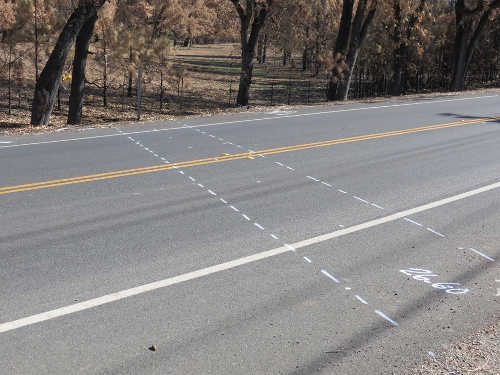
LAKE COUNTY, Calif. – Caltrans said this week that repair and cleanup work on Highway 29 and Highway 175 in the Valley fire area is under way.
Caltrans District 1 spokesman Phil Frisbie said the agency initially estimated costs to repair damage done to state highways by the fire – which broke out Sept. 12 and was fully contained on Oct. 6 – at $18 million.
He said the state entered a $15 million emergency contract with Granite Construction, with the difference between the total estimate and the contract totals explained by $3 million allocated to Caltrans for oversight and management.
Frisbie said work began on Sept. 17 with Granite Construction removing damaged trees along the state right-of-way, a process that is still ongoing.
Since then, Caltrans reported that work has expanded to include cleanup from the Lake/Napa County line to Hidden Valley Lake on Highway 29 and on Highway 175 in Middletown to Loch Lomond.
Frisbie said Granite Construction is bringing in a crew to being repairing metal beam guardrail that was damaged in the fire.
He said there is more than 5,000 feet of guardrail – almost a mile's worth – that the fire burned that needs to be replaced along Highway 29 and Highway 175.
Granite Construction will completely remove that existing guardrail and install all new metal posts before the new guardrail is placed, Frisbie said.
Frisbie said work also is set to start on Highway 175 to replace a culvert damaged in the fire.
He said the contractor has been out marking lines on the highway where the work will take place.
Once the guardrail and culvert replacement gets started, there will be temporary road closures and traffic delays, Frisbie said.
“We would really encourage nonresidents to please avoid the area,” Frisbie said.
In addition to the Valley fire-related repairs, Caltrans' contractors are continuing other projects around Lake County this next coming week.
Those projects include guardrail repairs from Blue Lakes Road to Saratoga Springs Road west of Upper Lake, pavement repairs from Rosemont Drive to the junction of Highway 20 and Highway 53 along the Northshore, work on Main Street in Kelseyville to the junction of Highway 29 and Highway 175 near Lakeport, and drainage work from the Lake and Mendocino County line to five miles east on Highway 175.
Email Elizabeth Larson at
MENDOCINO NATIONAL FOREST, Calif. – Fire restrictions on the Mendocino National Forest were lifted at 12:01 a.m. Saturday as a result of lower temperatures and increased humidity in the area.
Visitors with a valid California Campfire Permit will once again be able to have fires outside of designated campgrounds.
The fire restrictions were put in place July 2 due to increased fire danger and hot, dry weather.
“The Mendocino National Forest has been very fortunate this season to not have a large wildfire, despite hot weather and ongoing drought conditions,” said Forest Supervisor Ann Carlson. “This success is partially due to the care taken by Forest visitors with campfires, stoves and other items that can create a spark. We want to thank Forest visitors for their assistance and ask that they continue to help us prevent human-caused wildfires on the Mendocino National Forest.”
Despite the change in weather, fire season is not officially over. Visitors are asked to continue to be careful when using campfires, charcoal fires and gas stoves in the National Forest.
When you have a campfire, please do the following:
· Clear all flammable material away from the fire for a minimum of 5 feet in all directions to prevent escape of the fire.
· Have a shovel available at the campfire site for preparing and extinguishing campfires.
· Have a responsible person in attendance at all times.
· Extinguish campfire with water, drowning the fire, stirring the coals and ash, and feeling for heat or warm spots; continue the process until the coals and ash are cold.
California Campfire Permits are free and may be obtained at any Forest Service, Bureau of Land Management or Cal Fire office in California, as well as most Forest Service field employees. The permits also may be obtained online at www.preventwildfireca.org .
For more information, please contact the Mendocino National Forest at 530-934-3316 or visit www.fs.usda.gov/mendocino .