 How to resolve AdBlock issue?
News
LAKE COUNTY, Calif. – Traffic collisions are the No. 1 killer of teenagers in the United States, ending more young lives every day than cancer, homicide, and suicide combined.
To bring awareness of the dangers facing young people when they drive, the California Highway Patrol will participate in National Teen Safe Driver Week, Oct. 18 to 24.
“Among all drivers, teenagers are at the greatest risk for a collision and are more prone to distraction than any other age demographic,” CHP Commissioner Joe Farrow said. “A national study from the American Automobile Association Foundation for Traffic Safety has shown that teenagers are distracted almost a quarter of the time they are behind the wheel.”
In 2013, the California Department of Motor Vehicles reported that California had 864,974 licensed drivers aged 15 to 19.
The CHP’s Statewide Integrated Traffic Records System showed that more than 19,000 of them were involved in fatal or injury collisions.
The teenage driver was at fault in 12,622, or 66 percent, of those collisions. This is a slight improvement from 2012, when more than 20,000 California drivers age 15-19 were involved in fatal or injury collisions, in which 13,424, or 67 percent, were at fault.
“Although national data shows a decline in the number of young drivers involved in vehicle crashes over recent years, they are still at greater risk than any other age group. The CHP will always be dedicated to promoting safe habits for California’s young drivers,” Commissioner Farrow said.
The CHP has its own teen driver programs and works with the California Office of Traffic Safety and Impact Teen Drivers to educate young drivers about the dangers and responsibilities behind the wheel.
Impact Teen Drivers is a nonprofit program focused on saving teen lives through education.
“Parents are the strongest influence on their teens’ driving attitudes and behaviors. By the time they drive, your children have been watching, listening, and learning from everything you have been doing behind the wheel for the past 15.5 years. As a parent, when you model safe driving behaviors, you could save your child’s life,” Dr. Kelly Browning, executive director of Impact Teen Drivers, said.
Every 15 Minutes is a two-day CHP program focusing on high school juniors and seniors. It challenges them to think about drinking, driving, personal safety, the responsibility of making mature decisions, and the impact their decisions have on family, friends, and others.
Another CHP program is Start Smart, a two-hour class for teen drivers and their parents/guardians.
Start Smart educates teenagers and parents about the responsibilities they face and teaches them how to stay safe on the road. Classes are free.
The CHP's Clear Lake Area office offers the classes on a regular basis both at its office in Kelseyville and at locations around the county.
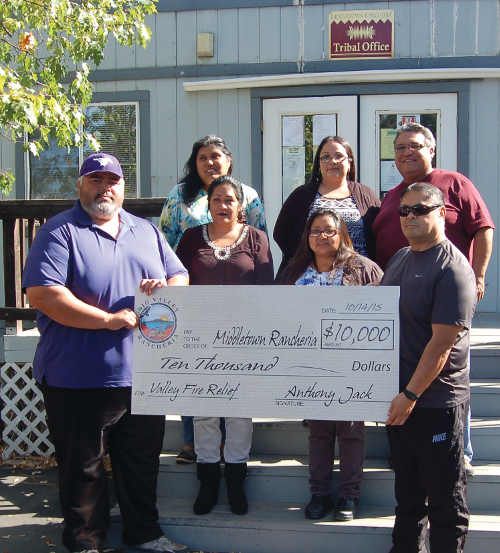
MIDDLETOWN, Calif. – In response to the destructive Valley Fire, Big Valley Rancheria has made a donation to support its neighbors in recovery efforts.
The Big Valley Rancheria Business Committee and Tribal Administrator presented a check in the amount of $10,000 to the Middletown Rancheria for recovery from the Valley fire on Wednesday, Oct. 14, in front of the Middletown Rancheria Tribal Office.
The donation was made from the tribe’s charitable donation fund which is used to support the community throughout the year.
More than 38 Middletown Rancheria tribal members, employees of the Twin Pine Casino and St. Helena Brewing Co., and community members suffered losses as a result of the fire.
“Our neighbors are in need, and Big Valley is committed to helping in any way possible,” said Tribal Chairman Anthony Jack.
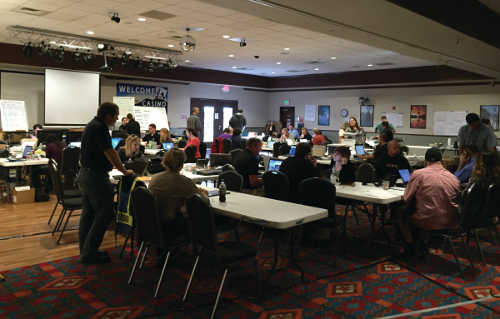
This donation isn’t the first contribution that Big Valley Rancheria made to support fire response and recovery efforts.
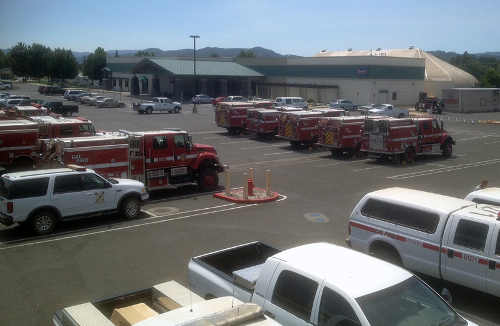
During the Rocky and Valley fires, Konocti Vista Casino opened its doors to the Lake County Office of Emergency Services and housed the Emergency Operation Center, or EOC.
In addition to the space, Konocti Vista Casino and staff provided meals and snacks around the clock to personnel working in the EOC.
The tribe’s gymnasium was used as an evacuation center for the public and personnel assisting in recovery efforts.
Firefighters and many other first responders filled the hotel during the Valley fire.
Big Valley Rancheria officials said it is committed to providing additional financial support as the community recovers from this devastating fire.
On Jan. 1, 2016, a recently signed California law will allow revocable transfer on death deeds, or TOD deeds, to be recorded in California.
Let us examine the TOD deed and where it is most likely to be appropriate.
The TOD deed is a revocable beneficiary deed, involving the gift of a residence, which is signed, dated and notarized by the transferor. It must then, within 60 days of execution, be recorded with the county where the real property is situated.
The TOD deed, unlike other deeds, does not become a completed transfer (gift) until the transferor dies.
While the transferor is still alive, he or she can at any time revoke the TOD deed in the following ways: By recording a written revocation with the same county recorder's office; by recording another TOD deed; or by transferring or selling the real property and recording the irrevocable transfer deed.
The purpose of the TOD deed is to provide a less expensive option for those persons with simple estate planning goals that do not require a revocable living trust in those estate planning situations the joint tenancy or reserved life estate irrevocable deeds are not desirable approaches.
Specifically, consider a parent who wants to leave his or her residence without probate outright to one child whose circumstances do not necessitate the protection of a further trust. The TOD deed is intended for this simple situation.
Unlike the joint tenancy or the reserved life estate approaches the parent remains the sole owner till death and is free to do as he or she pleases with the residence.
Also, like the reserved life estate deed, when the parent dies the child receives a new tax basis equal to the date of death appraised value of the residence.
If, however, the parent intends that the residence is sold, after she dies, and the proceeds divided amongst multiple children, or if one or more of these children receives SSI or Medi-Cal, then a TOD deed may not be the answer and having a living trust with a single trustee in charge of settling the estate and a special needs trust for the children on SSI or Medi-Cal is still well worth the additional expense.
The TOD deed also does not protect against SSI or Medi-Cal claims, either those claims against the transferor or the transferee (gift recipient).
Because the TOD deed is revocable it is included in the transferor's estate for purposes of estate recovery claims related to the transferor’s receipt of needs based public benefits.
Thus, if the transferor him or herself received SSI or Medi-Cal benefits prior to death then California will place a lien on the residence when the transferor dies, regardless of the TOD deed.
Accordingly, the TOD deed is not really appropriate for someone wanting to avoid SSI or Medi-Cal estate recovery claims against their residence. Instead, an irrevocable deed prior to death, usually with a retained life estate in favor of the transferor, is used in that situation.
When multiple beneficiaries are involved, having one trustee in charge of marshaling, selling and distributing the decedent's trust assets – including assets other than the residence – will provide a compelling advantage over the TOD deed which results in multiple owners of the decedent’s residence having to cooperate amongst themselves regarding what becomes of the residence.
In summary, the TOD deed is not an equivalent to the revocable living trust. Rather, like the joint tenancy and life estate deeds, the TOD deed occupies a limited niche position.
The revocable living trust remains the most comprehensive and often times best approach to dealing with one’s estate planning needs.
Dennis A. Fordham, attorney (LL.M. tax studies), is a State Bar Certified Specialist in estate planning, probate and trust law. His office is at 870 S. Main St., Lakeport, California. Fordham can be reached by e-mail at

From Pluto’s unusual heart-shaped region to its extended atmosphere and intriguing moons, New Horizons has revealed a degree of diversity and complexity in the Pluto system that few expected in the frigid outer reaches of the solar system.
The New Horizons team describes a wide range of findings about the Pluto system in its first science paper, released Thursday.
“The Pluto System: Initial Results from its Exploration by New Horizons,” led by mission Principal Investigator Alan Stern, appears as the cover story in the Oct. 16 issue of Science, just three months after NASA’s historic first exploration of the Pluto system in July.
“The New Horizons mission completes our initial reconnaissance of the solar system, giving humanity our first look at this fascinating world and its system of moons,” said Jim Green, director of planetary science at NASA Headquarters in Washington. “New Horizons is not only writing the textbook on the Pluto system, it’s serving to inspire current and future generations to keep exploring—to keep searching for what’s beyond the next hill.”
NASA’s New Horizons spacecraft reached a distance of 7,750 miles from Pluto’s surface during its July 14 closest approach, gathering so much data it will take almost another year to return to Earth.
The data returned so far show a surprisingly wide variety of landforms and terrain ages on Pluto, as well as variations in color, composition and albedo (surface reflectivity).
Team members also discovered evidence for a water-ice rich crust, multiple haze layers above the surface in Pluto’s atmosphere, and that Pluto is somewhat larger and a bit more ice rich than expected.
“The Pluto system surprised us in many ways, most notably teaching us that small planets can remain active billions of years after their formation,” said Stern, with the Southwest Research Institute (SwRI) in Boulder, Colorado. “We were also taught important lessons by the degree of geological complexity that both Pluto and its large moon Charon display.”
Some of the processes on Pluto appear to have occurred geologically recently, including those that involve the water-ice rich bedrock as well as the more volatile, and presumably more mobile, ices of the western lobe of Pluto’s “heart.” The diverse geology and apparent recent activity raise fundamental questions about how small planetary bodies remain active many billions of years after formation.
The research suggests that other large worlds in the Kuiper belt – such as Eris, Makemake and Haumea – could also have similarly complex histories that rival those of terrestrial planets such as Mars and Earth.
The New Horizons team notes that Triton, likely a former Kuiper Belt planet captured by Neptune, was considered the best analog for Pluto prior to the July 14 flyby.
The team now believes that the geologies of Triton and Pluto are more different than similar, but will know more as additional data are returned.
New Horizons is part of NASA’s New Frontiers Program, managed by the agency’s Marshall Space Flight Center in Huntsville, Alabama. The Johns Hopkins University Applied Physics Laboratory, Laurel, Maryland, designed, built, and operates the New Horizons spacecraft and manages the mission for NASA’s Science Mission Directorate. SwRI leads the science mission, payload operations, and encounter science planning.

COBB, Calif. – In response to concerns from the community about removal of trees in the Valley fire area, a meeting will take place next week featuring officials from a variety of state and local agencies to discuss the reasons for the tree cutting and also the reforestation process ahead.
County Supervisor Rob Brown has organized the meeting, which will begin at 6 p.m. Monday, Oct. 19, at Cobb Mountain Elementary School, 15895 Highway 175.
Brown said trees will be the meeting's main topic.
He said a wide variety of agencies involved in the fire recovery – and, in some cases, the tree removal – are being invited to take part, including Cal Fire, the California Office of Emergency Services, CalRecycle and its main contractor on the cleanup Pacific States, the Federal Emergency Management Agency, Caltrans, Pacific Gas and Electric, AT&T, the University of California Cooperative Extension and the county of Lake.
There also will be representatives on hand from wood mills to discuss purchasing the timber, Brown said.
The work of taking down burned, dead or dying trees has been ongoing since not long after the fire began on Sept. 12.
Caltrans and PG&E are estimated to have taken down the most trees, citing safety concerns in public right of ways and the potential for damaging utility equipment, which could give rise to another fire.
The county of Lake, Caltrans and PG&E officials explained their activities in a Lake County News article published earlier this month: www.bit.ly/1LnHoyb .
However, community members have reported trees that appear to be OK being removed from areas that don't appear to be near right of way.
Brown said he's followed up on those reports, finding some of them to be accurate, but also finding cases where the trees were clearly burned and needed to be felled.
He said he's been attending a number of small group meetings in the community about the trees in recent weeks in an effort to get a sense about people's concerns.
Frequently asked questions he's hearing relate to the costs to remove trees once they're taken down and who will have to remove hazard trees that remain on properties but aren't in public right of way areas. Brown anticipates having definitive answers for those and other questions by the Monday meeting.
Other discussion topics will include the massive reforestation effort ahead.
Cal Fire Capt. Joe Fletcher emphasized that trees that are being removed need to be taken down for safety reasons. The trees aren't selected randomly.
Fletcher also said there will be a massive reforestation process ahead, as well as efforts to control erosion and protect the watershed.
“Trees do a lot more than just provide oxygen and shade,” he said, adding, “They're part of the water system.”
Fletcher estimated that up to 500,000 tree seedlings will need to be planted in and around the nearly 3,500-acre Boggs Mountain State Demonstration Forest area alone.
Late in September, Cal Fire announced it was closing the demonstration forest indefinitely due to the hazardous conditions created there because of the fire.
Greg Giusti, University of California Cooperative Extension's director and advisor for forests and wildland ecology in Lake and Mendocino counties, is one of the local officials invited to attend and speak.
Giusti said he has convened a working group of about 15 forestry and resource professionals – including regional foresters, Cal Fire, Natural Resources Conservation Service, local resource conservation districts and large property owners – to begin talking about the reforestation process.
He said the group has met once, and will meet again on Monday morning, which will allow him to have an update at the Monday night meeting.
Giusti said he understands the concerns of community members regarding the removal of trees so soon after the fire.
He said he's contacted Caltrans to suggest that the agencies and utilities removing trees be sensitive to what people are going through in the fire's wake.
While he appreciates the effort to make the area safe after the fire, “It may be prudent to slow down a little bit and to be sensitive,” he said, adding that community members need the chance to breathe.
“I think there needs to be a recognition that people's nerves are raw,” he said, acknowledging the intense visual impact of cutting down trees in the midst of dead and dying trees.
Giusti said many people have asked if Cobb will look the same.
“The reality is, it will be decades before it looks like it did before the fire,” he said.
Email Elizabeth Larson at
LAKE COUNTY, Calif. – Although it's been fully contained for a week and a half, the Valley fire's area continues to be patrolled daily by firefighters.
The 76,067-acre fire, which began burning on Sept. 12, was fully contained on Oct. 6, but that didn't mean the work was done.
This week, there were reports of a flare up on the Napa County side of the fire and a hot spot in the Anderson Springs area.
Cal Fire Capt. Joe Fletcher said that in the early days of the fire, there were hundreds of smoke check reports. Lately, it's more like one or two a day.
Explaining why the flare ups continue to happen, Fletcher said that when conditions are as dry as they are currently, it's not just the vegetation on the surface of the ground that dries out – the root system also becomes very dry.
That allows fire to get down into the root system, where it can travel underground and pop up in different places.
“It's a complex process,” he said.
He said those types of flare ups are going to occur. As a result, “We're still patrolling every day,” and checking out every smoke call, he said.
Fletcher said it's anticipated that those patrols will continue for at least a few more weeks.
“We still have a ton of work to do” in the fire area, Fletcher added, explaining that work includes making repairs to the landscape and the reforestation project ahead.
Email Elizabeth Larson at