 How to resolve AdBlock issue?
News
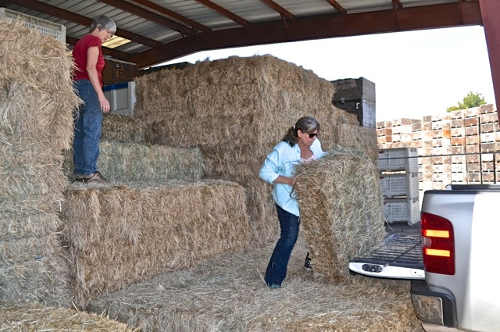
LAKE COUNTY, Calif. – For those community members with horses and other large animals needing help in the wake of the Valley fire, a North Coast nonprofit is continuing its efforts to make sure that animals are fed and their people have the supplies and tack needed in the days ahead.
Sonoma Action for Equine Rescue, or SAFER, is offering assistance in the form of feed for all types of large animals and livestock – horses, cows, goats, sheep, llamas – to Lake County residents affected by the Valley fire, and also have expanded that assistance to those impacted by the Rocky and Jerusalem fires before it.
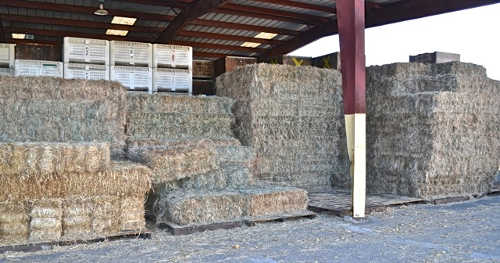
“We just have an enormous amount of hay and feed coming in,” said Kate Sullivan, who founded SAFER in 2007.
There also are bags of food like Equine Senior, and a wide array of donated tack, tools, tarps, some fencing and other supplies, Sullivan said.
Sullivan said they are increasing their local outreach – which has included social media, fliers at locations such as animal hospitals and outreach to groups around the state – to make sure that they have reached everyone who needs their help.
SAFER – also known in Mendocino and Lake counties as North Counties Horse Rescue – had an active presence in Lake County well before the fire, both on the side of animal rescue and assistance for owners trying to afford their horses through economically trying times.
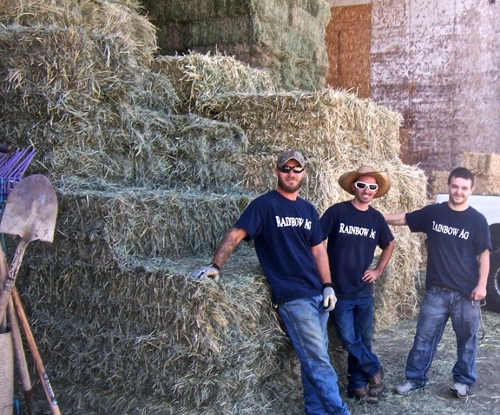
Several years ago, SAFER instituted its “Donate A Bale” program through Rainbow Ag, which offered assistance for horse owners trying to hold onto their animals during the depths of the recession.
The organization joined many other groups from across the region, California and even the nation in offering assistance to impacted animals after the Valley fire began its devastating sweep through southern Lake County on Sept. 12.
Sullivan said SAFER also has assisted victims of the Butte fire, which burned in Amador and Calaveras counties at the same time as the Valley fire.
SAFER has a number of public programs, one being the rescuing of horses directly from auctions, Sullivan said.
On the day the fire started Sullivan was heading home to Sebastopol from the Escalon Auction outside of Modesto with six horses she had purchased after outbidding a notorious meat buyer, and thinking she might take a break for a few days. Then she heard about the fire.
She soon was swinging into action to offer help, calling Jim Mayfield of Rainbow Ag the next day to make adjustments to the Donate A Bale program so that it could also serve evacuees, their horses and livestock.
That night, she followed up by sending out an online request to her extensive network of connections, seeking help for fire victims.
While she couldn't have guessed how enormous the need would be, neither could she nor her group have known how big the response would be.
Working closely with Sullivan is Carleene Cady of Lakeport, an equestrian and a retired nurse practitioner who was employed in a Sonoma County hospital emergency room, and whose multitasking abilities make her just the person for the job, according to Sullivan.
Cady calls the entire experience of working both with fire victims and those who want to help them “truly amazing.”
Help from far and wide
On Sept. 14, Scott Bell at Bell Ranching called Sullivan, wanting to donate a semi load of hay for the fire victims. However, Bell had a short window in which to deliver it, and Sullivan needed a place to store the hay.
She began making phone calls and was pointed toward Lake County Farm Bureau Executive Director Brenna Sullivan, herself an accomplished horsewoman.
By the next day, Brenna Sullivan secured a large shed at Adobe Creek Packing for feed storage. Adobe Creek Controller Shirley Campbell contributed the facility for long-term feed storage.
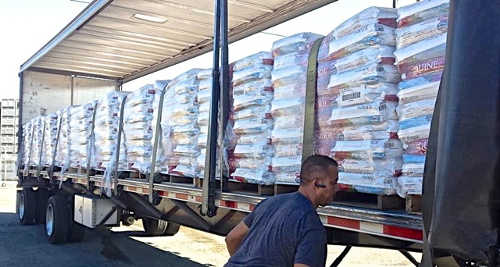
Other help also started coming in, such as a donation from Rainbow Ag and Purina of 24 pallets of Equine Senior, plus smaller loads from other donors, Kate Sullivan said.
From there, Sullivan said supplies started rolling out to those who needed them.
SAFER now has supply depots in both Kelseyville and Middletown, with fire survivors also able to access help through the Rainbow Ag stores in Lakeport and Ukiah, Sullivan said.
She recognized the ASPCA's equine division for its help, noting the organized quickly granted SAFER $5,500 for horse hay purchases.
Sullivan said North Coast Barns and 7-M Ranch came forward in the Middletown area to participate with SAFER's fire assistance program. She also recognized Kevin Tighe for all his work receiving and dispensing feed as well as his counsel on how best to serve the agriculture community at this time.
“Together we watched and listened anxiously as reports came in of sad losses and miraculous survivals amongst the families impacted by the fires. We are both humbled and delighted to be working with so many folks from all over Northern California who have come forward to help out fellow animal owners. It's a great community,” Sullivan said.
There has been so many offers of help that SAFER had to turn some donations down, Sullivan said.
Sullivan said Cady came on four days into the effort, working seven days a week coordinating the comings and going of more than $150,000 worth of hay, feed and other donations, while also arranging meetings with people at the depots to either take applications for assistance or to receive donations and give tax receipts to donors.
“She's just tireless,” Sullivan said of Cady.
Cady said a lot of hay has been trucked in from the Sacramento Valley. Equine groups like the Shoreline Riders of Fort Bragg have stepped up to offer tack, putting out the call for donations and then driving over from the coast to deliver five Western saddles, three English saddles, saddles pads and bridles.
Only one of the saddles is left, Cady said.
She recalled one woman coming in seeking tack, and when asked what kind of saddle she wanted, she said she was happy with any kind – she just wanted to ride her horse.
For those who have lost everything save their animals, it's the little things that have had great meaning, said Cady.
She said one person came in and picked up a hoof pick to clean their horse's hooves. “You would have thought it was worth $100,” she said of the usually inexpensive item.
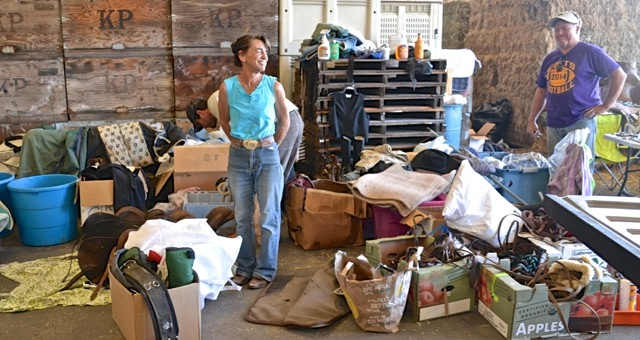
Another fire survivor became emotionally overwhelmed when she picked up a set of donated screwdrivers, noting she didn't even have that most basic tool, Cady said.
Cady said other donations have included shovels, tape measures, levels, pliers and duct tape. One person who came in gave an exclamation of delight at finding the duct tape, she said.
“These people have been so wonderful,” she said. “They don't want to take too much.”
The survivors also are optimistic, Cady said, and “are starting to get their feet under them a little bit,” and beginning the process of planning for the future.
“They're phenomenal,” she said.
She's been glad to help, calling it a rewarding but exhausting experience. Returning home after a busy day, she reminds herself that she is in her own house – something that isn't a fact for many of the people she is assisting.
She said those who come in seeking assistance are sharing their stories with her. “When bad things happen, sometimes you need to tell your story over and over,” she said.
Most of the people who have come to SAFER for assistance saved their animals, but then there are heartbreaking cases, like the woman who showed Cady pictures of the horses she lost.
“The people that lost animals, they've all said that was the worst,” beyond loss of houses, Cady said.
It's still not clear just how many large animals and livestock died during the fire or afterward as a result of their injuries. The California Office of Emergency Services reported that in the weeks after the fire, animal carcasses – including more than 100 cattle and five horses – were taken to a rendering plant.
Separately, Sullivan said they've heard of other animals that have died whose owners buried them at home.
Sullivan said that, as of this week, SAFER has fed more than 800 head of surviving cattle, at least 70 of the evacuee foster horses as well as contributing feed to Middletown Animal Hospital and Lake County Animal Care and Control.
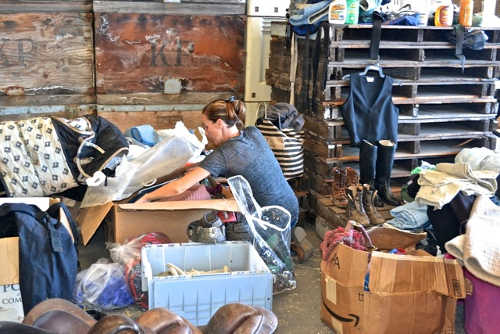
“We are still sending horse hay to major evacuation fosters as well as livestock ranches and will continue to do so as necessary,” she said. “We are also aware, however, that the local businesses that supply these folks also need to be supported and we plan to phase out support of those animals whose situations are resolved.”
Sullivan added that, for families who have lost everything, SAFER will be here as long as they are needed to help care for dependent animals while rebuilding takes place.
Cady said they continue to store hay, tack, some fencing and other supplies, with everything kept secure and protected from the weather so it can be available in the months ahead.
In the midst of its Valley fire efforts, SAFER is keeping busy with one of its core tasks – finding homes for horses in need.
Case in point: Remember those six horses that Sullivan rescued the day before the fire? She said they were vetted, trimmed and evaluated by a trainer, and four already have been adopted in the month since they were rescued from the meat buyer at the Escalon Auction.
For those who would like to assist SAFER, money can be donated by calling the Rainbow Ag store in Lakeport at 707-279-0550 and asking for the SAFER Fire Relief Account; a tax receipt will be sent.
To donate goods like hay and horse supplies or to request assistance, call Cady at 707-349-1993. Kate Sullivan can be reached at 707-824-9543.
Visit SAFER's Facebook page and its Web site, http://www.saferhorse.com/ , for more information about the organization and updates.
Email Elizabeth Larson at
LAKEPORT, Calif. – A central storefront for distributing the Valley fire donations that have poured in from around the country is set to open this week in Lakeport.
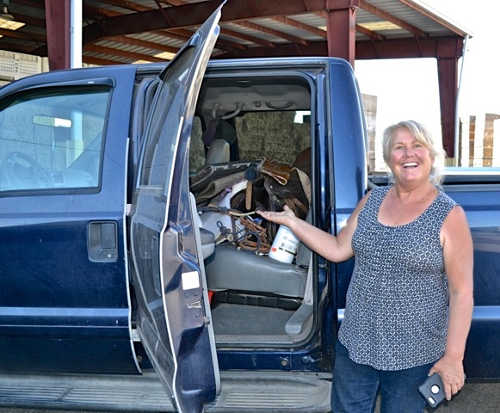
The “store” – which actually will offer donated goods at no cost to Valley fire victims – will open on Monday, Oct. 19, in the former Sears retail store at 857 11th St., next to the laundromat behind Round Table Pizza.
The store is being run by Adventist Community Services, according to Seth Cantu, who is a part of the pastoral team at the Upper Lake Seventh-day Adventist Church.
“We'll be open Monday for our first day,” said Cantu.
This week, the store will be open 10 a.m. to 5 p.m. Monday through Thursday as they work to finalize the schedule and make sure they have volunteers to cover all the hours, Cantu said.
Then, next weekend, regular hours will get fully under way, with the store to be open 10 a.m. to 5 p.m. Sunday through Thursday, Cantu said.
He said Sunday is being added to the schedule so that people who work have a chance to stop in over the weekend.
“In the beginning we really want to be there as often as we can for the people,” he said.
As time goes on, Cantu said survivors' needs will determine opening hours and days.
The 7,000-square-foot building has 5,000 square feet of display space and 2,000 square feet for stocking and sorting, Cantu said.
Cantu said the hub for handling donations – including sorting and storage – is at the Work Right building next to Lampson Airport.
County Deputy Administrative Officer Jeff Rein said the 66,000-square-foot Work Right building is filled with donations that are being sorted and that then will be transferred to the Lakeport storefront for free distribution.
Rein said the county has received donations from all 48 continental states. “As a result, the county has been inundated with donated clothing, personal items, household goods and the like and for the most part, material donations are more than sufficient to meet the need.”
He credited both Adventist Community Services and members of the local Church of Jesus Christ of Latter-day Saints for lending their time and expertise to achieving “significant progress” in organizing the consolidated approach to handling the donations.
Donations that had been collected by other organizations, such as the Clearlake Oaks Moose Lodge, the Middletown and Cobb Lions clubs, Middletown Bible Church, United Christian Parish, Clearlake Methodist Church and many others, are now being directed to the distribution center, according to Rein and Cantu.
When community members impacted by the fire visit the store, they will be asked to present a form of identification, as well as their pre-disaster address, their current address and information about their family, Cantu said.
That information, he said, will be used to help keep track of needs and assist with outreach, as well as ensure that people who need the items get them.
In addition to the Lakeport site, Rein said the county is attempting to find space in Cobb or Middletown – or both – to set up similar distribution points in the south county.
Email Elizabeth Larson at
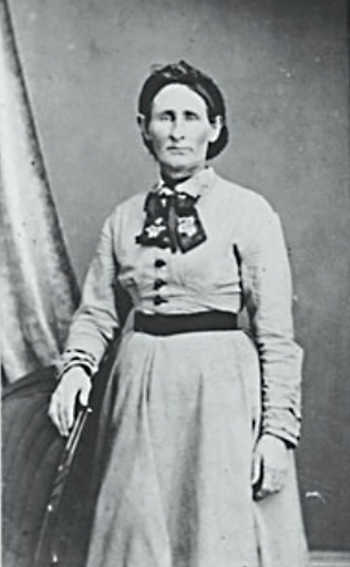
LAKE COUNTY, Calif. – In the first installment, I began telling the story of Kentucky-to-California pioneer, Nancy Kelsey, who was interviewed by her daughter in 1896.
The story was compiled by Roy M. Sylar.
Mrs. Kelsey and the Bidwell-Bartleson Party departed from Missouri in 1841. While in Nebraska the pioneer party dined on buffalo. The men in the group found it necessary to post night watchmen “who kept up a steady fire with their guns so the herds would split around the camp.” They lost a good number of their oxen team as they took off with the herds.
When the trail-weary travelers reached Soda Springs, the Bartleson Party and a missionary group split off to head to Oregon. Now, Nancy Kelsey had the distinction of being the only woman with the group of 32 men.
These became difficult times as the party traveled over the salt flat desert of the Great Salt Lake in search of “Mary’s River, “ which was depicted on Dr. John Marsh’s map. The story then states that they followed the Humboldt River believing it to be “Mary’s River.”
The Kelsey party eventually found their way to the Sierra Nevada Mountains, but not before abandoning their wagons and relying only on horseback as a means for their travels.
Mrs. Kelsey explained, “Of course we did not know where we were. The party scattered here to find the best way to descend the mountains. I was left with my babe alone, and as I sat there on my horse and I listened to the sighing and moaning of the winds through the pines, it seemed the loneliest spot in the world. The descent was so abrupt that an Indian, who had come to us on the mountain, was allowed to lead my horse for part of the way. At one place an old man of the party (George Hanshaw) became so exhausted, or nearly so, that they had to threaten to shoot him before he would proceed.
“At another place four pack animals fell over a bluff and we never tried to recover them,” she said. “They had gone so far that it was no use to think of it. We were then out of provisions as we had eaten all of our cattle. I walked barefoot until my feet were blistered. For two days I had nothing to eat but acorns. My husband came near dying of cramps and it was suggested we leave him out, but I protested and declared I would never leave him as long as there was life. We killed a horse and stayed over until the next day when he was able to go on.”
After this harrowing experience, and many more, the party found their way to the San Joaquin Valley. By November, with the aid of some Indian scouts they made it to Dr. John Marsh’s ranch in what is now Martinez.
When you think about the mountain roads we travel now, with today’s fine highways, then compare this to the pioneer travel of yesteryear, it’s amazing indeed to comprehend just what those hardy pioneers lived through to get west.
Mrs. Kelsey’s story gets a bit confusing to follow, at times, and understandably so. When you consider all of the events that took place, along with the consideration of her age and health at the time she recounted them, she does a remarkable job. Events have been compared with other journals written at the time to corroborate her stories.
It was December when the Kelseys found themselves at John Sutter’s Fort near the Sacramento River.
They were aided, once again by unnamed Indians, who spent 15 days rowing the weary travelers up the river.
Mrs. Kelsey stated, “This winter was a very wet one and in the spring of ’42, in April, we left the kitchen door of Sutter’s Fort and landed near Cache Creek where we camped all summer, killed deer and elk, and made Spanish boots out of their hides and saved the tallow.”
Then, like a scene from a Western movie, Mrs. Kelsey recounted a run-in with Salvador Vallejo, who ran cattle in Lake County and was the brother of General Mariano Vallejo of Sonoma.
She explained, “Salvador unarmed us and ordered us to be taken to the mission (in Sonoma), but our men stole into their camp that night and quietly recaptured their weapons and we returned to Sutter’s Fort. With the profits we made on this hunt, we bought one hundred cattle and took them to Oregon in the spring and summer of 1843.”
By 1845 the Kelseys had a home in Napa Valley. Mrs. Kelsey recalled, “We were in Napa Valley when the Mexican War, or the Revolution as we called it then, broke out (in 1846). My husband offered his service to Fremont (John Fremont).
“I was sent to Fort Sonoma and rode the distance horseback and carried a one month old babe in my arms. (The Kelsey’s fourth child.) I was so weak when I arrived at my destination that I could hardly stand up.
“I found Mrs. Vallejo at Sonoma. Her husband had been captured and sent to Sutter’s Fort.”
Nancy Kelsey went on to explain that she and another woman sewed shirts and baked bread for Fremont’s men at that time. According to the records, it wasn’t only shirts that she sewed. Nancy Kelsey, Mrs. Benjamin Dewell, and Mrs. Mathews helped make the famous Bear Flag for the Bear Flag Revolt in Sonoma.
The rest of Nancy Kelsey’s story continues to read like a “Who’s Who” of the American West, with anecdotes about Kit Carson’s half-brothers, Lindsay and Moses Carson. Lindsay and some of the other Carsons had a ranch in Lake County.
A true tale of the American West wouldn’t be complete without stories of the Gold Rush, which are also woven into the colorful tapestry of Nancy Kelsey’s true history.
When we consider the settlement of our state, we never want to overlook the grim inhumanities that occurred to the Native population along the way, which assault our senses today.
Ken Burns, PBS movie maker and historian, said, “America without the West is unthinkable now. Yet there was nothing inevitable about our taking it. Others had prior claim to its vastness, after all, and we could have quite easily have remained forever huddled east of the Mississippi. In resolving to move west and become a continental nation we would exact a fearful price from those already living on the land. But we also became a different people, and it is no accident that the turbulent history – and the myths that have grown up around it – have made the West the most potent symbol of the nation as a whole, overseas as well as in our own hearts."
Burns continued, “The story of the West was once told as an unbroken series of triumphs- the victory of “civilization” over “barbarism,” a relentlessly inspirational epic in which greed and cruelty were often glossed over as enterprise and courage. Later, that epic would be turned upside down by some, so that the story of the West became another –equally misleading- morality tale, one in which the crimes of conquest and dispossession were allowed to overshadow everything else that ever happened beyond the Mississippi. The truth about the West is far more complicated and much more compelling.”
Kathleen Scavone, M.A., is an educator, potter, writer and author of “Anderson Marsh State Historic Park: A Walking History, Prehistory, Flora, and Fauna Tour of a California State Park” and “Native Americans of Lake County.” She also writes for NASA and JPL as one of their “Solar System Ambassadors.” She was selected “Lake County Teacher of the Year, 1998-99” by the Lake County Office of Education, and chosen as one of 10 state finalists the same year by the California Department of Education.
LAKE COUNTY, Calif. – Seven hopeful dogs are waiting for adoption at Lake County Animal Care and Control.
Dogs available for adoption this week include mixes of cocker spaniel, pit bull terrier and terrier.
For those looking for lost pets as a result of the Valley fire, visit the Lake County Animal Care and Control Web site, which features additional dogs and cats that officials are looking to reunite with their families.
Dogs that are adopted from Lake County Animal Care and Control are either neutered or spayed, microchipped and, if old enough, given a rabies shot and county license before being released to their new owner. License fees do not apply to residents of the cities of Lakeport or Clearlake.
If you're looking for a new companion, visit the shelter. There are many great pets hoping you'll choose them.
In addition to the animals featured here, all adoptable animals in Lake County can be seen here: http://bit.ly/Z6xHMb .
The following dogs at the Lake County Animal Care and Control shelter have been cleared for adoption (additional dogs on the animal control Web site not listed are still “on hold”).
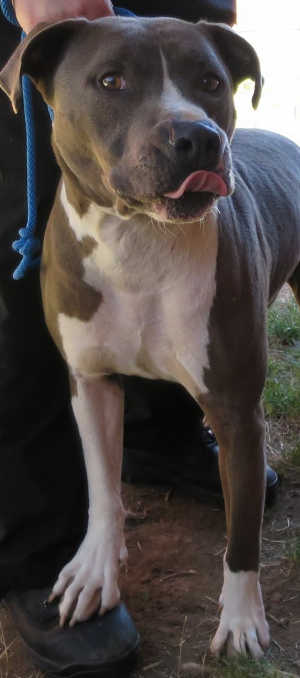
Male pit bull mix
This male pit bull terrier mix has a short gray and white coat.
He's in kennel No. 7, ID No. 3458.

'Digger'
“Digger” is a male terrier mix with a short tan coat.
He was found on Lakeview Drive in Nice.
He's in kennel No. 8, ID No. 3693.

'Tortia'
“Tortia” is a female pit bull terrier mix.
She has a short brown coat.
Tortia is in kennel No. 9, ID No. 3760.
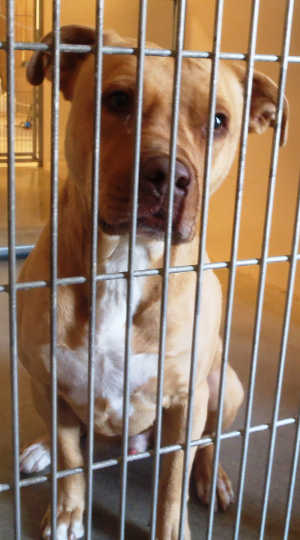
Male pit bull terrier
This male pit bull terrier mix has a short brown and white coat.
He was found in Clearlake Oaks.
He's in kennel No. 17, ID No. 3719.

'Sebastian'
“Sebastian” is a buff-colored male cocker spaniel.
His owner died and now he is looking for a new home.
He's in kennel No. 18, ID No. 3270.
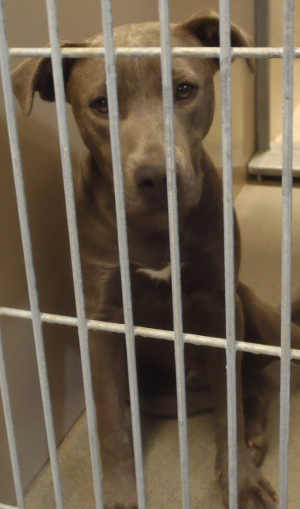
'Buddy'
“Buddy” is a male pit bull terrier mix with a short gray coat.
He was found on Lakeview Drive in Nice.
He's in kennel No. 25, ID No. 3694.
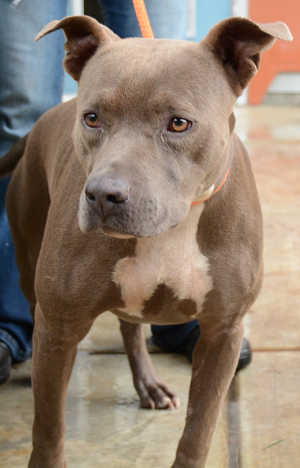
Female pit bull terrier mix
This female pit bull terrier mix has a short gray and white coat.
Shelter staff said she is a sweet dog.
She is in kennel No. 26, ID No. 3280.
To fill out an adoption application online visit http://www.co.lake.ca.us/Government/Directory/Animal_Care_And_Control/Adopt/Dog___Cat_Adoption_Application.htm .
Lake County Animal Care and Control is located at 4949 Helbush in Lakeport, next to the Hill Road Correctional Facility.
Office hours are Monday through Friday, 11 a.m. to 5 p.m., and 11 a.m. to 3 p.m., Saturday. The shelter is open from 11 a.m. to 4 p.m. Monday through Friday and on Saturday from 11 a.m. to 3 p.m.
Visit the shelter online at http://www.co.lake.ca.us/Government/Directory/Animal_Care_And_Control.htm .
For more information call Lake County Animal Care and Control at 707-263-0278.
Email Elizabeth Larson at
Scientists using NASA's Hubble Space Telescope have produced new maps of Jupiter – the first in a series of annual portraits of the solar system's outer planets.
Collecting these yearly images – essentially the planetary version of annual school picture days for children – will help current and future scientists see how these giant worlds change over time.
The observations are designed to capture a broad range of features, including winds, clouds, storms and atmospheric chemistry.
Already, the Jupiter images have revealed a rare wave just north of the planet's equator and a unique filamentary feature in the core of the Great Red Spot not seen previously.
“Every time we look at Jupiter, we get tantalizing hints that something really exciting is going on,” said Amy Simon, a planetary scientist at NASA's Goddard Space Flight Center in Greenbelt, Maryland. “This time is no exception.”
Simon and her colleagues produced two global maps of Jupiter from observations made using Hubble's high-performance Wide Field Camera 3.
The two maps represent nearly back-to-back rotations of the planet, making it possible to determine the speeds of Jupiter's winds. The findings are described in an Astrophysical Journal paper, available online.
The new images confirm that the Great Red Spot continues to shrink and become more circular, as it has been doing for years. The long axis of this characteristic storm is about 150 miles shorter now than it was in 2014.
Recently, the storm had been shrinking at a faster-than-usual rate, but the latest change is consistent with the long-term trend.
The Great Red Spot remains more orange than red these days, and its core, which typically has more intense color, is less distinct than it used to be.
An unusual wispy filament is seen, spanning almost the entire width of the vortex. This filamentary streamer rotates and twists throughout the 10-hour span of the Great Red Spot image sequence, getting distorted by winds blowing at 330 miles per hour or even greater speeds.
In Jupiter's North Equatorial Belt, the researchers found an elusive wave that had been spotted on the planet only once before, decades earlier, by Voyager 2. In those images, the wave is barely visible, and nothing like it was seen again, until the current wave was found traveling at about 16 degrees north latitude, in a region dotted with cyclones and anticyclones. Similar waves – called baroclinic waves – sometimes appear in Earth's atmosphere where cyclones are forming.
“Until now, we thought the wave seen by Voyager 2 might have been a fluke,” said co-author Glenn Orton of NASA's Jet Propulsion Laboratory in Pasadena, California. “As it turns out, it's just rare!”
The wave may originate in a clear layer beneath the clouds, only becoming visible when it propagates up into the cloud deck, according to the researchers. That idea is supported by the spacing between the wave crests.
In addition to Jupiter, the researchers have observed Neptune and Uranus, and maps of those planets also will be placed in the public archive. Saturn will be added to the series later. Hubble will dedicate time each year to this special set of observations, called the Outer Planet Atmospheres Legacy program.
“The long-term value of the Outer Planet Atmospheres Legacy program is really exciting,” said co-author Michael H. Wong of the University of California, Berkeley. “The collection of maps that we will build up over time will not only help scientists understand the atmospheres of our giant planets, but also the atmospheres of planets being discovered around other stars, and Earth's atmosphere and oceans, too.”
LAKE COUNTY, Calif. – The unemployment rate in Lake County dropped to the lowest level in more than a decade in September, with California's jobless rate also down while the national jobless rate remained flat.
Lake County's September unemployment rate in the Lake County was 6 percent, down from 6.5 percent in August, and below the year-ago estimate of 7.8 percent, according to data from two separate surveys released Friday by the California Employment Development Department.
California’s unemployment rate – derived from a federal survey of California households – decreased to 5.9 percent in September, dropping below 6 percent for the first time since November 2007, the Employment Development Department reported.
For comparison, the state’s August unemployment rate was 6.1 percent, and in September 2014, the unemployment rate was 7.3 percent, based on the report.
The Bureau of Labor Statistics reported that the U.S. unemployment rate was 5.1 percent in September, unchanged from August.
Lake County's 6-percent September unemployment is the lowest rate reported for the county since August 2001, when unemployment was 5.8 percent, according to a review of Employment Development Department data.
At the same time, Lake County's civilian labor force dropped from 30,980 people in August to 30,140 people to September, but still topped the 30,000 workforce members recorded in September 2014.
While thousands of people were impacted by the Valley fire in September, it's not yet clear how many jobs or workers were lost as a result, and at least preliminarily that drop in members of the workforce appears to be linked to industry patterns, particularly farming.
Between July and August the workforce grew from 30,040 to 30,980 people, while farming jobs grew from 1,310 to 1,840. Farming jobs subsequently dropped to 1,240 in September.
Jobs across all industries totaled 16,720 in September, down from 17,350 in August, the height of the county's pear season.
Total farm jobs declined by 32.6 percent, while all industries were down 3.6 percent.
In September, Lake County's 6-percent unemployment rate ranked it No. 34 statewide.
Lake's neighboring counties were ranked as follows: Colusa, 9.2 percent, No. 56; Glenn, 6.7 percent, No. 41; Mendocino, 4.6 percent, No. 13; Napa, 3.6 percent, No. 4; Sonoma, 3.8 percent, No. 6; and Yolo, 5.3 percent, No. 20.
San Mateo County had the lowest unemployment rate, 3 percent, while Imperial's 21.6 percent rate earned it the No. 58 ranking.
Details on state employment picture
California's nonfarm payroll jobs increased by 8,200 during September to total 16,199,000, for a total gain of 2,077,700 jobs since the recovery began in February 2010, according to a survey of 58,000 California businesses that measures jobs in the economy.
The year-over-year change – September 2014 to September 2015 – showed an increase of 444,300 jobs, up 2.8 percent, the report said.
The federal survey of 5,500 state households showed an increase in the number of employed people, estimating the number of Californians holding jobs in September was 17,884,000, an increase of 12,000 from August, and up 400,000 from the employment total in September of last year.
The number of people unemployed in California was 1,121,000 – down by 43,000 over the month, and down by 255,000 compared with September of last year, the Employment Development Department reported.
On Friday the Employment Development Department also reported that there were 343,419 people receiving regular Unemployment Insurance benefits during the September survey week, compared with 367,255 in August and 392,823 in September of 2014.
New claims for Unemployment Insurance were 40,821 in September, compared with 43,332 in August and 52,279 in September of last year, the state reported.
Email Elizabeth Larson at