 How to resolve AdBlock issue?
News
Winter is approaching. The early, wakeful sunbeams of summer are a fading memory as October mornings grow dark and cold. Frankly, waking up isn't as easy as it used to be ...
Except this week.
If you find yourself yawning over your morning coffee before sunrise, longing for repose, just take a look out the window. Three bright planets are converging in the eastern sky – and the view is an eye opener.
Look east before sunrise in late October for a beautiful conjunction of bright planets.
Every morning in late October, Venus, Jupiter, and Mars will rise in the east an hour or so before the sun. Together, they form a triangle in the pre-dawn sky.
Venus and Jupiter are the brightest vertices – visible even after the black pre-dawn sky turns cobalt blue.
Once you find them, you will have little trouble locating the dimmer Red Planet, which completes the triangle while the sky is still black.
Although any morning in late October is a good time to look, the six day stretch from Oct. 24 through the 29 is the best. That's because during this time, the triangle of planets will shrink until it is less than five degrees wide.
For reference, the bowl of the Big Dipper is about 10 degrees wide so two of these triangles would fit comfortably inside the bowl.
Of greater significance, however, is what you can see through binoculars. Typical binoculars can see a patch of sky about six or seven degrees wide. So when the triangle of planets shrinks to five degrees, they will all fit inside a binocular field of view.
Imagine looking through the eyepiece and seeing three planets – all at once. This rare and beautiful sight is what is waiting to help wake you up.
In addition to the planets are the moons, Jupiter’s moons: Io, Europa, Ganymede, and Callisto. Three or four of these giant satellites will typically be visible if the binoculars are held steady by leaning on something sturdy or by mounting them on a tripod. The configuration of the moons will be different every morning.
By the time October comes to an end, the planetary triangle will start breaking apart. But there are still two dates of special interest: Nov. 6 and 7. On those increasingly wintry mornings, the crescent Moon will swoop in among the dispersing planets for a loose conjunction guaranteed to dislodge the "sleep in your eyes."
On Nov. 6 it will be close to Jupiter. By Nov. 7 it is just past Mars and Venus.
Waking up before sunrise may not be so bad after all ...
CLEARLAKE, Calif. – The Clearlake VA Clinic will celebrate its fifth year of service to veterans of Lake and Mendocino counties on Monday, Nov. 2.
All veterans, their family and friends are invited for light refreshments in the lobby of the clinic – located at 15145 Lakeshore Drive in Clearlake – from 10:30 a.m. to 2 p.m. Nov. 2.
“This past six months has been very eventful for our community and clinic,” said Clinic Director Carol A. Brown, RN, BSN. “Please plan to visit, see how the clinic has grown, and hear about our vision for the future.”
For more information call the clinic at 707-995-7200.
Over the last two years, the California Department of Fish and Wildlife's Wildlife Investigations Lab, or WIL, has received more than 50 reports of sick or dead deer in urbanized areas from Siskiyou County to Fresno County.
Evidence collected from deer carcasses suggests that adenovirus hemorrhagic disease is one of the main causes.
While fatal to deer, it is not harmful to humans, livestock or pets.
“While the sight of sick or distressed deer can be unsettling, it’s not cause for alarm,” said CDFW Wildlife Veterinarian Ben Gonzales. “Occasionally, we see viruses run through various deer populations, especially those on the urban fringe. Many diseases are transmitted through direct contact and are worsened when deer congregate in small areas. It’s important for residents not to provide food or water sources for deer.”
Wildlife veterinarians and biologists are documenting outbreaks, but there are no treatments for most viral diseases. Many outbreaks will run their course through a population and then reappear sporadically.
Adenovirus symptoms include nasal and anal bleeding, foaming at the mouth, weakness and instability. It can strike fast and without warning.
Residents can see apparently healthy deer one day and find them dead the next morning. The public can report sick or dead deer to their CDFW Regional office.
Though deer and other species have to work harder to survive during drought conditions, they are equipped to survive and do not need handouts.
California’s deer population plays an important role in the ecosystem. They serve as prey species for predators and keep vegetation in check.
More information on living with deer can be found at www.keepmewild.com .
CDFW’s WIL monitors and manages population health issues in California’s native wildlife. It provides resources to field staff in assessing wildlife populations, mortality response, biological sampling, captures, rehabilitation and more.
Additional information and news can be found at www.dfg.ca.gov/wildlife/wil/ and https://calwil.wordpress.com/ .
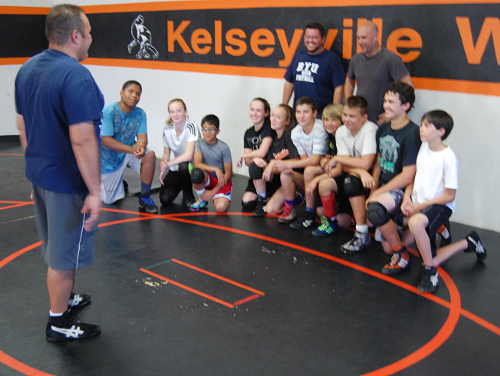
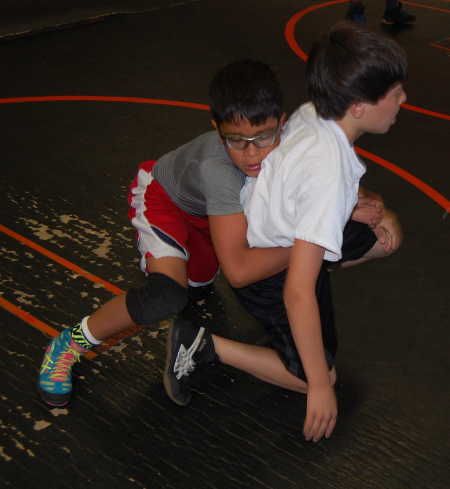
KELSEYVILLE, Calif. – What the girls in the little-known Lake County Wrestling Club want is a league of their own.
And what the Lake County Wrestling Club overall wants is, well, not to be little-known.
Adam Garcia, a California Highway Patrol officer who is a chief spokesperson for it, describes the club as a youth development organization that functions the way youth leagues serve as feeders for high school football or Little League does in baseball.
It was started by Garcia and outgoing Rob Brown, a longtime wrestling coach and county supervisor, which explains why the club is based at Kelseyville High School. Brown wrestled for Kelseyville in the 103-pound weight division.
“We’re trying to build the club as are most of the high school wrestling coaches, who are pushing for acceptance,” Garcia says. “I don’t think we’ve been that relevant for a number of years.
“And we’re trying to work under the radar. Elvis Cook (high school) and Ronnie Campos (wrestling club) are also helping with the wrestling. Brown keeps everything going and I’m helping him Kelseyville.
“We have about 20-some kids who come in at different times. The youngest kid is 5 and they go all the way up to 18.”
Weights run as high as 250 pounds.
The club, a countywide endeavor, originated as the Middletown Mat Rats. But the move was made because of the distance from Middletown to Kelseyville.
There are three neighborhood clubs in all, one for each section of Lake County – i.e. Kelseyville, Upper Lake and Lower Lake – according to assistant Kelseyville coach, Julio Ambriz.
What they do is develop skill sets for Lake County wrestlers to enable them to compete against counties among the 58 in California for honors at the section, state – and hopefully national – level.
“I don’t think anybody from our (North Central) league ever won a state (title) here in Lake County. Kelseyville, to my knowledge, has never had a section champion,” said Garcia who during the 1990s wrestled for the Lower Lake Trojans and has been an assistant wrestling and football coach for Lower Lake High School.
“We’ve never had a state or section champion at Kelseyville. So that’s the goal,” he added.
“League champions ... we’ve had plenty of those. State qualifiers ... we’ve had plenty of those. We want some section champions and state medals,” he said.
Garcia makes no secret of the fact that both of his sons – Alex, 14, and Brandon, 12 – are totally focused on bringing the first national wrestling medals home to Lake County.
“I think maybe the potential’s there,” said Garcia. “Alex has been dedicated during the summer and been in the weight room. Getting kids to come here and then work out and commit to something is hard.”
Alex has a dual objective. He is also being groomed as the Kelseyville junior varsity football team quarterback.
At the same time, Lake County girl wrestlers have grown weary of not having an organized structure.
Brown says he has talked to the county’s girl wrestlers about setting up tournaments. Could Lake County girl wrestlers indeed form a league of their own?
“Yes,” said Brown, “they could do it."

Twin wrestlers Korbyn and Kylie Ambriz estimate there are 30 to 36 female wrestlers in Lake County high schools.
“It would be very important to have a league to get more girls to come out,” said Korbyn.
“I think it would be good to compete against Windsor and Santa Rosa,” said Kylie. “It could only help us get better. I think that all of the different teams like Sacramento could really help us out for our competition.”
But, said Kylie, “You have to have the mindset for it and the will to do it. You’d have to be a leader.”
Girls never really had their own league here, said Garcia. ”But we’ve had a lot of interest from them, plus there’s a middle school program, thanks to Rob Brown.
“That’s the one thing I’m really proud of,” said Garcia. “We put time into – I don’t know if you call it a vision or not – to make it possible, Brown twisted the arm, so to speak, of the County Office of Education and talked to the supervisors and got them to approve. It’s been amazingly successful.”
Girls, said Brown, have always wrestled.
“They’ve always had one or two wrestlers,” he said. But until women’s wrestling was allowed in the Olympics it was just kind of a novelty. “Now they are an integral part of our team. Critical athletes.”
Brown noted that last year there were seven girls on the Kelseyville team, including his daughter Juliette, an outstanding wrestler.
Garcia noted that California and New Jersey are the only two states with one individual state champion in every weight class.
“There is only one champion in each weight in California, whereas you go to Nevada, Arizona or Washington they’ll have a champion based on school size. So you have five or six state champions in each weight class. When we go to ‘state’ it’s us against everybody,” he said.
Girls middle school wrestling in Lake County started just two years ago.
“The turnout with the girls is getting more and more,” said Ambriz.
“The opportunity for (middle-school) girls is large and attainable,” said Garcia. “It’s very exciting to see them picking up the sport.”’
The wrestling club has a third goal – the hard cases to which Ambriz devotes himself.
The worst-case scenario involved what Ambriz estimated was a sixth grader.
“I told him if you don’t do something to straighten yourself out you’re probably going to end up in jail,” he said. “That kid came over to our wrestling program for two years. The first year he had a really hard time. Then he actually won some matches and won a medal. I took a picture of him with his medal and then framed it and gave it to his family. It was like Christmas morning.”
Email John Lindblom at
HIDDEN VALLEY LAKE, Calif. – In the twilight hours of Saturday, Sept. 12, nearly everyone in Hidden Valley Lake and the adjoining area of the Ranchos was anxiously looking for a way to evade the Valley fire, which was closing with a rush and laying waste to everything in its path.
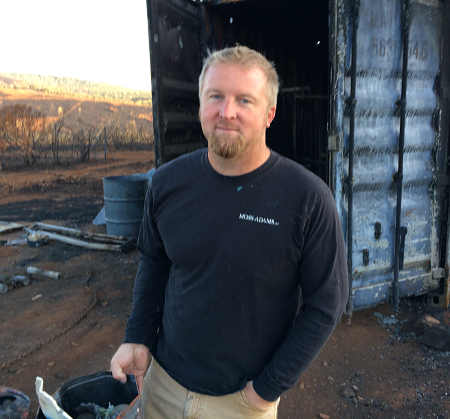
Shawn Harper, who had spent most of his 38 years of life there, was among them. In fact, he was seeking safety for seven residents of the area – five adults and two young boys – to avoid the devastating effects of a conflagration that has been declared a major disaster.
One of the most creative and amazing approaches to escaping the fire was the one taken by Harper: his next-door neighbor’s swimming pool.
“It was just a natural instinct,” said Harper, who knew he had to come up with a lifesaving measure quick after his efforts to secure gas for an alternate source of power were thwarted.
“The power went out around 6 p.m. and I ran down to get some gas so that we’d have power,” Harper added. “I was on my way down to the gas station and the fire hadn’t hit yet. I got down to the Hidden Valley baseball field on Hartmann Road. A small fire came up the hill and went into the Rancho area. Then I panicked and saw all the chaos of cars. They were stacked up trying to get out of here.”
Harper fought to protect his mother’s home on Honey Hill before racing back to his property to save what he could there. When he could fight no longer, he grabbed his children and ran to his childhood friend and neighbor’s house and told everyone to get into the pool.
Seven people did get in and were up to their noses in the water. But it was no cinch getting them there. The 81-year-old mother of one of Shawn’s neighbors resisted.
“She had a hard time getting in,” said Harper. “My mom and her son had to help her.”
Harper’s wife who works in in Santa Rosa was not present because the California Highway Patrol halted all vehicles at the Middletown city limits.
Besides the five adults and two boys, there were three dogs, one of which was in the pool, the others whimpering outside.
“The fire was a couple of hundred feet away,” Harper said, “but the winds were blowing and the flames from the vineyards were stretching and the air made it hard to breathe.”
Harper said that two outbuildings on his property were destroyed; one, a tool shed, he battled to try to save after the fire had passed.
Harper considered himself lucky. The log cabin that he and his parents built and which he grew up in was saved, as was his mother’s house.
But the affluent Ranchos area was hit by the fire as much as anyplace.
While the Ranchos are not owned by Hidden Valley Lake Association, Jim Freeman, the association's communications specialist, estimated that two dozen Ranchos units went up in flames.
Lives changed by loss
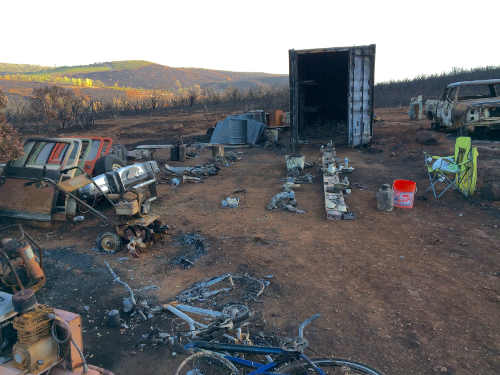
At last report, the Valley fire destroyed 1,958 structures, among them more than 1,300 homes, across the south county.
Thousands of lives have been changed by the fire, which for many took away nearly everything.
Said Dennis Jensen of Cobb, who taught art at Middletown High School for 30 years and coached football and wrestling, “We lost a cabin we’d had for 30 years.”
He continued, “I was not there when it burned. I was taking care of my little sister who was terminally ill and (eventually) died.”
Lawrence Forrest of Middletown felt helpless when he watched his home burn.
“The house we lost was more than a home. My wife and I spent 45 years of marriage there,” he said.
He lost a 1965 Chevy that belonged to his brother, along with a motorcycle, and much more. “I lost everything, including $50,000 worth of model engines. My model engine collection included engines from 1920 up to 1960 and was one of the finest collections on the West Coast, but I feel sorrier for my wife than I do me. She lost everything – the pictures of kids and the little Christmas tree ornaments that the kids made.”
Forrest was about to enjoy an anniversary dinner with his wife when he got a telephone call from a friend, tipping him off that a news program would carry a segment on Middletown’s burning.
“We watched our house burn down at my daughter’s house,” he said.
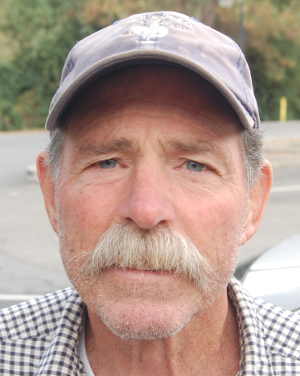
Gina Cantrell, a registered nurse from Middletown, had a home filled with a book collection that had taken her years to amass.
Cantrell had lived in her home for nine years, and had a custom bookcase made for what she estimated was a collection of 35,000 books.
“I had history, romance, science fiction and a really big collection of Issac Asimov,” said Cantrell. “But I lost everything I had.“
So did Anthony Carter, a car dealer, in Middletown.
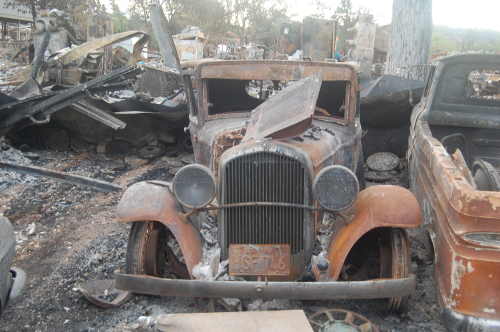
“We lost 11 vehicles including three Cadillacs. We also lost a ’31 Plymouth that belonged to grandfather,” said Carter.
Darlene Simmons of Middletown lost her home of 45 years, which her husband had built.
“Feel? How do you think I feel? My whole life – 60 years – I’ve lived in Middletown. I raised my children here. I spent my first Mother’s Day here. There were a whole bunch of roses in the yard that my husband planted years ago. And they were beautiful. But we lost everything,” she said.
But, she added, “Will I rebuild? You betcha.”
Email John Lindblom at

LAKE COUNTY, Calif. – Climate studies, more imperative than ever, abound both here on earth, and beyond.
Along with ongoing explorations of the Solar System, the National Aeronautics and Space Administration, or NASA, continues its investigations of our favorite planet, Earth, through its Global Precipitation Measurement Mission.
According to NASA, “Global Precipitation Measurement (GPM) is an international satellite mission to provide next-generation observations of rain and snow worldwide every three hours. NASA and the Japanese Aerospace Exploration Agency (JAXA) launched the GPM Core Observatory satellite on Feb. 27, 2014, carrying advanced instruments that will set a new standard for precipitation measurements from space.”
NASA further stated, “The GPM mission will help advance our understanding of Earth's water and energy cycles, improve the forecasting of extreme events that cause natural disasters, and extend current capabilities of using satellite precipitation information to directly benefit society.”
Michael Newland, staff archaeologist at the Anthropological Studies Center at Sonoma State University, has carried out extensive digs in many areas of Lake County, such as Anderson Marsh and McLaughlin Natural Reserve. Newland also is searching for evidence of past cultures along the California coast.
The nature of his studies has been altered by climate change, making it imperative that he document the past before the ocean waters rise and obliterate the past forever.
“We've got about 20 new sites in Marin and Monterey counties that we didn't know about before,” said Newland. “Some are in sand dunes and the wind has likely exposed them. Others are in areas that just haven't been explored before. There's about an even number of Coast Miwok ancestral sites and historic-era sites associated with ranching and maritime activities from the turn of the 20th century.
“In Monterey, Cabrillo College led the survey along the coastline in Los Padres National Forest,” Newland said. “While they didn't find any new sites, they did revisit a host of sites that hadn't been looked at in decades. In several cases, they noted that a lot of erosion had taken place, and some of the sites had large parts that had already fallen into the ocean. Coastal erosion would be hitting these sites regardless of climate change, but they are particularly in danger and we needed to get a benchmark as to what their preservation looked like.”
When asked about what he expected to find, Newland said, “Really, we expect to find the sorts of things that we have been finding. Coastal shell middens and small campsites, ranching, and fishing or ocean transport sites. Much of the California coastline is really only suitable for staying at during certain times of the year. We have this idea of a gorgeous coast, which is true, but it is often cold, windy, and foggy depending on where you are at. In many places, the villages are further inland, in more protected areas.
“But that's not always the case,” he continued. “Archaeologists are continually finding major village and habitation sites. We found a pretty robust one along the Marin coastline that was completely unexpected, and by the looks of it, it was buried and had been uncovered by some ranchers. I've been talking with folks from the Federated Indians of Graton Rancheria about visiting the site and looking at the potential for future impacts there.”
He said the Society for California Archaeology Web site has launched a Climate Change and Archaeology Web page that will track the development of the project.
“It's in the beginning stages, but I hope to have it really developed, with supporting documents,” Newland said. “ We are hoping to have a public report out through the National Park Service ... KQED in San Francisco has done two reports and I am anticipating more local news out on it.”
The need, or even yearning for natural surroundings, grows exponentially as global development encroaches.
The heartbreak of living on a landscape's wild edge, as we do here in Lake County, and intimately knowing its features are now and forever altered. We have been blessed to have been interlinked with our close-by wild territory.
As a county we mourn the tremendous losses incurred by the Valley Fire. We grieve, as so very many do, who live outside of Lake County, for the devastating loss of lives, homes, belongings and lifetimes of cherished memories that were nurtured within those homes.
Each patch of forest contained wildlife encounters and stories rich with each changing season. Life was made more vivid by the awareness of the mini-universe found just outside our doorsteps – from the towering trees down to the lowly insects.
As John Nichols says, “When a tree falls, the 'hole in the sky' it leaves behind … is a visible ghost.”
Having resided in beautiful Lake County for more than 40 years and been witness to the land that my children and I tramped, fished, explored and grew up upon – these many oak woodlands and pine forests – indescribably changed, it will take practice and much patience to enjoy the extremely altered landscape once again. But one day the ecstasy of the great outdoors will return to all of us.
Neighboring Cities sent comfort,
To the poor lone helpless ones,
And God will not forget them
In all the years to come.
Now the City of Chicago
Is built up anew once more,
And may it never be visited
With such a great fire no more.
From The Great Chicago Fire by Julia Ann Moore
Kathleen Scavone, M.A., is an educator, potter, writer and author of “Anderson Marsh State Historic Park: A Walking History, Prehistory, Flora, and Fauna Tour of a California State Park” and “Native Americans of Lake County.” She also writes for NASA and JPL as one of their “Solar System Ambassadors.” She was selected “Lake County Teacher of the Year, 1998-99” by the Lake County Office of Education, and chosen as one of 10 state finalists the same year by the California Department of Education.