 How to resolve AdBlock issue?
News

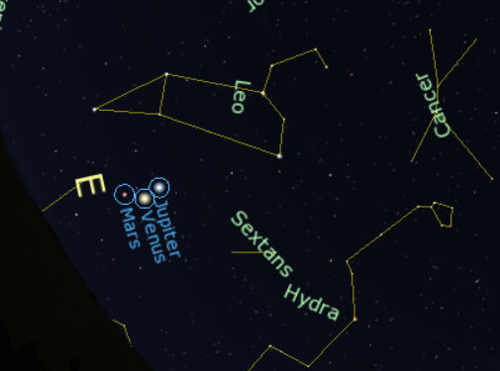
LAKE COUNTY, Calif. – This month we’ll spend some time exploring the constellations currently visible. Consult our star chart above as we begin our tour.
One of fall’s most striking constellations is Pegasus, the winged horse. You can find it by looking for the big square of Pegasus rising in the east.
Pegasus is one of the original 48 constellations identified by the 2nd century astronomer Ptolemy.
In Greek mythology, Pegasus was a magical winged horse that used its hooves to carve out a spring. Anyone who drank from the spring was blessed with the power to write poetry.

Our image of Pegasus shows the horse is flying upside down!
Below Pegasus is Pisces the fish. In Greek mythology, Pisces was the fish that carried Venus and her son Cupid to safety from the monster Typhon.
Below Pisces is Cetus the whale. Greek mythology has Cetus as a sea monster whom Perseus killed to protect the beautiful princess Andromeda.
To the west of Cetus is Aquarius, the water bearer. Aquarius is shown pouring water so that Pisces Austrinus can swim.
Pisces Austrinus, the southern fish, lies below Aquarius. The ancient Egyptians recognized this constellation and believed it represented the fish that saved the life of the Egyptian goddess Isis.
Finally, to the west of Aquarius is Capricornus, the sea goat. Capricornus is sometimes identified as Pan, the god with a goat's head, who saved himself from the monster Typhon by giving himself a fish's tail and diving into a river.

With the exception of Pegasus, all of the constellations we have seen are associated with water. Perhaps this is a good omen at a time when a strong El Niño is predicted, which is hoped will help alleviate the drought.
Other attractions in October include the Orionids meteor shower. This can best be seen after midnight on Oct. 21.
Finally, a rare grouping of 3 planets – Venus, Mars and Jupiter – will occur early in the morning of Oct. 28. Look to the east to see this.
John Zimmerman is a resident of Lake County and has been an amateur astronomer for more than 50 years. For more information about Astronomy and local resources, visit his Web site at www.lakecountyskies.com .
LAKE COUNTY, Calif. – Lake County Animal Care and Control is once again transitioning back to its normal animal control and shelter operations as the Valley fire winds down.
For weeks shelter staff have been working from rescue agencies from around the region, as well as the ASPCA, to evacuate, care for and house animals impacted by the 76,067-acre fire.
Director Bill Davidson said staff is getting back into normal hours, and going back to focusing on core operations including finding homes for animals.
The dogs offered for adoption this week include mixes of Chihuahua, cocker spaniel, Labrador Retriever, pit bull terrier and terrier.
For those looking for lost pets as a result of the Valley fire, visit the Lake County Animal Care and Control Web site, which features additional dogs and cats that officials are looking to reunite with their families.
Dogs that are adopted from Lake County Animal Care and Control are either neutered or spayed, microchipped and, if old enough, given a rabies shot and county license before being released to their new owner. License fees do not apply to residents of the cities of Lakeport or Clearlake.
If you're looking for a new companion, visit the shelter. There are many great pets hoping you'll choose them.
In addition to the animals featured here, all adoptable animals in Lake County can be seen here: http://bit.ly/Z6xHMb .
The following dogs at the Lake County Animal Care and Control shelter have been cleared for adoption (additional dogs on the animal control Web site not listed are still “on hold”).
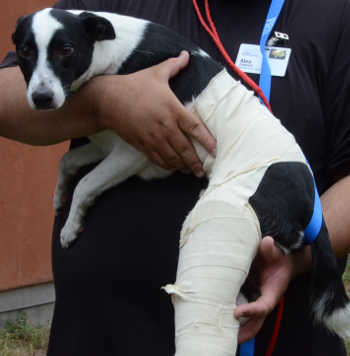
'Posey'
“Posey” is a male Labrador Retriever-terrier mix found on Lakeshore Boulevard in Lakeport.
He has a short black and white coat, and has an injured left rear leg.
He's in kennel No. 6, ID No. 3697.

'Sebastian'
“Sebastian” is a buff-colored male cocker spaniel.
His owner died and now he is looking for a new home.
He's in kennel No. 7, ID No. 3270.
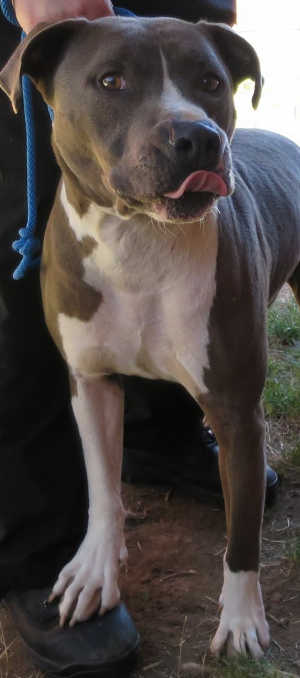
Male pit bull mix
This male pit bull terrier mix has a short gray and white coat.
He's in kennel No. 7, ID No. 3458.

Terrier mix puppies
The shelter has a litter of eight terrier mix puppies.
The pups have short coats in a variety of colors.
They are in kennel No. 8a, ID No. 3726.

Male pit bull terrier mix
This male pit bull terrier mix has a short brown and white coat.
He was found on Point Lakeview Road in Lower Lake.
He's in kennel No. 16, ID No. 3675.

Chihuahua-terrier mix
This male Chihuahua-terrier mix has a short brown and white coat.
He was found on Third Street in Kelseyville.
He's in kennel No. 23, ID No. 3677.
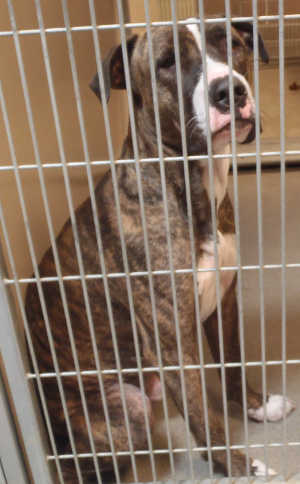
'Maverick'
“Maverick” is a male pit bull terrier mix.
He has a short brindle and white coat.
He's in kennel No. 28, ID No. 3228.

'Rocky'
“Rocky” is a male terrier mix.
He has a short black and white coat.
He's in kennel No. 32, ID No. 3667.
To fill out an adoption application online visit http://www.co.lake.ca.us/Government/Directory/Animal_Care_And_Control/Adopt/Dog___Cat_Adoption_Application.htm .
Lake County Animal Care and Control is located at 4949 Helbush in Lakeport, next to the Hill Road Correctional Facility.
Office hours are Monday through Friday, 11 a.m. to 5 p.m., and 11 a.m. to 3 p.m., Saturday. The shelter is open from 11 a.m. to 4 p.m. Monday through Friday and on Saturday from 11 a.m. to 3 p.m.
Visit the shelter online at http://www.co.lake.ca.us/Government/Directory/Animal_Care_And_Control.htm .
For more information call Lake County Animal Care and Control at 707-263-0278.
Email Elizabeth Larson at
LAKE COUNTY, Calif. – A historical documentary about Lake County's rich native cultural heritage has earned national and statewide recognition.
“A Walk Through Time: The Story of Anderson Marsh” will soon receive a Governor’s Historic Preservation Award and was also selected for the 2015 American Indian Film Festival.
The film was produced by the Advanced Laboratory for Visual Anthropology, or ALVA, at California State University, Chico.
“A Walk Through Time” explores the rich history of a group of the Koi people, a Pomo Indian tribe that settled near Clear Lake in Lake County more than 14,000 years ago.
The Koi people were the first to colonize the Anderson Marsh area, which is home to some of the most diverse wildlife and landscape in the state.
The film traces the Koi’s history and culture through the 1840s, when they were driven off their land by the influx of non-native settlers.
The film had its premiere at the Native American Day Gala in Clearlake on July 18, as Lake County News has reported. Actor/director Peter Coyote, was on hand for the event.
The 1,300-acre Anderson Marsh State Historic Park in 1982 was established to protect the area’s significant natural and historical resources. The marsh is also listed on the National Register of Historic Places for its prehistoric archeological significance.
The 28-minute film was produced this year in partnership with the California Department of Parks and Recreation and the Koi Nation of Northern California.
It was directed by ALVA lab technician Dan Bruns and produced by state park archaeologist Leslie Steidl, representatives from the Koi Nation and several consulting archaeologists. ALVA director Brian Brazeal served as executive producer.
“We are proud to have been able to tell the story of the Koi Nation, and we are gratified that the governor has recognized our work,” Brazeal said. “This film is the result of successful collaboration between a Native American nation, a state agency and an academic institution to preserve the history of a people and to educate the public. It teaches us about the glories of the ancient past, the injustices of the modern era and the possibility of a future based on the recognition of the sovereignty of native peoples.”
The Governor’s Historic Preservation Award is presented through the state’s Office of Historic Preservation and recognizes efforts to preserve, promote and highlight California history. The awards will be presented during a Nov. 19 ceremony in Sacramento.
The American Indian Film Festival is hosted by the American Indian Film Institute and is the nation’s oldest venue for American Indian film arts and entertainment. The 40th annual festival will be held Nov. 6 to 14 in San Francisco.
The Advanced Laboratory for Visual Anthropology was the first facility to use digital cinema technology in anthropological research and to communicate that research to broad audiences. The lab houses state-of-the-art filming, production and post-production equipment.
Since 2012, the lab has sought to partner with cultural resource management companies and public agencies to use film as a tool for public outreach and to share the results of their anthropological research with a wide audience.
Learn more about ALVA by visiting www.csuchico.edu/ALVA .
LAKE COUNTY, Calif. – If you applied for assistance from the Federal Emergency Management Agency and received a letter or text message saying you were not eligible for disaster aid, you should know that the first communication may not be the last word.
While applicants may be ineligible for FEMA disaster grants, they may receive assistance through the U.S. Small Business Administration (SBA).
And there may be an easy-to-resolve reason why some wildfire survivors received a notice stating that they are ineligible for assistance.
If you were informed that your application is “ineligible” or “incomplete,” more information may be needed, officials said.
A common reason for initially being ineligible for disaster assistance is that an applicant needs to provide FEMA with a copy of an insurance determination letter before a grant application can be processed.
Other reasons for a determination of ineligibility include:
• The applicant did not sign the required documents.
• The applicant did not prove occupancy or ownership.
• Applicant’s identity may not have been verified.
• The damage is to a secondary home or a rental property, not a primary residence.
• Someone else in the household may have applied and received assistance.
• Disaster related losses could not be verified.
Every applicant for federal assistance has the right to file an appeal. Appeals may be mailed, faxed or personally delivered to a Disaster Recovery Center (DRC) and must be received within 60 days of the date on the determination letter.
Applicants or someone they designate to act on their behalf must explain in writing why they believe the initial decision was wrong and provide any new or additional information and documents that support the appeal.
Applicants who have questions about filing an appeal can call the FEMA helpline at 800-621-3362; TTY 800-462-7585; 711 Relay or Video Relay Services, call 800-621-3362.
Appeals can be mailed to FEMA – Individuals & Households Program, National Processing Service Center, P.O. Box 10055, Hyattsville, MD 20782-7055.
Appeals can be faxed to 800-827-8112, Attention: FEMA – Individuals & Households Program.
Applicants may also visit a DRC, where specialists from FEMA and the SBA can help with appeals, answer questions, review applications and accept required documents.
The following DRCs are open in Lake County:
• Middletown Senior Center, 21256 Washington St. Hours of operation are Monday through 8 a.m. to 7 p.m., Monday through Sunday.
• Former Apria Health Care building, 14848 Olympic Drive, Clearlake. Hours of operation are Monday to Friday, 8 a.m. to 6 p.m.; Saturday, 8 a.m. to 5 p.m.; and Sunday, noon to to 4 p.m.
FEMA’s mission is to support our citizens and first responders to ensure that as a nation we work together to build, sustain and improve our capability to prepare for, protect against, respond to, recover from and mitigate all hazards.
The SBA is the federal government’s primary source of money for the long-term rebuilding of disaster-damaged private property.
SBA helps businesses of all sizes, private non-profit organizations, homeowners and renters fund repairs or rebuilding efforts and cover the cost of replacing lost or disaster-damaged personal property.
These disaster loans cover losses not fully compensated by insurance or other recoveries and do not duplicate benefits of other agencies or organizations.
For more information, applicants may contact SBA’s Disaster Assistance Customer Service Center by calling 800-659-2955, emailing

On Tuesday, Sept. 29, NASA's Curiosity Mars rover drilled its eighth hole on Mars, and its fifth since reaching Mount Sharp one year ago.
The drilling of the hole 2.6-inches deep in a rock the team labeled “Big Sky” is part of a multi-day, multi-step sequence that will result in the analysis of the Martian rock's ingredients in the rover's two onboard laboratories – the Chemistry and Mineralogy X-Ray diffractometer (CheMin) and the Sample Analysis at Mars (SAM) instrument suite.
“With Big Sky, we found the ordinary sandstone rock we were looking for,” said Curiosity Project Scientist Ashwin Vasavada. “It also happens to be relatively near sandstone that looks as though it has been altered by fluids – likely groundwater with other dissolved chemicals. We are hoping to drill that rock next, compare the results, and understand what changes have taken place.”
The analyses of the Big Sky rock-powder samples by CheMin and SAM will occur over the next week. Meanwhile, the team will be turning the rover's attention and its wheels towards the second rock, where the sample analysis process will begin anew.
Curiosity is currently on the lower slopes of Mount Sharp in a region covered in sandstone called the Stimson Unit.
Two weeks ago, still in the same general vicinity, Curiosity took a pair of long-range images toward higher regions of the mountain. In the foreground – about 2 miles from the rover – is a long ridge teeming with hematite, an iron oxide. Just beyond is an undulating plain rich in clay minerals. And just beyond that are a multitude of rounded buttes, all high in sulfate minerals.
The changing mineralogy in these layers of Mount Sharp suggests a changing environment in early Mars, though all involve exposure to water billions of years ago. The Curiosity team hopes to be able to explore these diverse areas in the months and years ahead.
Farther back in the image are striking, light-toned cliffs in rock that may have formed in drier times and now are heavily eroded by winds.
“The only thing more stunning than these images is the thought that Curiosity will be driving through those lower hills one day,” Vasavada said. “We couldn't help but send a postcard back to all those following her journey.”
NASA's Mars Science Laboratory Project is using Curiosity to assess ancient habitable environments and major changes in Martian environmental conditions.
NASA's Jet Propulsion Laboratory, a division of Caltech, built the rover and manages the project for NASA's Science Mission Directorate in Washington.
For more information about Curiosity, visit http://www.jpl.nasa.gov/msl , http://www.nasa.gov/msl and http://mars.jpl.nasa.gov/msl/ .
You can follow the mission on Facebook at http://www.facebook.com/marscuriosity and on Twitter at http://www.twitter.com/marscuriosity .
LAKE COUNTY, Calif. – The National Weather Service has issued a red flag warning and a wind advisory for Lake County and other portions of Northern California due to concerns for high winds on Saturday night and into Sunday morning.
Both the red flag warning and the wind advisory will be in effect from 5 p.m. Saturday to 11 a.m. Sunday, the National Weather Service reported.
A red flag warning means that critical fire weather conditions are either occurring or are anticipated. A wind advisory is issued when winds of 35 miles per hour are expected.
In the case of the potential for fire weather conditions, forecasters warned of lower humidity combined with strong winds that could create explosive growth potential for any fires that occur during the advisory period.
Forecasters said a strong and unseasonal low pressure system coming over the region from the Pacific Northwest is anticipated to bring strong, gusty winds and lower temperatures to Northern California.
North and northeasterly winds of between 25 and 35 miles per hour – with gusts up to 55 miles per hour over the region's higher terrain, are forecast, the agency said.
The National Weather Service said the strongest winds and lowest humidity areas will include the western parts of Shasta County, the interior Coast Range southward to Lake County, and the northern and central Sacramento valley.
Within Lake County specifically, the forecast predicts winds of as high as 48 miles per hour in the Cobb area, 45 miles per hour in Kelseyville, 25 miles per hour in Lakeport, 40 miles per hour in Lower Lake, 31 miles per hour in Lucerne, 44 miles per hour in Middletown and 25 miles per hour in Upper Lake.
Forecasters warned of the potential for winds to topple drought-stressed trees and damage power lines.
In areas hit by recent wildland fires, the winds also could create the potential to knock down burned and weakened trees.
Email Elizabeth Larson at