 How to resolve AdBlock issue?
News
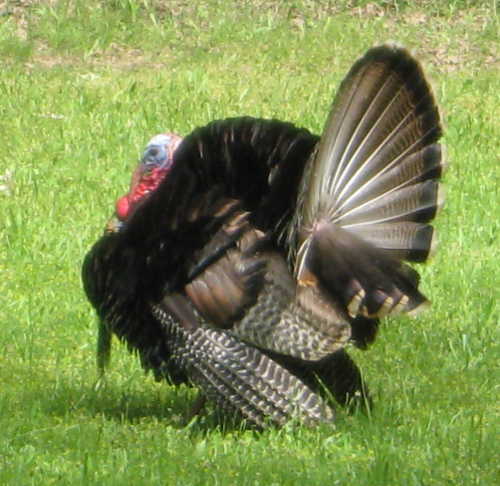
“We can only be said to be alive in those moments when our hearts are conscious of our treasures.” –Thornton Wilder
“Gratitude is not only the greatest of virtues, but the parent of all others.” – Cicero
LAKE COUNTY, Calif. – More than 150 years ago, when it formed from Napa County, in 1861, Lake County was just a shadow of what it is now, population-wise. Now, Lake County has around 64,000 residents.
The pioneers of Lake County, such as those who resided in our famed Stone House in Middletown constructed in 1853-54 by Robert Sterling, whose wife, of which the State Registered Landmark No. 450 plaque pronounces “was the first white woman in Coyote Valley” may not have even celebrated Thanksgiving.
Whether or not our local pioneers celebrated Thanksgiving is debatable, however most cultures past and present give thanks for a good harvest in the fall, whether it is within the context of a religious ceremony or as a cultural celebration.
Our country's Founding Fathers observed Thanksgiving as a day to feast and give thanks. The specific date to honor the harvest varied up through Lincoln's time.
President Lincoln determined, through presidential proclamation, that Thanksgiving be celebrated on the same date in all states. It took until after the Civil War for the proclamation to stick, into the 1870s.
Then in 1941 President Franklin D. Roosevelt worked with Congress to ensure that the holiday was honored on the fourth Thursday in November.
Farther back in history, the pilgrims at Plymouth Colony feasted, to be sure, but the main focus was a goose or duck instead of the now popular turkey.
Along with waterfowl they consumed wild turkeys, venison, corn bread, porridge and shellfish like lobster and mussels.
The typical turkeys, cranberries and pumpkin pies that have become staples of the holiday were made popular due to the New Englanders' abilities to grow and harvest these regional foods.
Apple cider was a popular beverage for the colonists. New Englanders consumed around 35 gallons each year, since it was believed that cider was more healthful – and cleaner – than water.
Wild turkey was enjoyed, along with the aforementioned venison and shellfish and was surely a welcome addition to the meal since the colonists' new digs were so foreign and taxing that first winter.

Since a variety of cranberry grows in some areas of Europe, the food may not have been a novelty to the colonists. Native peoples cultivated and consumed the ruby berries which were grown in a marsh, or bog, throughout history.
Boiled cranberries to which sugar was added with a side of boiled onions became popular as side dishes to the feast since before 1796.
Eating sweet potatoes with marshmallows became popular in the 1800s. That was when folks in the North discovered what those who lived in the South knew all along – that sweet potatoes provide a good accompaniment to a meal.
The creative culinary connoisseurs from France found that if the roots of the marshmallow plant, althaea, were combined with sweetened egg whites, it was a pairing extraordinaire, and that so sweet potatoes with marshmallow became de rigueur.
The colonists were well-versed in filling pie crusts with meats or fruits, so it was not a long segue for them to include pumpkin in those crusts.
The tradition of breaking the wishbone goes back well over 2,400 years, to the Etruscans. The Romans also wished upon chicken bones for good fortune. Pilgrims arriving at Plymouth Rock continued this custom with the abundant turkeys they hunted.
Kathleen Scavone, M.A., is an educator, potter, writer and author of “Anderson Marsh State Historic Park: A Walking History, Prehistory, Flora, and Fauna Tour of a California State Park” and “Native Americans of Lake County.” She also writes for NASA and JPL as one of their “Solar System Ambassadors.” She was selected “Lake County Teacher of the Year, 1998-99” by the Lake County Office of Education, and chosen as one of 10 state finalists the same year by the California Department of Education.
NORTH COAST, Calif. – The holidays are a busy and bustling time, which can lead to distracted driving and other consequences that will make your holiday season not so bright.
In the Caltrans News Flash shown above, the agency shares some important driving safety tips so that you can properly enjoy the holidays with those closest to you.
News Flash is a series of videos highlighting Caltrans’ activities that keep California’s transportation system moving forward.
For more information about the department’s activities, connect with Caltrans at http://www.dot.ca.gov/socialmedia .

Mars’ largest moon, Phobos, is slowly falling toward the planet, but rather than smash into the surface, it likely will be shredded and the pieces strewn about the planet in a ring like the rings encircling Saturn, Jupiter, Uranus and Neptune.
Though inevitable, the demise of Phobos is not imminent. It will probably happen in 20 to 40 million years, leaving a ring that will persist for anywhere from one million to 100 million years, according to two young earth scientists at the University of California, Berkeley.
In a paper appearing online this week in Nature Geoscience, UC Berkeley postdoctoral fellow Benjamin Black and graduate student Tushar Mittal estimate the cohesiveness of Phobos and conclude that it is insufficient to resist the tidal forces that will pull it apart when it gets closer to Mars.
Just as earth’s moon pulls on our planet in different directions, raising tides in the oceans, for example, so too Mars tugs differently on different parts of Phobos.
As Phobos gets closer to the planet, the tugs are enough to actually pull the moon apart, the scientists say. This is because Phobos is highly fractured, with lots of pores and rubble. Dismembering it is analogous to pulling apart a granola bar, Black said, scattering crumbs and chunks everywhere.
The resulting rubble from Phobos – rocks of various sizes and a lot of dust – would continue to orbit Mars and quickly distribute themselves around the planet in a ring.
While the largest chunks would eventually spiral into the planet and collide at a grazing angle to produce egg-shaped craters, the majority of the debris would circle the planet for millions of years until these pieces, too, drop onto the planet in ‘moon’ showers, like meteor showers. Only Mars’ other moon, Deimos, would remain.
Different moons, different fates
Black and Mittal, both in UC Berkeley’s Department of Earth and Planetary Science, were drawn to the question of what might happen to Phobos because its fate is expected to be so different from that of most other moons in our solar system.
“While our moon is moving away from earth at a few centimeters per year, Phobos is moving toward Mars at a few centimeters per year, so it is almost inevitable that it will either crash into Mars or break apart,” Black said. “One of our motivations for studying Phobos was as a test case to develop ideas of what processes a moon might undergo as it moves inward toward a planet.”
Only one other moon in the solar system, Neptune’s largest moon, Triton, is known to be moving closer to its planet.
Studying such moons is relevant to conditions in our early solar system, Mittal said, when it’s likely there were many more moons around the planets that have since disintegrated into rings – the suspected origins of the rings of the outer planets.
Some studies estimate that during planet formation, 20-30 percent of planets acquire moons moving inward and destined for destruction, though they would have long since disappeared. Some of Mars’ several thousand elliptical craters may even have been formed by remnants of such moonlets crashing to the surface at a grazing angle.
When tidal stresses overcome rock strength
To estimate the strength of Phobos, Black and Mittal looked at data from similarly fractured rocks on Earth and from meteorites that struck Earth and have a density and composition similar to Phobos.
They also constrained the strength of Phobos based on results from simulations of the 10-kilometer diameter Stickney impact crater, which formed in the past when a rock rammed into Phobos without quite smashing the moon apart.
That crater spans about one-sixth the circumference of Phobos and looks as if someone took a scoop out of the moon.
Once they determined when and how they expected tidal forces to tear Phobos apart, Mittal modeled the evolution of the ring, adapting techniques developed to understand Saturn’s rings.
“If the moon broke apart at 1.2 Mars radii, about 680 kilometers above the surface, it would form a really narrow ring comparable in density to that of one of Saturn’s most massive rings,” Mittal said. “Over time it would spread out and get wider, reaching the top of the Martian atmosphere in a few million years, when it would start losing material because stuff would keep raining down on Mars.”
If the moon breaks up farther from Mars, the ring could persist for 100 million years before raining down on Mars, they found.
Mittal said it’s not clear whether the dust and debris rings would be visible from earth, since dust does not reflect much sunlight, whereas ice in the rings of the outer planets makes them easily visible.
But Mars’ ring may reflect enough light to make Mars slightly brighter as seen from Earth, he said, and through a telescope the shadows of the rings might also be visible on the surface.
“Standing on the surface of Mars a few tens of millions of years from now, it would be pretty spectacular to watch,” Black said.
Robert Sanders writes for the UC Berkeley News Center.
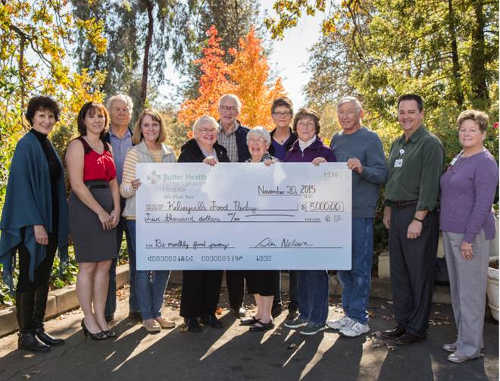
LAKEPORT, Calif. – Sutter Health partnered with Sutter Lakeside Hospital to make a $10,000 donation to the Kelseyville Food Pantry and the Lake County Hunger Task Force as part of a larger donation of $255,000 by the Sutter Health system to benefit 27 food banks across Northern California, Oregon and Hawaii.
Over the past seven years, Sutter Health’s donations to community food banks have totaled more than $1.6 million.
“This is a tradition that Sutter Health and Sutter Lakeside Hospital continue year after year,” said Siri Nelson, Chief Administrative Officer, Sutter Lakeside Hospital. “We’re proud to partner with organizations like the Kelseyville Food Pantry and the Hunger Task Force to help feed families in need this holiday season, and recognize the work they do year-round to serve our county.”
The Kelseyville Food Pantry is a coalition of volunteers, supported by local churches, which hosts a food pantry on the second and fourth Wednesday of each month for needy families.
“We are thankful for Sutter Lakeside Hospital’s generosity,” said Lyn Hilton of the Kelseyville Food Pantry. “We rely on donations of food and money from people in our community to support our efforts of feeding an average of 220 families each month.”
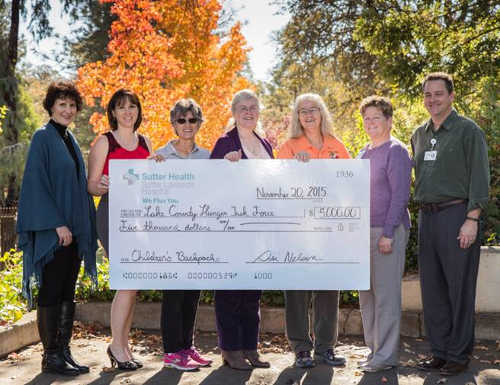
The Lake County Hunger Task Force is a non-profit organization that tracks Lake County hunger statistics and obtains resources to fill identified needs. Sutter’s donation will go towards its backpack project, an initiative intended to feed children when they’re not at school.
“We are so thankful for the opportunity to support such impactful organizations,” said Nelson. “We look forward to a future of partnership to enhance the well-being of our shared community.”
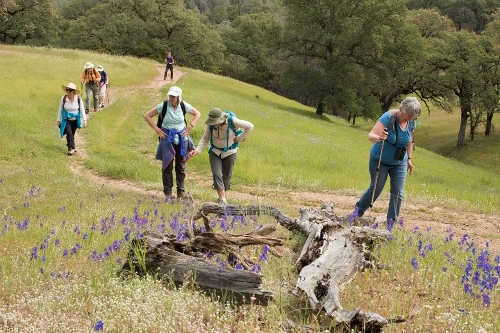
NORTHERN CALIFORNIA – Like a lot of folks, I want to get outdoors and feel more connected to our local wild areas, But in my older years I just don’t have the stamina or desire to do a hike that is too strenuous for me. I just want to find some place that’s interesting to look at and easy to walk through.
Luckily, we have some really remarkable “go-to” places in and around the new Berryessa Snow Mountain National Monument.
First, there’s the Fremont Weir State Wildlife Area in Yolo County.
The wildlife area itself is relatively flat and comprised of riparian habitat, oak woodlands and annual California grasses.
It contains a variety of native trees like oaks, willows and cottonwoods, and critters such as muskrats, deer and river otters.
It’s also touted to be an “awesome” place for birding. Pheasant, valley quail and waterfowl are often found here.
One word of warning: the area is a floodplain for the Sacramento River, so you can’t enter it when the river is at flood stage.
To get there: take Interstate 5 toward the Yolo Bypass, and find County Road 22. Turn east onto County Road 22 and take the first left, County Road 117, over the railroad tracks. Travel on County Road 117 for 5.8 miles and turn left (west) on County Road 16 (unpaved). County Road 16 will terminate at the parking lot on the east levee of the Fremont Weir Wildlife Area. Park at the top of the levee, and hike north along the levee, until you reach the weir. There are no developed trails, so the distance can be as far as you like.
Then you might try out the Redbud Trail in Lake County. This is an “out and back” trail, so you can go as far as you want.
The trail winds up to Perkins Ridge where you get a fabulous view of the main fork of Cache Creek and Brushy Sky High Mountain.

Once you reach Baton Flat, the trail crosses the creek and heads to the Wilson Valley. On this trail you might get a glimpse of tule elk. Fall is the rutting season for the elk, so you may hear the males bugling. This is an area where black bears may also be seen.
This hike is particularly interesting now as it was burned in the Rocky fire. You’ll be able to see how some places burned really “hot” and others
burned “cooler” and going out to the trail now will give you some idea of how wildfires affect an ecosystem.
Taking “before” photographs now, and “after” photographs in the spring (when the wildflowers will be in bloom) will demonstrate for you the incredible resiliency of nature.
To get there: Take Highway 20 and follow it into Lake County until you cross over the bridge at the North Fork of Cache Creek. Look for the Redbud Trail and Cache Creek Management Area sign on the side of the road. Turn into the parking area there.
Finally, you can try out the East Shore Trail at Lake Berryessa in Napa County.
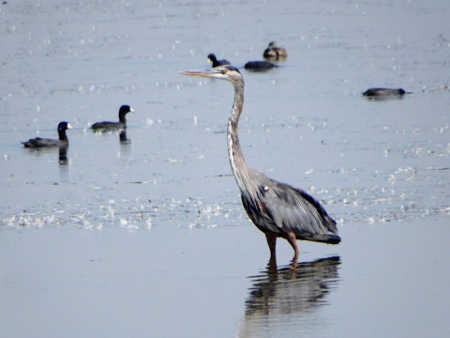
The east shore is an undeveloped wildlife area backed by cattle ranches. A large variety of raptors and waterfowl may be viewed along the shoreline including white pelicans, golden and bald eagles, western grebes, cormorants and many species of ducks. This time of year there are lots of migrating birds to be seen.
The well-maintained gravel East Shore Ranch and Fire Access Road allows public access for almost six miles of the shoreline starting from the Knoxville-Berryessa Road and extending south to a turnaround loop. Short trails lead from each gate to the shore.
Note: The somewhat confusing "closed area" signs mean only that the area behind the sign is closed to off-road vehicle use. Unless otherwise noted, foot access is allowed and hikers are welcome.
See? Many can be about relaxing and enjoying the outdoors at your own pace. So get out there, get some fresh air and exercise, and get connected with your public lands.
Check out Tuleyome’s Web site at www.tuleyome.org for more trails and hiking information.
Tuleyome is a 501(c)(3) nonprofit conservation organization based in Woodland, Calif. Mary K. Hanson is a Certified California Naturalist and author of “The Chubby Woman’s Walkabout” blog. For more information on Tuleyome, visit www.tuleyome.org .

LUCERNE, Calif. – Northshore Fire has a new piece of equipment to help keep the community safe.
The district has taken delivery of its new water tender, a 2015 Freightliner truck built by Florida-based Pierce Manufacturing.
Northshore Fire Chief Jay Beristianos said the water tender cost just over $238,000.
The new water tender, which goes by the number 9011, was primarily funded by a $194,072 grant from the Federal Emergency Management Agency's Assistance to Firefighters Grants program.
The grant, which the district received over the summer, was written by Pat Brown, who retired earlier this year from his deputy chief post with the district. Brown said he had tried for several years before his grant application was successful.
The new vehicle is a kind of tank truck firefighters use to bring water to areas where there aren't hydrants or other readily available water sources.
The grant required that the vehicle cost at least $203,000, with a $9,700 match from the district. For the district to get the top quality, lasting equipment it needed, Beristianos said it was decided to spend more than that base amount.
Like its predecessor, the new water tender holds 3,000 gallons of water, Beristianos said. What's new is that it has an additional 3,000 gallon portable tank.
The old vehicle was 1989 model with more than 600,000 miles. It was a converted construction water tender with a 13-speed manual transmission. That earlier truck was top heavy and difficult to drive, and so it was hard to find qualified operators, Beristianos said.
The new water tender is an automatic and handles nicely. Beristianos said Pierce Manufacturing had it driven to Lake County from Florida.
The district has sold the old water tender to a local contractor who is now using it for work in the Valley fire area, Beristianos said.
The grant required that the old equipment be sold with a stipulation that it cannot respond any longer to 911 calls. The idea, Beristianos said, is to get old, outdated equipment out of the fire service.
The new water tender will be based in Upper Lake. The district's second water tender, 7511, is a 2010 model at the other end of the district, in Clearlake Oaks, Beristianos said. That truck has about 12,000 miles on it.
Beristianos said the district is looking forward to updating other emergency equipment.
In mid-December, the district expects to take delivery of a new ambulance for its Lucerne station. Beristianos said the district has four frontline ambulances and two older backup models.
In 2016 there are plans to buy another new ambulance, which Beristianos said would gave all of the stations ambulances less than 10 years old – an important update considering the amount of use the district's ambulance get.
He said two new defibrillator units, costing a total of $72,000, recently were purchased to put on district ambulances, in an attempt to have the best, most state-of-the-art equipment for the community they serve.
He said a donation a few years ago from SuperLotto winner Tony Velasquez of Clearlake Oaks had funded other new defibrillator units.
Email Elizabeth Larson at