 How to resolve AdBlock issue?
News
Californians have reduced water use by 27.1 percent in the five months since emergency conservation regulations took effect in June, continuing to meet Governor Edmund G. Brown Jr.’s 25 percent mandate despite a decline in the statewide water-savings rate for October.
In October, when outdoor water use – and the opportunity for significant savings – typically drops off from the hot summer months, the statewide conservation rate was 22.2 percent, down from 26.4 percent in September.
Adding to the challenge, October brought temperatures that were well above normal for most of the state.
Nonetheless, average statewide water use declined from 97 gallons per person per day in September to 87 in October.
“We anticipated a dip in the conservation rate for October, but it is not because people are losing interest – they actually did quite well considering how unusually hot it was in October,” said Felicia Marcus, chair of the State Water Resources Control Board.
“It’s harder to keep the percentages up in the fall and winter when little outdoor watering takes place,” Marcus said. “That’s why the savings over the summer were so important. Now, we need to keep finding ways to save water. While El Nino storms may bring significant rain this winter, the depth of our drought and the uncertainty of the amount, type, and location of precipitation means we have to continue conserving every way we can. In other words, unless we get a ton of snow in the Sierras that lasts through April, every drop saved today is one we’ll be glad we have tomorrow.”
A public workshop to discuss concepts for a renewed urban water conservation regulation has been set for Dec. 7.
he current drought emergency water conservation regulation adopted by the board in May expires in February 2016.
Last month, the governor issued an additional executive order giving the State Water Board authority to extend and revise the emergency water conservation regulations.
State Water Board is soliciting public comment on what the next iteration of the regulation will look like. Following public review and comment, the Board tentatively plans to adopt the updated regulations by late January or early February.
At the same time, the State Water Board is reminding small water suppliers (those with 3,000 or fewer customers) that they are required to report water use by Dec. 15. While large urban suppliers have been required to report water conservation information every month, small water suppliers must report only once.
The regulations state that small water suppliers must limit outdoor landscape irrigation to no more than two days per week or reduce total potable water production by 25 percent as compared to 2013. The full report of information submitted by small water suppliers is expected to be available by mid-January 2016 here.
The State Water Board tracks water conservation for each of the state’s urban water suppliers on a monthly basis, but compliance with individual water supplier conservation requirements and the statewide 25 percent mandate is based on cumulative savings.
Cumulative tracking means that conservation savings will be added together from one month to the next and compared to the amount of water used during the same months in 2013.
October conservation data
For June through October, the cumulative statewide reduction was 27.1 percent, compared with the same months in 2013. That equates to 913,851 acre-feet (297.8 billion gallons), or 76 percent of the 1.2 million acre-feet savings goal to be achieved by the end of February 2016.
Statewide water savings for October was 22.2 percent (128,901 acre-feet or 41.9 billion gallons), a decrease from September’s 26.2 percent savings. See fact sheet here.
Statewide, the average water use for October was 87 residential gallons per capita per day (R-GPCD), a decrease from the 97 residential gallons per capita per day reported for September.
Although October 2015 had the lowest level of monthly savings since June 2015, suppliers still saved more than three times the volume of water saved in October 2014.
The last five months have been the hottest on record and October was no exception, with higher average temperatures than October 2013.
Enforcement data
Suppliers reported 69,999 compliance and enforcement actions taken in October, a decrease from the 77,868 actions suppliers reported in September. See the enforcement statistics for more information.
The Office of Enforcement continues to work with suppliers that have not met their conservation standard.
Since June, the State Water Board has issued nine conservation orders; 104 information orders; 72 warning letters; four administrative civil liability complaints and seven alternative compliance orders.
October saw a decrease in compliance by water suppliers. Of the 409 suppliers reporting for October, 69 percent met or were within one percentage point of meeting their conservation standard and 15 percent were between one and five percentage points of meeting their standard.
Conservation must continue through winter
Residential water users are urged to keep up their efforts to conserve through the winter months. That includes complying with urban water supplier directives to switch to watering schedules of once a week as well as a prohibition against watering during a rain event and 48 hours directly following a rain event.
“We can’t know when the drought will end, so we have to keep saving every drop we can,” Chair Marcus said. “Predictions are just that, predictions. Having the odds in our favor, can give us hope, but not the certainty we need to relax our efforts.”
Conservation programs put in place during the late spring and early summer months by most of the state’s water suppliers have yielded dramatic reductions in water use and a reexamination of personal water-use habits.
In addition to many effective local programs, state-funded turf removal and toilet replacement rebates are also now available. Information and rebate applications are available at www.saveourwaterrebates.com/ .
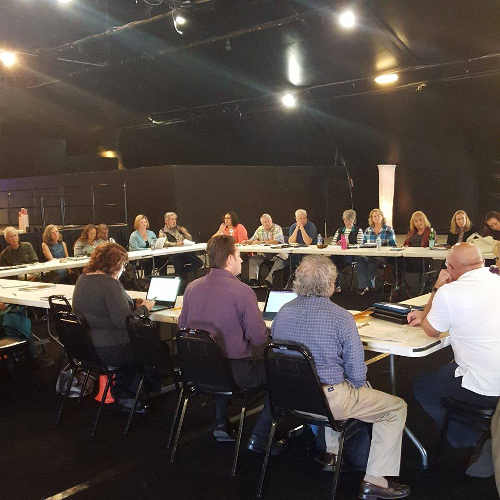
LAKE COUNTY, Calif. – With the Valley fire long subsided and the rains starting to come, Lake County is turning its attention toward long-term recovery from the summer wildfires that destroyed hundreds of homes and tens of thousands of acres.
A major player in that recovery process is Team Lake County (TLC), a volunteer-led long-term recovery group.
Recognized by the National Voluntary Organizations Active in Disaster (NVOAD), TLC is comprised of non-governmental agencies, faith-based groups and interested individuals, and seeks to identify needs and fill gaps in services across all impacted areas of Lake County.
TLC has elected a board consisting of 11 members which is chaired by Shelly Mascari, director of Community Wellness at Adventist Health.
In addition to officers, the board is comprised of representatives from each TLC committee, including volunteer, finance, donations, construction/housing, case management, spirituality and counseling, communications, and community assessment committees.
Each committee meets regularly and reports on progress at the board meetings, which take place at the Twin Pine Casino & Hotel in Middletown.
The next meeting is Friday, Dec. 18, at 10 a.m.
"Our focus through TLC is long range – a marathon and not a sprint,” says Mascari. “We are committed to supporting our communities and individuals in the months and even years ahead to rebuild.”
According to TLC Communications Committee Chair Erroll Marchais, “As a network of nonprofits and business organizations active in our community, TLC is in a unique position to coordinate the vast local and national resources available to aid in Lake County's recovery.”
Participating TLC partners offer services at no charge to fire survivors, including needs assessments, housing assistance, spiritual guidance, insurance consulting, and property clean up.
These services are funded exclusively by donations and grants, and the TLC board votes on how to allocate funds.
For example, TLC is working with Habitat for Humanity to expand the reach of home repairs and new construction for low-income families. Funds provided through TLC will never need to be paid back, nor will any labor or other costs be charged as part of the services provided.
In order to efficiently raise and disburse funds, TLC sought fiscal sponsorship from North Coast Opportunities (NCO), a 501c3 organization that serves as the Community Action Agency for Lake and Mendocino Counties.
NCO had previously responded to the fires through the Lake County Wildfire Relief Fund, which disbursed $1.42 million in direct aid to over 1,000 fire survivors.
Intended for emergency relief, the fund closed on Nov. 2, and NCO has since shifted its focus to long-term recovery efforts.
As the fiscal sponsor for TLC, all additional funds raised go straight to TLC to be voted on by the board.
“People know a donation to NCO will go directly to fire survivors,” said NCO Executive Assistant Elizabeth Archer. “Partnering with TLC lets us channel all additional funds raised into recovery efforts done for the community, by the community.”
Donations are still being accepted at Mendo Lake Credit Union, Tri Counties Bank, and Savings Bank of Mendocino County.
NCO Executive Director Patty Bruder is the finance committee chair, and she agrees that the partnership between NCO and TLC is a perfect fit.
“We’re so proud to be part of this team, and we know that by working together we can be efficient, avoid duplicating efforts, and maximize available resources to have the highest possible impact. It’s pretty exciting,” said Bruder.
It's a learning process for all of us, but our hearts are here,” added Mascari. “We believe that together Lake County will become even stronger than before the Valley Fire."
To learn more about TLC, visit www.teamlakecounty.org or www.facebook.com/teamlakecounty .
To donate to long-term relief efforts, visit www.ncoinc.org .
MIDDLETOWN, Calif. – The men and women who dedicate their careers to educating Lake County's students were honored at an annual awards ceremony in late November.
The Lake County Office of Education hosted the 21st Annual Excellence in Education Awards Ceremony on Friday, Nov. 20, at Twin Pine Casino & Hotel in Middletown.
This event honored the county teacher of the year, district teachers of the year, as well as others who have positively impacted education in Lake County.
Lake County Assistant Superintendent of Schools April Leiferman was the master of ceremonies for the event.
“In every school, during every era, the children, staff, and parents create a mini culture unique to them,” Leiferman said. “Over time, each of these cultures provides all the material needed for a dramatic mini-series. You can find heroes, tragedies, comedies, laughter, tears, and especially learning in many dimensions.”
This year’s honorees include teachers of the year from the county's school districts.
Elisa Prather received honors including Lake County Teacher of the Year and Lakeport Unified School District Teacher of the Year.
Cheryl Mostin was named Kelseyville Unified School District Teacher of the Year, Pam Ingersoll was named Konocti Unified School District Teacher of the Year, Megan Grant was honored as Lucerne Elementary District Teacher of the Year, Sue Olsen is Middletown Unified School District Teacher of the Year, Clarinda Higgins is Upper Lake Union Elementary School District Teacher of the Year and Paul Holt is Upper Lake Union High School District Teacher of the Year.
Classified employees of the year include Eduardo Ledesma, Kelseyville Unified; Barb Denno, Konocti Unified; Tracy Columbi, Lakeport Unified; Marilyn Bingham, Middletown Unified; Mechelle Finney, Upper Lake Union Elementary; and Buddy Thomas, Upper Lake Union High.
In addition, Pamela Hobbs received the Early Childhood Educator of the Year Award and Tim Gill was named Administrator of the Year by the Association of California School Administrators.
Annie Mills works for the Lake County Office of Education.
The California Department of Water Resources on Tuesday announced an initial 2016 allocation of 10 percent for customers of the State Water Project.
Depending upon the amount of rain and snow that reaches California this winter, the allocation may be increased or decreased.
If dry conditions continue into a fifth year of drought, DWR may reallocate State Water Project, or SWP, supplies to meet critical human health and safety needs.
Despite early season storms, California continues to face severe water shortages with record low levels in some reservoirs, including Folsom Lake near Sacramento.
Lake Oroville in Butte County, the SWP’s principal reservoir, is dipping toward its record low of 882,000 acre-feet set on Sept. 7, 1977.
Oroville, which supplies a percentage of the water for 25 million Californians and just under a million acres of irrigated farmland, is holding only 929,151 acre-feet, 26 percent of its capacity of 3.5 million acre-feet and 43 percent of its historic average for the date.
Shasta Lake north of Redding, California’s and the federal Central Valley Project’s (CVP) largest reservoir, is at 29 percent of its 4.5 million acre-foot capacity, 49 percent of its historical average for this time of year.
San Luis Reservoir, a critical south-of-Delta pool for both the SWP and CVP, is at 19 percent of its 2 million acre-foot capacity, 32 percent of average for the date.
Folsom Lake, a CVP reservoir, is holding a record low 136,980 acre-feet of its 977,000 acre-foot capacity. The reservoir’s previous low was 140,600 acre-feet on Nov. 20, 1977.
Low reservoir levels mean there is plenty of room for runoff from El Niño-driven storms should they develop, but even an extremely wet winter would not return conditions – especially groundwater levels – to normal after four consecutive dry years.
“No matter how hard it’s raining, we need to remember to use water wisely and sparingly,” said DWR Director Mark Cowin. “Our historic drought has lasted for years and isn’t going to quickly be washed away.”
The 29 public water agencies that receive SWP water (State Water Project Contractors) requested 4,172,786 acre-feet of water for 2016.
Under Tuesday's initial allocation, they will receive 422,848 acre-feet. For most agencies, that amounts to 10 percent of the supplies for which they contract with DWR.
It is important to note that nearly all areas served by the SWP also have other sources of water, among them streams, groundwater and local reservoirs.
DWR is hopeful that Tuesday's SWP allocation, made before the wettest months, will increase as storms bring rain and snow to the state. But drought may continue to be the reality.
This calendar year’s (2015) 20 percent allocation is the second lowest since 1991, when agricultural customers of the SWP got a zero allocation and municipal customers received 30 percent. In 2014, SWP deliveries were five percent of requested amounts for all customers.
The last 100-percent SWP allocation – difficult to achieve even in wet years because of Delta pumping restrictions to protect threatened and endangered fish species – was in 2006.
SWP allocations in recent years are as follows: 2014 – 5 percent; 2013 – 35 percent; 2012 – 65 percent; 2011 – 80 percent; 2010 – 50 percent; 2009 – 40 percent; 2008 – 35 percent; and 2007 – 60 percent.
UPPER LAKE, Calif. – Five board members have been selected to lead the new district created by the unification of Upper Lake's elementary and high school districts.
The boards of the Upper Lake Union Elementary School District and the Upper Lake Union High School District voted unanimously to unify this spring, as Lake County News has reported.
Lake County Superintendent of Schools Brock Falkenberg appointed Keith Austin and Claudine Pedroncelli, who currently sit on the high school district board, and current elementary school board members Mel O'Meara, who was just reelected to the elementary school board in a district election Nov. 3, Diane Plante and Don Meri.
The Lucerne Elementary School District chose not to take part in the unification and will continue to serve kindergarten through eighth grade students independently.
The Lake County Board of Education – sitting as the County Committee on School District Organization – approved the unification at its Oct. 21 meeting.
The official date of unification will be July 1, 2016.
Falkenberg said he appointed the five board members after the California Board of Education approved waivers for the election process that gave him the selection power at its meeting in early November.
“If the state had not approved those waivers, this would have gone to an election,” Falkenberg said.
While he waited for the state board to take its vote, Falkenberg said he began accepting letters of interest from community members wanting to serve on the new district board.
Altogether 12 letters were submitted, Falkenberg said. Once the state approved the waivers, he moved forward with the selection process.
Falkenberg said he formed a selection panel that consisted of former local school superintendents including Chris Thomas, who had worked for the Lake County Office of Education; Bill MacDougall, retired Konocti Unified School District superintendent; and Wally Holbrook, Falkenberg's predecessor as county superintendent.
On Nov. 10, Falkenberg said all 12 applicants were interviewed and the selections made.
He said the new board's first meeting is scheduled for 6 p.m. Tuesday, Dec. 15, at the Upper Lake High School Library, 675 Clover Valley Road.
That meeting will be mostly for the purposes of organization, including establishing meeting dates and times, and electing officers, he said.
Falkenberg said the new board also is expected to meet in closed session at that time to discuss the process for hiring the new district's superintendent.
The contracts with Upper Lake Elementary Superintendent Valerie Gardner and Upper Lake High School Superintendent Patrick Iaccino will be null and void at the end of the school year, said Falkenberg.
The direction the new district board can take in hiring a superintendent “is really wide open,” he said.
Falkenberg said the new board could hire a consultant to fill the job on an interim basis, contract with the Lake County Office of Education temporarily or hire one of the existing superintendents.
In interviews earlier this year, district officials reported that Gardner was planning to retire in 2016, with Iaccino intending to retire in June 2017, when his current contract originally was set to end. That would make him available to lead the district during its first year.
“They really could do whatever they want,” said Falkenberg, but a decision needs to be made as soon as possible due to the amount of work that must be completed over the next several months, ahead of the July 1 unification date.
Along with the new board, the existing elementary and high school boards will remain in place until June 30, the end of the school year, Falkenberg said.
So far, based on the timelines Iaccino, Gardner and Falkenberg had given this spring, everything is on track and on schedule, Falkenberg said.
“That doesn't mean it hasn't been hectic,” he said.
And the County Office of Education is far from done with its involvement in the process he said.
“There's all kinds of work to be done in establishing a new district,” Falkenberg said.
Last week, the County Office of Education submitted a packet to the California Board of Equalization to make sure the tax base is appropriate for the new school district, he said.
Officials also must establish the new district with the California Department of Education, set up software systems to serve the new district, and merge and update financial data systems, according to Falkenberg.
For his office and for the Upper Lake districts, “It's quite a workload ahead of us,” he said.
Email Elizabeth Larson at
LAKE COUNTY, Calif. – Rain is expected to arrive in Lake County on Tuesday night and continue through much of the rest of the week, according to forecasters.
Following a weak weather system that brought some rain – and even a little snow and sleet – to parts of the county on Monday, the National Weather Service is predicting that more rain is on the way.
Forecasters are predicting a 20-percent chance of showers on Tuesday night and again on Wednesday morning, when rainfall totals are expected to reach up to a tenth of an inch. A 20-percent chance of showers also is forecast for Wednesday night.
On Thursday, as a larger storm hits the region, chances of rain are up to 100-percent in Lake County, according to the National Weather Service's forecast.
Rain is expected to continue on Thursday night – with a 40-percent chance – with a chance of showers also on Friday morning, the agency said.
Conditions are expected to clear from Friday night through Saturday night, with chances of showers once again in the forecast from Sunday through Monday, based on the seven-day forecast.
Nighttime temperatures over the next week are forecast to be in the high 30s, with daytime temperatures across the county expected to be in the mid 50s, with some light winds.
Email Elizabeth Larson at