 How to resolve AdBlock issue?
News
KELSEYVILLE, Calif. – In an attempt to educate and protect young local drivers, the Clear Lake Area office of the California Highway Patrol will offer a free “Start Smart” traffic safety class on Tuesday, Dec. 22.
The class will take place from 6 to 8 p.m. at the Clear Lake Area CHP office, 5700 Live Oak Drive in Kelseyville.
The CHP offers the class for soon-to-be licensed, newly licensed and teenage drivers and their parents or guardians.
The leading cause of death for Americans 15 to 19 years old is motor vehicle collisions, according to the National Highway Traffic Safety Administration, and the CHP's goal is to reduce the death rate among young drivers as the result of these collisions.
“The CHP is committed to mitigating traffic collisions involving young, inexperienced drivers, because they are preventable,” said Lt. Hector Paredes, commander of the CHP's Clear Lake Area office. “'Start Smart' is an excellent program that promotes safe driving for young new drivers.”
The CHP’s “Start Smart” program is aimed at helping newly licensed and future licensed teenage drivers understand the critical responsibilities of driving and to understand that accidents happen, but collisions are 100-percent preventable.
The program is designed to provide an interactive safe driving awareness class which will illustrate how poor choices behind the wheel of a car can affect the lives of numerous people.
“Start Smart” also focuses on responsibilities of newly licensed drivers, responsibilities of parents or guardians and collision avoidance techniques.
Space is limited for this class. For more information or reservations, call Officer Kory Reynolds at the Kelseyville CHP office, 707-279-0103.
LAKE COUNTY, Calif. – Lake County Animal Care and Control has several new cats needing homes this week.
Available are cats in a variety of ages, coat types and colors.
In addition to spaying or neutering, cats that are adopted from Lake County Animal Care and Control are microchipped before being released to their new owner. License fees do not apply to residents of the cities of Lakeport or Clearlake.
If you're looking for a new companion, visit the shelter. There are many great pets there, hoping you'll choose them.
In addition to the animals featured here, all adoptable animals in Lake County can be seen here: http://bit.ly/Z6xHMb .
The following cats at the Lake County Animal Care and Control shelter have been cleared for adoption (other cats pictured on the animal control Web site that are not listed here are still “on hold”).
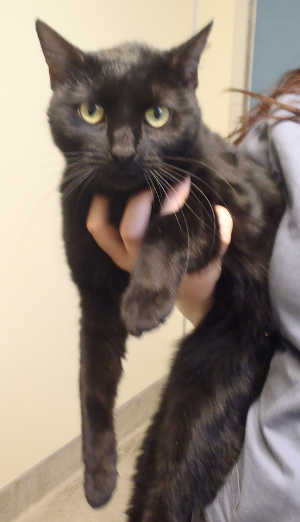
'Binx'
“Binx” is a domestic long hair cat with a black coat.
Her owners were victims of the Valley fire who had to give up her because they no longer had a place to keep her.
She's in cat room kennel No. 19, ID No. 4067.

Gray tabby kitten
This female gray tabby kitten has a short coat.
She's in cat room kennel No. 66, ID No. 4084.
This male domestic short hair mix is in cat room kennel No. 74, ID no. 4075. Photo courtesy of Lake County Animal Care and Control.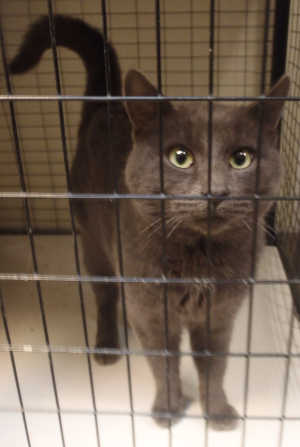
Domestic short hair mix
This male domestic short hair mix has an all-gray coat.
Shelter staff said he is very sweet and just wants attention.
He is in cat room kennel No. 87, ID No. 4065.
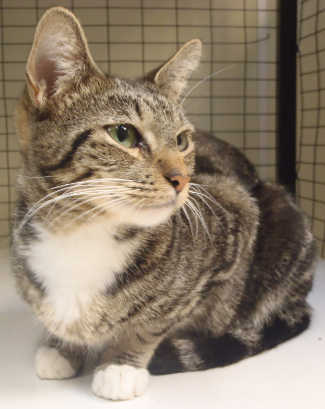
'Mom'
“Mom” is a domestic short hair mix.
She has a gray tabby coat with white markings.
Mom is in cat room kennel No. 110a, ID No. 4076.
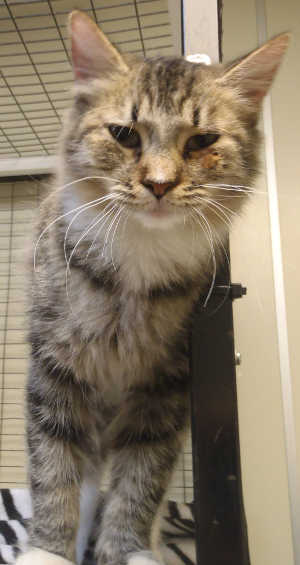
Domestic medium hair mix
This female domestic medium hair mix has a gray tabby coat.
Shelter staff said she likes to cuddle and be petted, and would make a great house cat.
She's in cat room kennel No. 119, ID No. 4068.
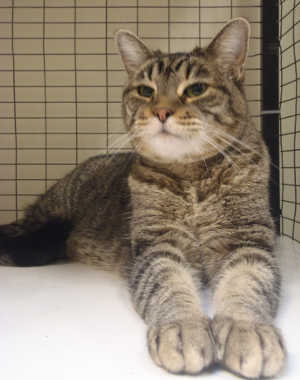
'Mia'
“Mia” is a female domestic short hair mix with a gray tabby coat.
Shelter staff said she would be great in a home with no other cats.
She's in cat room kennel No. 125, ID No. 4054.
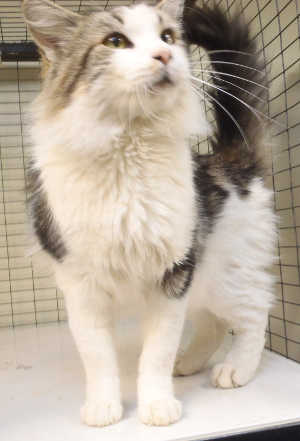
Domestic long hair mix
This male domestic long hair mix has a gray tabby and white coat.
Shelter staff said he's super sweet, and likes to be cuddled and held.
He's in cat room kennel No. 150, ID No. 4059.
Adoptable cats also can be seen at http://www.co.lake.ca.us/Government/Directory/Animal_Care_And_Control/Adopt/Cats_and_Kittens.htm or at www.petfinder.com .
Please note: Cats listed at the shelter's Web page that are said to be “on hold” are not yet cleared for adoption.
To fill out an adoption application online visit http://www.co.lake.ca.us/Government/Directory/Animal_Care_And_Control/Adopt/Dog___Cat_Adoption_Application.htm .
Lake County Animal Care and Control is located at 4949 Helbush in Lakeport, next to the Hill Road Correctional Facility.
Office hours are Monday through Friday, 11 a.m. to 5 p.m., and 11 a.m. to 3 p.m., Saturday. The shelter is open from 11 a.m. to 4 p.m. Monday through Friday and on Saturday from 11 a.m. to 3 p.m.
Visit the shelter online at http://www.co.lake.ca.us/Government/Directory/Animal_Care_And_Control.htm .
For more information call Lake County Animal Care and Control at 707-263-0278.
Email Elizabeth Larson at
CLEARLAKE, Calif. – The Clearlake Planning Commission this week will meet to discuss updates to the 2040 Clearlake General Plan.
The commission, sitting jointly as the Parks and Recreation Committee, will meet beginning at 6 p.m. Tuesday, Dec. 1, in the council chambers at Clearlake City Hall, 14050 Olympic Drive.
Under business, the commission will hear about the 2040 general plan update orientation and status, and get an overview of proposed changes to the draft, which includes the general plan document, the general plan background report and the general plan environmental impact report.
The changes include updates to the land use, circulation, noise, safety and conservation (cultural resources) elements.
The meeting also will include a workshop on the general plan update, with a review of the general plan land use and circulation maps, reviews of growth forecasts and economic and housing assumptions, and an overview of policies and programs.
Other items on the agenda include the timeline for completing the general plan update, the status of the zoning code update and design review manual, and summary of next steps, with times for questions and comments.
Email Elizabeth Larson at
120115 Clearlake Planning Commission agenda packet
MIDDLETOWN, Calif. – Work on drainage improvements on a former geothermal waste collection site is set to begin this week near Middletown.
The 460-acre property, formerly operated by Geothermal Inc. from 1976 to 1986, is located at 19020 Butts Canyon Road.
It had been used to collect wastes including plant and sump water, drilling muds and drill cuttings.
Pacific Gas and Electric – one of the companies that had used the facility and which took over responsibility for its maintenance in 2003 – gave a presentation to the Middletown Area Town Hall in June on plans for improvements at the site, as Lake County News has reported.
More details about that meeting can be found at www.bit.ly/1JPwfci .
PG&E reported that beginning on Monday, and continuing into January, it will be conducting fieldwork at the site to improve the water drainage.
That work will include drilling soil borings around the landfill perimeter, excavating a trench adjacent to the landfill and installing a drainage pipe, PG&E reported.
PG&E said neighbors of the landfill can expect to see construction equipment – including a drill rig and trucks – at the landfill over the next two months.
Company spokesman Brian Swanson said they installed piezometers at the site to measure the groundwater levels beneath the landfill ahead of the work.
“We did that work in September with the intention that we'll come back around this time to install the drainage,” he said.
As for the impact of the Valley fire, “The fire did not delay the work,” Swanson said.
“There's a fire break around the site that helps,” he said, noting the fire may have brushed up against the edge of that break.
The work at the site is being overseen by the Central Valley Regional Water Quality Control Board.
Email Elizabeth Larson at
LUCERNE, Calif. – The annual “Big Read” event in Lake County culminated last month in an event featuring a prestigious panel of legal and historical experts who explored the issue of race relations and civil rights in the South.
The panel was held Oct. 23 at Marymount California University's Lakeside Campus – known as “The Castle” – in Lucerne.
The Lake County Big Read focused this year on Harper Lee's famed novel, “To Kill a Mockingbird.”
The panel, moderated by local businessman and historian Bernie Butcher, presented three speakers who put “To Kill a Mockingbird” and its contemplation of race relations into a historical, legal and personal context.
Stanford University Professor of History Emeritus David M. Kennedy, the winner of the 2000 Pulitzer Prize for “Freedom from Fear: The American People in Depression and War,” would offer the historical perspective, discussing race relations in the United States from 1619 forward.
U.S. District Court Judge William Alsup is a Mississippi native, a graduate of Mississippi State University and Harvard Law School graduate and had been clerk for Supreme Court Justice William O. Douglas before going on to be named a district court judge in 1999. He offered his personal experience having grown up in the South and the impact of Lee's work on his career path.
Kelseyville attorney Peter Windrem, a Lake County native, spoke about his experience as a student at the University of the Pacific in Stockton, where he was recruited to take part as a Freedom Rider in 1963. He later would receive his law degree from the University of Virginia before returning to Lake County to practice law.
Butcher also offered commentary on Lee's new book, “Go Set a Watchman,” which gives a different – and highly controversial – view of the famed literary figure, attorney Atticus Finch.
Alsup told Lake County News later that he was expecting a group of about 40 people. Instead, more than 120 – many of them high school and college students – filled the room, and he called the degree of interest “a pleasant surprise.”
“It shows that the upcoming generation pays attention to important national issues,” he said. “Race provided the focus of Harper Lee's two books, and pervaded the South in my time there, and still influences our country today, sometimes in good ways and sometimes in bad ways. The younger generation will have to address this national issue, as our generation did, and having the benefit of Harper Lee's work will help them understand the history.”
Race relations in the South: A thumbnail sketch
Butcher – who was a teaching assistant to Kennedy – said he gave Kennedy the “very simple task” of compressing an entire course on race relations in the South from before the Civil War to the 1960s in 10 minutes.
Kennedy, in turn, said he thought Butcher's assignment was so simple that he did one better – he decided to go back all the way to 1619.
Why 1619? Because in that year, a Dutch slave trading vessel showed up and sold a cargo of slaves to the Jamestown, Va., settlers, beginning the importation of Africans to what became the United States.
The same year, the Virginia settlers set up a House of Burgesses, the first legislative body set up in the New World colonies, he said.
Kennedy said the year 1619 has a certain poetic and symbolic significance because – in that same year and same place – the roots of the country's Democratic representational system was being set up at the same time as the slavery system began.
For the next 400 years plus, the country has wrestled with how to reconcile the belief in democracy and the dignity in all people and the right to be represented in government with slavery and racial discrimination, he said.
“The problem is a very old one,” he said, and it was a contradiction that Lee was certainly aware of while writing her book.
He then moved to the Civil War era, and the addition of the Thirteenth, Fourteenth and Fifteenth amendments to the US Constitution, and the efforts over the next century to thwart the rights of blacks through Jim Crow laws.
During the Jim Crow era, from the post-Reconstruction era in the 1870s to the 1960s, Kennedy said the majority of blacks still lived in the 11 states that had made up the Confederacy, with 80 percent of blacks still residing in those states to the eve of World War II. As such, they lived under sanctioned segregation.
The 1896 Plessy v. Ferguson case allowed for the concept of “separate but equal,” but Kennedy noted, that the reality was that separate facilities weren't equal. That was acknowledged in the 1954 landmark decision, Brown v. Board of Education, which dealt with segregation in schools.
Kennedy called attention to a “lesser known but I think still quite dramatic episode in this long history of wrestling with this question” of racial equality. That was Executive Order 8802, issued by President Franklin Roosevelt in 1941, in which the president decreed that there would be no segregation in employment in defense plants as the country geared up for World War II.
Kennedy compared that executive order to the Thirteenth Amendment, explaining that its comparability was that it was the first federal initiative on behalf of blacks since the 1870s. He believes that Roosevelt's executive order helped to start take the Jim Crow era apart.
That order also was a big catalyst to stimulate the migration of blacks out of the South and to other areas – the west and the north – to find work where they would be treated fairly. “It was a pretty muscular federal initiative to guarantee the rights of African-American citizens, at least those that were in defense plants,” Kennedy said.
By 1970, more than 50 percent of blacks lived outside the states of the old Confederacy. Outside of the South, blacks were by and large enfranchised, and they would help push the Democratic Party in the direction of getting on the record behind equal rights for blacks, Kennedy explained.
That would culminate in the 1964 Civil Rights Act and the 1965 Voting Rights Act under the Lyndon Johnson administration. Kennedy called those two laws “very potent statutory tools” still used to guarantee the rights of blacks.
He said Lee had to have been aware of some egregious cases of violent and unjust persecutions of blacks in the South.
Kennedy referred to the Scottsboro boys case in the 1930s, which referred to a group of black youngsters accused of raping two white girls. He called the “terrible judicial decisions” made during the case on par with the Dred Scott decision. Most of the young men spent time in prison, although later were exonerated.
He also referred to the 1955 case of Emmett Till, a 14-year-old from Chicago visiting family in Mississippi who was brutally beaten, mutilated and killed by a group of white men after he allegedly whistled at a white woman.
President Johnson signed the Civil Rights Act in 1964, and as he handed one of the pens to one of his aids, Bill Moyers – now a journalist and documentarian – he told Moyers that by his action he had lost the South for the Democratic Party for a generation, Kennedy said.
During the discussion, it was noted that the American Communist Party had helped with the defense of the Scottsboro boys, and the Communist Party was very active in black communities all over the United States, which would turn out to be problematic for black leaders like Martin Luther King Jr. It would give J. Edgar Hoover, head of the Federal Bureau of Investigation, a reason to monitor black leaders.
American historian C. Vann Woodward, one of Kennedy's great mentors and professional models, was the premier historian of the post-Reconstruction South and author of “The Strange Career of Jim Crow.”
Kennedy referred to a passage in Woodward's memoir “Thinking Back,” in which he said that future generations would look back on the South of the Jim Crow era and wonder how their ancestors could have daily made their way through that anthropological museum of folk customs and behaviors that have no rational basis to them.
He said it takes a leap of the historical imagination for people today to understand just how oppressive, violent and cruel that era was.
Kennedy also would note that in the South before the passage of the 1960s civil rights acts, black voter participation rates were in the single digits.
“The greatest constitutional right that was denied the blacks was the right to vote, and it took some blood and considerable federal muscle in the South to actually register African Americans to vote and give them political weight,” he said. “Martin Luther King said more than once, 'Give us the vote, that is the single greatest thing you can give us. We need the vote.'”
Growing up in the South
After a brief discussion on Lee's new book, it was time to hear from Alsup, who was wearing a “To Kill A Mockingbird” tie from Lee's hometown of Monroeville, Ala., of which he noted, “I don't get many chances to wear this.”
Alsup was born in 1945 in Jackson, Miss., four years after FDR's Executive Order 8802 that Kennedy had mentioned. Growing up on the outskirts of the city, Alsup enjoyed what he called a classic boyhood, playing in the woods and shooting his BB gun, just like Lee's characters Scout and Jem.
He graduated from high school in 1963, went off to college and then to Harvard to complete his law degree. Having lived in the South during the zenith of the Civil Rights era, Alsup offered his perspective of the pivotal years of 1963 and 1964 and the passage of the 1964 Civil Rights Act.
“I think that that law was an impossible law to get passed at the time. It was a miracle that it was passed,” he said, and four things came together that made it possible for that legislation to be passed.
First, President John F. Kennedy had proposed it in June 1963, so when he was assassinated six months later, it was on the table.
Second, President Lyndon Johnson had proposed remembering Kennedy by passing the Civil Rights Act, and Alsup recalled watching Johnson on television address Congress on the topic two days after Kennedy died.
The third factor was that the Republicans did the right thing, and Sen. Everett Dirksen – during the centennial year of the Emancipation Proclamation – chose to end a filibuster against the law, Alsup said, while the fourth factor was the moral force of the civil rights movement in the South.
Alsup said there was a major change from 1962 to 1964. In 1962, the civil rights movement was viewed with suspicion by the New York Times and even Robert Kennedy.
However, by 1964, so many people had died for civil rights that he said the country switched and became in favor of passing the civil rights bill, which became law that year. When Johnson signed the bill, he gave the first of the signing pens to Dirksen.
Alsup also offered a distinction between two groups of whites in the South in that era. “It's a distinction that has been lost by history and forgotten by history, and for good reasons,” he said, emphasizing that he wasn't defending the system at the time.
That distinction was between the white supremacists and segregationists. He said the first group believed the white race was superior to all other races, and didn't buy into “separate but equal” because they didn't believe there was any equality. The Ku Klux Klan was the most vigorous manifestation of that group. He estimated one-third of people in Mississippi when he was growing up fit that category.
The second group, the segregationists, didn't believe in white supremacy but did believe in segregation. Alsup said that was the case for his parents. By long tradition and social custom, they believed there should be segregation in most places, particularly schools. He added that his parents believed churches shouldn't be segregated, and his father quit a church that pursued racial separation.
Alsup offered an analogy of the change in public opinion regarding civil rights and gay marriage. He pointed out that in 2008 President Obama and Hillary Clinton both said they didn't believe in gay marriage. He said both have since changed that opinion, as has much of the country. The “civil unions,” rather than marriages, that had been suggested for gays previously had struck Alsup as being like segregation – separate but equal.
“Decent people believed in separate but equal,” he said, explaining that the character Atticus Finch was not a white supremacist, but someone who believed in separate but equal and fairness, and who was a decent man. In Lee's first book, he represented a black man accused of raping a white woman.
By the time of the second book, Finch's segregationist colors are coming out, said Alsup, who emphasized he wasn't defending that viewpoint. It was wrong then, it's wrong now, but he lived through it, and felt it was critical to explain it.
Butcher said the differences Alsup outlined suggested that people can mature and change their viewpoints. Alsup said he's seen that in people he grew up with, who were segregationist then but are not now.
Butcher asked Alsup if “To Kill A Mockingbird” had influenced his career choice. Alsup read the book in college and saw the movie. He said it definitely influenced him in changing his major from engineering to law.
“I wanted to be Atticus Finch,” Alsup said to a round of applause.
In answering some questions from the audience, Alsup recalled how his parents had said they felt schools for black children needed to be on par with those for white children. Yet as a boy he recalled seeing a shack out in the middle of a quarry that he realized was a school for black children.
“There was never any real, even approximation of separate but equal. It was always totally unequal,” he said.
While the country's mood about the civil rights changed in a few years, he said it took longer for others with deeply held beliefs to change their viewpoint.
The Freedom Riders
Windrem grew up in Kelseyville, in a family that has been in the county for 150 years. Growing up in the county, the only black man he encountered saved his life after he and his sisters capsized a canoe in Clear Lake.
He graduated from high school in 1962 and went to Stockton to attend the University of the Pacific, where there also were only a few black students – all of them recruited to play football.
In 1963, huge events were taking place, including the murder in Mississippi of NAACP leader Medgar Evers and the March on Washington.
He said the civil rights movement was about two key things – ending segregation and acquiring the right to vote.
Windrem recalled the recruitment for Freedom Riders at University of the Pacific. At age 18, he was among four students who volunteered to go. They drove in the vehicle of a student from Ohio – he said Ohio license plates were better than California. When they stopped in Barstow, Windrem sent his parents a postcard – that was the first he had told them of his plans to go to the South.
Once they arrived in Mississippi, he recalled the four of them giving a young black woman a ride to an event connected to the Freedom Riders, and how the fearful young woman hid under the dashboard during the drive.
Fear for civil rights workers was real, he said. It also was real for the South's black citizens.
Windrem said he went to Biloxi to walk precincts in black neighborhoods, encouraging residents there to register to vote. He said people were scared to come to the door.
Alsup pointed out that at that time, for a white person to go to the door of a black family, the family couldn't have known if the person at their door was a stooge for the Ku Klux Klan.
“It was a dicey thing for them to come to the door,” Alsup said.
Windrem said he participated in an interview with a man who headed the White Citizens' Council, who said they took good care of the blacks and didn't want outside agitators coming in. He also interviewed CBS reporter Dan Rather who was in the south to cover the story.
During his time there, Windrem said he was under constant surveillance by the Federal Bureau of Investigation.
He said the young people of Mississippi who stepped up and took the beatings for sitting at segregated lunch counters and knew they could be killed were the ones who had the courage and deserved all the praise.
“Courage and fear, that ran throughout everything,” he said.
Coming to the present, Windrem quoted inflammatory comments by presidential candidate Donald Trump about Hispanics and undocumented immigrants.
“I ask you, what dime's worth of difference is there between those statements and the statements of the white supremacists and segregationists of the White Citizens Council?” he asked.
Windrem said those who were recruiting Freedom Riders brought in young white people from other areas to send the message that people around the country supported full enfranchisement for everyone.
During final comments toward the end of the evening, Alsup noted that blacks faced serious repercussions if they registered to vote. “It was 50-50 that you would lose your life, it was 100-percent that you would lose your job.”
Kennedy pointed out that the term “grandfathered” came from the allowance for people whose grandfathers had been free; it was a way to exempt white voters from literacy tests but to require those tests of black voters.
Asked about the low voter turnout of today, Kennedy pointed out that many people have died for the right to vote.
“We do them deep dishonor if we don't exercise that right,” said Kennedy.
As a followup to the panel discussion, Windrem told Lake County News, “For me, to serve on a panel with Professor Kennedy and Judge Alsup was an honor. They are men of the highest character and accomplishment. As reported in the daily news, race and ethnic tensions are as disturbing now as when 'To Kill a Mockingbird' was written. Congratulations to the Big Read for presenting such a compelling book and topic.”
Alsup said he appreciated meeting the community members who came out for the event. “I was most honored to have had the chance to be part of the discussion.”
Email Elizabeth Larson at
LAKE COUNTY, Calif. – It's another full house of adoptable dogs at Lake County Animal Care and Control this week.
This week's adoptable dogs include mixes of border collie, Chihuahua, corgi, Labrador Retriever, pit bull, Rottweiler, Sharpei, shepherd and terrier, and include one remaining dog rescued from the Valley fire.
Dogs that are adopted from Lake County Animal Care and Control are either neutered or spayed, microchipped and, if old enough, given a rabies shot and county license before being released to their new owner. License fees do not apply to residents of the cities of Lakeport or Clearlake.
If you're looking for a new companion, visit the shelter. There are many great pets hoping you'll choose them.
In addition to the animals featured here, all adoptable animals in Lake County can be seen here: http://bit.ly/Z6xHMb .
The following dogs at the Lake County Animal Care and Control shelter have been cleared for adoption (additional dogs on the animal control Web site not listed are still “on hold”).
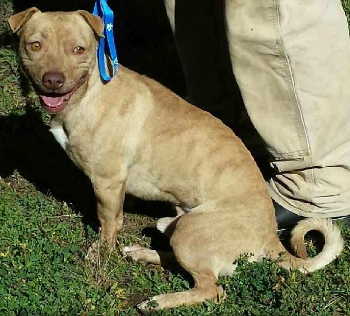
'Digger'
“Digger” is a male terrier and Sharpei mix with a short tan coat.
He was found on Lakeview Drive in Nice.
Shelter staff said he always comes to the front of the kennel, wiggly and happy. He has no food aggression, allowed them to pull at his feet and tail with no problems and he gets along great with female dogs.
He's in kennel No. 4, ID No. 3693.
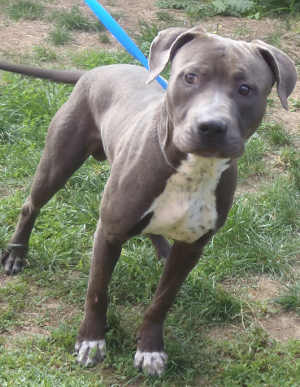
Valley fire dog
This male pit bull terrier is a Valley fire survivor, found behind the Middletown gas station, and he's still waiting for a home.
He's a friendly fellow with a short gray and white coat.
Shelter staff said he has no food aggression, and would be great in an athletic home with children ages 12 and up.
He's in kennel No. 5, ID No. 3720.

'Rocco'
“Rocco” is a Corgi-Chihuahua mix with a short brown coat and white markings.
He's in kennel No. 7, ID No. 4109.
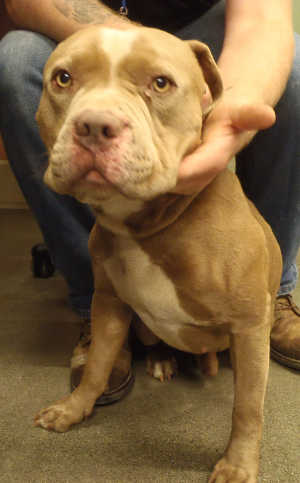
'Kong'
“Kong” is a male pit bull terrier mix.
He has a short brown coat with white markings.
He's in kennel No. 9, ID No. 4037.
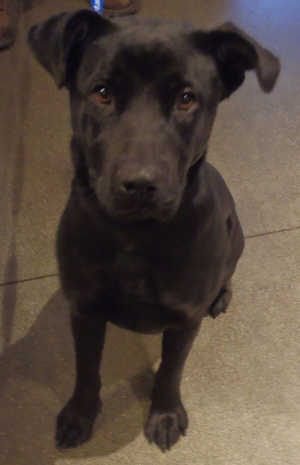
Labrador Retriever mix
This female Labrador Retriever mix has a short black coat.
She's in kennel No. 12, ID No. 4064.
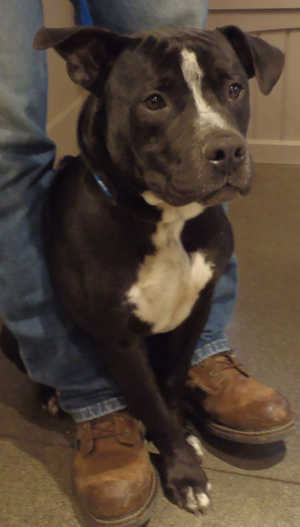
Pit bull terrier mix
This male pit bull terrier mix has a short black coat with white markings.
He's in kennel No. 15, ID No. 4102.

'Naughty'
“Naughty” is a female pit bull terrier mix.
She has a white coat with a gray eye patch.
She's in kennel No. 16, ID No. 4083.

Pit bull terrier mix
This male pit bull terrier mix has a short brown coat with white markings.
He's in kennel No. 26, ID No. 4101.
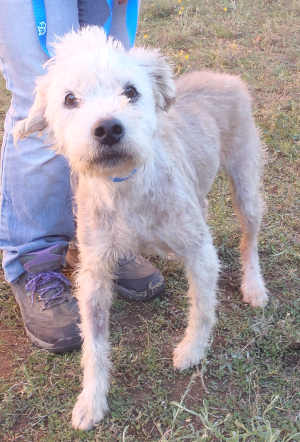
Terrier mix
This male terrier mix has an all-white coat.
He's in kennel No. 30, ID No. 3970.
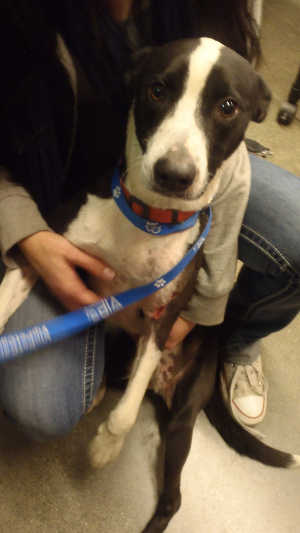
'Tux'
“Tux” is a male border collie mix with a short black and white coat.
Shelter staff said Tux is a sweet boy who is recovering from an injury to his leg.
He's in kennel No. 32, ID No. 4036.

Labrador Retriever-shepherd mix
This male Labrador Retriever-shepherd mix has a short tan and black coat.
He's in kennel No. 33, ID No. 3861.
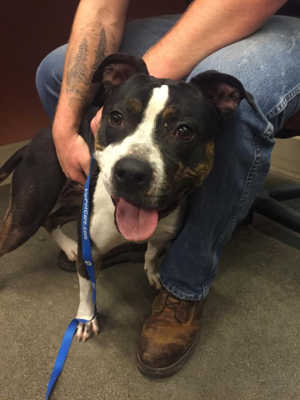
Pit bull terrier mix
This female pit bull terrier mix has a short tricolor coat.
Shelter staff said she is treat-motivated.
She's in kennel No. 34, ID No. 4039.
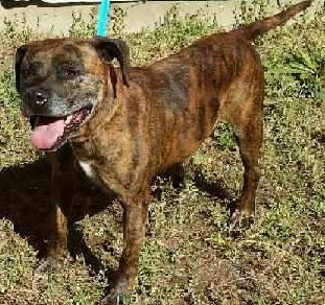
'Camo'
"Camo" is a male pit bull terrier mix.
He has a short brown brindle coat.
He's currently in foster, ID No. 3911.
To fill out an adoption application online visit http://www.co.lake.ca.us/Government/Directory/Animal_Care_And_Control/Adopt/Dog___Cat_Adoption_Application.htm .
Lake County Animal Care and Control is located at 4949 Helbush in Lakeport, next to the Hill Road Correctional Facility.
Office hours are Monday through Friday, 11 a.m. to 5 p.m., and 11 a.m. to 3 p.m., Saturday. The shelter is open from 11 a.m. to 4 p.m. Monday through Friday and on Saturday from 11 a.m. to 3 p.m.
Visit the shelter online at http://www.co.lake.ca.us/Government/Directory/Animal_Care_And_Control.htm .
For more information call Lake County Animal Care and Control at 707-263-0278.
Email Elizabeth Larson at