 How to resolve AdBlock issue?
News
LOWER LAKE, Calif. – Come celebrate the holidays at the Lower Lake Schoolhouse Museum on Friday, Dec. 11.
The free event takes place from 5:30 to 8 p.m.
Kicking off the event will be a Christmas tree lighting, music and Santa Claus arriving on a fire truck.
The tree lighting starts at 5:30 p.m. and Santa should be arriving on the fire truck shortly thereafter.
Afterwards, everyone is invited into the museum where Santa Claus will give out candy canes and take pictures with children.
For those of you who want to sing carols yourselves, sit around the player piano in the parlor for a sing-along.
Cookies and hot cider will round out this great family-fun holiday event.
The Lower Lake Schoolhouse Museum is located at 16435 Main St.

An atmospheric haze around a faraway planet – like the one which probably shrouded and cooled the young Earth – could show that the world is potentially habitable, or even be a sign of life itself.
Astronomers often use the Earth as a proxy for hypothetical exoplanets in computer modeling to simulate what such worlds might be like and under what circumstances they might be hospitable to life.
In new research from the University of Washington-based Virtual Planetary Laboratory, UW doctoral student Giada Arney and co-authors chose to study Earth in its Archean era, about 2.5 billion years back, because it is, as Arney said, “the most alien planet we have geochemical data for.”
The work builds on geological data from other researchers that suggests the early Earth was intermittently shrouded by an organic pale orange haze that came from light breaking down methane molecules in the atmosphere into more complex hydrocarbons, organic compounds of hydrogen and carbon.
“Hazy worlds seem common both in our solar system and in the population of exoplanets we’ve characterized so far,” Arney said. “Thinking about Earth with a global haze allows us to put our home planet into the context of these other worlds, and in this case, the haze may even be a sign of life itself.”
Arney and co-authors will present their findings Nov. 11 at the American Astronomical Society’s Division of Planetary Sciences conference in National Harbor, Maryland.
The researchers used photochemical, climate and radiation simulations to examine the early Earth shrouded by a “fractal” hydrocarbon haze, meaning that the imagined haze particles are not spherical, as used in many such simulations, but agglomerates of spherical particles, bunched together not unlike grapes, but smaller than a raindrop.
A fractal haze, they found, would have significantly lowered the planetary surface temperature.
However, they also found the cooling would be partly countered by concentrations of greenhouse gases that tend to warm a planet. They saw that this combination would result in a moderate, possibly habitable average global temperature.
Such a haze, the researchers found, also would have absorbed ultraviolet light so well as to effectively shield the Archean Earth from deadly radiation before the rise of oxygen and the ozone layer, which now provides that protection.
The haze was a benefit to just-evolving surface biospheres on Earth, as it could be to similar exoplanets.
The researchers also found that, based on the early Earth data, it’s unlikely such a haze would be formed by abiotic, or nonliving means. So for exoplanets with Earthlike amounts of carbon dioxide in their atmospheres, Arney said, “organic haze might be a novel type of biosignature.
However, we know these hazes can also form without life on worlds like Saturn’s moon Titan, so we are working to come up with more ways to distinguish biological hazes from abiotic ones.”
Co-author Shawn Domagal-Goldman of the NASA Goddard Space Flight Center in Greenbelt, Maryland, said, “Giada’s work shows that the haze could have intertwined with life in more ways than we previously suspected.”
Arney added that astronomers often think of Earthlike exoplanets as “pale blue dots” – after a famous photo of Earth taken by the Voyager spacecraft – “but with this haze, Earth would have been a ‘pale orange dot.'”
The research was funded through the NASA Astrobiology Institute.
Arney’s UW co-authors are Victoria Meadows, professor of astronomy and director of the Virtual Planetary Laboratory, and doctoral student Edward Schwieterman and postdoctoral researcher Benjamin Charnay. Other co-authors are Domagal-Goldman, Eric Wolf of the University of Colorado at Boulder and Mark Claire of the University of St. Andrews in the UK and Seattle’s Blue Marble Space Institute of Science.
Peter Kelley is with the University of Washington.
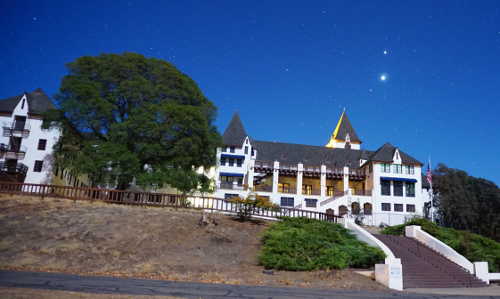
"By degrees the castles are built." – Irish proverb
LUCERNE, Calif. – Lake County's famous castle is situated in beautiful Lucerne, just over 7 miles east-northeast of Lakeport.
Lucerne and its regal castle boast lofty views of the largest natural lake in California, overlooking Clear Lake's 68 square miles.
Situated at 1,329 feet above sea level, the castle is now home to Marymount California University's Lakeside Campus.
The castle's colorful history spans back in time to when women were flappers. The term “flapper,” is a slang word that denotes an avian species flapping its wings. Dresses worn in the roaring 20s were less restricting and catered more to the comfort of women than the previous styles.
Lake County was roughly 60 years old when the Clear Lake Beach Company invested in land to start the town of Lucerne in the 1920s.
The next step for the progression of the picturesque town was for investors of the Lucerne Hotel Corp., instigated by Richard Palmer and Louis Becker to sell stock for the hotel corporation.
Soon after, in 1926 the hotel's construction began.
Alas, the Great Depression struck and construction came to a halt in 1929.
After a further series of setbacks, in 1934 the Clear Lake Beach Company entered bankruptcy.
It wasn't too long before the economy picked up again and Mr. West of the Cruickshank Company was able to complete construction of the hotel in 1938.
The hotel entered several roller coaster-like phases, with new owners opening and soon closing the hotel again and again.
It was sold to the Northern California Baptist Association in the 1950s, and once again it was sold over and over, never staying open for long.
In 2010 the county of Lake bought the hotel for $1.35 million.
Finally, in 2012 Lake County's first four-year university, Marymount California University, entered into a 15-year lease with the county of Lake to begin a college in the 75,000 square-foot iconic building.
According to the university's Web site, the university's Lucerne home is described as follows: “At a historic, castle-like edifice, surrounded by towering oaks, overlooking the largest freshwater lake in California, Marymount is proud to offer its newest campus – and a unique opportunity for upper-division and graduate students to advance or complete their academic degrees."
Kathleen Scavone, M.A., is an educator, potter, writer and author of “Anderson Marsh State Historic Park: A Walking History, Prehistory, Flora, and Fauna Tour of a California State Park” and “Native Americans of Lake County.” She also writes for NASA and JPL as one of their “Solar System Ambassadors.” She was selected “Lake County Teacher of the Year, 1998-99” by the Lake County Office of Education, and chosen as one of 10 state finalists the same year by the California Department of Education.
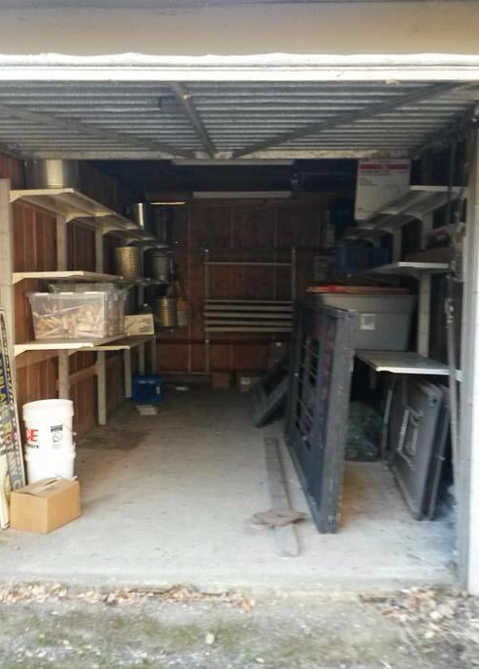
CLEARLAKE, Calif. – As it's busy preparing for its annual community Christmas dinner, the Rotary Club of Clear Lake is dealing with the theft of important equipment and Christmas decorations after its storage unit was burglarized.
“It's kind of a bummer,” said Terry Stewart, the club's past president.
On Tuesday, a Rotary member had gone to the club's longtime storage unit to retrieve items for the Christmas dinner in December and found that that the lock had been changed, Stewart said.
Stewart went over with bolt cutters on Wednesday morning and removed the lock. That's when he discovered the theft.
Items Stewart said were stolen included 26 large fryers used for the club's February seafood boil – its main fundraiser of the year – as well as three large watering troughs used for drinks and a lot of restaurant supplies, table cloths and napkins, as well as all of the decorations used for decorating the Burns Valley School for the Christmas dinner.
“Basically they just cleaned out our storage unit,” said Stewart.
He said whoever burglarized the unit had to have known they were stealing from Rotary. Items left behind in the storage unit included club signs, club minutes going back to the start of the club's founding in the early 1970s and wine glasses with the Rotary emblem etched on them.
There also were some containers of wooden mallets for cracking crab at the seafood boil there were left behind, Stewart said.
A brand new – and expensive – Santa Claus suit that the club had purchased within the last few years was safe since it was at a member's home, according to Stewart.
It's not clear exactly when the theft occurred, as it had been some months since club members had gone to get anything out of the unit, which is located in a complex on Old Highway 53, Stewart explained.
The Christmas dinner is planned for Dec. 12. “Now we're scrambling to replace that stuff in time to put the event on,” Stewart said.
Stewart said the break-in has been reported to the Clearlake Police Department, which took a theft report.
He estimated that losses ranged between $500 and $1,000 for the Christmas event, with at least a few thousand dollars in losses associated with the seafood boil equipment.
He said it's going to put a pretty big dent in the Rotary club's budget to replace the items stolen. They have no insurance to cover the theft, although they are seeking assistance from Rotary International.
Rotary Club of Clear Lake President Kinene Barzin said the February seafood boil is the group's biggest fundraiser, averaging about $25,000, which goes toward scholarships for students at Lower Lake High, Carlé High and Yuba College, as well as other Rotary projects.
In addition, this year the Rotary Club of Clear Lake has joined Rotary clubs from around Lake County in raising funds through the Lake Area Rotary Club Fire Relief Fund. Barzin estimated the effort has raised $400,000 so far.
Barzin said that, despite the setback of the theft, the club – which has about 50 members – is pushing forward with its annual community Christmas dinner, which will be held from 10 a.m. to 2 p.m. Saturday, Dec. 12, at Burns Valley School, 3620 Pine St. in Clearlake.
“Christmas dinner is our gift to the community,” Barzin said, noting everyone is invited.
In past years, the club has served as many as 900 people at the dinner, and they are expecting that many – and possibly many more – because of the impact of this year's wildfires, she said.
Santa Claus will be on hand to visit with children, all of whom will receive a photo and a gift.
This year the club also is distributing winter coats, with the assistance of the Boy Scout Troop 44, as part of the annual “Warm for the Winter” giveaway, Barzin said.
The club asks that anyone who has information about the stolen equipment call the Clearlake Police Department at 707-994-8251.
If anyone would like to help the club recoup its losses through a donation, checks can be sent to the Rotary Club of Clear Lake, P.O. Box 549, Clearlake, CA 95422.
Visit the club online at its Facebook page or its Web site.
Email Elizabeth Larson at
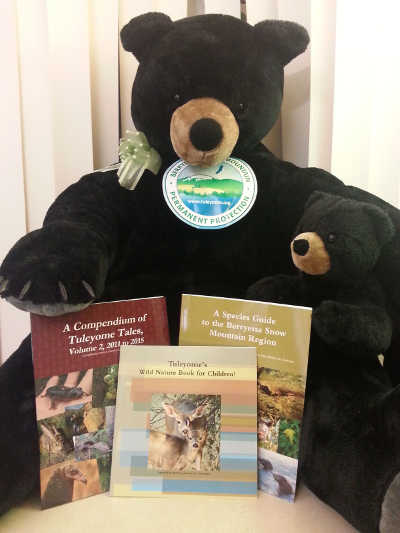
NORTHERN CALIFORNIA – A series of four nature-based books has been published by Tuleyome, the nonprofit conservation organization based in Woodland that spearheaded the Berryessa Snow Mountain National Monument campaign.
Tuleyome’s campaign to protect more than 330,000 acres of federal public land between Berryessa Peak and the Snow Mountain Wilderness came to a successful completion on July 10 of this year when President Barack Obama proclaimed the region the new Berryessa Snow Mountain National Monument.
The monument touches parts of seven local counties including Lake, Yolo, Solano, Napa, Mendocino, Glenn and Colusa.
Tuleyome started the book-writing project a little over a year ago in the hopes of educating the public about the Berryessa Snow Mountain region and the habitats and watersheds in and around it.
Some of the books were written with older teens and adults in mind, while others were focused specifically on children.
Out of the six books originally slated for the project, four of the books in the series have been completed and are now available for sale.
“A Compendium of Tuleyome Tales” is a two-volume set of books comprised of more than 100 articles written primarily by Tuleyome board and staff members on the conservation history and natural diversity of the Berryessa Snow Mountain region.
The articles – some of which have been featured on Lake County News – span from 2003 to 2015, and cover such topics as the efforts to combat the algae bloom in Clear Lake, the horse-rustling history of Glascock Mountain, the fight to preserve Cache Creek as a Wild and Scenic River, the geology of the region, the collaborative efforts to remove invasive Ravenna Grass, and how things like lichen and slime molds interact with the natural environment.
“Tuleyome’s Wild Nature Book for Children” is written for kids ages 6 and up. It includes large photographs and some fun facts about them, and then poses questions for the reader to answer.
At the request of local librarians who were shown an advance draft of the book, the Wild Nature book is very “Yolo-centric”; that is, all of the plants, animals and places mentioned in the book can be found in or around Yolo County itself. It’s hoped that this book will entertain children as well as spark an interest in them to do further research and explore the natural places just outside their door.
“A Species Guide to the Berryessa Snow Mountain Region” is the largest book in the series, and provides information on over 200 species of plants and animals found in the Berryessa Snow Mountain National Monument.
While the guide is admittedly not comprehensive, it does provide readers with an introduction to some of the more common species in the region, as well as information on some of the rare and endemic species found within the national monument.
The book also provides readers with a portion of the proclamation signed by President Obama which explains why the region was so important to protect, as well as articles written by local experts such as Dr. Eldridge and Judith Moores, Dr. Glen Holstein, Dr. Chad Roberts and Dr. Susan Harrison on the geology, watersheds and forest of the region, and the national monument’s conservation value.
All of the books were compiled and edited by Mary K. Hanson, Tuleyome’s on-staff Certified California Naturalist and author of The Chubby Woman’s Walkabout blog, who also provided many of the photos seen in the books. Hanson volunteered more than 250 hours of her time to get the books ready for release this month.
The books are available for sale through www.Lulu.com (just go to www.Lulu.com and search for “Tuleyome”) and are being offered at a 15 to 25 percent discount for a limited time. All proceeds from the sale of the books will go to further Tuleyome’s book-writing projects.
Future books are slated to include pocket-sized guides for local trails, an auto-tour of the Berryessa Snow Mountain National Monument, and a nature-based coloring book for small children.
For more information about Tuleyome, visit www.tuleyome.org .
UPPER LAKE, Calif. – The town of Upper Lake will host its annual Christmas celebration on Saturday, Dec. 5.
This year's theme is “A Country Christmas.”
The event begins at 6 p.m. downtown with the tree lighting ceremony.
The parade will begin at approximately 6:30 p.m. with the line up starting at the Upper Lake High School and middle school parking lots.
Everyone is welcome to enter in the parade, but you must be entered before lining up, so be sure to get there early enough to enter. No entry fee is required and trophies will be given out for different categories.
Parade entry forms are available on the North Shore Business Association's Web site, http://www.northshorebusinessassociation.com/ .
Santa arrives after the parade to listen to each child's Christmas wish and presents an excellent photo opportunity for the parents, so don't forget to bring your cameras.
This year the Upper Lake 4-H will be selling pulled pork sandwiches, slaw and chips. The Upper Lake Senior Support Services will be offering bread pudding and hot chocolate.
The eighth grade class from Upper Lake Middle School will serve a lighter fare of hot dogs and popcorn, and the sixth grade class from Upper Lake Elementary are preparing "cocoa in a jar" and "reindeer food" to sell.
Come join the festivities, support local groups and help the Northshore Fire Department and the Upper Lake Community Council ring in the holiday season.
For more information please call Debbie at Country Carpets, 707-275-2000, or Sara at 707-900-8585.