 How to resolve AdBlock issue?
News
CLEARLAKE, Calif. – Clearlake Animal Control is starting off the week with six dogs for adoption: Blue, Buster, Kiddo, Mona, Poppy and Timothy.
This week's dogs include a mix of Australian Cattle Dog, Australian Shepherd, boxer, Chihuahua, pit bull, Rottweiler and terrier.
To meet the dogs, contact Marcia Taylor, the animal control outreach technician, at 707-994-8201, Extension 103, 9 a.m. to 3 p.m. Monday through Thursday, or contact Animal Control Officer Jenna Tuller at Extension 115 from 9 a.m. to 5 p.m. those same days.
Also follow Clearlake Animal Control on Facebook for the latest updates.
Below are this week's available dogs.
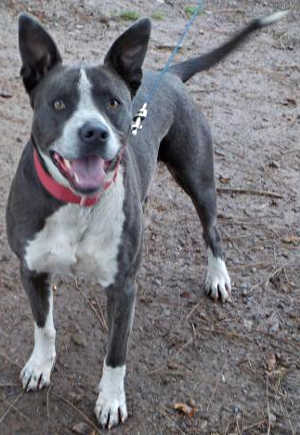
Blue
Blue is a male Australian Cattle Dog (blue heeler) and Australian Shepherd mix.
He had been hanging out at an elementary school every day until Clearlake Animal Control picked him up. It appeared that Blue thought his owner was at school. He loved hanging out with all the kids and everyone wanted to take him home.
He loves cocking his head sideways when he hears a funny noise and is an inquisitive boy.
Shelter staff said he is loads of fun. He can dance in place on his back two legs and he gets along great with other dogs.
Blue's adoption fee is only $40, as he already is neutered and vaccinated.
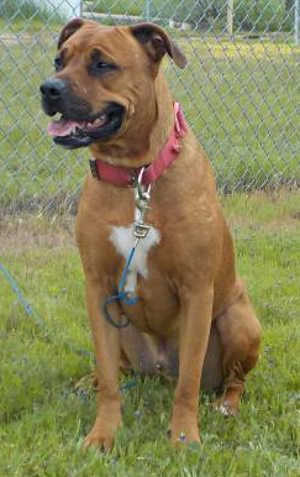
'Buster'
“Buster” is a 3-year-old male pit bull terrier mix.
He walks nicely on leash and has a mellow personality.
Shelter staff said he's good with cats and will make a good family member.
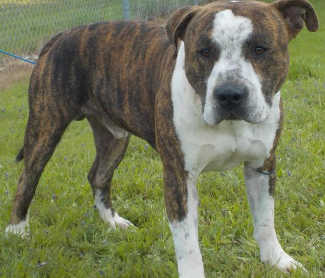
'Kiddo'
“Kiddo” is a young male pit bull terrier mix.
Shelter staff said he is great on the leash, has a mellow personality.
While very kind-hearted, shelter staff said Kiddo can be picky about who he gets along with.
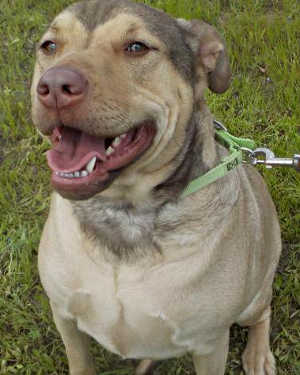
'Mona'
“Mona” is a young female Rottweiler-boxer mix with a low-key personality.
She is already spayed.
Shelter staff said she walks well on a leash, and is good with children, cats and other dogs.
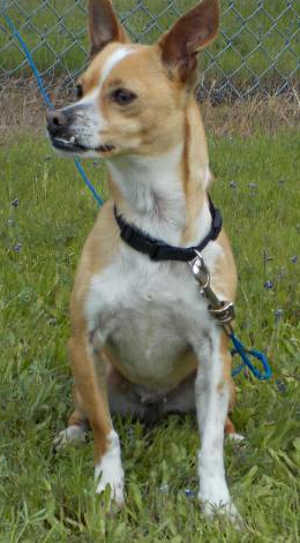
'Poppy'
“Poppy” is a young female Chihuahua and terrier mix.
She enjoys going for walks, is playful, and loves to sit on your lap and cuddle.
Shelter staff said she is very sweet and lovable.
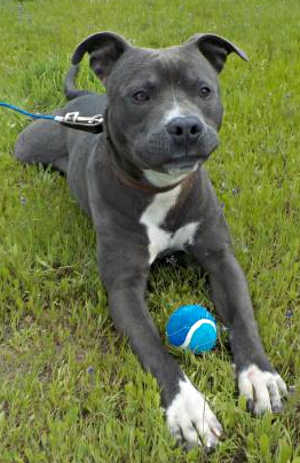
'Timothy'
“Timothy” is a male blue nose pit bull mix, estimated to be about 9 months old.
He loves to play ball and has a very happy personality, getting along well with people and other dogs.
Shelter staff described him as a “fantastic” and fun dog that would do best in a home without cats.
Email Elizabeth Larson at
NORTHERN CALIFORNIA – March and April are some of the best months to see the wildflower displays in the Berryessa Snow Mountain National Monument region, which includes Lake County.
A few of our favorite places to find and photograph wildflowers are along Highway 16 and Highway 20, along the Judge Davis Trail, and along Walker Ridge.
Driving along Highway 16 you’ll see outcroppings of wildflowers everywhere including blue and yellow lupine, paintbrush, orange and yellow wallflowers, bush monkey flowers, Chinese houses and many others.
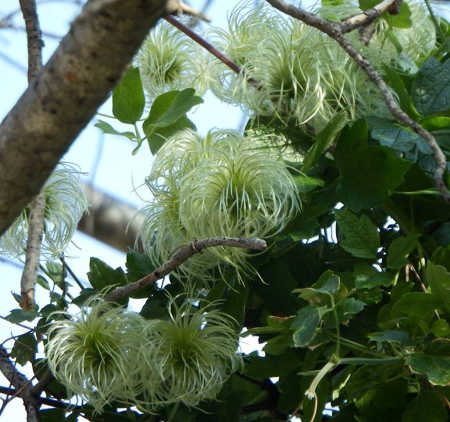
At one spot along this route last year, I also found some old men’s beards vines (Clematis drummondii) growing in the trees above a pull-out. When this vine goes to seed it gets silky heads all over it that look like something out of a Dr. Seuss story.
As you travel along the twisting and turning highway, you’ll find plenty of turn-off points, but be careful where you park and how you cross the road. You don’t want to obstruct traffic and you certainly don’t want to be hit by a car coming around a bend.
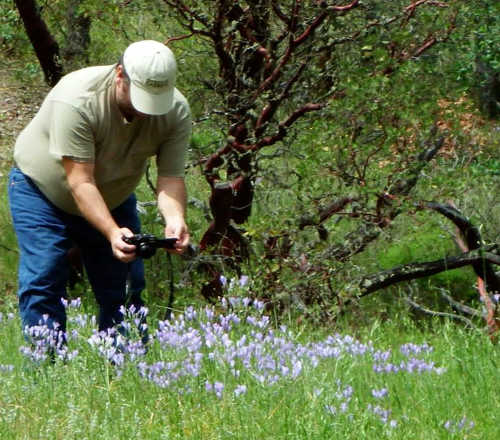
To get the best photos of the flowers you find use the “macro” setting on your camera (it will usually be marked with a flower or tulip-like icon), and get as close to the flower as you can. Snap off several shots from many different angles, so you have lots of views to choose from later.
If you’re not sure what kind of flower you’re looking at, also take photos of the leaves and the base of the plant. These will provide you with clues to their identities.
Taking Highway 16 on to Highway 20 will lead you to more great wildflower sites.
At the intersection of the two highways you may find huge fields of California poppies, gold nuggets, tidytips, owl clover and other flowers.
There are large turnout points along the highway here, too, but stay on the highway side of the fences you see here. On the other side of those fences is private property, and trespassing is not allowed. Go back to this spot several times over the next few months to make sure you see everything.
Access to Walker Ridge is also available off of Highway 20. This spot provides you with views of some specialized plants that only grow in serpentine soil.
From the intersection of Highways 16 and 20, turn left toward the foothills. The sign for Walker Ridge will come up on your right. Turn onto Walker Ridge Road and continue until you get to the intersection of Walker Ridge Road and the road to Indian Valley. Park at the intersection then walk back down the road to find the ridge trail head.
Off of Highway 20 you can also get to the Judge Davis Trail. You’ll take Highway 20 up into the foothills and as you start coming down again, the trailhead will be immediately to your left. Signs mark the trailhead, and there is parking and a restroom facility there.
This area was severely burned in the wildfires last year, but is expected to yield some interesting wildflower viewing this year because there are some flowers that will only show themselves after a burn.
This is usually a great spot to find loads of shooting stars, larkspur, wild onions and twining lilies, Indian warrior, and field irises. Go up the trail or up the fire break for some great vista views as well.
Tuleyome will be hosting a few wildflower tours this year that are free to the public, so check out their MeetUp site ( http://www.meetup.com/Tuleyome-Home-Place-Adventures/ ) for dates and times.
You can also get some great wildflower and plant identification information from the book “A Species Guide to the Berryessa Snow Mountain Region” available for purchase online at www.lulu.com .
As you go out wildflower hunting, keep in mind the “leave no trace” ethic: don’t pick the flowers or remove the plants (in some areas it’s actually illegal to do so). They are integral parts of their environment and need to be left where they are.
As Pee Wee Herman might say, “Take a picture; it’ll last longer.”
“Tuleyome Tales” is a monthly publication of Tuleyome, a 501(c)(3) nonprofit conservation organization based in Woodland, Ca. Mary K. Hanson is a Certified California Naturalist and author of “The Chubby Woman’s Walkabout” blog. For more information about Tuleyome, visit www.tuleyome.org .
LAKE COUNTY, Calif. – Lake County Animal Care and Control has a full shelter of dogs this week that will be offered for adoption at lower rates thanks to one of its regular adoption events.
This week's adoptable dogs include mixes of American Bulldog, border collie, boxer, cattle dog, Chihuahua, Doberman, German Shepherd, hound, Labrador Retriever, terrier and pit bull.
Lake County Animal Care and Control is adopting out dogs this week with a $50 discount – waiving the county adoption fee portion and costs for microchipping. There will will be costs for spaying and neutering dogs.
Dogs that are adopted from Lake County Animal Care and Control are either neutered or spayed, microchipped and, if old enough, given a rabies shot and county license before being released to their new owner. License fees do not apply to residents of the cities of Lakeport or Clearlake.
If you're looking for a new companion, visit the shelter. There are many great pets hoping you'll choose them.
In addition to the animals featured here, all adoptable animals in Lake County can be seen here: http://bit.ly/Z6xHMb .
The following dogs at the Lake County Animal Care and Control shelter have been cleared for adoption (additional dogs on the animal control Web site not listed are still “on hold”).
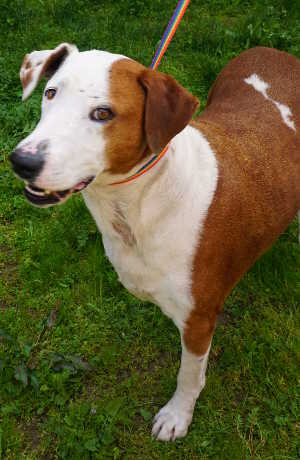
Hound-Labrador Retriever mix
This male hound-Labrador Retriever mix has a short red and white coat.
He's got a big personality and is energetic, getting around well despite having only three legs.
He's friendly, well-behaved and ready for a new home.
He's in kennel No. 2, ID No. 4628.
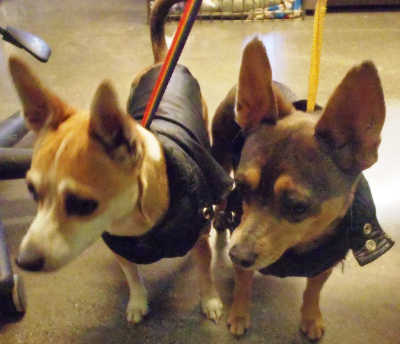
Female Chihuahuas
These two female Chihuahuas have short multicolored coats.
They're in kennel No. 3a, ID Nos. 4636 and 4637.

Pit bull terrier mix
This male pit bull terrier mix has a short black coat with white markings.
Shelter staff said he is great with other dogs, both male and female, is very sweet and while he gets excited he doesn't jump on people.
He walks well on a leash and has basic commands.
In addition, he allows handling of his ears, mouth, paws and allowed nail trimming, has no food guarding, avoided cats and didn't mind the horses.
He's in kennel No. 4, ID No. 4511.
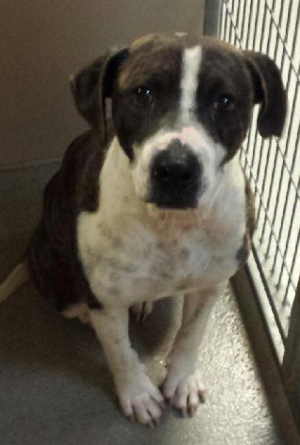
Female boxer mix
This female boxer mix has a short gray coat with white markings.
Shelter staff said she needs basic leash training, but is manageable for her size. She also allows handling of her ears, mouth, paws and body, and tolerated nail clipping without pulling away.
She has no food aggression, and would do great in a home with no cats. Staff said she has been tested with another dog and got along well.
They believe she will be happiest in a quiet home and will form a very strong bond with her handler.
She's in kennel No. 5, ID No. 4551.
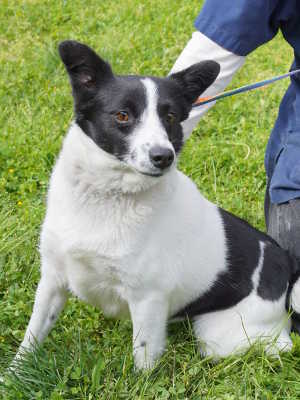
'Missy'
“Missy” is a fun little dog who shelter staff believe is a mix of rat terrier and border collie.
She has an energetic personality, is sweet and loves to play.
She's in kennel No. 6, ID No. 4231.
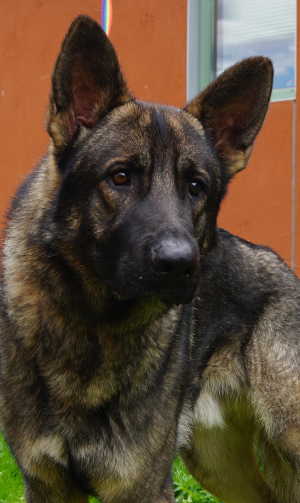
Male German Shepherd
This male German Shepherd has a sable, black and tan coat.
He has a happy, friendly personality, knows basic commands and loves people.
He's in kennel No. 7, ID No. 4565.
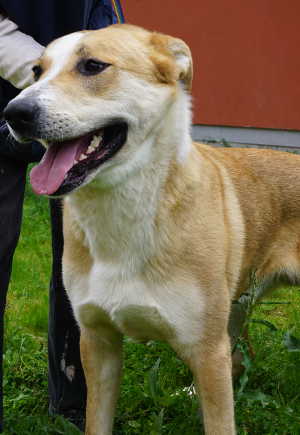
Male shepherd mix
This male shepherd mix has a short brown coat with white markings.
Shelter staff said he needs leash training but is very manageable, and in the play yard came when called when food was used as a motivator. He doesn't know basic commands yet, but did volunteer the behavior when another dog was doing it for treats.
He has no food aggression towards people or dogs, and allows handling of ears, mouth, paws and tail without any problems. He avoided the cats.
He's in kennel No. 8, ID No. 4560.
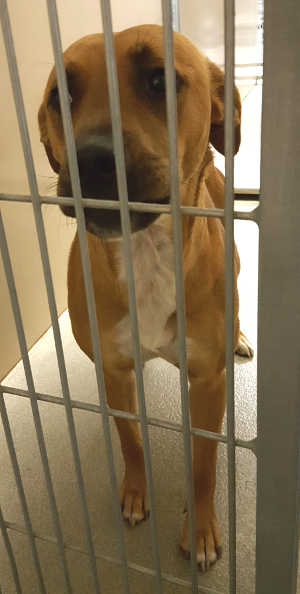
'Mamma Doo'
“Mamma Doo” is as a sweet female hound mix has a short brown coat with white markings.
She's in kennel No. 9, ID No. 4298.

Male pit bull terrier mix
This male pit bull terrier mix has a light brown and white coat.
He's in kennel No. 12, ID No. 4608.
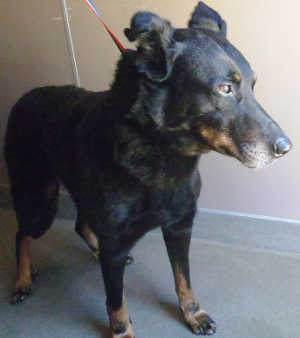
Shepherd-Doberman mix
This female shepherd-Doberman mix has a beautiful black and brown coat.
She's in kennel No. 13, ID No. 4638.
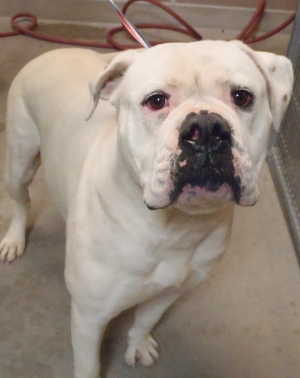
'Daisy'
“Daisy” is a female American Bulldog.
She has a white coat with some black markings.
She is in kennel No. 16, ID No. 4564.
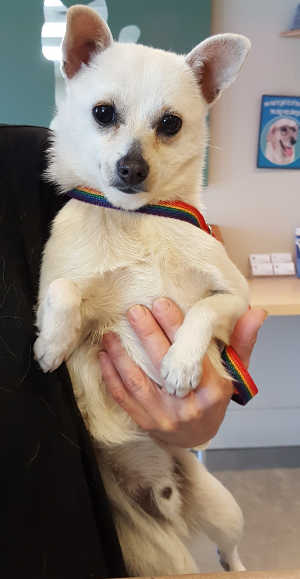
Male Chihuahua mix
This male Chihuahua mix has an all-white coat.
He's in kennel No. 17, ID No. 4591.

Labrador Retriever-pit bull mix puppies
These four female Labrador-Retriever mix puppies come in a variety of colors.
They're in kennel No. 18, ID Nos. 4574, 4577, 4579 and 4581.

'Yogi Jr.'
“Yogi Jr.” is a male Labrador-Retriever mix puppy with a short black coat.
He's in kennel No. 19a, ID No. 4573.

Male Labrador-Retriever mix puppy
This male Labrador-Retriever mix puppy has a short brown coat with white and black markings.
He's in kennel No. 19b, ID No. 4575.
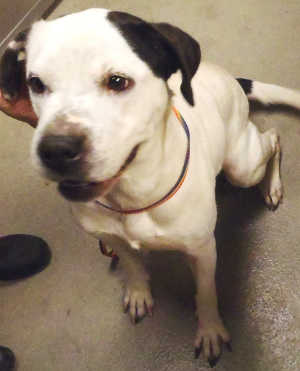
Hound-Labrador Retriever mix
This female hound-Labrador Retriever mix has a short white coat with black markings.
She's in kennel No. 21, ID No. 4641.
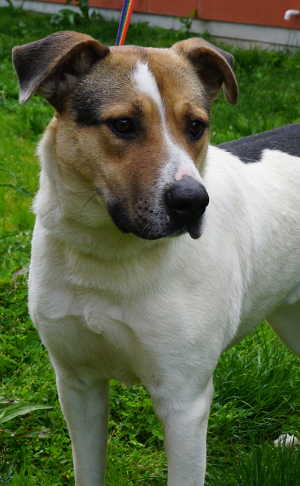
'Buddy'
“Buddy” is a handsome male Labrador Retriever-hound mix with a short tricolor coat.
He was assessed with every dog in the kennel and loved them all, although shelter staff said he would do best in a home without livestock, small dogs or cats.
Shelter staff said he is a very well-mannered, tolerant dog with low energy.
He's in kennel No. 22, ID No. 4487.
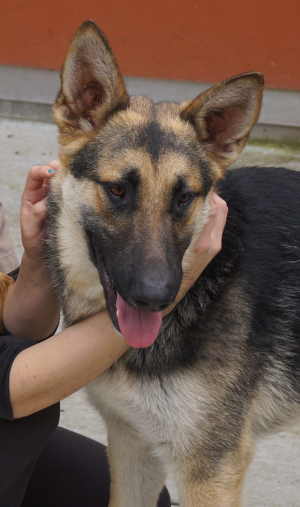
Male German Shepherd
This handsome male German Shepherd has a short tan and black coat.
Shelter staff said he is good with other larger dogs, male or female, and would do best in a home with no small dogs or cats and children above age 5.
He's friendly and likes to play.
He's in kennel No. 23, ID No. 4514.

'Bronco'
“Bronco” is a male cattle dog mix.
He has a short white and brown coat.
Shelter staff said he needs some basic training and has a lot of potential.
He's in kennel No. 24, ID No. 4592.
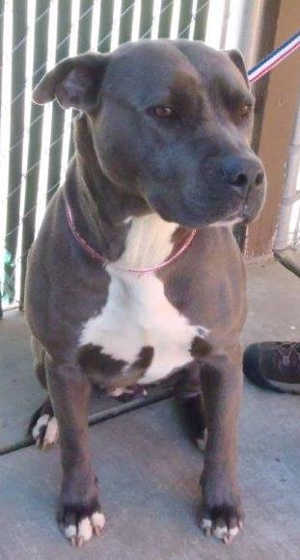
Female pit bull mix
This female pit bull mix has a short gray and white coat.
She's in kennel No. 25, ID No. 4588.

'Papi'
“Papi” is a male Chihuahua mix.
He has a short black and white coat.
Shelter staff said he is good with other dogs, cats and children.
He's in kennel No. 26, ID No. 4642.

Labrador Retriever puppy
This male Labrador Retriever mix puppy has a short black coat with white markings.
He's in kennel No. 28, ID No. 4423.
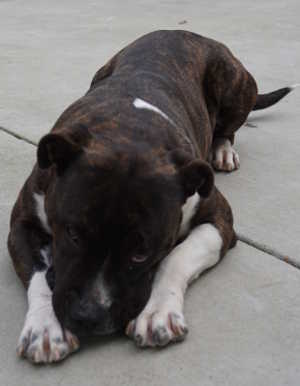
Female pit bull mix
This female pit bull mix has a short brown brindle coat with white markings.
She loves cuddles and attention, and does very cute play bows, enjoys playing and is great with other dogs, but would do best in a home without cats.
She's in kennel No. 29, ID No. 4337.
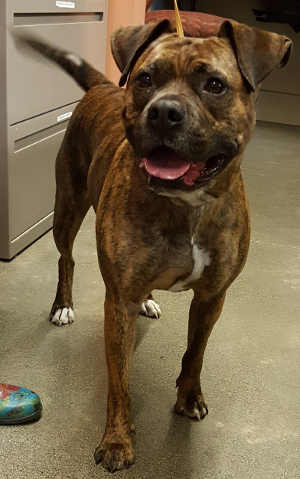
'Rosie'
“Rosie” is a female boxer-pit bull mix.
She has a short brown brindle coat with white markings.
Her adoption fee will be less expensive due to already being spayed.
She's in kennel No. 32, ID No. 4670.

'Tank'
“Tank” is a male cattle dog-pit bull terrier mix, according to shelter staff.
He has a short black coat.
Shelter staff said he's great with other submissive dogs.
He's in kennel No. 33, ID No. 4497.
To fill out an adoption application online visit http://www.co.lake.ca.us/Government/Directory/Animal_Care_And_Control/Adopt/Dog___Cat_Adoption_Application.htm .
Lake County Animal Care and Control is located at 4949 Helbush in Lakeport, next to the Hill Road Correctional Facility.
Office hours are Monday through Friday, 11 a.m. to 5 p.m., and 11 a.m. to 3 p.m., Saturday. The shelter is open from 11 a.m. to 4 p.m. Monday through Friday and on Saturday from 11 a.m. to 3 p.m.
Visit the shelter online at http://www.co.lake.ca.us/Government/Directory/Animal_Care_And_Control.htm .
For more information call Lake County Animal Care and Control at 707-263-0278.
Email Elizabeth Larson at

Observations from NASA's Spitzer Space Telescope have led to the first temperature map of a super-Earth planet – a rocky planet nearly two times as big as ours.
The map reveals extreme temperature swings from one side of the planet to the other, and hints that a possible reason for this is the presence of lava flows.
"Our view of this planet keeps evolving," said Brice Olivier Demory of the University of Cambridge, England, lead author of a new report appearing in the March 30 issue of the journal Nature. "The latest findings tell us the planet has hot nights and significantly hotter days. This indicates the planet inefficiently transports heat around the planet. We propose this could be explained by an atmosphere that would exist only on the day side of the planet, or by lava flows at the planet surface."
The toasty super-Earth 55 Cancri e is relatively close to Earth at 40 light-years away. It orbits very close to its star, whipping around it every 18 hours.
Because of the planet's proximity to the star, it is tidally locked by gravity just as our moon is to Earth. That means one side of 55 Cancri, referred to as the day side, is always cooking under the intense heat of its star, while the night side remains in the dark and is much cooler.
"Spitzer observed the phases of 55 Cancri e, similar to the phases of the moon as seen from the Earth. We were able to observe the first, last quarters, new and full phases of this small exoplanet," said Demory. "In return, these observations helped us build a map of the planet. This map informs us which regions are hot on the planet."
Spitzer stared at the planet with its infrared vision for a total of 80 hours, watching it orbit all the way around its star multiple times. These data allowed scientists to map temperature changes across the entire planet.
To their surprise, they found a dramatic temperature difference of 2,340 degrees Fahrenheit (1,300 Kelvin) from one side of the planet to the other. The hottest side is nearly 4,400 degrees Fahrenheit (2,700 Kelvin), and the coolest is 2,060 degrees Fahrenheit (1,400 Kelvin).
The fact Spitzer found the night side to be significantly colder than the day side means heat is not being distributed around the planet very well.
The data argues against the notion that a thick atmosphere and winds are moving heat around the planet as previously thought. Instead, the findings suggest a planet devoid of a massive atmosphere, and possibly hint at a lava world where the lava would become hardened on the night side and unable to transport heat.
"The day side could possibly have rivers of lava and big pools of extremely hot magma, but we think the night side would have solidified lava flows like those found in Hawaii," said Michael Gillon, University of Liège, Belgium.
The Spitzer data also revealed the hottest spot on the planet has shifted over a bit from where it was expected to be: directly under the blazing star. This shift either indicates some degree of heat recirculation confined to the day side, or points to surface features with extremely high temperatures, such as lava flows.
Additional observations, including from NASA's upcoming James Webb Space Telescope, will help to confirm the true nature of 55 Cancri e.
The new Spitzer observations of 55 Cancri are more detailed thanks to the telescope’s increased sensitivity to exoplanets.
Over the past several years, scientists and engineers have figured out new ways to enhance Spitzer’s ability to measure changes in the brightness of exoplanet systems. One method involves precisely characterizing Spitzer’s detectors, specifically measuring “the sweet spot” – a single pixel on the detector – which was determined to be optimal for exoplanet studies.
“By understanding the characteristics of the instrument – and using novel calibration techniques of a small region of a single pixel – we are attempting to eke out every bit of science possible from a detector that was not designed for this type of high-precision observation,” said Jessica Krick of NASA’s Spitzer Space Science Center, at the California Institute of Technology in Pasadena.
NASA's Jet Propulsion Laboratory (JPL) in Pasadena, California, manages the Spitzer Space Telescope mission for NASA's Science Mission Directorate, Washington. Science operations are conducted at the Spitzer Science Center. Spacecraft operations are based at Lockheed Martin Space Systems Company, Littleton, Colorado. Data are archived at the Infrared Science Archive housed at the Infrared Processing and Analysis Center at Caltech. Caltech manages JPL for NASA.
For more information about Spitzer, visit http://www.nasa.gov/spitzer .
LAKE COUNTY, Calif. – An effort to ensure more people in Lake and Mendocino counties have access to nutritious fresh produce is launching an online fundraising event in April.
The North Coast Opportunities Gardens Project relies on government grants and community fundraising to continue to expand and sustain its network of gardens.
On April 4, the Gardens Project will be launching the “Let’s E.A.T.” online fundraising campaign to raise $20,000 to support current and future community garden projects.
E.A.T. is an acronym that stands for “Empower,” “Access” and “Teach,” which is what they aim to do with the funds raised.
With $20,000, the Gardens Project will be able to “Empower 20 new gardeners through leadership training, create access to 4 new gardens benefiting 400 family members and teach 15 gardening and nutrition workshops to more than 200 people.”
One in seven Americans lack access to fresh, healthy, affordable food. For them, every day is a struggle to find enough food to eat. Many do not have reliable access to enough food, in part because they cannot afford it.
In Mendocino County and Lake County those numbers are one in six and one in five people, respectively.
People in Lake and Mendocino counties experience hunger at higher rates than the national average because rural areas have high unemployment rates, low-wage jobs and lack of transportation to reliable food sources.
The Gardens Project of North Coast Opportunities seeks to relieve hunger and inadequate nutrition throughout Mendocino and Lake counties by creating access to community-based food production and local, nutritious food.
Since its founding in 2007, the Gardens Project has helped establish 38 successful community and school gardens. These gardens produce 28,470 pounds of produce and feed more than 3,000 people annually.
Each year, more than 200 people attend free workshops on food production and healthy eating in both Mendocino and Lake counties. And, since 2011, they have trained more than 75 gardeners to become positive leaders in their communities to ensure effective management and sustainability of community gardens.
In November 2015, the Gardens Project expanded further into Lake County.
Project Coordinator Ava Ryan already has begun work on two community gardens in Clearlake and is “currently investigating numerous other sites throughout the county, and hope[s] to have at least three gardens finished by the end of 2016.”
“Being able to grow in the community garden saves me a lot of money on organic produce. It greatly increases the diversity of the foods I eat,” said Shannon Kleiber, garden leader at Vinewood Park Community Garden in Ukiah. “The garden is also very therapeutic for me.”
Community gardens create a positive local environmental impact for pollinators, wildlife, healthy soils and air. These gardens also encourage healthy eating and connecting with nature for everyone involved.
Thanks to her participation in her local community garden, Klieber said, “I have met and built amazing friendships with people in my community.”
“I’ve been growing stuff and I’ve really liked it because it’s so much cheaper than the stores, the stores are crazy. I mean, look at all this [she points to her raised bed full of greens] and I still have stuff, and I’ve been picking off this for two months. I can give some to the neighbors and everything,” said Ruth Smith of her community plot.
Smith is mostly wheelchair-bound and her raised bed plot makes growing food easy and accessible for her.
The demand for new gardens is high. A survey conducted in Lake County found that 36 percent of low-income respondents would participate in a community garden if they had access to one.
Ryan said she currently has “at least 100 people interested and waiting for a community garden in northern Lake County.”
In Mendocino County there are existing lists of at least five to 10 families at every community garden waiting to receive the opportunity to have a plot of their own, according to Mendocino Project Coordinator Stephanie Logsdon.
In a recent Lake County survey, 47 percent of respondents said that the lack of community gardens was a major barrier to healthy food consumption.
The demand for fresh, affordable fruits and vegetables exists and the Gardens Project needs the support of the community to bring the gardens to the people.
You can view and make a donation to the Let’s E.A.T. campaign at https://www.generosity.com/community-fundraising/let-s-e-a-t .
In addition to the online fundraiser, the Gardens Project team also will be hosting a series of events and garden workdays for Earth Day.
On Saturday, April 16, from 9 a.m. to 3 p.m., come out, stake some plots, build raised beds and eat some barbecue in the community garden at the Highlands Senior Center, 3245 Bowers Ave. in Clearlake.
On Sunday, April 17, from 10 a.m. to 2 p.m. help the Clearlake Food Pantry Garden get ready for the season by doing clean up, weeding and filling beds with compost.
For more information, contact Ava Ryan in Lake County at
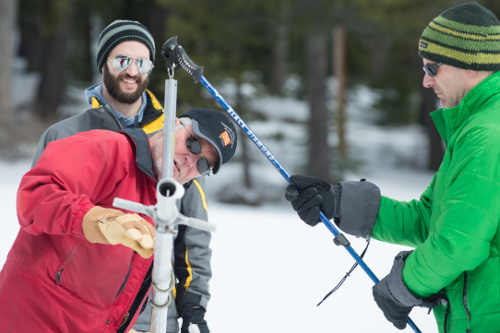
NORTHERN CALIFORNIA – The year 2016 has brought amounts of snow and rain to California that many have hoped would break the drought, but the latest snowpack measurements show the state is not out of the cycle of dry years just yet.
Snowpack – especially across the northern, central and southern Sierras – is a critical measure of California's water supply.
State officials said that, in normal years, the snowpack supplies about 30 percent of California’s water needs as it melts in the spring and early summer.
As a result, the Department of Water Resources reported that, the greater the snowpack water content, the greater the likelihood California’s reservoirs will receive ample runoff as the snowpack melts to meet the state’s water demand in the summer and fall.
On Wednesday, the Department of Water Resources' manual snow survey at Phillips Station, east of Sacramento in the Sierra Nevada, showed that the snowpack was at 87 percent of the March 30 historical average.
“While for many parts of the state there will be both significant gains in both reservoir storage and stream flow, the effects of previous dry years will remain for now,” said Frank Gehrke, chief of the California Cooperative Snow Surveys Program, whose team conducted the Wednesday manual snow survey.
The below-average snowpack now is a concern because it's at this time of year that California’s statewide snowpack usually reaches its peak depth and water content, the Department of Water Resources reported.
From this point on, officials explained the snow begins to melt as the sun’s path across the sky moves a little further north each day.
While not ideal, the snowpack conditions measured this week are much improved compared to those reported last year, when Gov. Jerry Brown went to Phillips Station where there was no snow to measure – just bare ground – and announced that he was mandating a 25-percent reduction in water use throughout California.
At that point, the Sierras' snowpack water content was only 5 percent of normal – the lowest since 1950, officials said.
On Friday, the California Cooperative Snow Surveys measurements showed that the statewide snowpack summary was at 86 percent of normal for April 1, with 24.2 inches of snow water equivalent.
That breaks down as follows for the three regions of the Sierra: north, 95 percent of average, 27.4 inches of snow water equivalent; central, 88 percent of average, 25.1 inches of snow water equivalent; and south, 73 percent of average, 19.4 inches of snow water equivalent.
Closer to home, at Anthony Peak in the Mendocino National Forest's Covelo Ranger District, the March snowpack measurement was at 46 percent of normal, the highest snowpack number since May of 2011 and the best March snowpack measurement since 2002, according to California Department of Water Resources data.
As for Lake County's key water measurement – the depth of Clear Lake – the lake's depth late Friday was at 7.70 feet Rumsey. A full lake is 7.56 feet Rumsey.
Email Elizabeth Larson at