 How to resolve AdBlock issue?
News
Lakeport, Calif. -- Lakeport police arrested a man Tuesday afternoon for stabbing another man.
Shortly after noon Tuesday, Lakeport Police Officers responded to a report of a male subject walking in and out of traffic and yelling at motorists on S. Main St. at E St.
Upon arrival officers made contact with Wayne Pernell 70 who is described as a transient. Pernell reported being stabbed by another male subject.
As Pernell was speaking to the officers he pointed up the street to a male subject, identified as Brett White 33 Lakeport and stated he was the person who stabbed him.
Officers detained White, and through the course of the investigation, learned that White and Pernell had been drinking alcohol in the area of Lupoyoma Heights when Pernell made sexual advances toward White.
White told Pernell to stop touching him but Pernell continued.
White, who was holding a folding pocket knife with the blade open, warned Pernell that if he didn’t stop touching him, he would stab him.
Pernell told White to “go ahead” and White reached toward Pernell with the knife and stabbed Pernell in the left hand as Pernell was placing his hands up to protect himself.
Pernell was evaluated at the scene by Lakeport Fire and subsequently transported to Sutter Lakeside Hospital, via ambulance.
White was placed under arrest for violation of Penal Code section 245(a)(1) PC-Assault with a deadly weapon or force likely to produce great bodily injury and 422 PC-Criminal threats.
White was transported to the Hill Road Correctional Facility where his bail was set at $25,000.
Anyone with information is asked to contact Officer Trouette at the Lakeport Police Department 707-263-5491.
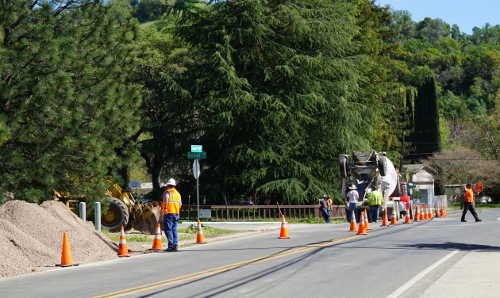
LUCERNE, Calif. – California Water Service Co. is planning a series of repair projects on its water delivery system in the town of Lucerne.
Over the past week there have been some leak repairs, including one on Foothill Drive, according to Gay Guidotti, manager for the Redwood Valley District, which includes Lucerne.
Guidotti said Cal Water's contractor also did some prep work last week in order to begin a water main project on Country Club Drive this week.
She said that project was supposed to have been done in 2015. “We got delayed due to weather,” she said, noting the year's late rains.
That project – which Guidotti estimated will take three to four weeks to complete – will include running a new 6-inch main down the easement between 12th and 14th avenues and tying it in at Country Club Drive. It's a total of 660 feet of 8-inch PVC pipe and 475 feet of 6-inch PVC.
She noted that the county previously upgraded a portion of its 6-inch main in that easement several years ago in anticipation of commercial development along 13th Avenue. She estimated that upgrade included about 400 feet of pipe from the south end of the easement running north.
“Our project will come from the north end of that easement and run south to meet that section,” she said.
The whole easement will then be served by a 6-inch main and be connected at both ends – to Country Club’s main at the north end, and the main in the frontage easement at the south end, Guidotti explained.
She said there have not been new commercial developments along 13th Avenue to require more upgrades to the main. However, this new work will benefit flow, circulation and water quality in that area, and so any planned commercial development that occurs.
Another project slated to take place this year – and the largest on the drawing board for 2016 – is a 1,400-foot main replacement using 8-inch PVC that Guidotti said will run on Country Club beginning from the far west end of Foothill, where there will be a new tie-in, to Fifth Avenue.
Guidotti said it will offer better circulation in the system better and will bring repair progress closer to Fifth Avenue.
Other projects also are planned in 2016, including a 200-foot main extension at the end of Roland Drive, where a new house is being constructed, Guidotti said.
There also will be work to recoat and make structural improvements to a water tank on Panoramic Drive, according to Guidotti.
Guidotti said the California Public Utilities Commission prefers the company to carry out a certain amount of footage in line repairs annually.
In Lucerne, she said it tends to be about 1,300 to 1,400 feet each year, although sometimes that work is deferred due to rates.
A substantial amount of the system, which serves 1,277 active accounts, still needs to be repaired, Guidotti said.
As for how priorities are set, “We're hitting the main arteries and where we're having repeated leaks. That's the criteria that we use,” Guidotti said.
Email Elizabeth Larson at
California Department of Public Health (CDPH) Director and State Public Health Officer Dr. Karen Smith announced Monday that the state has shown continued improvements in slowing the rate of death as a result of AIDS, cancers and heart disease.
The announcement came as CDPH released its annual County Health Status Profiles.
“The improvements are encouraging and show how far we’ve come,” said Dr. Smith. “Despite the achievements, it’s important to remember there are areas, especially in chronic conditions, where we have opportunities to do better. We also need to ensure that all communities show improvement so we can truly make California the healthiest state in the nation.”
The County Health Status Profiles 2016, released Monday by CDPH as part of National Public Health Week (April 4 to 10), provide statewide and county-level data to report on the course of health promotion and preventive services, including the objectives of Healthy People 2020 National Objectives.
Highlights of the County Health Status Profiles 2016 include:
· A 28-percent decrease in the incidence of AIDS (aged 13 and older). While San Francisco’s incidence of AIDS continues to be above the state average, it has decreased 37 percent from the previous three-year period.
· All cancers age-adjusted death rates (including female breast cancer, colorectal, lung cancer and prostate cancer) decreased, with the lung cancer death-rate decreasing more than 12 percent.
· Infant mortality has decreased for all races. Notably, Black infant mortality decreased nearly 13 percent, Asian/Pacific Islander decreased nearly 11 percent, White decreased 8 percent and Hispanic decreased nearly 6 percent.
· Births to teen mothers (aged 15 to 19 years) decreased nearly 26 percent.
· Coronary heart disease age-adjusted death rate decreased nearly 12 percent.
· Tuberculosis decreased nearly 11 percent.
· Gonorrhea incidence among males in the 15 to 44 age group increased by 54 percent. Gonorrhea incidence rate for females increased by 35 percent.
· Chlamydia incidence increased by 7 percent.
In Lake County, rankings in key areas were the worst in the state and, in many instances, appeared largely unchanged since the 2015 report.
Lake County ranked No. 58 for death from all causes, lung cancer and drug-induced deaths.
Deaths due to all cancers, chronic liver disease and cirrhosis and accidents (unintentional injuries), and infant mortality for all groups ranked the county No. 57.
The county was ranked No. 56 for chronic lower respiratory disease and homicide, and No. 55 for coronary heart disease and suicide. It earned a No. 52 ranking for firearm-related deaths.
As for AIDS incidence in age 13 and over, the county ranked No. 36. It was ranked No. 57 for gonorrhea incidence among females age 15 to 44, while male incidence of the disease for the same age group was ranked No. 34. The county's chlamydia incidence ranking was No. 19.
Californians came just shy of meeting Gov. Edmund G. Brown Jr.’s 25 percent water conservation mandate for the nine months since mandatory urban conservation began, state officials said Monday.
Statewide cumulative savings from June 2015 to February 2016 totaled 23.9 percent compared with the same months in 2013.
“Twenty-four percent savings shows enormous effort and a recognition that everyone’s effort matters,” said State Water Resources Control Board Chair Felicia Marcus. “Californians rose to the occasion, reducing irrigation, fixing leaks, taking shorter showers, and saving our precious water resources in all sorts of ways.”
With nearly 1.19 million acre-feet of water conserved from June 2015 through February 2016, the state achieved 96 percent of the savings goal of 1.24 million acre-feet of water.
Water saved during the nine month period is enough to supply more than 5.9 million Californians for one year; this is approximately the combined population of San Diego, Riverside and Tulare counties, or 15 percent of the state’s population.
Statewide, the conservation rate dropped from 17.1 percent in January to 12 percent in February, likely because February 2016 was one of the warmest and driest Februaries since the drought began.
In addition, residents generally use much less water for outdoor irrigation in the winter months, so there is less opportunity for high volume, and percentage, savings.
As the wet season draws to a close in April – and with water suppliers, residents, and businesses posing important questions about the future of water conservation in California – the State Water Board will hold a public workshop on April 20 to receive input on conservation needs through the summer.
The workshop will consider adjustments to the current emergency regulations given available water supply, storage, and snowpack.
In the meantime, Californians are urged to continue applying their water conservation skills and habits through the spring months.
These efforts should include complying with urban water supplier directives on when outdoor irrigation is permitted, not irrigating outdoors during and within 48 hours following a rain event, and fixing leaks that are discovered during individual water user audits.
“March brought us much needed rain and snow after a frightening February,” Marcus said. “It was more of a moderate March than the miracle March we hoped for, but we’re grateful for every raindrop and every snowflake, and we are still hoping for more April showers. We are in better shape than last year, but are still below average in most of California. We need to keep up our efforts to conserve the water we’ve gotten. We can better tune up and adjust our emergency rules once we see our final rain and snowpack tallies in the next few weeks.”
An updated and extended emergency regulation was adopted by the Board on Feb. 2 and took effect Feb. 11.
The regulation extends restrictions on urban water use through October while providing urban water suppliers some latitude in the conservation requirements they must meet.
The action follows Gov. Brown's Nov. 13, 2015, Executive Order directing the State Water Board to extend the emergency water conservation regulation through Oct. 31, 2016 should drought conditions persist.
February conservation data
– For June through February, the cumulative statewide reduction was 23.9 percent, compared to the same months in 2013. That equates to nearly 1.19 million acre-feet of water saved, putting the state 96 percent of the way to meeting the 1.24 million acre‑feet savings goal set for the end of February.
– Statewide water savings for February 2016 was 12 percent (41,591 acre feet or 13.6 billion gallons), a decrease from January 2016’s 17.1 percent savings. See fact sheet here.
– February 2016 compliance indicates that 55 percent of suppliers met their conservation standards.
– Statewide average water use for February was 67 residential gallons per capita per day (R-GPCD), closely matching the December 2015 average but higher than January’s all-time low of 61 gallons per person per day.
Enforcement
The State Water Board’s Office of Enforcement continues to work with water suppliers that are not meeting their conservation standards, and with small water suppliers that have not filed their December 2015 report.
Since June 2015 the State Water Board has issued:
– 98 warning letters;
– 118 notices of violation;
– 12 conservation orders (one was rescinded due to compliance);
– Four administrative civil liability complaints (one ACL paid; three in negotiations); and
– Seven alternative compliance orders.
In his April 1, 2015 Executive Order, Gov. Brown mandated a 25 percent water use reduction by users of urban water supplies across California.
In May 2015, the State Water Board adopted an emergency regulation requiring an immediate 25 percent reduction in overall potable urban water use.
The regulation uses a sliding scale for setting conservation standards, so that communities that have already reduced their R-GPCD through past conservation will have lower mandates than those that have not made such gains since the last major drought.
LAKE COUNTY, Calif. – The California Fair Political Practices Commission has approved an enforcement action against a candidate in a 2014 Lake County supervisorial race based on violations for failing to file required forms and taking a cash donation that was larger than allowed.
The FPPC voted 4-0 in favor of staff enforcement action recommendations on March 17 in the matter of John Brosnan of Upper Lake and John Brosnan for District 3 Supervisor 2014, according to commission spokesman Jay Wierenga.
Wierenga said both the commission's enforcement staff and Brosnan accepted and signed off on the agreement before it was finalized by the commission.
Brosnan told Lake County News that the FPPC staff was “very supportive” and assisted him during the investigation.
“So far I'm very pleased with their position and how they were able to see if there was or wasn't any culpability,” he said.
Brosnan, who ran for the District 3 supervisor seat in 2014, was a successful candidate in the June 3 primary and then was involved in a runoff with Jim Steele of Clearlake Oaks, who ultimately won the race on Nov. 4 of that year.
Brosnan said he was told by FPPC staff that the basis of the investigation was a complaint over a campaign mailer that arrived days before the November 2014 election.
A copy of the complaint filed against Brosnan, obtained from the FPPC by Lake County News, confirmed that it was filed by Steele.
Steele, acknowledged to Lake County News that he filed the complaint.
“I made the original complaint to ensure election practices in Lake County are kept fair, the voter is not deceived and each candidate takes responsibility for their campaign material,” he said. “The FPPC agrees that the Political Reform Act was violated and is requiring a fine for improper disclosure.”
He added, “I hope that all candidates take a responsible role in promoting a positive message in coming elections and stand up for fair practices.”
That mailer accused Steele's wife Olga Martin Steele of being a “double dipper” based on a July 2008 San Jose Mercury News article titled “Water CEO is double-dipping” that drew attention to her state pension and a part-time salary with Santa Clara Valley Water District that totaled $432,000 annually: http://www.mercurynews.com/localnewsheadlines/ci_9815139 .
Also in July 2008, ABC News ran a story, “States eye cycle of retiring, rehiring,” that referenced Olga Martin Steele's pension and part-time salary as an example for why states were cracking down on letting retirees collect pensions and salaries: http://abcnews.go.com/Business/story?id=5391940&page=1 .
The mailer also stated, “Don't let this 'Power Couple' into our pockets!!”
It urged voters not to vote for Jim Steele for supervisor “unless you want more of THIS” – with an arrow pointing to a picture of then-Sheriff Frank Rivero, with whom the Steeles were closely tied.
Olga Martin Steele had been Rivero's campaign manager during his 2010 campaign. She also hosted a local radio program providing Rivero a media platform during his tenure as sheriff.
In his complaint, Steele wrote that the mailer postcard contained information similar to a campaign mailer that was sent by the Committee to Elect John Brosnan.
Steele also said he was told by two individuals – Latrell Lacey and Herb Gura, the latter who had run for the District 3 supervisorial seat in the June 2014 primary – that they “heard Brosnan describe the scenario depicted in the illegal postcard/mailer.”
In addition to alleging that Brosnan was behind the “illegal” campaign mailer, Steele's complaint alleged libelous campaign literature for that mailer, misuse of voter data files, use of Brosnan's company trucks – and, possibly, his employees – for putting up campaign signs, failure to disclose expenses, no form 410 reports, late filing of campaign reports and a questionable large cash contribution of $5,000.
Those latter issues – late filing of reports and that $5,000 cash contribution – were the basis for the enforcement the FPPC approved at its March 17 meeting.
Brosnan – who was the treasurer for his own campaign committee – along with that committee failed to file four preelection campaign statements by the due dates in March, May, July and October of 2014 and one semiannual campaign statement in October 2014, which violated sections of state Government Code, according to the settlement.
The settlement narrative said those late reports represented 75 percent of total contributions received and 56.64 percent of total expenditures made by Brosnan's election committee.
In addition, Brosnan and the committee received cash contributions of $100 or more totaling $5,000, which violated another state Government Code section, according to the enforcement document.
In the case of the latter violation, the settlement explained that Brosnan received a prohibited cash contribution totaling $5,000 from his parents in June 2013.
While that contribution was reported in the appropriate campaign statement, the settlement explained that contributions of $100 or more cannot be received in cash.
Altogether, the case consisted of two violations of the Political Reform Act, which carried a total administrative penalty of $10,000, the FPPC reported.
However, noting that Brosnan and his committee had no enforcement history and fully cooperated with the FPPC investigation, the recommended penalty was $4,000, with $2,500 of that amount being for the failure to file the campaign statements in timely fashion and $1,500 for taking the prohibited cash contributions.
The settlement document also noted that most of the contributions received by the campaign committee were from Brosnan and his family.
“The investigation did not reveal evidence of deliberate concealment or intent to deceive the public. And the Enforcement Division found that Brosnan and the Committee’s amended campaign statements substantially complied with the Act’s campaign reporting requirements,” the document said.
Wierenga said Brosnan has to pay the $4,000 penalty to the state general fund.
“I'm very pleased with how they assisted us and exonerated me for that mailer,” Brosnan said.
However, when asked if the matter is at an end, Wierenga told Lake County News, “FPPC Enforcement still has an open and active investigation on this matter,” and because of that he couldn't comment further.
Based on a review of FPPC records, Brosnan's enforcement is the second-largest issued against a Lake County candidate or holder of public office.
The largest enforcement action was taken in 1987 against former Lake County Supervisor Jesse Combs, fined $12,000 for 12 counts related to committing violations on matters “that clearly benefited business partners and developers who were sources of income” which also were not disclosed on his statement of economic interests.
Those matters in question included his votes on expansion of Lampson Airport and the development of the north Lakeport subdivision Lakeside Heights.
Lakeside Heights is at the heart of an ongoing lawsuit against the county by homeowners as a result of a landslide that began developing in March 2013 and has destroyed several homes.
Email Elizabeth Larson at
Two-thirds of Californians without health insurance in 2014 were eligible for coverage, but most said they did not enroll because of the cost, according to a new study by the University of California, Berkeley’s Center for Labor Research and Education and the UCLA Center for Health Policy Research.
The researchers found that the remaining third of uninsured Californians were ineligible for coverage under the Affordable Care Act due to their immigration status.
Using California Health Interview Survey (CHIS) data, the study on "Affordability and Eligibility Barriers Remain for California’s Uninsured" reports that California residents without health insurance fall into four groups:
– Undocumented residents: 32 percent. Residents who do not qualify for health coverage under the Affordable Care Act are predominantly low-income, Latino and have limited English language proficiency.
– Those eligible for Medi-Cal: 28 percent. Adult citizens and lawfully present immigrants with incomes at or below 138 percent of the federal poverty level, and children at 266 percent of the poverty level.
– Those eligible to buy health coverage on the state exchange, Covered California, with a federal subsidy to help offset costs: 31 percent. Citizens and lawfully present immigrants with incomes from 139 percent to 400 percent of the poverty level.
– Those eligible to buy health coverage on Covered California, but not eligible for federal subsidy: 9 percent. Citizens and lawfully present immigrants with incomes above 400 percent of the poverty level, which disqualifies them from federal subsidies.
An expensive place to live
Among reasons for not having insurance, the largest percentage of citizens and lawfully present immigrants (46 percent) cited cost as the main reason.
“We’re a relatively high cost-of-living state,” said Miranda Dietz, a researcher at UC Berkeley and the study’s lead author. “It’s no wonder some Californians, who may be unaware they qualify for health subsidies and other programs, still find the cost of health insurance out of reach. For people who are already stretched paying their rent, filling the car to get to work and feeding the kids, figuring out how to come up with more money for health care on top of that is a lot to handle.”
California has more than one million undocumented, uninsured residents who do not benefit from the Affordable Care Act because of their immigration status.
“Hundreds of thousands of men, women and children, not to mention the workers who power California’s economy, are one health emergency away from potential financial ruin because they lack insurance,” said Nadereh Pourat, a co-author of the study and the director of research for the UCLA center.
“From an economic perspective,” she said, “it’s bad business to rely on workers and then not offer them equal health protection. And from a humanitarian perspective, it’s just wrong.”
Young adults, men most likely to be left out
UCLA and UC Berkeley also collaborated on a related study, “Who Had Medi-Cal and Who Remained Uninsured in the First Year of Expansion?" to examine CHIS data on low-income adults under age 65 who were eligible for Medi-Cal in 2014.
The researchers found that eligible but uninsured adults were more likely to be under the age of 30 and male, compared to those who enrolled, and concluded that health advocacy outreach should especially target men in that age bracket.
Reasons Californians gave for not being enrolled in Medi-Cal varied.
About one-third of those who were eligible said they thought they were ineligible or didn’t know if they were eligible.
Another 20 percent said they were getting insurance, reflecting a major backlog during the first year of processing applications that has largely been resolved since then.
Both studies were funded by the Blue Shield of California Foundation.
The Affordable Care Act was implemented in 2014, a time of major changes to the state’s health care system.
The study notes that many previously uninsured Californians have enrolled for coverage, but fully covering those still uninsured will require changes in policy to improve affordability and expand eligibility.
Kathleen Maclay writes for the UC Berkeley News Center.