How to resolve AdBlock issue?
Refresh this page
How to resolve AdBlock issue?
Refresh this page
Lake County News,California
  • Home
    • Registration Form
  • News
    • Education
    • Veterans
    • Community
      • Obituaries
      • Letters
      • Commentary
    • Police Logs
    • Business
    • Recreation
    • Health
    • Religion
    • Legals
    • Arts & Life
    • Regional
  • Calendar
  • Contact us
    • FAQs
    • Phones, E-Mail
    • Subscribe
  • Advertise Here
  • Login

News

CHP reports on major injury motorcycle crash

LAKE COUNTY, Calif. — The California Highway Patrol has offered additional details on a major injury motorcycle crash that occurred on Thursday night in Nice.

The wreck between a pickup and a motorcycle sent the motorcycle rider to the hospital, as Lake County News has reported.

The crash occurred just after 6 p.m. Thursday on Highway 20 at Keeling Avenue near the Dollar General in Nice.

Sgt. Joel Skeen of the CHP’s Clear Lake Area office said Gregory Cox was driving a Dodge Ram pickup that collided with a Harley Davidson Dyna Glide motorcycle ridden by Karl Pentz.

Pentz was flown to an out-of-county trauma center for treatment, based on radio traffic and the CHP’s online crash reports.

Skeen said neither drugs nor appear to be factors in the crash.

Email Elizabeth Larson at This email address is being protected from spambots. You need JavaScript enabled to view it.. Follow her on Twitter, @ERLarson, and on Bluesky, @erlarson.bsky.social. Find Lake County News on the following platforms: Facebook, @LakeCoNews; X, @LakeCoNews; Threads, @lakeconews, and on Bluesky, @lakeconews.bsky.social.

Helping Paws: New terriers and shepherds

LAKE COUNTY, Calif. — Lake County Animal Care and Control has several new unique dogs needing homes this week.

The dogs available for adoption this week include mixes of Australian shepherd, border collie, boxer, Cardigan Welsh corgi, cattle dog, Chihuahua, German shepherd, German shorthaired pointer, husky, Labrador Retriever, Patterdell terrier, pit bull terrier and terrier.

Dogs that are adopted from Lake County Animal Care and Control are either neutered or spayed, microchipped and, if old enough, given a rabies shot and county license before being released to their new owner. License fees do not apply to residents of the cities of Lakeport or Clearlake.

Those dogs and the others shown on this page at the Lake County Animal Care and Control shelter have been cleared for adoption.

Call Lake County Animal Care and Control at 707-263-0278 or visit the shelter online for information on visiting or adopting.

The shelter is located at 4949 Helbush in Lakeport.

Email Elizabeth Larson at This email address is being protected from spambots. You need JavaScript enabled to view it.. Follow her on Twitter, @ERLarson, and on Bluesky, @erlarson.bsky.social. Find Lake County News on the following platforms: Facebook, @LakeCoNews; X, @LakeCoNews; Threads, @lakeconews, and on Bluesky, @lakeconews.bsky.social.


Pixie's preview photo
Pixie

Junior's preview photo
Junior

Hector's preview photo
Hector

 
Emma's preview photo
Emma

Kennel#10's preview photo
Kennel#10

Scooby's preview photo
Scooby

Kennel#21's preview photo
Kennel#21

Tilly's preview photo
Tilly

Kennel#8's preview photo
Kennel#8

Kennel#29's preview photo
Kennel#29


Kennel#28b's preview photo
Kennel#28b

Mazie's preview photo
Mazie

Cocoa's preview photo
Cocoa

Button's preview photo
Button

Peanut's preview photo
Peanut

Nugget's preview photo
Nugget

Lucky's preview photo
Lucky

Tanner's preview photo
Tanner

Rose's preview photo
Rose

Churro's preview photo
Churro

Kennel#6's preview photo
Kennel#6

Kennel#30's preview photo
Kennel#30

Kennel#19's preview photo
Kennel#19

Kennel#32's preview photo
Kennel#32


Kennel#24's preview photo
Kennel#24

Kennel#4's preview photo
Kennel#4

Kennel#25(Frank)'s preview photo
Kennel#25(Frank)

Trees ‘remember’ wetter times − never having known abundant rain could buffer today’s young forests against climate change


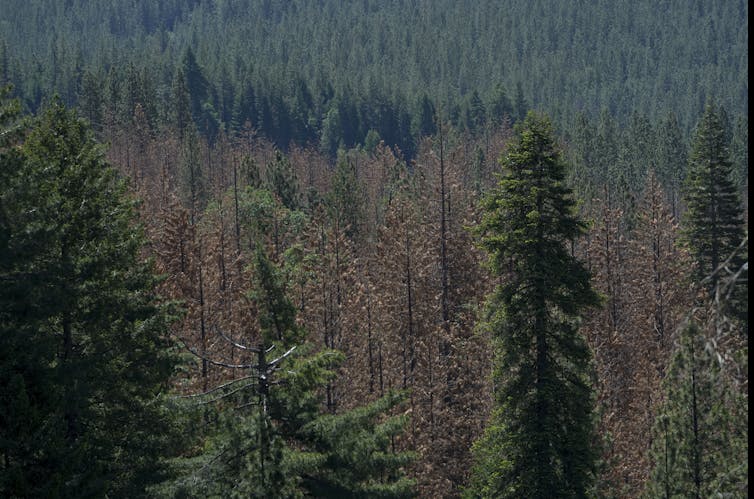
Trees killed by drought and an outbreak of bark beetles in California’s Tahoe National Forest in 2023. AP Photo/Godofredo A. Vásquez

What does the future hold for forests in a warmer, drier world? Over the past 25 years, trees have been dying due to effects of climate change around the world. In Africa, Asia, North America, South America and Europe, drought stress amplified by heat is killing trees that have survived for centuries.

Old trees may have grown through entire millennia that were wetter than the past 20 years. We are scientists who study forest dynamics, plant ecology and plant physiology. In a recent study, we found that trees can remember times when water was plentiful and that this memory continues to shape their growth for many years after wet phases end.

This research makes us optimistic that young trees of today, which have never known 20th-century rainfall, have not shaped their structure around water abundance and thus may be better equipped to survive in a chronically dry world.

Maps showing projected water deficits due to climate change by the mid-20th century across the U.S.
Climatic water deficit is a shortfall of water necessary to fully supply plants’ needs. If those needs are met, the deficit is zero. A higher number indicates drier conditions. Climate change will increase plants’ water needs, intensifying climatic water deficits in many areas. U.S. National Climate Assessment, 2023, CC BY-ND

What if we water the forest?

This study built on nearly 20 years of forest research in response to early warning signs of forest loss in the 1990s in the dry Rhône River Valley of the Swiss Alps. At that time, scientists observed that Scots pine trees that had stood for around 100 years were declining and dying. They wondered whether drought or other climate factors were driving this loss.

To tackle this question, researchers at the Swiss Federal Institute for Forest, Snow and Landscape Research designed an ecological experiment. To understand the impacts of drought, they would irrigate a mature forest, doubling natural summertime rainfall, and then compare how these water-rich trees fared in comparison with those receiving only natural precipitation.

The Pfynwald experiment, launched in 2003, has shown that trees survived at higher rates in irrigated plots. After 17 years of irrigation, the team found that irrigation didn’t just help trees survive dry phases – it also increased their growth rates.

Tree physiologist Leonie Schönbeck conducts research at Pfynwald, a natural reserve in southern Switzerland, to learn how trees take up and store energy and use their reserves to recover from drought.

Legacy effects are forests’ memories

Trees experiencing drought alter their leaves, wood and roots in ways that prime them for continued dry conditions. Wood under drought might have smaller cells that are less vulnerable to future damage, and roots might increase relative to leaf area. These structural changes persist after the drought has passed and continue to influence the tree’s growth and ability to tolerate stress for many years.

Known as “legacy effects,” these lingering post-drought impacts represent an ecological memory of past climatic conditions at the tree and forest level. Knowing that trees hold a persistent memory of past dry phases, researchers wondered whether they might also show structural changes in response to past wet periods.

Eleven years after summertime irrigation started in Pfynwald, scientists stopped irrigating half of each plot in 2013 to address this question. The formerly irrigated trees, which at this point were about 120 years old, had experienced a lasting period of irrigation – but now those times of plenty were over.

Would the trees remember? A decade later, we found out.

Trees, trains and particle accelerators

On an early March morning in 2023, two of us (Alana Chin and Marcus Schaub) met at Pfynwald to collect very fresh leaf and twig samples so that we and colleagues could look inside to search for signs of lasting effects of past water richness.

At the site, we climbed canopy access towers to collect newly grown treetop leaves and twigs from control trees that had never been irrigated; trees that had been irrigated every summer since 2003; and formerly irrigated trees that had not received irrigation water since 2013.

We took our samples to the Swiss Light Source, an intensely powerful synchrotron – a type of particle accelerator that produces the world’s most intense beams of light. This facility is the home of the TOMCAT, an extremely high-resolution X-ray that allowed us to look inside our leaves and twigs without disturbing their structure.

Scanning our samples took all night, but when we stumbled out of the building, we had images capturing every cell in exquisite detail.


The memory of water

We found that the new leaves of once-irrigated trees were different from both continually watered trees and never-watered control trees. Leaves carry out photosynthesis that fuels a tree’s survival and growth. Inside them, we could see the legacy of past water abundance, written in the size, shape and arrangement of cells.

Reading this cellular signature, we observed that, at the expense of structures promoting productivity, formerly irrigated trees showed every sign of chronic water stress – even more so than never-irrigated trees. In their anatomy, we saw why these trees that had it easy for 11 wet years were now growing slowly.

Every cell in a leaf comes with a trade-off. Trees must balance investments in rapid photosynthesis with others that promote leaf survival. Rather than building the cells used to harvest sunlight and ship sugar to the rest of the tree, leaves on the trees that had been irrigated showed every indication of drought stress we could think to measure.

After receiving extra water for an 11-year stretch and then losing it, the trees were producing new, tiny leaves that invested mostly in their own survival. The leaves were structured to protect themselves from insects and drought and to store water reserves. Compared with leaves on trees that had never known irrigation, these looked as though they were in the middle of the drought of the century.

While this memory of water might seem negative, it likely once helped trees “learn” from past conditions to survive in variable environments. The formerly irrigated trees did not know that humans had played a trick on them. Like trees experiencing climate change, they had no way of knowing that the water was not coming back.

Laser scan of a leaf showing structural changes in response to water stress
A leaf cross section from a formerly irrigated Scots pine tree. In contrast to leaves of trees that have never experienced irrigation, trees that have lost abundant water place more emphasis on features such as water storage (black cells in the center) and protection (large resin ducts that look like holes ringing the leaf) than on the cells needed to produce energy for tree growth (spotted cells). Alana Chin, CC BY-ND

When trees experience a drought event, recovery can mean reaching a “new normal” state, in which they are prepared to survive the next drought, with smaller, less vulnerable cells and increased energy reserves to ‘save up’ for future dry periods. They may have deeper roots or a smaller pool of leaves to support, helping them prepare for an unstable environment.

We wanted to know whether the same was true of trees that had experienced water abundance. Were they waiting in distress for the water to return?

Hard times may make tough trees

In some temperate forests, like the ones we studied in Switzerland, old trees once knew levels of water abundance that now are gone, thanks to climate change. That past abundance may have locked into place structural and epigenetic changes in the trees that are mismatched to today’s drier world. If this is true, then some of today’s devastating global tree mortality events may be, in part, due to the legacy effects of past water abundance.

In most of the world’s temperate forests, however, the current cohort of young forest trees – those sprouting in the past 15 to 20 years – has managed to establish itself under conditions that once would have been considered chronic drought. Those young trees, which have survived an endless dry period, will form the forests of the future.

In all, our observations in Pfynwald have provided us some room for hope that young trees currently taking their place in many forests worldwide may be better prepared to cope with the world as humans have shaped it. Climate shifts in recent decades have primed them for hard times, without the lingering memory of water.The Conversation

Alana Chin, Assistant Professor of Plant Physiology, Cal Poly Humboldt ; Janneke Hille Ris Lambers, Professor of Environmental Systems Science, Swiss Federal Institute of Technology Zurich, and Marcus Schaub, Group Leader, Forest Dynamics and Ecophysiology, Swiss Federal Institute for Forest, Snow and Landscape Research (WSL)

This article is republished from The Conversation under a Creative Commons license. Read the original article.

Space News: 2 populations of dark comets in the solar system could tell researchers where the Earth got its oceans


Dark comets accelerate through space but don’t have a dusty tail like most comets. Adina Feinstein and NASA’s Earth Observatory
Darryl Z. Seligman, Michigan State University

The water that makes up the oceans acted as a key ingredient for the development of life on Earth. However, scientists still do not know where the water here on Earth came from in the first place.

One leading idea is that space rocks such as comets and asteroids delivered water to the Earth through impacts. As a planetary scientist, I’m curious about the kinds of space objects that could have led to the formation of the oceans. For the past few years, I’ve been studying a type of object that I called a dark comet – which could be just the culprit. In a new study my colleagues and I published in December 2024, we discovered two classes of these elusive dark comets

An illustration showing two dark comets, which look like large rocks, orbiting a planet.
Dark comets fly through space, but unlike comets, they don’t have dust tails. Adina Feinstein and NASA’s Earth Observatory

What is a comet?

The solar system is teaming with small bodies such as comets and asteroids. These space rocks were fundamental building blocks of planets in the early solar system, while the remaining leftovers are the comets and asteroids seen today.

These objects are also avenues by which material can be transported throughout the solar system. These small worlds can contain things such as rubble, ice and organic material as they fly through space. That’s why researchers see them as good potential candidates for delivering ices such as water and carbon dioxide to the Earth while it was forming.

Traditionally, the difference between comets and asteroids is that comets have beautiful cometary tails. These tails form because comets have ice in them, while asteroids supposedly do not.

When a comet gets close to the Sun, these ices heat up and sublimate, which means they turn from ice into gas. The gas heats up because of the sunlight and is then blown off the comet’s surface in a process called outgassing. This outgassing brings with it rubble and small dust grains, which reflect sunlight.

Asteroids, on the other hand, do not have cometary tails. Presumably, they are more like classic rocks – without ice on their surfaces.

What is a nongravitational acceleration?

The outgassing material from the surface of a comet produces a cometary tail and a rocketlike recoil. The fast moving gas pushes on the surface of the comet, and this causes it to accelerate. This process drives comets’ motion through space on top of the motion set by the gravitational pull of the Sun.

So, when comets outgas, they have what planetary scientists call nongravitational acceleration – motion that isn’t caused by the gravity of objects in the solar system. Planetary scientists typically measure the nongravitational accelerations of comets after detecting their cometary tails.

What are dark comets?

Our team identified a class of small bodies in the solar system that take some of the properties of both comets and asteroids. We called them dark comets.

These dark comets have nongravitational accelerations like comets, so they experience a rocketlike recoil from comet outgassing. However, they don’t have the dusty tails that most comets have.

In other words, they look like typical asteroids, but gravity alone can’t explain their motion.

The first interstellar object, ’Oumuamua, was the first comet or asteroid-size body that was detected in the solar system that came from outside of the solar system.

’Oumuamua displayed this same mysterious combination of no dust tail but a cometlike nongravitational acceleration, which led to many theories trying to explain what the object could have been. One option is that it was outgassing like a comet but not producing a dusty tail.

Since ’Oumuamua was first spotted in 2017, my colleagues and I have identified other dark comets within the solar system. In our study, we found seven new dark comets, bringing the total to 14.

Now that we’ve found more dark comets, we’ve noticed that they come in two flavors. Outer dark comets are larger – about a mile wide in size – and on more elliptical orbits farther out in the solar system. Inner dark comets are smaller – typically 1,000 feet in size – and on circular orbits close to the Earth.

A diagram showing the paths of dark comets orbiting Jupiter. Outer comets have longer elliptical orbits while inner comets stay closer to Jupiter.
Outer dark comets, shown in red, have longer orbits than inner dark comets, shown in gray. Darryl Seligman

Contributions to the Earth’s oceans?

It’s still not clear exactly what these dark comets are. They may not even be traditional comets if they don’t have icy surfaces.

However, the most likely answer for their nongravitational accelerations is that they outgas water, like a comet, but don’t produce a dusty tail – at least not one we can see when we look at them with our telescopes.

If this is the case, there are sure to be many more of these objects, parading around like asteroids, still yet to be identified.

Since scientists don’t know for sure where the Earth’s water came from, if there really are lots of dark comets that have water near Earth, it is possible that these dark comets contributed water to the early Earth.

These dark comets could tell researchers more about the origins of Earth’s oceans and the development of life here on Earth.

Reasons to be excited for the future

This research is really just the tip of the iceberg, because we only just started finding these dark comets in 2023.

The Vera C. Rubin Observatory’s Legacy Survey of Space and Time, which comes online in 2025, will start scanning the entire southern sky almost every night to spot anything that moves. This telescope, located on a mountain in Chile’s Atacama desert, is home to the largest camera ever built.

It will give astronomers almost five orders of magnitude greater sensitivity for detecting moving objects in the night sky. It will likely help my colleagues and me discover lots of new dark comets in the near future.

Telescopes that are already operating, such as the Hubble Space Telescope and the James Webb Space Telescope, could also help my team watch for outgassing or ice on the surface of the 14 dark comets we’ve already identified.

Landing on a dark comet would probably look similar to Hayabusa2’s rendezvous with the Ryugu asteroid.

Finally, the JAXA Hayabusa2 extended mission is slated to rendezvous with one of the inner dark comets, 1998 KY26, in 2031. Therefore, we will be able to see the surface of a dark comet in exquisite detail.The Conversation

Darryl Z. Seligman, Postdoctoral Fellow in Physics and Astronomy, Michigan State University

This article is republished from The Conversation under a Creative Commons license. Read the original article.

Department of Interior approves Scotts Valley Pomo’s Vallejo casino project over other tribes’ objections

NORTHERN CALIFORNIA — Over the objections of other tribes as well as California’s governor, the Department of Interior on Friday approved the Scotts Valley Pomo’s plan for a mega casino in Vallejo, far from its traditional lands and on land sacred to the Patwin people.

The Scotts Valley Band of Pomo Indians, based in Lakeport, has faced strong opposition for years to its plan to build a 400,000 square foot, $700 million casino complex near I-80 and Highway 37 on a 128-acre site.

The development also is planned to include 24 homes and an administrative building to be “the nerve center for tribal governance,” Scotts Valley Tribal Chair Shawn Davis said during a July hearing.

The location was meant for open space and contains cultural sites sacred to the Yocha Dehe Wintun Nation, which on Friday issued a statement condemning the decision, which it said will lead to desecration of its homelands.

“For months, the Department of the Interior worked in secret to move the controversial project forward, undermining public notice, tribal consultation, and environmental review requirements along the way,” the Yocha Dehe said in its statement. “In fact, despite being informed multiple times, by both Tribes and the State Historic Preservation Officer, that the required and important National Historic Preservation Act Section 106 consultation process had not been completed, the Department knowingly and intentionally proceeded in violation of this bedrock law.”

The Yocha Dehe said the location is 100 miles away from Scotts Valley’s homelands, but at the core of its Patwin ancestral territory in Vallejo.

“We are deeply disappointed and disheartened to see this decision from the Biden Administration. It is difficult to believe that a group of politicians who claim to care about respecting tribal rights and sovereignty would give away historic Patwin homelands without ever consulting us. The hypocrisy is staggering,” said Yocha Dehe Chairman Anthony Roberts.

U.S. Senator Alex Padilla, U.S. Representatives John Garamendi (D-CA-08) and Mike Thompson (D-CA-04) oppose the project, as do a large number of Yolo County government officials and advocacy groups, and thousands of concerned citizens.

A common argument against the project has been Scotts Valley’s lack of historical connection to Vallejo.

The Yocha Dehe also pointed out that, on three separate occasions, the Department of the Interior has determined that Scotts Valley lacks the significant historical connection to the Bay Area needed to acquire land eligible for gaming.

However, it was a 2022 U.S. District Court for the District of Columbia ruling that put the case back with the Department of the Interior.

Since then, opposing tribes have criticized the Department of the Interior for bypassing their concerns. They said the situation has resulted in a lack of transparency, fairness and government-to-government consultation requests.

The Department of Interior also has been criticized for failing to thoroughly evaluate the environmental and related social and economic effects of the project by conducting an environmental impact statement. Instead, the agency issued what opponents said was an “inadequate environmental assessment” that fails to meet federal environmental guidelines, and which has inaccurate and complete information, or is missing key elements.

Gov. Gavin Newsom is amongst those opposing the Scotts Valley plan, as well as that of another Lake County tribe — the Koi Nation — that wants to build a casino in Windsor, as Lake County News has reported.

Newsom also has come out against a plan for the first off-reservation casino in Oregon. The project, to be located in Medford, is proposed by the Coquille Indian Tribe, whose reservation is in North Bend, nearly 170 miles away from the site.

On Friday, the Department of Interior signed the record of decision approving the Coquille tribe’s casino plan.

The Cow Creek Band of Umpqua Tribe of Indians, Karuk Tribe and Tolowa Dee-ni' Nation in Oregon reported that they immediately filed a request Friday evening for the U.S. District Court to issue a temporary restraining order, citing violations of the Indian Gaming Regulatory Act, the Indian Reorganization Act and the Coquille Restoration Act, as well as constitutional concerns related to the National Environmental Policy Act.

“We were excited and hopeful when Secretary Haaland was appointed but her legacy is irreparably tarnished by this shameful, illegal decision,” Roberts said. “For Tribes like ours, nothing is more important than our ancestral homelands. To see our land and cultural resources taken away for the benefit of wealthy investors is painful beyond words. Throughout this process, we have been left in the dark, struggling to have our voices heard. We hope that the next Administration will take a different approach to consultation with Tribes, especially on matters that affect their ancestral homelands.”

Roberts said the matter isn’t settled yet for his tribe.

“The Department of the Interior violated their trust responsibilities for all Tribes with this unfair decision,” continued Chairman Roberts. “Although the project was approved, our fight is not over. The Yocha Dehe Wintun Nation will take every step necessary to continue fighting for our homelands and our future.”

Email Elizabeth Larson at This email address is being protected from spambots. You need JavaScript enabled to view it.. Follow her on Twitter, @ERLarson, and on Bluesky, @erlarson.bsky.social. Find Lake County News on the following platforms: Facebook, @LakeCoNews; X, @LakeCoNews; Threads, @lakeconews, and on Bluesky, @lakeconews.bsky.social.

City of Lakeport highlights food recovery efforts

LAKEPORT, Calif. — California’s Senate Bill 1383 is changing the way communities manage food waste and support those in need.

The city of Lakeport reported on its efforts to meet SB 1383’s requirements.

City officials called SB 1383 “innovative legislation” that “is making a real difference in our community by reducing edible food waste and ensuring surplus food is redirected to individuals and families who need it most.”

In 2024, the three supermarkets in the city of Lakeport donated 187,534 pounds of food to the Clear Lake Gleaners Organization in Finley.

This donated food is then distributed by the Gleaners to individuals and families in need across Lake County, marking a significant win for both the community and the environment, city officials reported.

SB 1383 is legislation designed to reduce organic waste disposal by 75% and recover 20% of surplus edible food to feed those in need.

The law emphasizes collaboration between governments, businesses and residents to combat climate change, address food insecurity and create a sustainable future.

By participating in SB 1383, the city said it is reducing food waste and hunger, creating a sustainable food system and keeping organic waste out of the landfill.

The Clear Lake Gleaners will host their next USDA Food Distribution from 8 to 10 a.m. Thursday, Jan. 16.

Locations are:

Clearlake: The Crossroads Church, 6039 Crawford Ave.
Cobb: Cobb Mountain Lions, Little Red School House
Finley: Clear Lake Gleaners, 1896 Big Valley Road.
Middletown: Middletown Lions Club, 15399 Central Park Road.
Nice: 2817 Highway 20 (Cross street is Lakeview Drive)
Spring Valley: Community Center, 2975/3005 Wolf Creek Road.
  • 278
  • 279
  • 280
  • 281
  • 282
  • 283
  • 284
  • 285
  • 286
  • 287

Community

  • Lake County Wine Alliance offers sponsor update; beneficiary applications open 

  • Mendocino National Forest announces seasonal hiring for upcoming field season

Public Safety

  • Lakeport Police logs: Thursday, Jan. 15

  • Lakeport Police logs: Wednesday, Jan. 14

Education

  • Woodland Community College receives maximum eight-year reaffirmation of accreditation from ACCJC

  • SNHU announces Fall 2025 President's List

Health

  • California ranks 24th in America’s Health Rankings Annual Report from United Health Foundation

  • Healthy blood donors especially vital during active flu season

Business

  • Two Lake County Mediacom employees earn company’s top service awards

  • Redwood Credit Union launches holiday gift and porch-to-pantry food drives

Obituaries

  • Rufino ‘Ray’ Pato

  • Patty Lee Smith

Opinion & Letters

  • The benefits of music for students

  • How to ease the burden of high electric bills

Veterans

  • CalVet and CSU Long Beach team up to improve data collection related to veteran suicides

  • A ‘Big Step Forward’ for Gulf War Veterans

Recreation

  • Wet weather trail closure in effect on Upper Lake Ranger District

  • Mendocino National Forest seeking public input on OHV grant applications

  • State Parks announces 2026 Anderson Marsh nature walk schedule 

  • BLM lifts seasonal fire restrictions in central California

Religion

  • Kelseyville Presbyterian to host Ash Wednesday service and Lenten dinner Feb. 18

  • Kelseyville Presbyterian Church to hold ‘Longest Night’ service Dec. 21

Arts & Life

  • Auditions announced for original musical ‘Even In Shadow’ set for March 21 and 28

  • ‘The Rip’ action heist; ‘Steal’ grounded in a crime thriller

Government & Politics

  • Lake County Democrats issue endorsements in local races for the June California Primary

  • County negotiates money-saving power purchase agreement

Legals

  • March 3 hearing on ordinance amending code for commercial cannabis uses

  • Feb. 12 public hearing on resolution to establish standards for agricultural roads

How to resolve AdBlock issue?
Refresh this page