 How to resolve AdBlock issue?
News
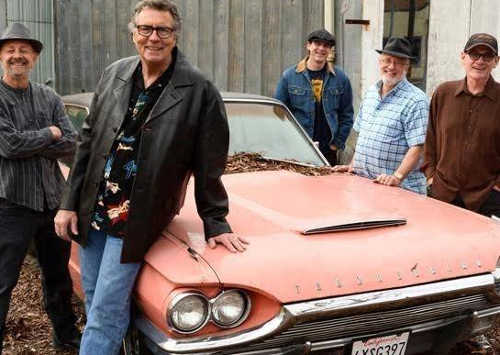 LAKEPORT, Calif. – On Friday, Jan. 20, the Soper Reese Theatre Third Friday Live series features Bill Noteman and the Rockets.
The show starts at 7 p.m. The dance floor will be open.
In 1983 Bill Noteman, Larry Platz, David Neft and Dave Falco got together for an impromptu jam in an old movie theater in Lower Lake.
What emerged that night was Bill Noteman and the Rockets, a band that soon took over Lake, Sonoma, Napa and Mendocino counties with a unique high energy blend of Chicago blues and rock and roll known as West Coast Jump.
Today Noteman, harmonica virtuoso and entertaining front man, is skillfully supported by original members and local legends "Mojo" Larry Platz on guitar, David “Rockin 88’s" Neft on keyboards, bassist Dave “Fingers” Falco and new member, drummer Steve "The Shuffler" DuBois.
One critic recently described the group in this way: "Raw expressive vocals, searing harmonica, sizzling guitar, and cooking keys dipped in the sauce of a smoldering rhythm section. This is the original music and feeling of Bill Noteman and the Rockets."
Tickets are $15 for all seats and are available online at www.SoperReeseTheatre.com or at The Travel Center, 1265 S. Main, Lakeport, Monday through Friday, 9 a.m. to 5 p.m.
The Soper Reese Theatre is located at 275 S. Main St., Lakeport.
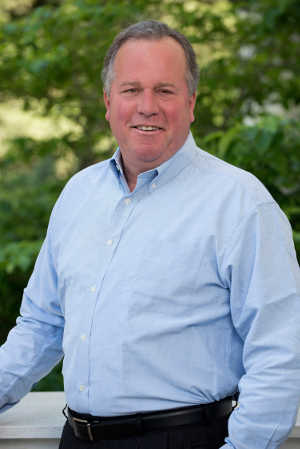
SACRAMENTO – State Sen. Bill Dodd (D-Napa) has been named as chairman of the Senate Banking and Financial Institutions Committee by Senate President pro Tem Kevin de León.
Sen. Dodd assumed office representing California's Third Senate District – which includes all or portions of Napa, Sonoma, Solano, Yolo, Sacramento and Contra Costa counties – at the start of December.
Dodd previously served as the representative for the Fourth Assembly District, which includes Lake County. He has pledged to continue to help Lake County in his new role.
“It’s an honor and a privilege to chair the Committee on Banking and Financial Institutions. As chair, I will focus on building strong consumer protections, while ensuring the economic vitality of California,” said Sen. Dodd. “I would like to thank Sen. de León for appointing me to key committee assignments that represent crucial policy areas for our district and for our entire state."
Dodd's committee could help California serve as a counterpoint to inaction or rollbacks of consumer financial protections at the federal level.
Dodd already has shown leadership on banking and consumer protection issues, recently introducing a bill in response to the recent Wells Fargo fake account scandal.
His bill would help victims of fraud by eliminating the use of forced arbitration clauses in contracts that were fraudulently created. Such contracts prevent consumers from having their day in court to recover damages.
“It’s unacceptable for consumers to be blocked from our public courts to recover damages for fraud and identity theft. Allowing victims their day in court not only allows them to recover, it can prevent more victims by putting an end illegal business practices,” said Dodd. “With quick federal action on this issue unlikely, it’s critical that California lead the nation to prevent these abuses.”
The president pro tem of the Senate appoints senators to committees at the start of each two-year session.
Dodd also was appointed to serve as a member of the Senate committees on Agriculture, Veterans Affairs, Governmental Organization, and Business, Professions and Economic Development.
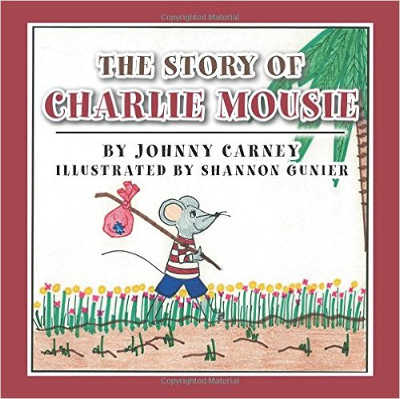
LAKE COUNTY, Calif. – Local business owner Shannon Gunier has completed her first children’s book, “The Story of Charlie Mousie.”
The book features 16 brightly colored illustrations of Charlie Mousie and all of his friends in the jungle that stresses, to children, the importance of a good attitude, how to get along with all types of personalities, and the importance of helping others.
It is the first in a series of “Charlie Mousie” books that will be published over the next few months.
As the oldest of 6 girls, Gunier used to listen to her dad tell the stories to her younger sisters at bed time each night.
Before he passed away Gunier, with her father, committed the stories to paper and she promised him she would illustrate each one of them and get them published.
“The Story of Charlie Mousie” makes an excellent gift and can be purchased on www.smile.Amazon.com as well as directly from the author (please contact
Some of the proceeds from the book are being donated to World Wide Healing Hands, an organization started by local Lake County physician Dr. Paula Dhanda.
WWHH volunteers have saved thousands of women and babies by traveling to Third World Countries with skilled medical training, modern equipment and healing medicine.
Dr. Dhanda is well known for her many years of service to the citizens of Lake County and Shannon currently serves on her Board of Directors.
Designed for preschool children and beginning readers, “The Story of Charlie Mousie,” is a lovely story that is perfectly illustrated to keep young kids minds wandering with imagination and excitement.
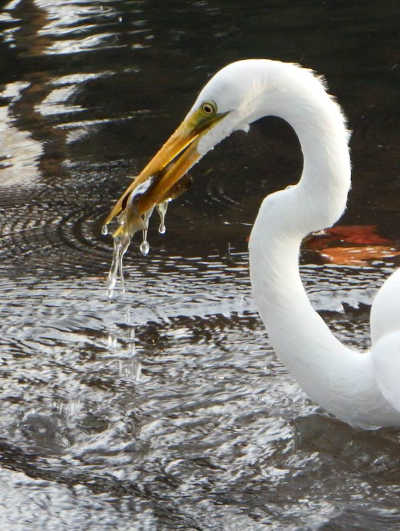
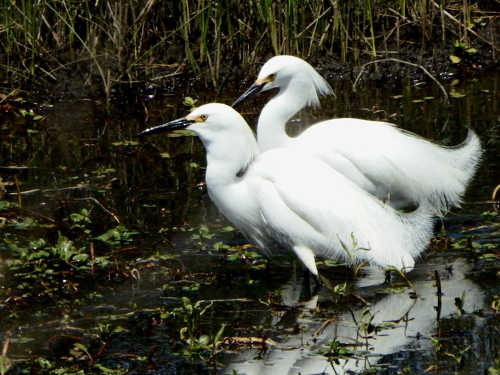 NORTHERN CALIFORNIA – We actually have three different species of white egrets in the Berryessa Snow Mountain National Monument region: the great egret, the snowy egret and the cattle egret.
Although at a quick glance they may all look pretty much the same, they’re actually quite different from one another and a closer inspection will help you determine which is which.
The great egret (Ardea alba) is the largest of the three maxing out at about 3.5 pounds with an almost 6-foot wingspan. It has a yellow beak and black legs.
In the breeding season a patch on its face turns bright neon green and it gets long trailing feathers on its tail that it can lift straight up and fan out (like the tail of a peacock). It was these beautiful feathers that nearly brought this species to the brink of extinction in the United States in the late 1800s.
Thousands of the birds were destroyed so their feathers could be used in women’s hats. The National Audubon Society was actually founded in part to protect this species, and the Great Egret is still used as a symbol for that organization.
Male egrets choose “display areas” in colony-like nesting sites and begin the construction of the nests themselves before pairing up with a female to finish the nest and breed.
Great egrets eat a variety of fish, insects, reptiles and amphibians, crayfish, and even small birds and mammals. I once watched a great egret catch a large water vole in a rice field, then walk the rat over to a nearby pond to drown it before swallowing it whole.
The snowy egret (Egretta thula) is actually much smaller and more “svelte” that the great egret, weighing in at about 1 pound. Like great egrets, however, snowy egrets also nest in large colonies in tree-tops. Both males and females help to incubate the eggs, and sometimes pass sticks on to one another as they shift positions on the nest. These egrets are also known to cross breed with herons and other egrets producing hybrid species.
Like the great egrets, snowy egrets have bright white plumage, but their beaks are black and their feet are bright yellow. The snowy egret’s yellow feet (which turn brighter in the breeding season) are used in part to feel for prey hiding in the plants and silt in the water.
During the breeding season the snowy’s face will blush pink, and it gets long curling tail feathers. In 1886 these curling plumes were valued at two times the price of gold, and like the great egret this species was almost wiped out before conservationists rushed in to protect it.
The snowy’s diet is similar to that of the great egret, and they use both a stab-and-grab technique for fishing, along with the less dignified let’s-scramble-after-everything technique during which they chase after prey with their wings outspread.
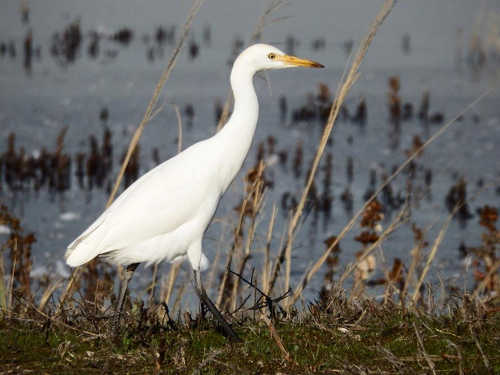
The cattle egret (Bubulcus ibis) looks something like a great egret with a yellow beak and gray-black legs, but it’s much smaller and stockier.
Unlike the great and snowy egrets, the cattle egret doesn’t really require an aquatic environment. It prefers foraging in open fields and can often be found following after herds of cattle, eating whatever insects and other small creatures run or fly around in the cattle’s wake.
These egrets will also “chase fires,” flying toward plumes of smoke to capture the insects that are trying to escape the flames.
In the breeding season, cattle egrets get a buff-colored wash on their head and chest feathers which can sometimes make them look “dirty.”
Like the other egrets, they form large breeding colonies, but they’re also more social on a daily basis than the other egrets and will often feed in large groups with other cattle egrets.
So, there you have it, a short primer on the three kinds of white egrets in the Berryessa Snow Mountain National Monument region.
As you go camping and hiking, keep an eye out for them, and see if you can properly identify them.
Mary K. Hanson is a Certified California Naturalist, a member of the Society of Environmental Journalists, and author of the “Cool Stuff Along the American River” series of nature guides available online through www.Lulu.com . Tuleyome is a501(c)(3) nonprofit conservation organization based in Woodland, Calif. For more information, visit www.tuleyome.org .
LAKE COUNTY, Calif. – The National Weather Service's latest New Year's forecast holds the potential for both rain and snow for the first days of the new year.
Forecasters are expecting a 20-percent chance of rain in Lake County on Saturday, declining to 10 percent during the day on Sunday.
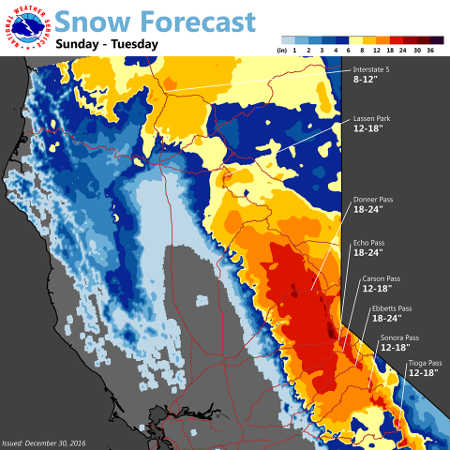
Cold air that's on the way to Northern California early in the first week of the new year may bring rain and snow showers beginning on Sunday night, based on the specific Lake County forecast.
Snow levels may drop to as low as 500 feet, and several inches of snow is expected in some northern parts of Lake County, the forecast said.
The National Weather Service also is forecasting rain and snow showers continuing into Monday morning, with rain also likely on Monday night.
The possibility of snow also is forecast for Tuesday morning before the weather clears and remains mostly clear and sunny for the rest of the week, based on the forecast.
From Saturday through Friday, temperatures are expected to range from daytime highs in the upper 50s to nighttime lows into the low 30s, the National Weather Service said.
Email Elizabeth Larson at

Any of the 10,000 Baby Boomers retiring every day who are contemplating a second job in their retirement may want to reconsider, due to an unfamiliar network of federal and state taxes that can serve as significant work disincentives, advises a University of California, Berkeley, economist and professor of law and a team of fellow researchers.
In “Is Uncle Sam Inducing the Elderly to Retire?” a working paper published by the National Bureau of Economic Research, a team that includes Alan Auerbach, a UC Berkeley professor and director of the Robert D. Burch Center for Tax Policy and Public Finance at UC Berkeley, suggests that prospective retirees can forget the Social Security Administration-provided benefit calculations that come in the mail.
“They’re completely meaningless,” said Auerbach.
He said they simply don’t factor in the implicit and explicit taxes that those ages 50 through 79 face from the offsets between income, age and benefits.
Auerbach said the research highlights a need for much more transparency in the nation’s retirement and fiscal systems.
The Social Security Administration could provide the information, he said, but likely needs a push to do so by “someone in government who thinks it’s important.” That someone, Auerbach suggested, could be in the presidential administration or in Congress.
Auerbach and his fellow researchers – Laurence Kotlifkoff, of Boston University and the Fiscal Analysis Center; Darryl Koehler, of Economic Security Planning Inc. and the Fiscal Analysis Center; and Manni Yu, of Boston University – did the math using data collected from older respondents to the Federal Reserve’s 2013 Survey of Consumer Finances and special software they developed.
The Fiscal Analyzer incorporates all major federal and state fiscal programs – such as federal corporate income tax, personal federal and state income taxes, state sales taxes, estate taxes, Social Security benefits, food stamps, disability benefits, Medicare and Medicaid benefits and premiums and Federal Insurance Contributions Act (FICA) taxes – and calculates remaining lifetime marginal net tax rates.
First, the good news
“We find that working longer, say an extra five years, can raise older workers’ sustainable living standards,” they report in their paper.
But the researchers report the impact is far smaller than suggested, in large part due to high net taxation of labor earnings. They also warn that many boomers now face or will face extremely high work disincentives arising from the hodgepodge and uncoordinated design of the nation’s fiscal system.
“Our findings show that older workers typically face high, very high or remarkably high marginal net taxation on their extra earnings,” they write, adding that work disincentives are highest for those at the bottom and top levels of resource distribution.
Don’t let the door hit you …
“Our findings suggest that Uncle Sam is, indeed, inducing the elderly to retire,” they conclude.
“Of particular concern is Medicaid and Social Security’s complex earnings test and clawback of disability benefits,” the researchers summarized. A clawback is the recovery of funds disbursed by a company, pension or government.
“But an open question is the extent to which the elderly correctly perceive these disincentives,” the report says. “Indeed … it’s hard to believe that policymakers, themselves, are cognizant of the level and spread of the work disincentives they are imposing on the elderly.”
The researchers found that the marginal net tax rate linked to a significant increase in retirement earnings, such as $20,000 a year from a part-time job, can for many elderly be “dramatically higher than that associated with earning a relatively small, say $1,000 a year, extra amount of money.”
For the lowest 20 percent of the population aged 50 to 79 with the lowest incomes, earning an extra $1,000 raises a household’s expected value of lifetime spending by just around $700, which translates into a 30 percent marginal net tax rate. Even an extra $10,000 of lifetime earnings means another roughly $6,000 in lifetime spending, and a 40 percent remaining lifetime net tax rate on those additional earnings.
Other financial tradeoffs or exchanges cited by the research team include:
• Medicare income limits, Social Security earnings test limits for those retiring before the current full retirement age of 66 and Social Security income tax thresholds.
• Increased premiums for Medicare Part B for retirees earning more money.
• Rising out-of-pocket healthcare costs through higher premiums, higher Medicare Part B co-payments and outpatient care not covered by Part B, as well as projected increases in prescription drug expenses.
• Implicit taxes linked to government benefits such as food stamps.
From bad to worse?
All this is set against a backdrop of an already grim financial picture for many baby boomers’ golden years. Only 67 percent of them have any retirement account, and many of those have very low balances. Forty percent of boomers have no retirement savings at all.
While Social Security was designed as a basic floor for retirees’ living standards, it actually provides at last 90 percent of more than a third of elderly households’ income. Nearly two-thirds of older households rely on Social Security for at least half of their income.
Meanwhile, prospects of increased Social Security benefits to help boomers are dim. Social Security already is 32.2 percent underfunded, according to current actuarial projections.
Kathleen Maclay writes for the UC Berkeley News Center.