 How to resolve AdBlock issue?
News

LAKE COUNTY, Calif. – The Lake County Sheriff’s Office is conducting a search for a missing Rohnert Park man whose vehicle was found in Clearlake on Saturday.
Fernando Ruben-Minon, 34, was last seen in Rohnert Park on Feb. 9, and then was spotted three days later in Clearlake Oaks, the sheriff’s office reported.
Ruben-Minon suffers from some medical issues and is considered at-risk, officials said.
Authorities said his vehicle was located near Highway 53 and Ogulin Canyon in Clearlake on Saturday. It may have been there for several days.
A search currently is under way by the Lake County Sheriff's Office Search and Rescue team in that area, with authorities asking people to keep clear of the area.
Ruben-Minon is described as a being 5 feet 10 inches tall and 170 pounds, with brown eyes and black hair.
If you have seen Fernando Ruben-Minon or have information as to his location, please contact the Lake County Sheriff's Office Dispatch at 707-263-2690.
NORTH COAST, Calif. – Beavers are burly.
Second only to the Australian capybara for being the largest rodent on the planet, male beavers can weigh in at over 70 pounds. (A few have even been cited at over 100 pounds!)
Although some people consider them a pest species that causes temporary flooding of areas adjacent area to their home, the ever-active North American Beavers (Castor canadensis) have actually been proven over and over again to be a boon to humankind in many ways.
In the last two or three years, projects and studies have been conducted throughout several Western states that conclusively prove that the beavers are actually 80 percent more effective (and less costly) at repairing and improving degraded stream systems than humans. And part of the reason for that is because the beavers instinctively know where the best places are to build their dams and lodges.
Although the beavers’ mechanism for finding suitable places to build their homes isn’t entirely understood by scientists (who tried to emulate the beavers’ efforts and were not very successful at producing the same beneficial results), it’s believed that a variety of factors are figured into the beavers’ mental calculations: the time of year, access to running water, the right kinds of trees, and vegetative food sources.
The beavers build their dams and lodges out of mud and the branches, sticks and twigs of trees they can harvest locally.
Although some people complain about this practice – because the downing of trees can be visually unpleasant – the beavers’ tree-cutting activities actually have a long-term benefit to both the felled trees and the surrounding environment.
Beavers don’t kill the trees they harvest. Rather, they cut the trees down with their sharp incisor teeth to just above ground-level, leaving the root system entirely intact.
In wildlife habitat restoration and management done by humans, this exact same process is call “coppicing.”
The majority of coppiced trees don’t die; they instead grow new healthier shoots from the severed stump, providing for long-term regrowth and reforestation.
This is part of the reason why beavers are considered to be a “keystone species” in the environment: their creation of new growth and water pathways and ponds actually increases the biodiversity in the areas in which they live.
Studies have proven that where beaver dams are allowed to exist naturally, waterfowl and fish populations increase, and become healthier and more diverse.
In Washington state, for example, studies proved that beavers – which do not eat fish – were a benefit to local trout and salmon populations, increasing smolt production from about 15 individuals per range to 1,170 fish.

A similar effect on waterfowl diversity was seen in Wyoming, where it was shown that waterways where beavers were present resulted in a 75 percent increase in the number and diversity of ducks.
Other benefits afforded by beavers and their construction sites include:
· An increase in the variety of vegetation which enhances bird habitat.
· The removal of toxins from local waterways by filtering out sediments, phosphates, and heavy nitrogen concentrations.
· A reduction in soil erosion (which can decrease flood dangers for people in surrounding areas).
· Helping to reestablish and increase riparian habitat which also aids in the interception of runoff, increasing soil nutrients, and providing habitat for a wide variety of plants and trees. Increased plant life has the added benefit of improving air quality as trees and plants naturally remove toxin form the air.
· Because the dams slow down the flow of water near them they help to recharged spent aquifers (raising the level of water stored underground for use during drought conditions).
So the big, burly beavers can actually be a boon to humankind. Working alongside humans they provide a natural workforce that has a documented history of improving air and water quality, growing underground water storage areas for future use, increasing biodiversity, and benefitting local populations of fish and waterfowl.
Mary K. Hanson is a Certified California Naturalist, author and nature photographer. She will be co-teaching a naturalist course for the public through Tuleyome in early 2018. Tuleyome is a501(c)(3) nonprofit conservation organization based in Woodland, CA. For more information visit www.tuleyome.org .
LAKEPORT, Calif. – Acting Administrator Robert Blaney of the U.S. Small Business Administration’s Region IX office announced that SBA will close its Disaster Loan Outreach Centers in Lakeport on Tuesday, April 4, at 5:30 p.m.
Also closing that day are centers in Maxwell, Quincy and Susanville.
“SBA opened these centers to provide personalized assistance to California businesses and residents who were affected by the severe storms and flooding that occurred Feb. 1 to 25, 2017. Until the centers close, SBA customer service representatives will continue to be available to meet with businesses and residents to answer their questions, explain SBA’s disaster loan program and close their approved disaster loans,” said Blaney.
Businesses and residents can meet with SBA representatives on Monday, April 3, and Tuesday, April 4, from 9 am. to 5:30 p.m. at the center, located at the WorkforceLake Building, 55 First St., Suite 114 in Lakeport. No appointment is necessary.
SBA’s disaster declaration makes assistance available in Alameda, Butte, Colusa, Glenn, Lake, Lassen, Mendocino, Merced, Modoc, Monterey, Napa, Plumas, San Benito, San Joaquin, San Mateo, Santa Clara, Santa Cruz, Shasta, Sierra, Sonoma, Stanislaus, Sutter, Tehama, Yolo and Yuba counties in California; and Washoe County in Nevada.
Businesses of all sizes and private nonprofit organizations may borrow up to $2 million to repair or replace damaged or destroyed real estate, machinery and equipment, inventory and other business assets.
SBA can also lend additional funds to homeowners and businesses to help with the cost of improvements to protect, prevent or minimize the same type of disaster damage from occurring in the future.
For small businesses, small agricultural cooperatives, small businesses engaged in aquaculture and most private nonprofit organizations of any size, SBA offers Economic Injury Disaster Loans to help meet working capital needs caused by the disaster. Economic injury assistance is available regardless of whether the business suffered any property damage.
Disaster loans up to $200,000 are available to homeowners to repair or replace damaged or destroyed real estate. Homeowners and renters are eligible for up to $40,000 to repair or replace damaged or destroyed personal property.
Interest rates can be as low as 3.15 percent for businesses, 2.5 percent for private nonprofit organizations and 1.875 percent for homeowners and renters with terms up to 30 years. Loan amounts and terms are set by SBA and are based on each applicant’s financial condition.
Applicants may apply online using SBA’s secure Web site at https://disasterloan.sba.gov/ela .
Disaster loan information and application forms are also available from SBA’s Customer Service Center by calling 800-659-2955 or emailing
For more disaster assistance information or to download applications, visit https://www.sba.gov/disaster . Completed applications should be mailed to U.S. Small Business Administration, Processing and Disbursement Center, 14925 Kingsport Road, Fort Worth, TX 76155.
The filing deadline to return applications for property damage is May 19, 2017. The deadline to return economic injury applications is Dec. 20, 2017.

On April 1, 2017, comet 41P will pass closer than it normally does to Earth, giving observers with binoculars or a telescope a special viewing opportunity.
Comet hunters in the Northern Hemisphere should look for it Saturday night near the constellations Draco and Ursa Major, which the Big Dipper is part of.
The comet is expected to have good viewing opportunities through April 3 due to being very close to Earth.
Whether a comet will put on a good show for observers is notoriously difficult to predict, but 41P has a history of outbursts, and put on quite a display in 1973.
If the comet experiences similar outbursts this time, there’s a chance it could become bright enough to see with the naked eye. The comet is expected to reach perihelion, or its closest approach to the sun, on April 12.
Officially named 41P/Tuttle-Giacobini-Kresák to honor its three discoverers, the comet is being playfully called the April Fool’s Day comet on this pass.
Discovery credit goes first to Horace Tuttle, who spotted the comet in 1858.
According to the Cometography website, 41P was recognized at the time as a periodic comet – one that orbits the sun – but astronomers initially were uncertain how long the comet needed to make the trip. The comet was rediscovered in 1907 by Michael Giacobini but not immediately linked to the object seen in 1858.
Later, the astronomer Andrew Crommelin determined that the two observations had been of the same object and predicted that the comet would return in 1928 and 1934, according to the Cometography entry for the comet. However, the object was not seen then and was considered lost. In 1951, L’ubor Kresák discovered it again and tied it to the earlier observations.
A member of the Jupiter family of comets, 41P makes a trip around the sun every 5.4 years, coming relatively close to Earth on some of those trips.
On this approach, the comet will pass our planet at a distance of about 13 million miles (0.14 astronomical units), or about 55 times the distance from Earth to the moon. This is the comet’s closest approach to Earth in more than 50 years and perhaps more than a century.
For scientists, 41P’s visit is an opportunity to fill in details about the comet’s composition, coma and nucleus.
“An important aspect of Jupiter-family comets is that fewer of them have been studied, especially in terms of the composition of ices in their nuclei, compared with comets from the Oort cloud,” said Michael DiSanti of NASA’s Goddard Space Flight Center in Greenbelt, Maryland. He and his team will be observing 41P on April 1 using NASA’s Infrared Telescope Facility in Hawaii.
Astronomers will try to determine characteristics such as how quickly 41P’s nucleus rotates, which provides clues about how structurally sound the nucleus is, and whether any changes can be documented in the coma and tail. Observers also will look for outbursts, which are an indication of how active a comet is.
By cataloging the subtle, and sometimes not-so-subtle, differences among comets, researchers can construct a family tree and trace the history of how and where these objects formed as the solar system was taking shape.
“Comets are remnants from the early solar system,” said DiSanti. “Each comet that comes into the neighborhood of Earth gives us a chance to add to our understanding of the events that led to the formation of our own planet.”
Elizabeth Zubritsky is with NASA's Goddard Space Flight Center in Greenbelt, Md.
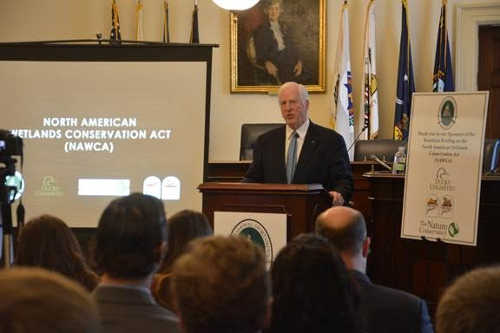
WASHINGTON, DC – On Friday, Rep. Mike Thompson (CA-05) – co-chair of the Land Conservation Caucus – led an effort to support funding for the North American Wetlands Conservation Act, or NAWCA.
In a letter to Chairman Ken Calvert and Ranking Member Betty McCollum of the Appropriations Subcommittee on the Interior, Thompson called attention to the importance of our wetlands in preventing flooding, reducing damage from storm surges, and mitigating the effects of soil erosion.
Rep. Thompson speaks with the Congressional Sportsman’s Caucus about the importance of NAWCA.
“Our wetlands are a critical habitat for a number of species, and they play a key role in minimizing the damage from storms and severe weather,” said Thompson. “As a duck hunter myself, I know firsthand how important it is to protect these key habitats.”
Thompson continued, “While our country has lost much of its original wetlands, NAWCA has helped conserve and restore more than 33.4 million acres. It is one of our most cost-effective conservation programs. Every dollar the federal government invests is matched by an average three dollars from non-federal partners. And that money goes right back into our economy, as many of the lands NAWCA protects are used for hunting, fishing, and outdoor recreation – a $646 billion industry. Studies have also shown NAWCA creates about 7,500 jobs each year. Clearly this program is working, and Congress should make sure it gets the funding it needs.”
“NAWCA continues to be a critical tool to help conserve America’s most vulnerable wetlands. We are blown away by the bipartisan support shown in the Dear Colleague letter and the leadership of Representatives Thompson, Young, LaMalfa and Lowenthal. Ducks Unlimited looks forward to continuing to work with members on both sides of the aisle to secure the funding this program needs and deserves,” said Whitney Tawney, senior water policy advisor, Ducks Unlimited.
The U.S. has lost roughly 52 percent of its original wetlands. Every year, an addition 80,000 acres of wetlands disappear.
NAWCA helps reduce that trend by leveraging federal dollars to raise contributions from private landowners, corporations, nonprofits, state and local governments, and other organizations in support of conservation grants.
In the last 20 years, $1.48 billion in federal funding has been matched by $4.34 billion in non-federal partner contributions.
NAWCA has strong support from farmers, ranchers, all 50 state wildlife agencies, and countless other groups. Demand for the program continues to outstrip available funding on a yearly basis. This year, more than 100 bipartisan Members cosigned the letter – the highest level of support it has seen since 2008. The full text of the letter can be found here.
Thompson is also a member of the Migratory Bird Conservation Commission, and he is leading legislation to reauthorize NAWCA for the next five years.
COVELO, Calif. – At 1 p.m. Monday, April 3, and Tuesday, April 4, Cal Fire’s Mendocino Unit will be conducting a vegetation management control burn on privately-owned land in the area of the Eel River drainage, south of the town of Covelo.
The prescribed burning conducted under this vegetation management program project will be done to meet a specific objective and conducted under specific climatic conditions to ensure control and minimize air quality and biological impacts.
These conditions will mimic conditions under which natural wildfires occur to maximize the positive effects of fire on vegetation.
The primary goal of this prescribed burn is to reintroduce fire as a natural element of the ecosystem.
A second goal is to improve wildlife habitat by inducing new shoots, from sprouting species to increase forage production, with islands of unburned fuel left within burn units to provide shelter for small mammals.
A third goal is to reduce overall fuel loading to decrease the chance of catastrophic wildfires in the future.
Historically, chaparral fuel beds experience fire every 15 to 20 years.
Portions of the project site have not seen fire for over 25 years, allowing fuels to reach maximum volume. This has greatly reduced the ability of wildlife to move through the area and has reduced the flow of waters from creeks and springs.
This project burn will be conducted under strictly controlled weather and fuel conditions.
For information on making your home fire safe visit. www.fire.ca.gov .