How to resolve AdBlock issue?
Refresh this page
How to resolve AdBlock issue?
Refresh this page
Lake County News,California
  • Home
    • Registration Form
  • News
    • Education
    • Veterans
    • Community
      • Obituaries
      • Letters
      • Commentary
    • Police Logs
    • Business
    • Recreation
    • Health
    • Religion
    • Legals
    • Arts & Life
    • Regional
  • Calendar
  • Contact us
    • FAQs
    • Phones, E-Mail
    • Subscribe
  • Advertise Here
  • Login

News

New U.S. Census Bureau and AmeriCorps research tracks virtual volunteering for first time


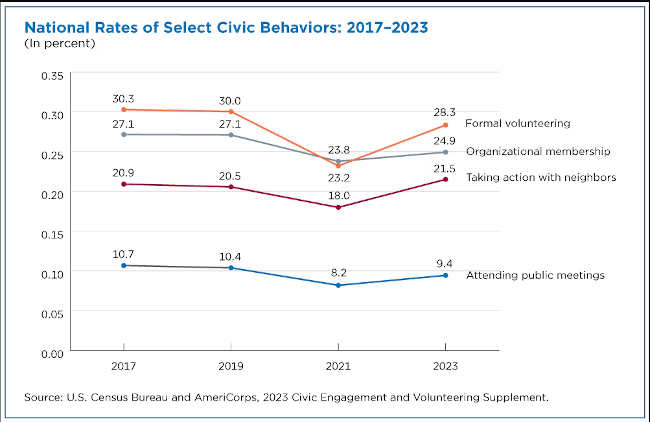
Over 75.7 million or 28.3% of the U.S. population age 16 and up formally volunteered through an organization between September 2022 and September 2023, approaching a return to pre-pandemic levels of volunteerism, according to joint research by the U.S. Census Bureau and AmeriCorps.

National rates of several other types of civic engagement similarly bounced back during that period, even surpassing pre-pandemic rates in some cases — a sign of renewed involvement in many aspects of civic life.

Although more Americans formally volunteered, the number of hours served per person has continued to decline.

Every two years, the Census Bureau partners with AmeriCorps to conduct a comprehensive survey of civic engagement across the United States and over time.

New data shows that formal volunteering is rebounding and informal helping is climbing.

Formal volunteering is helping others through organizations like food banks and other nonprofits. Informal helping includes activities like mowing a neighbor’s lawn or bringing them groceries.

According to AmeriCorps’ analysis of the Census Bureau’s Current Population Survey Civic Engagement and Volunteering Supplement (CEV) data collected in September 2023, formal volunteers served an estimated 4.99 billion hours and contributed over $167.2 billion in economic value between September 2022 and 2023.

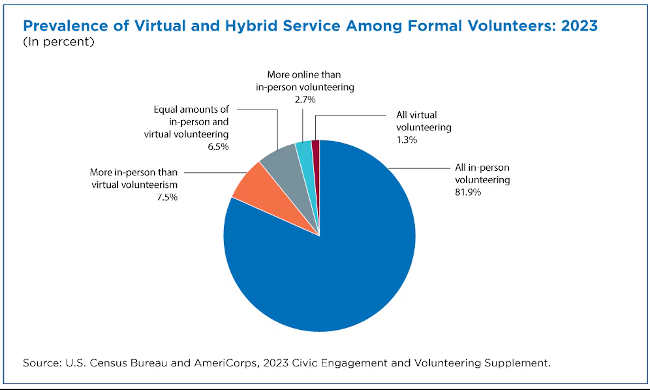
And for the first time, the survey is tracking virtual volunteering, which gained popularity during the pandemic. It shows that 18% of formal volunteers served completely or partially online.

An estimated 54.2% of Americans helped or exchanged favors with neighbors such as house sitting, running errands, or lending tools between September 2022 and 2023 compared to 51.7% in 2019.

Taking the pulse of our nation’s civic health

The Census Bureau has partnered with AmeriCorps to conduct the Current Population Survey Civic Engagement and Volunteering Supplement (CEV) biennially since 2017, with related supplements going back to 2002.

This collaboration has produced the nation’s most robust data about civic engagement, the constellation of activities individuals engage in to make a difference in their communities and promote the common good.

A growing body of work leverages the CEV to examine trends in civic engagement across the country and over time, provides insights into what drives civic health, and underscores the relationship between civic engagement and community well-being.

In September 2023, approximately 47,000 Americans age 16 and up answered CEV questions about their engagement with organizations, neighbors, politics, economic institutions, friends, family, and social issues.

The latest questionnaire also includes attitudinal measures of civic work introduced in 2021 and a first-of-its-kind measure of virtual volunteering launched in 2023, shedding light on the breadth and depth of contemporary volunteering and civic life in America.


Formal volunteering is rebounding

In many communities across the country, formal volunteering rates are rebounding from historic lows recorded during the COVID-19 pandemic.

The estimated 28.3% of Americans who reported volunteering through an organization in the previous year in the latest survey is up from 23.2% in 2021.

The 2023 national volunteering rate remains 1.7 percentage points below pre-pandemic levels but the 5.1 point jump over two years represents a growth rate of 22.1% — the largest expansion of formal volunteering since the Census Bureau and AmeriCorps began tracking it in 2002.

Although less pronounced, there were also rebounds in national rates of organizational membership, attending public meetings, and joining with neighbors to improve their community. Along with formal volunteering, these three measures of civic engagement experienced the largest relative declines of any in the CEV at the height of the pandemic.

Who is driving the increase in volunteerism?

Nationally, the largest relative gains in formal volunteering between 2021 and 2023 were among:

• Millennials (ages 27 to 42).
• People who identified as Asian, Native Hawaiian or Pacific Islander, or Hispanic.
• Those with less than a high school education.
• People with family incomes of less than $25,000.
• Rebounds in the formal volunteering rate were not equally distributed across states and the largest 12 metropolitan statistical areas (MSAs).

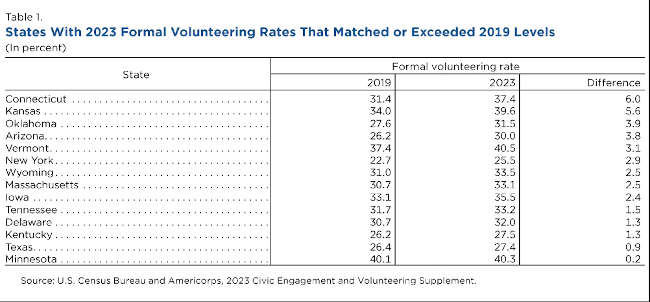
In 14 states and five of the largest 12 MSAs, rates of formal volunteering in the latest CEV data matched or exceeded 2019 levels.

In contrast, 2023 formal volunteering rates remained more than 5 percentage points below pre-pandemic levels in 11 states and the District of Columbia metropolitan area.

Although the share of Americans who formally volunteered through an organization rebounded since the pandemic officially ended, the latest data show ongoing declines in the amount of time each volunteer served.

Nationally, average hours served per volunteer in the previous year dropped from 96.5 hours when the CEV began in 2017 to 70 hours in 2023. Similarly, half of formal volunteers served 40 hours in 2017 compared to 24 hours in the latest data. These trends are consistent with other evidence suggesting recent growth in episodic volunteering.

Virtual volunteering

Another phenomenon attracting attention in the civic engagement world is virtual volunteering, or volunteer activities that are performed through an organization online.

Many organizations offered virtual or hybrid (a mix of in-person and online) volunteering opportunities during the COVID-19 pandemic when social distancing policies and other public health measures discouraged face-to-face interaction. Yet relatively little is known about the prevalence of virtual volunteering and characteristics of virtual volunteers across the United States and over time.

In 2023, the CEV introduced the first measure of virtual volunteering to be administered in a Census Bureau population survey. Developed in collaboration with experts at the University of Maine, the new question asks the following of respondents:

Volunteer survey

Data released today show that almost 1 out of 5 formal volunteers served either partially or completely online. While the majority of formal volunteers continued to serve in-person, over 13.4 million formal volunteers engaged in service that included at least some online activities.

A research brief summarizes insights from this new virtual volunteering measure. Highlights include:

• On average, virtual and hybrid volunteers reported engaging in more hours of service per year (95 hours) than those who volunteered solely in-person (64 hours).
• Six in 10 virtual and hybrid volunteers were under the age of 55.
• Ten percent of virtual and hybrid volunteers reported having a disability.


Informal helping on the rise

The national informal helping rate has been stable in previous waves of the CEV, with about half of Americans consistently reporting they helped out neighbors with various tasks between 2017 and 2021.

Since then, there has been a statistically significant increase of 3.4 percentage points in the national informal helping rate.

An estimated 137.5 million people — or 54.2% of Americans — helped their neighbors informally between September 2022 and 2023. About 1 in 10 engaged in informal helping a few times a week or more during this period.

Overall, data released today suggests that Americans continue to help each other both formally and informally, online or in person, in the wake of the COVID-19 pandemic.

Future waves of the CEV will allow policymakers, practitioners, and the public to see whether the renewed engagement in U.S. volunteering and civic life evident in 2023 is momentary or an ongoing trend.

Laura Hanson Schlachter is a survey statistician in the AmeriCorps Office of Research and Evaluation. Tim Marshall is a survey statistician in the Census Bureau’s Associate Directorate Demographic Programs Division.

State Senate doubles down on Golden State commitment to stabilize insurance market and protect Californians

As Californians continue to face skyrocketing insurance rates in the aftermath of numerous deadly firestorms over the past decade, Senate Leader Mike McGuire (D-North Coast) and a coalition of senators are moving forward with solutions to help stabilize the state’s insurance market.

Just a few weeks ago, the Senate announced a sweeping legislative package — the Golden State Commitment — to expedite rebuilding of neighborhoods and communities destroyed by wildfires, invest in schools that have been impacted by wildfires and make communities more fire-safe.

Now, the Senate is advancing additional legislation focused on long-term stability of the state’s insurance market.

Specifically, these bills will:

• Develop an Insurance Community Hardening Commission to create statewide standards for wildfire mitigation across high-risk communities. By creating one set of bedrock standards (and the homeowner complying with those hardening standards), homeowners, developers, and builders can more easily comply with mitigations. This will finally allow homeowners a simpler path forward to access insurance or keep their standard homeowners insurance policy. (SB 616, Senators Rubio, Cortese, and Stern)

• Establish the nation’s first public catastrophic model for wildfires. This transparency tool evens the playing field and finally allows the public — not just insurance companies — access to their property’s risk score. If homeowners know what their risk score is, they can mitigate wildfire risk to bring down wildfire liability at their home and property. (SB 429, Senator Cortese)

• Expand the one-year non-renewal moratorium, which currently only covers residential policies, to include commercial policies to help small businesses recover. This will not only benefit small businesses, but multifamily residences like condominiums. (SB 547, Senators Perez, and Rubio)

• Require annual inspections to maintain defensible space requirements in Very High Fire Severity Zones. This will allow homeowners to keep up to date with defensible space requirements, both lowering their fire risk and helping them maintain their insurance policy. (SB 629, Senator Durazo)

• Require insurance companies to pay wildfire survivors 100% of their contents coverage (after their home is destroyed by wildfire) without needing a detailed inventory list. It also grants consumers additional time — at least 180 days — to provide proof of loss to their insurance company following a declared state of emergency. (SB 495, Allen)

“We have been sounding the alarm on the pending insurance crisis for years and it has become unsustainable,” said Pro Tem Mike McGuire. “This is why California is making historic investments to reduce fire risk, make our communities more fire safe, and aggressively respond to wildfire. There’s much more that needs to be done—and the Senate is doubling down on commonsense, effective measures that protect consumers, harden communities, hold insurers accountable, and ensure the market returns to stable ground.”

“This is a moment of clarity and purpose. We must implement necessary changes now to tackle climate challenges, incentivize insurers to expand in our state, and strengthen consumer protections. Our role is to assist people in recovering while preparing for future wildfires, ensuring that insurance companies remain stable and solvent to protect consumers and fulfill their claims,” said Insurance Commissioner Ricardo Lara. “These proposals advance our efforts to resolve the state’s insurance crisis, and I thank these Senators for collaborating with me on various bills. These measures build on my executive actions and complement my Sustainable Insurance Strategy, which was finalized last year. My goal remains unchanged: to enhance consumer protections, integrate insurance into our climate strategy, and stabilize our market.”

“It’s time to get smarter about how we build in the state,” said Sen. Susan Rubio (D-Baldwin Park), Chair of the Senate Insurance Committee. “California families are struggling to afford insurance and making impossible choices between safety and groceries. That’s unacceptable. The Insurance Community Hardening Commission will bring together the best and brightest to take lessons from past wildfires to ensure we build safer and stronger to mitigate future catastrophes. By strengthening building standards and improving efficiency, we can protect communities, lower insurance costs, and put money back in the pockets of hardworking Californians.”

“Small businesses need our help and this is exactly what our bill does,” said Sen. Sasha Renée Pérez (D-Pasadena). “SB 547 implements the same insurance protections provided to residential homeowners within the wildfire zones. This commonsense bill expands the one-year moratorium to prevent insurance cancellations or notices of nonrenewal. Our small businesses and nonprofits are vital members of our community and deserve to have this protection during the disaster recovery.”

“We need to be making it easier for Californians who lost their homes during these catastrophic wildfires,” said Sen. Ben Allen (D-Los Angeles). “By guaranteeing full coverage of their contents inventory, we are reducing the mental and logistical hurdles homeowners currently have to jump through to receive their insurance claims that they’ve been paying for through their policies. SB 495 would also extend deadlines for homeowners to provide proof of loss, providing needed flexibility while they try to get back on their feet.”

“California’s nation-leading public wildfire catastrophe model will forever change how we plan and prepare for future wildfires,” said Sen. Dave Cortese (D-San Jose). “This transparent, data-driven approach will provide insight for state and local emergency planners, aid wildfire safety efforts that protect lives and property of homeowners, increase research on the effectiveness of wildfire prevention efforts, and ultimately consumer relief.”

McGuire represents the North Coast of California, which stretches from the Golden Gate Bridge to the Oregon border, including Del Norte, Trinity, Humboldt, Lake, Mendocino, Sonoma and Marin counties.

Colleges’ career success stats don’t tell the whole story about how their graduates are doing after they get their degree


Prospective college students should know what questions to ask during a campus tour. Peathegee Inc. via Getty Images

When high school students and their families investigate which college is the best fit, they will inevitably be inundated with various facts and figures. Brochures and websites might highlight the school’s dining halls or student-led clubs and activities. But one of the most important statistics for students and families to consider when choosing a college is the career outcomes of its graduates.

This is, perhaps, the greatest selling point for any institution of higher education. Students consistently say that finding a good-paying job is among the top reasons why they go to college.

As scholars of career education, we believe it’s important for students and families to know there may be more under the surface to those career outcome statistics.

Why career placement matters

What does “career success” even mean, and why should students or their parents care? How do colleges measure it? And most importantly, how are those statistics verified?

These are all questions that should be on the minds of prospective students and their families. It’s worth asking these questions during college visits.

Put simply, career success or career outcomes refer to a graduate’s employment or academic enrollment status within a period of time after graduating college. By industry standards, a graduate may achieve career success if they are employed or continuing their education within six months of graduation. So when we at Champlain College tout a 90% career success rate for our class of 2023, what we mean is that 90% of the class was either employed or continuing their education within six months of graduation.

Sounds good, right? But compared with what?

The National Association of Colleges and Employers releases annual reports with national career success outcomes. Their latest report, released in October 2024, showed that the national average for career success rates in the class of 2023 was nearly 85%. So, yes, it is good.

Critical to this career success rate, however, is another number – one that’s less discussed but also very telling. That’s the knowledge rate, or the percentage of graduates who shared their outcomes with their college after graduating and that the college can reasonably verify. Think of it this way: If a college boasts 100% career success for a graduating class, but their knowledge rate is only 50%, then that “100% career success” becomes a lot less impressive, as it represents only half the class.

All of these numbers are part of the First-Destination Survey, designed by the National Association of Colleges and Employers and distributed by more than 300 universities and colleges across the country, including Champlain College.

According to the organization’s most recent annual report, which reflects data collected from the class of 2023, the national knowledge rate for bachelor’s degree students was only 56%. That means that the national career success average of 85% reported by the class of 2023 represents just over half of all graduates.

That means that when it comes to the career success outcomes touted by any given college or university – even those that make annual “best of” rankings – it’s safe to assume that the numbers reflect only 56% of the institution’s students. Say a college reports a 90% career success rate of its 1,000 graduates, then we would expect 900 of those students to be employed or pursuing a further degree. But if the knowledge rate for that institution is 50%, then the college is claiming a very high level of overall success while having data for only half of its graduating class.

A woman behind a desk cluttered with lots of stuff talks to a female student
High school guidance counselors play an important role in helping college-bound students learn about universities and ask the right questions. AP Photo/Wilfredo Lee

Data is public

Most colleges and universities release career success and knowledge rates to the public in annual reports. If you’re a prospective student considering a college, you can and should really delve into these statistics.

For example, if you look at some of the colleges on The Wall Street Journal’s best value list, you can see some low knowledge rates. Baruch College earned the top spot for best value, and the school’s success rate for the class of 2022 was 96%. However, its knowledge rate was only 49%.

Similarly, Bowdoin College reported for its class of 2022 a 92% career success rate, with a response rate of 35%.

That is not to say these schools are doing anything wrong. The point is that prospective students can educate themselves more on career success rates and corresponding knowledge rates.

Of course, knowledge rates also vary widely. Babson College, which ranked second on WSJ’s best colleges of 2025, reported an impressive career success rate of nearly 99%, with a knowledge rate of 83%. Davidson College reported a 91% career success rate for 2023, with a knowledge rate of 82%.

At Champlain College, where we serve as career coaches, our class of 2023 reported a career success rate of 90%, with a 81% knowledge rate.

Questions to ask

When prospective students are on college tours or interacting with admissions counselors, they should come prepared with probing questions regarding career success. Here are some questions that we think prospective students should ask college admissions counselors about the institution’s career success:

1. What is the process for tracking career success? You should learn the full process – how the school collects data and reports out on the statistics, and what trends, if any, the institution has noticed in its graduates’ career success over the years.

2. What is the school’s knowledge rate? If it’s low, it may be a reflection on either the institution’s career services or the quality of the overall student experience at that institution. If so, ask whether faculty are involved in the process to get a better idea of where the weakness lies.

3. When does the data collection process start and how long does it take? It should be an ongoing process, allowing for students to share career success both prior to and following graduation.

4. What kinds of additional questions did the school ask in its First-Destination Survey? Beyond relevant career information, is the institution asking about students’ internship experience? Did they study abroad? What other types of experiential learning or leadership opportunities did they undertake? What kind of advice do they have for prospective students? And, importantly, how do you verify student career success?

Equipped with these questions – and the understanding that career success rates are critical in the college selection process – students can feel more confident than they would otherwise that they have a good understanding of how well the institution prepares them for success after graduation.

Many schools publish their career outcomes directly on their website, but you can always speak with an admissions counselor to learn more.The Conversation

Kerry Shackett, Co-Director of the Career Collaborative and Career Coach, Champlain College and Patricia Boera, Co-Director of the Career Collaborative, Champlain College

This article is republished from The Conversation under a Creative Commons license. Read the original article.


Supervisors approve letters to state, federal officials over concerns about proposed Scott Dam removal

The Scott Dam at Lake Pillsbury in Lake County, California. File photo/courtesy of Pacific Gas and Electric Co.


LAKE COUNTY, Calif. — In a show of unity on Tuesday, Feb. 25, the Board of Supervisors voted unanimously to submit comments to Pacific Gas and Electric, the governor and the Trump Administration regarding the county’s concerns over plans to decommission and eventually remove the Scott Dam.

Built in 1922, the dam created the 80,000-acre-foot Lake Pillsbury, a center of recreation in the northern part of the county as well as a source of hydroelectric power and water that has proved critical for fire suppression during major wildland fire incidents over the past decade.

The dam is part of the Potter Valley Project which extends into Mendocino County. In addition to the Scott Dam and Lake Pillsbury, the project includes the Potter Valley powerhouse, built in 1908, the Cape Horn Dam, a fish passage and steelhead counting station, a tunnel and penstock, and Van Arsdale Reservoir.

The project diverts water from the main stem of the Eel River to the Russian River watershed, and manages water on which 600,000 Californians — in Lake, Mendocino, Sonoma and northern Marin — are reliant, PG&E and county documents explain.

For nearly six years, the dam — located entirely in Lake County, on the headwaters of the Eel River — has been the focus of an effort to remove it after PG&E decided to abandon the hydroelectric project, claiming it was no longer financially feasible.

A group of neighboring counties and wildlife advocacy organizations have joined the effort to advocate for the dam’s removal as part of a “two basin” solution, citing the benefit to salmon and steelhead.

It’s estimated that the dam’s removal could cost $500 million, a figure the board suggested is low if it’s to include restoring the land around the existing lake. At the same time, it’s estimated that an alternative, creating a fish passage, could cost $80 million.

Last month, Congressman Jared Huffman said the U.S. Bureau of Reclamation awarded Round Valley Indian Tribes and the Sonoma County Water Agency $15 million in Inflation Reduction ACt funds toward implementing the two-basin solution. The funding is a “down payment” on construction of a new wintertime diversion to the Russian River following the removal of two salmon-blocking dams on the Eel.

However, both supervisors EJ Crandell and Bruno Sabatier told Lake County News at the time of that announcement that the plan is far from a done deal.

In comments during the hourlong discussion at Tuesday’s meeting, board members noted that a lot of their discussions so far on the matter have been in closed session.

The supervisors and members of the public also questioned PG&E’s claims about the need to stop operating the project because of its profitability, considering the nearly $2.5 billion in profit the utility reported for 2024.

Board members also faulted the process so far, recounting a lengthy history of Lake County being blocked from participation in talks with both PG&E and other counties.

With PG&E releasing its decommissioning plan on Jan. 31 — with a March 3 deadline for public comment — the board voted to submit its own comments on the matter. Their comments include criticizing PG&E for offering less than 21 business days to submit “substantive comments on a 2,086 page document.”

PG&E held one virtual public meeting on the plan on the morning of Feb. 6. Lake County News made a request to the company to hold another for the benefit of the community. The utility has not responded to that request.

Now, faced with a process that appears to be moving swiftly forward largely without the input of the county of Lake or the community members around Lake Pillsbury, the supervisors decided to take the fight to the state and federal levels.

The action they took on Tuesday included approving a letter to Gov. Gavin Newsom in which they raise issue with the state taking sides in the process when they said it should have been neutral. Their criticism included pointing out that removal of the Scott Dam contradicts Newsom’s own January executive order on maximizing water storage, and they point out that the state, through the Department of Water Resources, is a party to a memorandum of understanding on the process that does not include Lake County.

Further, the county asks for time to meet with the Governor’s Office to discuss the situation. “Lake County has not been heard, and costs to keep Lake County whole in the face of potential future loss of Scott Dam have been minimized and misrepresented by other parties.”

The supervisors also decided to make the county’s case to the federal government.

In a letter addressed to President Donald Trump’s secretaries of Energy, Interior, Agriculture, Defense, Homeland Security, Commerce and U.S. Attorney General Pam Bondi, the board notes it has “grave concern destroying and draining Lake Pillsbury,” which it said “would constitute an expensive and irresponsible gamble with regional water supply in an area that has repeatedly been threatened by catastrophic wildfire events.”

The supervisors ask for the Trump Administration’s “collective support in ensuring the Federal Energy Regulatory Commission and your Federal Agencies take seriously the potential for profound human consequences.”

The board also pointed to Lake Pillsbury being a destination for hunting, fishing, camping, hiking and recreation, as well as being used to fight fires in the Mendocino National Forest that surrounds it. “Two of the three largest wildfires in the state of California occurred in the areas surrounding Lake Pillsbury, each within the past decade: the August Complex (1,032,648 acres, 2020) and the Mendocino Complex (459,123 acres, 2018). The August Complex was lightning-caused.”

The letter argues that the dam’s decommissioning puts regional agriculture, fire protection, water availability and the tourism economy at risk.

The county’s most forceful argument is that if the Federal Emergency Regulatory Commission, or FERC, approved the dam’s removal, it would directly contradict Trump’s Executive Order No. 14181, “Emergency Measures To Provide Water Resources in California and Improve Disaster Response in Certain Areas.”

Trump’s order requests that the Secretary of the Interior and the Secretary of Commerce, “immediately take actions to override existing activities that unduly burden efforts to maximize water deliveries,” the letter notes.

If FERC approved the decommissioning, the board argued that it would “‘unduly burden’ many communities that rely on Lake Pillsbury, minimizing water deliveries to our farmers and other end users, including water flows in fire hydrants.”

The letter also refers to a second Trump action, Executive Order No. 14156, issued on Jan. 20, “Declaring a National Energy Emergency,” in which the president requests increases to the nation’s energy supply.

County officials said they’ve long been kept from having a meaningful part in the discussion process. That’s despite their lobbying efforts as well as an October 2020 attempt from Congressman John Garamendi, then one of Lake County’s members of the House of Representatives, to get Lake County a seat at the table.

Board shares frustrations about process

Supervisor Crandell, also the board chair, said at the start of the Tuesday afternoon discussion that the process regarding the Potter Valley Project has been framed in that decommissioning the dam is the best way to move forward. However, he said the county has always felt there has never been a proper discussion about the option of not decommissioning the dam.

Supervisor Sabatier said that on Feb. 11 a memorandum of understanding was approved by a number of parties, including Sonoma County Water, Humboldt County, Mendocino County Inland Water and others as part of the Eel Russian Project Authority, which has been working with PG&E to be part of the FERC process to keep water diversions going.

“Good for them,”said Sabatier, noting there have been big misconceptions about what is happening in Lake County with regard to the situation.

Sabatier said a lot of people believe Lake County has been involved in the talks with other counties and groups. “Those discussions may have occurred but they are very superficial.”

He said Lake County has been denied multiple times in its efforts to be involved in the conversations about the dam’s future. Sabatier pointed to the county’s efforts to be included in talks involving the two-basin solution as part of the Russian River Forum.

Every time the county asked to present its side, it was denied. Finally, it got the opportunity and that was the last meeting the group ever had, Sabatier said.

“We are in the midst of one of the biggest human climate change experiences and it seems like this project wants to ignore climate change or at least ignore the fact that we have to look at a global perspective to climate change and not try to provide for one and not another,” Sabatier said.

He said water availability and fish passage to their spawning grounds have been presented as a binary choice, and they don’t have to be.

Sabatier said the plan also includes building a new dam elsewhere. He said that’s the only option if Sonoma and Mendocino counties want to have water during the end of summer season or especially during times of drought.

He said PG&E’s plan is to destroy not just the dam but the Lake Pillsbury community and water storage, and likely destroy another community somewhere in Mendocino or Sonoma counties because they will have to flood somewhere in order to create a new basin for another dam.

Sabatier said the conversion has been “very myopic,” rather than looking at the whole situation.

Crandell, along with Sabatier, has represented the county in what discussions there have been with the state government and other counties and agencies, but he said they haven’t really had meaningful discussions.

He said it’s also been the case that when Lake County brings forward its concerns, 20 to 30 agencies have arranged to pile up on the county, never acknowledging its concerns but only arguing back.

Crandell said county officials believe the dam is actually helping the fish survive, noting that last year, one of the agencies wrote a letter to FERC asking them to convince PG&E to raise the gates.

“Just giving you an example of the frustration that we’ve had,” Crandell said.

County staff present information

Sabatier praised county staffers for their effort to research the situation, recognizing Deputy County Administrative Officer Matthew Rothstein, County Counsel Lloyd Guintivano and Treasurer-Tax Collector Patrick Sullivan. He also praised the Lake Pillsbury community for being an “amazing partner throughout this entire journey.”

Rothstein explained that the county contracted with SLR International Corp. to analyze the effects of the proposed dam decommissioning. As part of the work, the company conducted a thorough review of PG&E’s draft surrender application and provided detailed comments for the board to include in its letters.

He said SLR also provided technical concerns such as slope stability at each stage of the proposed dam removal and risk of landslides in the area of Scott Dam, which he said should be better understood before the project proceeds.

The study confirmed that Lake Pillsbury has been an important fire suppression asset that has helped to keep wildfires small and that it indicates PG&E should provide resources and create a plan to improve firefighting response times.

Other recommendations included PG&E consulting with the county of Lake to obtain correct tax information and incorporate that information into their analysis.

Rothstein said SLR also remarked that the way of life for residents surrounding Lake Pillsbury will likely be adversely affected during and post construction and PG&E should therefore identify proper compensation for those who are to be affected.

Sullivan said that throughout the process it's often been indicated that Lake County has been accommodated or concerns have been addressed but, he added, “it's clearly not the case,” nor does there appear to be a restoration plan for Lake County that's being contemplated.

SLR staff were on Zoom to answer questions. In their brief comments, as well as in the response letter they prepared for the county, the consultants noted that there are about 20 “unavoidable consequences” PG&E has cited in its surrender plan, but SLR said those needed to be more thoroughly evaluated as required by state and federal law in order to find scenarios to minimize those impacts to the county and enhance recreation, ecosystem and fire suppression benefits.

Their letter recommended PG&E discuss with the County of Lake such “likely options” before the final application for surrender of license is submitted on July 29.

Crandell said he appreciated SLR’s synopsis, as they want those issues addressed before moving forward. He said it’s been frustrating that the county has not been able to have the dialogue or to come together with the other parties and have potential action. Rather, the county has been told to take a wait and see approach.

Supervisor Helen Owen said she was concerned about environmental impacts of the dam removal, including sludge deposits. She said it’s her understanding that quicksilver mining had been done in the area where the lake nowsits.

Members of the public weigh in

Nikcole Whipple, a member of the Round Valley tribe and a Lake County resident, said her tribal people and their water rights were harmed with the dam’s creation. She said the fishery was so strong that it was of economic value to “the colonizers” to take not only the water source but the fishery and to forcibly move her people off their ancestral aboriginal territories onto reservations.

Lake County Chamber Executive Director Amanda Martin emphasized “the critical importance of including Lake County in the decision making process,” adding, “It is vital that as the dam and the lake are within our county's borders, the people in businesses of Lake County have a voice in this discussion.”

Martin said any decision made about the future of Scott Dam will have “significant implications to our community and it is only fair and just that we are given an opportunity to participate in a process that will shape our environment and economy for generations to come. We believe that decisions about the lake must include those who live here, work here and rely on the lake for their livelihoods. The exclusion of Lake County from these discussions has been both unfair and short-sighted as it overlooks the direct impact such decisions will have on our local economy, tourism and quality of life.”

Ray Todt, a Lake Pillsbury resident, said he’s seen firsthand how valuable Lake Pillsbury is for firefighting. To remove the dam would be a “man-made environmental disaster,” he said.

Todt reported that PG&E has threatened to close all of the recreational facilities and campgrounds around Lake Pillsbury.

In response, Sabatier said there was a deal struck between PG&E and the Mendocino Land Trust in 2022, brought forward by the California Public Utilities Commission, that there will be a conservation easement on the entirety of the Potter Valley Project that only allows the maintenance of what is already there. That easement, he said, is so restrictive “that there is no such thing as Lake Pillsbury 2.0.”

He said he’d never seen the ability of other agencies to cancel the county’s economic development without the county being able to comment. It’s a process that he called “absurd.”

Former Lake County Chamber of Commerce Chief Executive Officer Melissa Fulton spoke of her efforts to work against the proposal. She said she found it “extremely disturbing” that Congressman Huffman, whose district doesn’t have any tie to Lake County, began the project to dismantle the dam. Fulton noted that Lake County has been sorely missing at the table; she recalled contacting Huffman’s office in early 2019 to ask for a meeting about the matter and was told that wasn’t possible.

She thanked the board for its efforts, noting the county’s letters “express very well the issues that Lake County has faced in trying to address an issue that is totally within their boundaries.”

Carol Cinquini, a Lake Pillsbury community leader who has fought the dam removal, also thanked the board. She said PG&E is under no obligation to forward community comments to FERC.

“It's going to be really important that we continue this, stay strong and be very prepared during the FERC process which will open July 29,” she said.

Crandell said he has no ill will towards any of the other agencies, tribes or government. “I think they've all been put in the same position we have, they need a source of water, so they're doing what they feel they need to for their constituency.”

He said the process frustrates him, pointing to the transparency issues and not being allowed to be involved in the early years of the process. Some of the animosity might have died down if Lake County had been able to be a part of it. Yet, he said the county was kept out even after it paid a required $100,000 to participate.

During the August Complex, Crandell said he was at Lake Pillsbury Ranch and watched the helicopters go over to bring in water. He said hotshot crews on the fire told him the county would have been toast if it hadn’t been for Lake Pillsbury as a water source.

On Zoom, Frank Lynch said Lake County has been slighted throughout the process. He saluted the board for trying to stay engaged.

Lynch echoed Sabatier’s comments about trying to find the economic balance, and he said an effort to examine finding another entity to take overoperation of the lake is warranted.

Jonathan Cronan said Lake County needs Lake Pillsbury for fire mitigation. He said wildlife — including bears, otters and mountain lions — will perish when the dam is removed.

“We also have paid $7.5 billion in California for a new additional water storage which would be nice if we could apply that towards refurbishing the dam,” Cronan said. “I use Lake Pillsbury for recreation. It's a beautiful area and I hate to see that dam come out.”

Crandell offered more time to speak, and Whipple returned to the microphone. “You guys can’t even take care of this lake here,” she said in an apparent reference to Clear Lake, advocating for letting the Eel be a free flowing river. “Having another bacteria infested cesspool is not getting us anywhere.”

She accused the county of coming into the talks about the lake and acting “entitled.”

Crandell said he wasn’t going to respond to Whipple’s comments because it would take all day.

Written comments to the board on Tuesday appeared unanimously against the dam’s removal.

Board holds short deliberation

Supervisor Jessica Pyska said she had watched a Humboldt County meeting from a few weeks ago, noting they were the only MOU party that has had a public discussion. However, they didn’t talk about issues like sediments, potential structural collapse due to instability, and she suggested there are issues that they may not be aware of.

“Again, everyone is looking out for their own interests. But, I can’t wrap my head around that this dam has to come down to build another reservoir somewhere else, in this day and age when we're so focused on water capacity and storage and recharging groundwater, that's exactly what this project already does,” Pyska said.

She added, Humboldt County also didn’t discuss the potential for the rivers to dry up every year, which it’s known happens. “I think there could have been a lot more collaboration between all of the parties, a better conversation, better work product,” because if there had been, Pyska said they wouldn’t be where they were.

Vice Chair Brad Rasmussen also thanked the board members and staff for their work. “I know there's a lot of stakeholders with concerns but I don't feel like the Lake County concerns have been listened to and I have a lot of concerns about the impact on our community here so I'm in support of sending these letters as written.”

Sabatier made three separate motions, to approve the comments to PG&E in response to its draft application to surrender the project license, as well as the letter to Newsom and to the Trump Administration, with Owen seconding all three.

The board voted 5-0 on all motions.

On Tuesday evening, Newsom’s office released a statement celebrating the Trump administration’s announcement that it had released more than $315 million of obligated money to create new water storage at the future Sites Reservoir in the northern Sacramento Valley and at the existing San Luis Reservoir.

“We are grateful for this shared priority with the Trump Administration as we move forward together to build critical infrastructure to improve water storage,” Newsom said.

Email Elizabeth Larson at This email address is being protected from spambots. You need JavaScript enabled to view it.. Follow her on Twitter, @ERLarson, and on Bluesky, @erlarson.bsky.social. Find Lake County News on the following platforms: Facebook, @LakeCoNews; X, @LakeCoNews; Threads, @lakeconews, and on Bluesky, @lakeconews.bsky.social.

022525 BOS Potter Valley Project Agenda Packet by LakeCoNews on Scribd


Thompson votes against federal budget; bill narrowly passes

On Tuesday evening, Congressman Mike Thompson (CA-04) said he voted against the Republican budget bill, which managed to pass by just two votes.

He also criticized Republican leadership for claiming no vote would be taken and then calling for one.

“Tonight, Republicans said they didn’t have the votes to pass their budget bill, sent everyone home, then called their bill up for a vote,” Thompson said.

“Every Democrat made it back to the floor, and every Democrat voted no. But Republicans passed their bill anyways, laying the groundwork to cut healthcare and food for children in order to pay for a tax cut for the richest in our country,” he said.

Thompson added, “If you can’t take Republicans at their word on the most basic things, like announcing there will be no more votes, then these people are not to be trusted.”

The budget passed by 217 to 2015, with just one Republican, Thomas Massie of Kentucky, joining Democrats to vote against it. Massie faulted the bill because he said that, over 10 years, it would $20 trillion to the deficit.

Thompson represents California’s Fourth Congressional District, which includes all or part of Lake, Napa, Solano, Sonoma and Yolo counties.

Unsuspecting airline passengers reveal smuggled sea turtle skull, other wildlife crimes to plainclothes CDFW wildlife officers

An illegally possessed mountain lion mount on display within a resilience in Napa County, California. Photo courtesy of the California Department of Fish and Wildlife.

NORTHERN CALIFORNIA — The California Department of Fish and Wildlife, or CDFW, has announced the settlement of an investigation involving the unlawful possession of a sea turtle skull, several mountain lions, a wolverine, a ringtail cat, owl parts and illegally harvested deer.

CDFW’s investigation was conducted in cooperation with the U.S. Fish and Wildlife Service and prosecuted by the Butte County and Napa County district attorney’s offices and the U.S. District Court for the Eastern District of California resulting in guilty pleas, fines and probation for all involved suspects.

CDFW’s investigation began in November 2023 when two of its canine officers from the Northern Enforcement District were flying back to Northern California from a training in San Diego.

The officers were dressed in plain clothes and seated in front of a couple who were discussing hunting. A conversation with the officers and the unsuspecting couple ensued that ultimately led to the couple disclosing that they were transporting a sea turtle skull from the East Coast in their luggage. The couple also discussed their unlawful take of a mountain lion, which is a specially protected species in California illegal to hunt or possess in whole or in part.

The couple then spoke openly about a close family member’s unlawful possession of multiple taxidermized mountain lions, a wolverine and wolves at the family member’s residence in Napa County.

The couple then proceeded to share a video with the wildlife officers of the family member’s “trophy room” where the illegal mounts were displayed.

After deboarding the plane, the wildlife officers asked if the couple would show them the sea turtle skull. The suspects acknowledged the potential unlawful possession and waited until after any Transportation Security Administration officers could see before showing the officers the sea turtle skull concealed in a jacket inside their carry-on luggage. The skull belonged to a green sea turtle, a federally listed endangered species illegal to possess and transport.

Once back to their patrol districts, the wildlife officers authored search warrants for the couple’s residence in Chico and the family member’s residence in Napa County. The warrants were signed by judges in Butte and Napa counties.

In the process of serving the search warrant in Butte County, wildlife officers found the couple processing a deer that was taken illegally earlier in the day. Deer season was closed, and the suspects had no deer tags. Also inside the residence, wildlife officers found mountain lion claws, a ringtail cat, a barn owl mount, an illegal spike buck and several unlawfully taken deer with tagging violations.

Ringtail cats are a fully protected species in California. Mounted raptors and raptor parts are illegal to possess without appropriate state and federal permits.

At the family member’s residence in Napa County, meanwhile, wildlife officers discovered two illegal, full-bodied taxidermized mountain lions and one full-bodied taxidermized wolverine. Wolverines are another fully protected species in California illegal to possess.

All the unlawfully possessed animals and parts of unlawful animals were seized as evidence for the prosecution in Napa County, Butte County and in federal district court.

Formal complaints were filed against 24-year-old Byron Lee Fitzpatrick, 28-year-old Shannon Lee Price and 64-year-old Harry Vern Fitzpatrick by the Butte and Napa County district attorney’s offices, which initiated prosecution of the poaching crimes. The possession of the sea turtle skull, portions of deer parts and the owl violations were turned over to the U.S. Fish and Wildlife Service, which assisted in the search warrants, investigation and prosecution.

A plea agreement was reached on Jan. 30, in Butte County. Byron Lee Fitzpatrick pleaded guilty to violating Fish and Game Code section 2000(a) and 2002, receiving a $1,865 fine and one-year probation prohibiting hunting or being around those engaged in hunting.

Shannon Lee Price pleaded guilty to violating Fish and Game Code section 2002, receiving a $1,015 fine and one-year probation prohibiting hunting or being around those engaged in hunting. All wildlife seized was forfeited.

A plea agreement was reached on April 23, 2024, in the U.S. District Court for the Eastern District of California. Byron Lee Fitzpatrick and Shannon Lee Price were each fined $1,000 for violations of federal wildlife regulations and laws.

A plea agreement was reached on Feb. 15, 2024, in Napa County. Harry Vern Fitzpatrick pled guilty to two counts of Fish and Game Code section 4800(b), was fined $605, ordered to serve six-months probation and forfeited all unlawfully possessed and transported wildlife as a result of the convictions.

“This case exemplifies the unwavering preparedness and swift action demonstrated by our wildlife officers,” said CDFW Chief of Law Enforcement Nathanial Arnold. “It highlights a broad spectrum of natural resource violations and underscores the critical role our officers play in safeguarding our resources, not only here in California but elsewhere throughout the country and abroad. These violations encompass the take of deer out of season and the illegal possession of taxidermy, including endangered and protected species. Like human and narcotics trafficking, wildlife trafficking of both live animals and animal parts is known to fund transnational criminal organizations and their violent activities all over the world. The individuals involved exhibited a flagrant disregard for laws governing natural resources and are now being held accountable for their actions.”

CDFW said it is thankful for the support from the Butte and Napa County district attorney’s offices as well as the U.S. Fish and Wildlife Service.

The investigation, which started as a casual conversation among airline passengers, led officers to serious violations of state and federal wildlife laws.

Anyone witnessing a poaching or polluting incident or any fish and wildlife violation or who has information about such a violation should immediately dial the toll-free CALTIP number, 1-888 334-CALTIP (888-334-2258), available 24 hours a day, seven days a week.
  • 245
  • 246
  • 247
  • 248
  • 249
  • 250
  • 251
  • 252
  • 253
  • 254

Community

  • Lake County Wine Alliance offers sponsor update; beneficiary applications open 

  • Mendocino National Forest announces seasonal hiring for upcoming field season

Public Safety

  • Lakeport Police logs: Thursday, Jan. 15

  • Lakeport Police logs: Wednesday, Jan. 14

Education

  • Woodland Community College receives maximum eight-year reaffirmation of accreditation from ACCJC

  • SNHU announces Fall 2025 President's List

Health

  • California ranks 24th in America’s Health Rankings Annual Report from United Health Foundation

  • Healthy blood donors especially vital during active flu season

Business

  • Two Lake County Mediacom employees earn company’s top service awards

  • Redwood Credit Union launches holiday gift and porch-to-pantry food drives

Obituaries

  • Rufino ‘Ray’ Pato

  • Patty Lee Smith

Opinion & Letters

  • The benefits of music for students

  • How to ease the burden of high electric bills

Veterans

  • CalVet and CSU Long Beach team up to improve data collection related to veteran suicides

  • A ‘Big Step Forward’ for Gulf War Veterans

Recreation

  • Wet weather trail closure in effect on Upper Lake Ranger District

  • Mendocino National Forest seeking public input on OHV grant applications

  • State Parks announces 2026 Anderson Marsh nature walk schedule 

  • BLM lifts seasonal fire restrictions in central California

Religion

  • Kelseyville Presbyterian to host Ash Wednesday service and Lenten dinner Feb. 18

  • Kelseyville Presbyterian Church to hold ‘Longest Night’ service Dec. 21

Arts & Life

  • Auditions announced for original musical ‘Even In Shadow’ set for March 21 and 28

  • ‘The Rip’ action heist; ‘Steal’ grounded in a crime thriller

Government & Politics

  • Lake County Democrats issue endorsements in local races for the June California Primary

  • County negotiates money-saving power purchase agreement

Legals

  • March 3 hearing on ordinance amending code for commercial cannabis uses

  • Feb. 12 public hearing on resolution to establish standards for agricultural roads

How to resolve AdBlock issue?
Refresh this page